The short version: before your cat arrives, set up one quiet room with a litter box, food, water, a bed, and a scratcher, remove hazards, and book a vet visit for the first week. After arrival, let your cat decompress in that room and add the rest of the house slowly. Below is the full list, in the order you will actually need it.
TL;DR
- Buy the core supplies first: carrier, litter box and litter, bowls, food, scratching post, bed, and a few toys. Everything else can wait.
- Set up a small sanctuary room and keep your cat there for the first week to 10 days.
- Book a vet visit within the first week for a health check, parasite screening, and the start of vaccines.
- Get identification sorted: a microchip and a collar with an ID tag.
- Expect an adjustment curve: three days to decompress, three weeks to settle, three months to feel at home.
Table of Contents
- Before your cat comes home: the supplies list
- Prepare your home before arrival
- Vet care, vaccines, and ID
- The first night and the first week
- A realistic first-month checklist
- What can wait
- Our perspective
- Shop the essentials with confidence
- FAQ
- Sources
Before your cat comes home: the supplies list
Most first-time owners overbuy. A cat needs surprisingly little on day one, and a lot of the gear in pet-store aisles is for you, not the cat. Start with the essentials below, then watch what your cat actually uses before spending more. The ASPCA's basic kitten prep list comes down to a litter box, food and water bowls, a scratching post, and toys, and that is a sound foundation for an adult cat too.
| Item | What to look for | Needed on day one? |
|---|---|---|
| Carrier | Hard-sided or sturdy soft carrier with a secure latch and a top opening | Yes |
| Litter box | Low sides for kittens and seniors, roomy enough to turn around in | Yes |
| Litter and scoop | The same type your cat used before, if you can find out | Yes |
| Food | The brand the shelter or breeder was feeding | Yes |
| Water and food bowls | Shallow, wide, and easy to wash; ceramic or stainless steel | Yes |
| Scratching post | Tall, stable, and sturdy enough not to wobble | Yes |
| Bed or blanket | Soft, washable, placed somewhere enclosed or elevated | Yes |
| ID tag and collar | Breakaway collar with your phone number | Yes |
| Toys | A wand toy plus a few small things to chase | Yes, keep it simple |
| Brush | Match to coat length | Within the first weeks |
| Pheromone diffuser | Optional comfort aid for the sanctuary room | Optional |
| Cat tree, window perch | Nice to have once your cat is settled | Can wait |
For a deeper rundown of the gear we have put through real homes, see our kitten essentials list, and browse our Cat Gear picks when you are ready to compare specific products.
The litter box setup

The litter box is the one item where mistakes cost you the most. The AAHA guideline is one litter box per cat, plus one extra, placed in separate, accessible locations. For a single cat that means two boxes once your cat has the run of the home. For the first week, one box in the sanctuary room is plenty.
A few practical rules we follow in our own testing:
- Put the box away from food and water bowls. Cats do not like eating next to their bathroom.
- Choose a quiet spot with an easy exit, not a corner where your cat feels trapped.
- If you can, use the litter material your kitten used in its previous home. Switch later, gradually, if you want something different.
- Scoop daily. A box that is skipped for two days is a box some cats will refuse.
If you are weighing litter types, our vet-informed guide to choosing cat litter walks through clumping, non-clumping, and alternative materials, and our tofu vs. clay litter comparison covers dust and cost. If you plan to add scented products, read whether litter deodorizer is safe for cats first. Big cats need big boxes, and our large litter box roundup is written for exactly that.
Food, treats, and bowls
Keep your cat on the food it was eating at the shelter, foster home, or breeder for at least the first days. A new home is stressful enough, and a sudden diet change can upset the stomach on top of it. Ask for the brand and feeding schedule when you pick your cat up, and make any switch gradually after your cat has settled.
Treats are useful for bonding and for coaxing a shy cat out of hiding, but they add up. The ASPCA says treats should be no more than 5 to 10 percent of a cat's daily diet. Use a small number of tiny pieces, not a handful.
Scratchers, beds, and toys
Scratching is not bad behavior. It is how cats stretch, mark, and maintain their claws. Give them a tall, stable post from day one, ideally near where they sleep or the room's main traffic path, and they are far less likely to pick your sofa.
For toys, start simple:
- A wand or feather toy for interactive play with you, which also helps build trust.
- A few small balls or soft mice for solo chasing.
- One puzzle feeder or treat toy if your cat seems bored or you work long hours.
Rotate toys every few days instead of leaving them all out. For ideas that held up to real cats, see our Cat Toys section.
Prepare your home before arrival
Supplies are the easy part. Cat-proofing is where kittens and curious adult cats get hurt. The core steps come from shelter and veterinary guidance: remove hazards, secure cords, and block unsafe gaps.
Walk the house at cat height
Get down on the floor. The ASPCA suggests looking at a kitten's level for hair ties, rubber bands, coins, and anything small enough to fit in a mouth. Then check each of these:
- Plants. Remove toxic plants. Lilies are the one the AAHA specifically names, and they are worth keeping out of the house entirely if you have a cat.
- Cords and strings. Secure electrical cords and tuck away blind cords, yarn, and ribbon. Cords and strings are on the hazard list for a reason.
- Gaps. Block spaces behind appliances, under recliners, and inside cabinets where a frightened cat could wedge itself or hide where you cannot reach.
- Windows and balconies. Make sure screens are secure before you open anything.
- Medications and cleaning products. Store them in closed cabinets.
Renting? Many of these fixes are removable and landlord-friendly. Our guide to cat-proofing an apartment before adoption covers the four fixes renters most often need.
Build the sanctuary room
Pick a small, quiet room, such as a spare bedroom or bathroom, with a door that closes. The Guelph Humane Society advises a quiet, secure starting room, and the NOAH Center encourages using a sanctuary room during the first week to 10 days so your cat can decompress and settle.
Stock it with:
- A litter box, set apart from the food.
- Food and fresh water.
- A bed or blanket, plus a box or covered hiding spot.
- A scratching post.
- A few toys.
- Something that smells like home, if the shelter or foster will give you a blanket.
Some owners also add a synthetic pheromone diffuser. International Cat Care notes that feline pheromone diffusers can help create a calmer, more secure environment for cats settling into a new home. If you want to try one, our pheromone diffuser comparison covers the options we tested, and it is useful even in a one-cat home.
Vet care, vaccines, and ID
Book the first vet appointment before the cat arrives, not after. The AAHA recommends a visit within the first week for a health check, parasite screening, and the start of a vaccine series. Bring any records from the shelter, rescue, or breeder, along with a stool sample if the clinic asks for one.
What to ask at the first visit
- Vaccines. The AVMA says the FVRCP combination vaccine is a core vaccine recommended for all cats, even indoor-only cats, protecting against feline panleukopenia, feline herpesvirus 1, and feline calicivirus. The AVMA also notes a booster at 6 months of age, with later boosters every year for intranasal vaccines or every three years for injectable ones. Your vet will set your cat's exact schedule.
- Spay or neuter. The AVMA advises talking to your veterinarian about spaying or neutering, which prevents unwanted litters and is part of responsible ownership. The AAHA recommends scheduling it before 5 months of age for kittens. Adopted cats from shelters are often already fixed, so check your paperwork.
- Microchip. The AAHA recommends microchipping at the first visit or soon after. Register the chip with your current phone number and keep it updated if you move.
- Signs of illness. Cats are good at hiding illness, and the AVMA says a vet can help you learn to spot subtle signs. Ask what changes in appetite, litter box habits, or energy should prompt a call.
- Indoor living. The AVMA advises keeping cats indoors to lower the risk of exposure to potentially infected cats. Ask your vet how to give an indoor cat enough activity and enrichment.
Identification
Even an indoor cat can bolt through a door in the first chaotic days. Put a breakaway collar with an ID tag on your cat once it has settled, and keep the microchip registration current. A tag gets your cat home fastest, while the chip is the backup if the collar comes off.
The first night and the first week
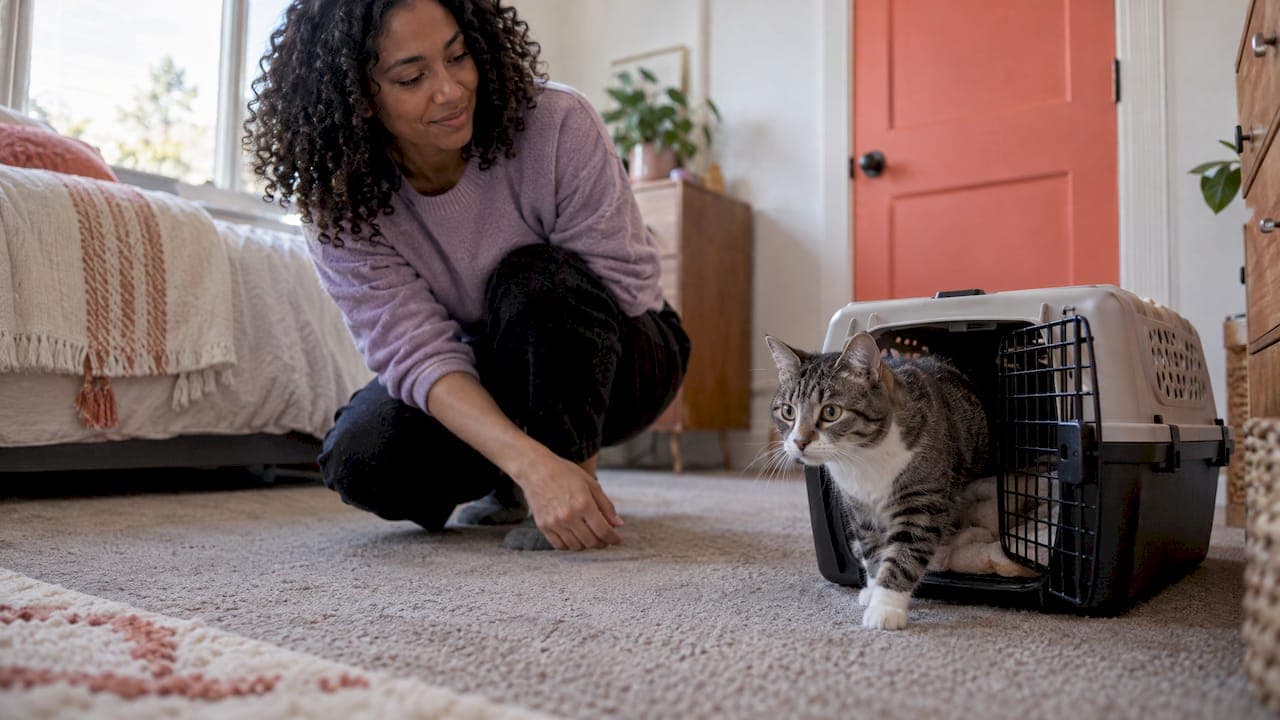
The first night is quieter than most people expect, and your cat is probably not going to curl up on your pillow. Bring your cat home in the carrier, go straight to the sanctuary room, close the door, open the carrier, and let your cat come out when it chooses.
Where should your cat sleep?
Let your cat sleep in its prepared room with comfortable bedding and access to everything it needs. International Cat Care points out that it may choose a different spot that feels safer, such as under the bed or inside a box. That is normal. Do not drag a hiding cat out to cuddle.
For the first night:
- Keep lights low and noise down.
- Check that food, water, and the litter box are easy to reach.
- Sit quietly in the room for a while, reading or on your phone, without trying to touch your cat.
- Skip the visitors. Introductions to friends and family can wait.
The 3-3-3 guideline
You will see this one everywhere. The ASPCA describes it as the first three days to decompress, the next three weeks to settle in, and the first three months for continued adjustment and growing trust. It is a guideline, not a schedule. Some cats are playing within hours, and others take months.
| Stage | What it usually looks like | What you do |
|---|---|---|
| First 3 days | Hiding, little eating, cautious movement | Keep the room calm, offer food and water, avoid forcing contact |
| First 3 weeks | Exploring, learning routines, testing boundaries | Keep feeding and play at consistent times, start short play sessions |
| First 3 months | Personality emerges, trust grows | Expand access to the house, introduce any other pets gradually |
Giving your cat time and space
The Guelph Humane Society advises giving a cat time and space to decompress without forced interaction. In practice:
- Let your cat approach you. Offer a slow blink or a hand to sniff, then let it decide.
- Feed meals at the same times each day. Predictability builds confidence faster than anything else.
- Use wand play in short sessions, a few minutes at a time.
- Open the door to the rest of the house only after your cat is eating, using the litter box, and coming out on its own.
If things are not going well, such as a cat that will not eat for a day or more, or that hides constantly after the first week or two, call your vet. Some adopters hit a point where the home and the cat truly do not fit, and if that happens, safe pet rehoming advice can help you make a careful choice for the animal. Most of the time, though, patience is the answer.
A realistic first-month checklist
Here is the whole timeline in one place. Tick things off as you go.
One to two weeks before arrival
- Choose and clear the sanctuary room.
- Buy carrier, litter box and litter, bowls, food, bed, scratching post, and toys.
- Cat-proof: cords, plants, gaps, windows, small objects.
- Ask the shelter or breeder what food and litter your cat uses, plus any vaccine records.
- Book the first vet visit.
Gotcha day
- Take your cat straight home in the carrier.
- Go to the sanctuary room, close the door, and open the carrier.
- Leave food, water, and the litter box ready, then give your cat quiet.
Days 1 to 7
- Keep to the same routine every day.
- Scoop the litter daily and watch for appetite or litter box changes.
- Attend the first vet visit for exam, parasite screening, vaccine series, and microchip.
Weeks 2 to 4
- Open up the house one room at a time.
- Add the second litter box in a separate location.
- Fit the collar and ID tag.
- Start grooming and nail-trimming introductions with treats in moderation.
Months 2 to 3
- Follow your vet's vaccine and spay or neuter schedule.
- Upgrade gear based on what your cat actually uses: a taller cat tree, a window perch, a better litter box.
- Add enrichment toys and rotate them.
What can wait
Pet stores will happily sell you more. From our own testing, these are things that can wait until your cat has shown you what it likes:
- Big cat trees and condos. Many cats prefer a cardboard box and a windowsill for the first weeks.
- Fancy fountains and feeders. Basic bowls work, and you can upgrade later.
- Automated litter boxes. They are great for busy households, but not essential on day one, and some nervous cats take time to trust them. When you are ready, see our comparisons of automatic litter boxes and self-cleaning litter boxes.
- Piles of treats and toys. Buy a few, see which ones your cat loves, then restock.
Our perspective
We review pet products by buying them and testing them in real homes, and with cats, the pattern is consistent: the households that settle in fastest are the ones that keep day one simple. One room, a reliable litter setup, a scratcher, and a calm routine beat a cart full of gadgets.
Where we do recommend spending a little more is on the things your cat touches every day: a litter box that suits your cat's size, a stable scratcher, and a comfortable bed. Those are the items where cheap versions fail first, and where a good product pays for itself in fewer replacements and fewer accidents.
We also lean on veterinary input for anything health related, and we state the downsides of every product we cover, so you can decide what is worth buying for your cat. Pair that with an early vet visit and you have a strong start.
Chris
Shop the essentials with confidence
When you are ready to buy, we have done the comparing so you do not have to. Our reviews show the pros and cons of each product, how it held up in daily use, and what our vet-informed checks found, covering Cat Litter, Cat Gear, Cat Health, and Cat Toys.

Start at Kiblco to see everything we have tested for new cat parents. We earn commissions from retailers when you buy through our links, but we never accept payment for coverage.
FAQ
What do I need for a new cat on day one?
You need a carrier, litter box and litter, food and water bowls, the food your cat has been eating, a scratching post, a bed, and a few toys. Set them up in one quiet room before you arrive. Everything else can wait until you learn what your cat likes.
How long should a new cat stay in one room?
The NOAH Center encourages using a sanctuary room for the first week to 10 days. Let your cat's behavior guide you: once it is eating, using the litter box, and coming out on its own, you can open more of the house.
When should a new cat or kitten see the vet?
Within the first week. The visit covers a health check, parasite screening, and the start of vaccines, and it is a good time to discuss microchipping and spay or neuter timing. Bring any records you got from the shelter or breeder.
How many litter boxes does one cat need?
The guideline is one per cat, plus one extra, in separate and accessible spots. During the sanctuary-room period, one box is enough. Add the second when your cat starts exploring the rest of the home.
Is a first-time cat owner checklist different for a kitten?
The core list is the same, but kittens need more cat-proofing because they chew, climb, and squeeze into small spaces. They also need a vaccine series, and a spay or neuter before 5 months, so the vet schedule is busier in the first months.
Sources
- Preparing Your Home for a New Cat or Kitten, Guelph Humane Society
- Top 5 Ways to Prep Your Home for a Puppy or Kitten, ASPCA
- New Kitten Checklist: First Vet Visit, Supplies and More, AAHA
- Cat Adoption Guide, The NOAH Center
- Bringing Home Your New Kitten, VCA Animal Hospitals
- Helping your new cat or kitten settle in, International Cat Care
- Feline panleukopenia, AVMA
- Selecting a pet cat, AVMA
- Adoption Tips, ASPCA
- General Cat Care, ASPCA
- Safe pet rehoming advice