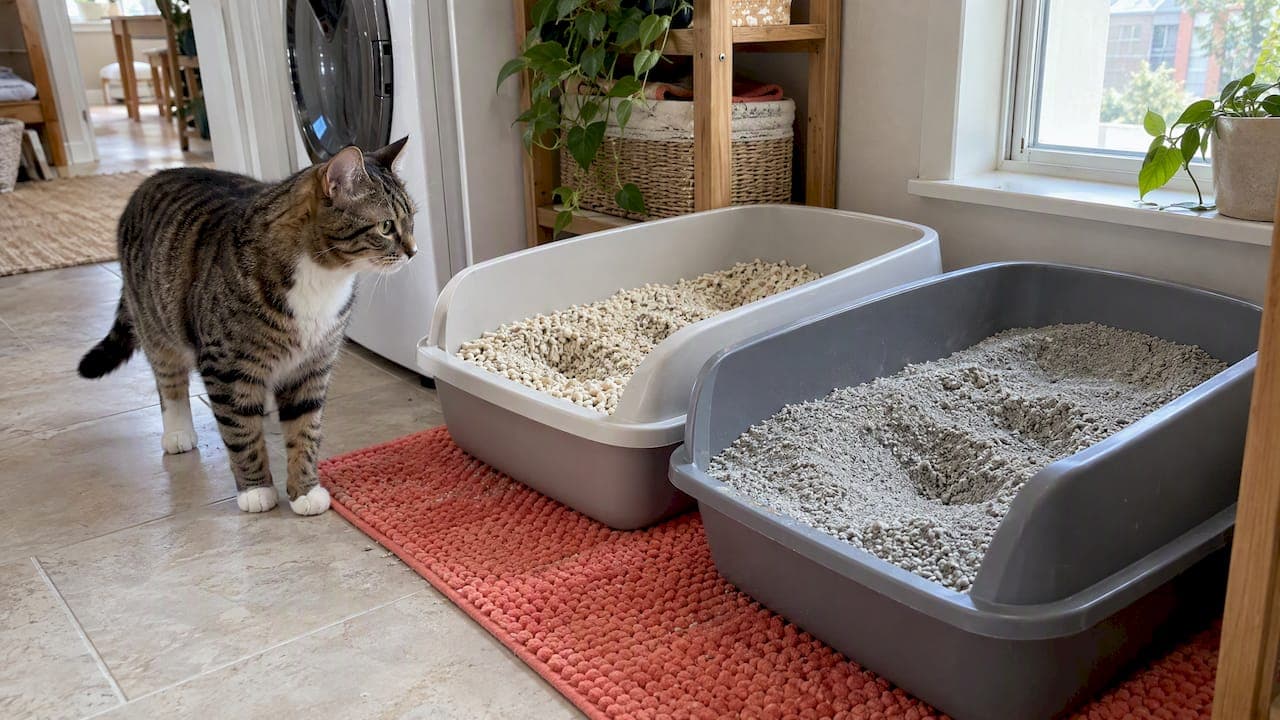
Tofu litter is the better default if you care most about low dust and easier disposal, while clay litter wins on upfront cost and clump strength. The real decision comes down to trade-offs: tofu costs more per pound and needs dry storage, while clay produces more dust and never breaks down in a landfill. If daily cleanliness and your cat's comfort matter more than price, keep reading the comparison below before you buy a bag.
TL;DR:
- Tofu litter produces less dust and tracks significantly less than clay, making it a better choice for households with respiratory sensitivities.
- Clay forms stronger, denser clumps that are easier to scoop but releases more dust, while tofu's softer clumps require gentler scooping techniques.
- Tofu is generally more expensive per pound and sensitive to humidity, requiring airtight storage, whereas clay is cheaper and more shelf-stable.
- Both litter types need daily scooping and proper disposal practices, with tofu being biodegradable and flushable in some cases, unlike clay.
- Transitioning cats gradually and ensuring proper routine adjustments are essential for avoiding accidents when switching between litter types.
Table of Contents
- Tofu vs clay: how they stack up on the factors that matter daily
- What makes clay and tofu behave so differently
- How to switch your cat to a new litter without accidents
- Dust, toxoplasma risk, and safe disposal practices
- What tofu and clay actually cost over a month
- Daily habits that keep either litter working well
- What our testing and vet-informed review process found
- Picking the right litter for your actual home
- See how Kiblco's litter picks compare
- FAQ
- Sources
Tofu vs clay: how they stack up on the factors that matter daily
Clumping is where the two materials diverge most. Clay forms rock-hard clumps almost immediately when wet, which makes scooping straightforward even with a narrow slotted scoop. Tofu clumps are softer and form around pellet-shaped grains, so they hold together well but can break apart if you scoop too fast or use a scoop with narrow slots.
Odor control works differently too. Clay relies on bentonite's natural ability to trap moisture and smell inside a hard clump, while tofu depends more on quick clumping plus the material's own low odor profile. Neither fully eliminates the need for a full litter change every few weeks, but many owners find tofu needs slightly less frequent full dumps because the box stays drier overall.
Dust and tracking separate the two most clearly. Consumer Reports testing found tofu litters produce noticeably less dust than clay, which matters for households with asthma or other respiratory sensitivities. Clay's fine powder clings to paws and gets tracked across floors, while tofu's larger pellet shape tends to stay closer to the box, though neither is completely track-free without a mat.
Cat acceptance can go either way, and this is where testing your own cat's preference matters more than any general rule. Some cats take to tofu's lighter pellet texture right away. Others, used to the finer feel of traditional clay, resist the switch until it happens gradually.
- Clumping: clay forms harder, more scoop-resistant clumps; tofu clumps are softer and need a gentler scoop technique.
- Odor control: clay traps odor inside dense clumps; tofu relies on quick clumping and naturally low odor.
- Dust and tracking: tofu is the lower-dust, lower-tracking option in most comparisons.
- Cat preference: texture acceptance varies by cat and requires a gradual transition either direction.
- Disposal: tofu is marketed as biodegradable and sometimes flushable, pending local plumbing rules; clay is not biodegradable.
- Cost: clay is usually cheaper per pound, while tofu commands a premium for its lower-dust, plant-based formula.
Our hands-on testing of four tofu brands backed up most of these patterns, with dust and clump softness being the two biggest differences owners notice in the first week.
What makes clay and tofu behave so differently
Clumping clay is made primarily from sodium bentonite, a natural clay that swells when it absorbs moisture, locking around urine to form a dense, solid clump. That swelling action is also what makes bentonite effective at odor control: it physically traps liquid rather than just masking smell.
Tofu litter is made from soybean fiber left over from tofu production, combined with plant starches and natural binders, then pressed into small pellets. Because the base material is fibrous rather than mineral, tofu pellets absorb liquid and clump through a softer, more porous process rather than through swelling.
Particle size and density explain most of the practical differences you will notice day to day. Clay's fine, powdery particles create more airborne dust and clump harder, while tofu's larger, lighter pellets produce less dust, track less, and break down faster when wet enough, which is also why some tofu brands are marketed as flushable in small amounts.

How to switch your cat to a new litter without accidents
Cats are creatures of habit, and a litter switch done too fast is one of the most common causes of house soiling. Cornell Feline Health Center guidance recommends providing one litter box per cat plus one extra, and most cats prefer fine-textured, unscented litter over coarse or heavily scented options.
- Keep the old litter box available and add a second box with the new litter nearby.
- Gradually mix small amounts of new litter into the old box over several days.
- Increase to a 50/50 mix for another two to three days, watching for normal box use.
- Move to 75% new litter for a few days before switching fully.
- Watch for signs of avoidance, like scratching outside the box or accidents nearby, and slow the transition if you see them.
Kittens and healthy adult cats usually adjust within a week or two. Elderly or arthritic cats may need a lower-sided box regardless of litter type, and multi-cat households should expect the transition to take longer since each cat adjusts on its own timeline.
Dust, toxoplasma risk, and safe disposal practices
Litter dust is not just a tracking nuisance. It contains fine particles that can aggravate asthma or allergies in both cats and the humans who clean the box, which is why low-dust options matter in sensitive households.
One of the clearest health guidelines involves toxoplasmosis risk, and it has nothing to do with which litter you buy. The CDC's toxoplasmosis prevention guidance notes that Toxoplasma oocysts take one to five days to become infectious, which means daily scooping, before that window closes, meaningfully lowers exposure risk regardless of litter material.
- Scoop daily and wash your hands afterward, especially if pregnant or immunocompromised.
- Wear gloves when cleaning the box and avoid touching your face during the process.
- Improve ventilation near the litter box and consider a low-dust litter if anyone in the household has asthma.
- Never assume a "flushable" label means safe for every plumbing system or municipal sewer line.
Flushability claims deserve a second look before you act on them. Plant-based litters can dissolve well enough in a test sink, but actual plumbing varies by home and municipality, so confirming local rules before flushing any litter, even in small amounts, protects both your pipes and the sewer system.
Ingestion is a separate concern, particularly with clay. Because sodium bentonite swells on contact with moisture, a cat that eats a meaningful amount of clay litter risks gastrointestinal blockage, something worth watching for in curious kittens or cats prone to pica.
What tofu and clay actually cost over a month
Clay litter is generally the cheaper option per pound, and that gap shows up fast in multi-cat households that go through a bag every week or two. Tofu litters, as Consumer Reports found, tend to cost more per pound, a trade-off most owners weigh against the lower dust and easier cleanup.
Storage matters more with tofu than most people expect. Because it is a plant-based, fibrous material, it can absorb ambient humidity and degrade faster if left in a damp garage or exposed to direct sunlight. Clay is far more shelf-stable and tolerates a wider range of storage conditions without losing its clumping ability.
Availability has narrowed the gap recently. Clay remains the default on most grocery and big-box shelves, while tofu litter has moved from specialty pet stores into mainstream retailers and major online marketplaces, making it easier to find than it was a few years ago.
Daily habits that keep either litter working well
Small adjustments to your routine make a bigger difference than the brand you choose. The right scoop, storage method, and box placement can offset most of the downsides of either material.
- Use a wide, flat scoop for tofu since narrow slots tend to crumble its softer clumps, while a narrow slotted scoop works better for clay's denser clumps.
- Store tofu litter in an airtight bin away from humidity and sunlight; clay tolerates more casual storage.
- Place a textured mat under the litter box to catch stray granules before they spread across the floor.
- Confirm your local plumbing and municipal guidelines before flushing any litter, even brands marketed as flushable.
Pro Tip: Lift tofu clumps slowly and at a slight angle. Fast scooping is the main reason owners think tofu "doesn't clump well" when the real issue is technique.
If tracked litter or an occasional accident ends up on carpet, treating the stain quickly with an enzyme-based cleaning approach prevents lingering odor from setting in. For recurring tracking problems, a dedicated litter mat built to catch grains solves most of what daily sweeping cannot.

What our testing and vet-informed review process found
Our team ran side-by-side home tests of both litter types, tracking dust buildup, clump integrity after 24 hours, and how much material ended up outside the box each day. Tofu consistently produced less visible dust and tracked noticeably less than clay in the same households, matching the pattern seen in outside testing.
Clump shape told its own story. Clay clumps held together under almost any scooping method, while tofu clumps needed the wider, flatter scoop to stay intact. On flushability, small tofu clumps broke down in water during controlled tests, but we still recommend checking local plumbing before making that a habit.
Veterinary input shaped how we weighed health and safety trade-offs, particularly around dust exposure and the toxoplasmosis handling guidance that applies regardless of litter brand.
Picking the right litter for your actual home
If your household includes anyone with asthma or allergies, tofu's lower dust profile makes it the more comfortable daily choice. If you are watching every dollar or your cat spends real time outdoors anyway, clay's lower price per pound is hard to beat. For owners prioritizing biodegradable disposal, tofu is the better fit, as long as you confirm composting or flushing rules locally rather than assuming the label applies to your situation. My own take: unless cost is the deciding factor, tofu's lower dust and easier cleanup make it the more livable option day to day.
— Chris
See how Kiblco's litter picks compare
We test litter the way you'd actually use it: scooped daily, tracked across real floors, and judged by whether our own cats accept it without a fuss. That hands-on approach, cross-checked against veterinary guidance, is how we built our tofu litter brand comparison and our broader Cat Litter reviews.
If you are ready to compare specific brands side by side rather than guess from a store shelf, a Cat Litter category page breaks down tested options, clumping behavior, dust levels, and more, so you can pick with confidence.
FAQ
Do vets recommend tofu cat litter?
Veterinary guidance does not endorse one litter brand over another, but general recommendations from Cornell Feline Health Center favor fine-textured, unscented litter, a description that fits many tofu products. The stronger factor is always what your individual cat accepts without avoiding the box.
What are the downsides of using tofu litter?
Tofu litter typically costs more per pound than clay, and its clumps are softer, which means they can break apart with the wrong scoop technique. It also needs dry, airtight storage since humidity can degrade the pellets faster than it affects clay.
Do vets recommend clay litter?
Clay litter is not specifically recommended over other types, but Cornell guidance on litter-box success emphasizes box size, cleanliness, and texture preference over material type. Clay's main veterinary concern is ingestion risk from its swelling properties if a cat eats a meaningful amount.
What is the healthiest cat litter to use?
There is no single litter proven healthiest for every cat, but low-dust options reduce respiratory irritation for both cats and owners, a pattern Consumer Reports testing found more often in tofu than clay. Daily scooping and proper handwashing matter more for disease prevention than the litter material itself, according to CDC guidance.
Sources
- Feline Behavior Problems: House soiling | Cornell Feline Health Center
- Toxoplasmosis: Prevention
- Should You Be Using Cat Litter Made of Tofu? - Consumer Reports
- I Got 99 Problems and a Box Ain't One | Cornell Shelter Medicine