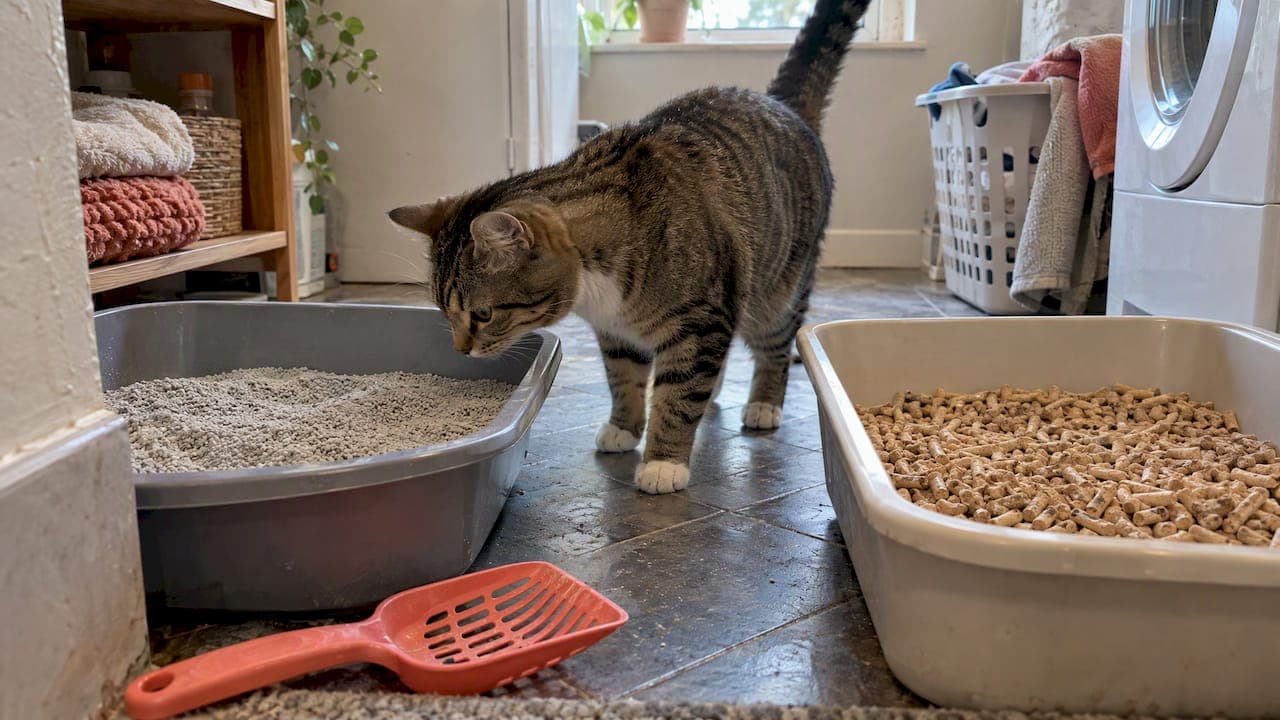
Choose the litter your cat will actually use, then pick the version of it that suits your home. For most healthy adult cats that means a fine-grained, unscented, clumping litter. Kittens, seniors, cats with breathing trouble and multi-cat homes each change the answer. Below you'll find how to weigh the material, the dust, the scent and your own cleanup habits, plus a simple home test that settles the question when the experts' general advice doesn't.
TL;DR
- Most cats prefer fine, soft, unscented litter that feels like sand or soil, and clumping clay is the most common version of it.
- Your cat's preference beats brand claims. Put two boxes side by side and see which one gets used.
- Kittens should use non-clumping litter, and cats with asthma or allergies need low-dust, unscented formulas.
- Switch gradually over several weeks. If a cat stops using the box and doesn't recover quickly, call your vet.
- Scoop daily, and don't flush litter or waste.
Table of Contents
- Start with the cat, not the bag
- The main litter types, compared
- Match the litter to your cat's situation
- Scent: skip it
- Run a two-box test at home
- Switching litters without a standoff
- Box setup matters as much as the litter
- Our perspective
- Hygiene and disposal: the part people skip
- When the problem isn't the litter
- What to expect on cost and convenience
- Where to find our litter reviews
- FAQ
- Sources
Start with the cat, not the bag
The aisle is full of claims: ultra-lightweight, 99% dust-free, odor-locking, flushable. None of them matters if your cat decides the box is unpleasant. Cornell's Feline Health Center says the ideal litter depends on the individual cat's preference, not on marketing, and that owners should be ready to test different types.
Hill's Pet puts it simply: the best litter is the one your cat likes and will use. But you are the cleanup crew too, so a second question follows: does it work for you, in terms of weight, tracking, dust and cost?
So rank your criteria in this order:
- Cat comfort and health: texture under the paws, dust, scent, age, medical conditions.
- Clumping and odor control: how easily you can scoop and how well the box stays fresh.
- Household fit: tracking, weight, price, how you dispose of it.
Get the first one wrong and the other two don't matter.
The main litter types, compared
Here is how the common materials stack up. The notes on texture and dust come from veterinary sources and from our own hands-on testing in real homes.
| Type | Clumps? | Dust | Texture for paws | Best for | Watch out for |
|---|---|---|---|---|---|
| Clumping clay | Yes | Higher | Fine, sand-like | Most healthy adult cats | Weight, dust |
| Non-clumping clay | No | Varies | Granular | Tight budgets | Frequent full changes |
| Tofu | Yes | Generally lower | Small pellets | Dust-conscious homes | Pellet shape some cats dislike |
| Corn | Yes | Lower | Soft granules | Natural-minded owners | Can be pricey |
| Wood or paper pellets | Usually no | Lower | Large, hard | Kittens (paper or wood), low tracking | Uncomfortable for sensitive or older paws |
| Grass seed or other plant-based | Often yes | Lower | Fine | Cats needing a softer option | Varies by brand |
| Silica crystals | No | Low to moderate | Coarse | Odor-focused homes | Many cats dislike the feel |
Clumping clay: the default for a reason
Zoetis Petcare notes that clay is generally a cat's preferred litter, since medium or fine grain resembles the sand or soil a cat would choose outdoors, and that clumping varieties are best for cleanliness. PetMD reports that clay litters account for more than half of cat litter sales, citing Chewy data. The trade-offs are dust and weight.
If you are choosing for a healthy adult with no breathing issues, this is the sensible place to start.
Tofu and corn: lighter, lower-dust options
Plant-based clumping litters are the usual next step for owners who want less dust or lighter bags. We have run side-by-side home tests on these. See our tofu vs clay litter comparison for the dust-versus-cost trade-off, and our tofu vs corn clump tests for how the two plant options hold their shape when scooped.
Pellets: tidy for you, not always for your cat
Larger-granule litters such as wood or some paper pellets tend to track less, which owners like. But veterinary experts caution that these textures are often uncomfortable or even painful to stand on, especially for cats with sensitive paws, declawed cats or older cats. If you are balancing a tidy floor against a happy cat, the cat gets the deciding vote.

Crystals and other specialty litters
Silica crystals and natural pebble-style litters are marketed hard on odor control and are sometimes suggested for multi-cat homes. They feel very different from sand, so introduce them slowly and keep a familiar box available until you know your cat accepts them.
Match the litter to your cat's situation
Kittens
Kittens explore with their mouths. Cornell's guidance is to use non-clumping materials for them, because kittens are more likely to lick or eat litter particles, and swallowed clumps could cause gastrointestinal blockages. Paper or wood pellets are the typical examples. Move to a fine-grained clumping litter later if you want to, and do it gradually.
Senior and arthritic cats
Older cats often struggle with pellet-style litters, which can be unstable and painful on arthritic paws. Cornell's sources recommend larger boxes with low sides so the cat can step in and out easily. Pair a soft, fine litter with a low-entry box. If your senior is also stiff elsewhere, our guide to heated beds for arthritic and senior cats covers the rest of the setup.
Cats with asthma or allergies
For cats with respiratory sensitivities, low dust is essential, and scented litters are best avoided. Cornell's Feline Health Center discusses feline asthma and environmental triggers, and wood, paper or plant-based litters such as grass seed or corn are often suggested as lower-dust alternatives to traditional clay. Your vet should guide any change for a cat with a diagnosis. Our dust-free litter picks for asthmatic cats list what we tested with that in mind.
Big cats and multi-cat homes
A large cat in a small box is a common cause of trouble. Our roundup of large litter boxes for big cats and Maine Coons shows what fits. For multiple cats, follow the n+1 rule from Cornell: one more box than the number of cats. Three cats, four boxes.
Scent: skip it
A fragrance that smells pleasant to you can be overwhelming to a cat. Cats have roughly 200 million scent receptors, compared with about 5 million in humans. Veterinary guidance generally advises unscented litter, and scented products can put a cat off the box.
The same logic applies to add-ons. If you want more odor control, rely on daily scooping and a good scoop first. We looked at whether litter deodorizers are safe for cats separately, and our litter scoop tests show how much a well-designed scoop speeds up the daily job.
Run a two-box test at home
The most reliable way to choose is to let your cat vote. Cornell recommends offering different substrates in boxes side by side and watching which one your cat uses.
- Keep the current box exactly as it is. Don't remove it.
- Add a second box of the same size and style, filled with the new litter at the same depth, in a quiet spot nearby.
- Watch for a week. Note which box gets used for urine and which for stool. Scoop both daily.
- Pick the winner. If your cat splits use evenly, you have flexibility and can choose on cost and cleanup.
- Retire the loser gradually, not overnight.
Only test one new variable at a time. Change the litter, not the litter and the box and the location in the same week.
Switching litters without a standoff
Sudden changes are a frequent trigger for litter box aversion, because many cats are sensitive to the texture and scent of unfamiliar materials. The approach in the Cornell guidance is gradual: mix small amounts of the new litter into the old over several weeks.
A simple schedule:
- Week 1: about one quarter new, three quarters old.
- Week 2: half and half.
- Week 3: three quarters new.
- Week 4: all new, if your cat has been using the box normally throughout.
If your cat balks at any stage, drop back to the last mix that worked and hold there longer.
Box setup matters as much as the litter
A good litter in a bad setup still fails. Cornell's guidance for reluctant cats is to place the box in a quiet, low-traffic spot and to prefer a large, uncovered box. Covered boxes are popular with owners for odor control, but they can trap smells and make a cat feel cornered, which may lead to avoidance. A box that offers a clear view and more than one way out helps a nervous cat feel safe.
If you want less hands-on work, automated boxes are an option, but they come with their own considerations for how a cat reacts to motion and noise. We tested automatic litter boxes for busy cat parents and self-cleaning models in real homes. Introduce any of them with a regular box still available.
Our perspective
When we test litter, the first thing we throw out is the idea that one product wins for every cat. Our reviews come from products bought and used in real homes, and the same litter that scores brilliantly in a one-cat apartment can fail in a house with a senior cat and a kitten. Dust, clumping and tracking are things we can measure on our kitchen floors. Whether your particular cat likes the feel under her paws is something only she can tell you.
So our advice is plain. Start with fine, unscented, and clumping if your cat is a healthy adult. Treat cost and weight as tie-breakers, not leading criteria. Be suspicious of any litter that sells itself mostly on fragrance. Where health is involved, such as kittens, asthma or a cat who suddenly changes habits, we cross-check with veterinary guidance rather than relying on our own impressions. And we always list the downsides, because every litter has them.
— Chris
Hygiene and disposal: the part people skip
Scooping isn't only about smell. Cats infected with Toxoplasma gondii can shed oocysts in their feces, and the AVMA advises owners to remove litter box waste daily, before those oocysts have had time to become infective, which typically takes one to five days. Anyone who is pregnant or immunocompromised should ask their doctor about extra precautions and avoid cleaning the box where possible.
On flushing: some products advertise flushable litter, but toxoplasma oocysts are hardy and can survive in water systems. Our write-up on what is actually safe to flush explains the limits. When in doubt, bag waste and put it in the trash, and check local rules.
When the problem isn't the litter
Cats that stop using the box are often telling you something, and it isn't always about the litter. According to Cornell, house soiling can come from medical problems, an aversion to the box, or a preference for another spot. The practical rule:
- If your cat hesitates after a litter change, go back to the old litter and reintroduce the new one more slowly.
- If your cat keeps avoiding the box, strains, cries in the box, passes small amounts frequently or produces bloody urine, call your veterinarian. Persistent avoidance can signal urinary or digestive illness, and a male cat who is straining and producing little or no urine needs urgent veterinary care.
Don't keep swapping brands to fix what may be a medical problem.
What to expect on cost and convenience
Price per pound is a poor yardstick. A heavy clay litter that you replace entirely every week can cost more over a month than a pricier clumping litter that you only top up. Weigh it by how many weeks a box lasts, not by the sticker on the bag. Lighter plant-based litters are easier to carry, which matters if you live in a walk-up or buy in bulk.
Here is a quick way to compare two options fairly:
- Note the bag price and weight.
- Record how many days one box fill lasts with daily scooping and top-ups.
- Divide the bag cost by the number of days it lasts across all your boxes.
The lowest cost per day, among litters your cat accepts, is your real cheapest option.
Where to find our litter reviews
If you're ready to shop, our cat litter category collects every litter we've tested, with pros and cons, clumping and dust notes, and what we saw in real homes. We earn a commission if you buy through our links, but we accept no payment for coverage, and the downsides stay in every review. For boxes, scoops and accessories, browse our cat gear reviews.
FAQ
What type of cat litter is best for most cats?
For a healthy adult cat, a fine-grained, unscented, clumping litter is the safest bet. Clay is the most common version, and plant-based clumping litters such as tofu or corn are lighter, lower-dust alternatives. Your own cat's reaction in a side-by-side test is the final judge.
What litter should I use for a kitten?
Use a non-clumping litter, such as paper or wood pellets, while your kitten is young. Kittens are more likely to lick or swallow litter, and clumps could cause a blockage. Ask your vet when to move to a clumping type.
Which litter should I avoid?
Avoid scented litters, since a cat's sense of smell is far stronger than yours and fragrance can drive them away from the box. Also be cautious with hard, large-granule pellets for senior, declawed or sensitive-pawed cats. Don't use flushable litters to dispose of waste down the toilet.
How often should I change the litter?
Scoop at least once a day. Full changes depend on the type of litter and the number of cats, so watch for odor, damp patches and clumps that no longer hold together. If you have more than one cat, expect to change litter more often.
Sources
- Feline Behavior Problems: House Soiling, Cornell University College of Veterinary Medicine
- Feline Asthma: Risky Business, Cornell Feline Health Center
- Cat Litter Types: Which is Right for Your Cat (and You), Zoetis Petcare
- Types of Cat Litter & How to Choose the Right One, Hill's Pet
- 10 Best Cat Litters, Recommended by Vets, PetMD
- Toxoplasmosis, American Veterinary Medical Association