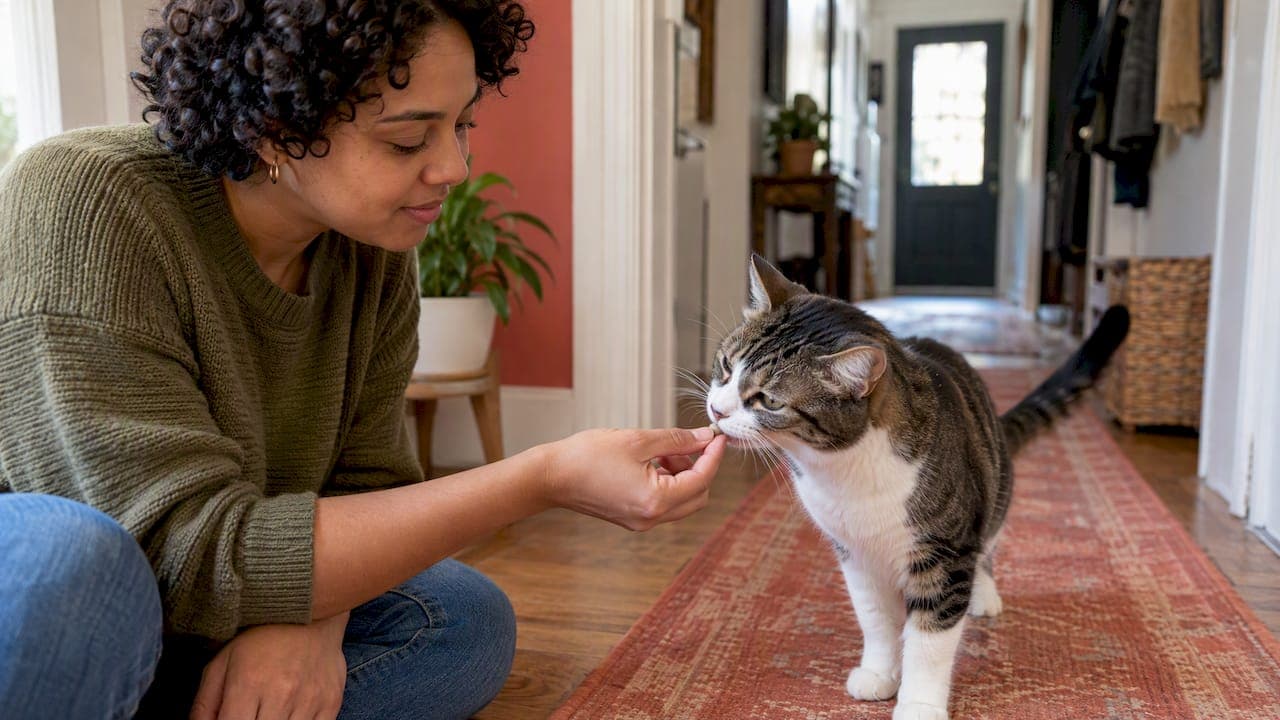
L-theanine is an amino acid found in tea leaves, and it is one of the few calming supplements for cats with published clinical data behind it. The data is modest but real: a small 2018 field study found stress signs improved in most cats within 15 to 30 days. It is not a sedative, not a cure for behavior problems, and not something to start without talking to your veterinarian. Here is what the evidence says, what to look for on a label, and how to judge whether it is helping.
TL;DR
- L-theanine may help cats with mild to moderate stress, but the best-known study was small (33 cats) and had no placebo group.
- Expect gradual change. In the study, improvement began around day 15 and was better by day 30.
- Dosing varies widely between products. Check the milligrams on the label and ask your vet for your cat's amount.
- Never give a human supplement. Added ingredients such as xylitol can be dangerous to cats.
- Supplements work best alongside changes to the home and behavior work, not instead of them.
Table of Contents
- What L-theanine is and why people use it for cats
- What the 2018 study actually found
- How long it takes and what to expect
- Why the environment matters more than the supplement
- Safety: what to check before you give anything
- Who might benefit, and who should skip it
- Our perspective
- Finding products to review with your vet
- FAQ
- Sources
What L-theanine is and why people use it for cats
L-theanine is an amino acid found in tea leaves. Researchers describe it as a structural analogue of glutamate, which means it can bind to glutamate receptors in the brain. In people and animals it has been linked to relaxation without heavy drowsiness, which is why it shows up in calming chews, treats and tablets for pets.
The Merck Veterinary Manual lists L-theanine among the options veterinarians may use for feline behavior problems, alongside synthetic pheromone products, alpha-casozepine and diets containing it. It says these can be used alone or adjunctively with drugs or other natural products. That word, adjunctive, matters. L-theanine is a supporting tool, not the whole plan.
Owners typically look at it for situations like:
- Stress around visitors, new pets or a move
- Fear of car rides or vet visits
- Hiding, vocalizing or over-grooming linked to a stressful change
- Litter box trouble that your vet has already checked for medical causes
That last point is worth stressing. Many signs that look like anxiety, including urinating outside the box, hiding, appetite changes and restlessness at night, can come from pain, urinary disease, thyroid problems or other illness. A cat who suddenly changes behavior needs an exam before a supplement.
What the 2018 study actually found
The main evidence behind L-theanine for cats is an open-label field study published in the Irish Veterinary Journal. Cats received 50 mg a day, given as 25 mg twice daily, for 30 days. Here is what the researchers reported:
| Measure | Result |
|---|---|
| Cats in the trial | 33 |
| Cats with a lower global stress score after 30 days | 91% (30 of 33) |
| Cats with at least a 50% reduction in that score | 64% (21 of 33) |
| Earliest significant improvement | About 15 days |
| Owner satisfaction | 82% |
| Palatability | 94% |
Those numbers look strong, and they are encouraging. They also need context.
Why the results call for caution
The study was open-label, which means there was no placebo group and owners knew their cat was getting the tablets. Improvement may reflect the supplement, but also the extra attention owners paid and the basic behavior advice provided during the trial. With only 33 cats, it is a promising signal rather than proof. The study also used one specific tablet product, so it does not show that every calming chew on the market works the same way.

A fair reading: L-theanine is reasonable to discuss with your vet for mild to moderate stress, and the safety record in this trial was good, but nobody should promise you a result.
How long it takes and what to expect
L-theanine is not a quick sedative. In the trial, meaningful improvement appeared at about day 15, with better results around day 30. If you give it for three days, see nothing and quit, you have not tested it.
A practical way to judge it:
- Write down a baseline. Before the first dose, note two or three specific signs: how often your cat hides, how many times a week she urinates outside the box, how long she takes to come out when guests arrive.
- Change one thing at a time. If you start the supplement the same week you add a new diffuser and move the litter box, you will not know what helped.
- Check again at 15 and 30 days. Compare against your notes, not your memory.
- Report back to your vet. If nothing has changed by about 30 days, or signs get worse, that is information your vet can use to adjust the plan.
Do not expect a calm cat in an emergency. If your cat is distressed during travel or a vet visit, ask your veterinarian whether a prescription option makes sense, since L-theanine is not designed to act like a fast-acting medication.
Why the environment matters more than the supplement
The Merck Veterinary Manual explains that medication and supplements are best used to lower underlying fear or anxiety so that learning can happen. Lasting change depends on the owner modifying the cat's behavior and removing stressors from the home. The manual's cat behavior chapter makes the same point: supplements alone are rarely a complete answer to complex behavior problems.
Before or alongside any supplement, work through the basics:
- Resources: one litter box per cat plus one extra, placed in quiet spots. Separate food, water and resting areas in multi-cat homes.
- Hiding and height: cat trees, shelves and covered beds let a nervous cat watch the room from safety.
- Routine: predictable feeding and play times lower the background level of uncertainty.
- Play: daily interactive play, like wand toys, burns off energy and builds confidence. Our cat toys picks cover options we have tested at home.
- Scent: some cats respond to enrichment like silvervine, which can work for cats that ignore catnip.
If you want a broader look at supplement categories, our cat health reviews go through what we have tested and what our vet input says about each.
Safety: what to check before you give anything
This is the part most owners skip, and it matters most.
Talk to your vet first
The American Veterinary Medical Association advises that you tell your veterinarian about every supplement your pet gets, including vitamins and holistic products, and to write down how often and how much. It also notes that human medications and dietary supplements should never be given unless your vet directs it. Call your vet before starting L-theanine, especially if your cat is on any medication, is pregnant or nursing, is a kitten, or has kidney or liver disease. Your vet can also rule out a medical cause for the behavior.
Never use a human L-theanine product by default
Human supplements can contain flavorings, sweeteners or other ingredients that are unsafe for cats. The AVMA reports that ingredients of main concern in human supplements include iron, manganese, alpha lipoic acid, methionine and vitamin D3. Xylitol is another well-known hazard in flavored products. A plain L-theanine capsule might be fine in principle, but "might be" is a call for your vet, who can tell you whether a product and amount suit your cat's size and health.
Read the label like a skeptic
"Natural" does not mean risk-free. The AVMA notes that pet supplements are not tightly regulated, that formulas can change, and that concentrations can be inconsistent. Its advice is to bring the actual container to your vet.
When you or your vet look at a calming product for cats, check:
- Milligrams of L-theanine per serving. The study used 50 mg a day split into two doses, but commercial products vary a lot. Giving the amount from one product's directions to a different product is a common mistake.
- Every other ingredient. Many calming chews combine L-theanine with chamomile, thiamine, tryptophan or other additions. More ingredients means more to check with your vet.
- Species on the label. Look for products formulated for cats, not dogs or people.
- Flavorings and sweeteners. Skip anything with xylitol, and ask about anything you do not recognize.
- Batch and manufacturer details. Lot numbers and a way to contact the company make problems easier to trace.
- Realistic claims. Be wary of any label that promises to cure aggression or eliminate anxiety.
We use a similar label-first approach for other supplements, as in our guides to taurine for cats and turkey tail.
If your cat gets into something
If your cat swallows a human supplement or too much of a product, call your veterinarian or an animal poison helpline right away. Pet Poison Helpline was reported in 2022 to charge $75 per incident, including follow-up consultations, so check its current fee when you call. Have the container in hand.
Who might benefit, and who should skip it
Reasonable to discuss with your vet:
- Cats with mild to moderate, situational stress, like a new home or a new baby
- Cats whose vet has already ruled out medical causes
- Owners ready to make environmental changes at the same time
Not a good fit as a first step:
- A cat with sudden behavior change, appetite loss, straining in the litter box or vomiting. These need an exam.
- Aggression that puts people or other pets at risk. That calls for a vet or a veterinary behaviorist.
- Cats on multiple medications, until your vet has reviewed the combination.
Our perspective
We review pet products that real pet parents buy, and calming supplements are one of the categories where we see the biggest gap between marketing and evidence. A bottle with a cat on the front and the word "calm" in big letters tells you nothing about how many milligrams are inside.
Our view on L-theanine is simple. It has more support than most calming ingredients, which is why we take it seriously. The best study is still small and open-label, which is why we do not oversell it. We would rather tell you a product is a reasonable thing to try under your vet's guidance than promise a transformation.
When we test products in real homes, we write down the downsides next to the upsides: does the cat actually eat it, is the label clear about the amount, does the ingredient list raise questions for your vet. Our health picks are cross-checked with veterinary input, and we do not accept payment for coverage. We do earn commissions if you buy through our links, and we say so openly.
If your cat is stressed, start with the home, get the vet visit done, and treat any supplement as one piece of the plan.
— Chris
Finding products to review with your vet
If your vet gives the go-ahead for a calming supplement, you can compare options in our Cat Health reviews, which list pros, cons and what we saw in real homes. For the non-supplement side of stress relief, like scratchers, perches and play, browse Cat Gear. Bring any product you are considering to your vet appointment and ask them to check the label.
FAQ
Can I give L-theanine to my cat?
Often it can be used under veterinary guidance, but ask first. Your vet can confirm the product, the amount and whether it suits your cat's age, health and other medications. Do not give human supplements without your vet's approval, since added ingredients can be harmful.
How long does L-theanine take to work in cats?
Not right away. In the 2018 field study, improvement in stress signs began around day 15, and results were better by day 30. If you expect an overnight effect, you may stop a product that would have helped, so track changes over several weeks.
When should you avoid L-theanine?
Avoid giving it before your vet has examined a cat with sudden behavior changes, since pain or illness may be behind them. Check with your vet first if your cat is a kitten, pregnant or nursing, on other medications, or has kidney or liver disease. Skip any product with xylitol or ingredients you cannot identify.
Is L-theanine enough to treat cat anxiety?
Usually not on its own. Veterinary references describe it as a supportive or adjunctive option that works best alongside environmental changes and behavior modification. Complex problems like aggression or severe fear may need a veterinarian or a veterinary behaviorist.
How can I calm a hyper cat at night?
Start with a vet check if the change is new, then add a long play session and a small meal before bedtime to mimic the hunt-eat-rest cycle. Use interactive toys rather than just leaving toys out. A supplement is not the first step for ordinary nighttime energy.
Sources
- Effect of l-theanine tablets in reducing stress-related emotional signs in cats: an open-label field study, Irish Veterinary Journal
- Behavior Problems of Cats, Merck Veterinary Manual
- Treatment of Behavior Problems in Cats, Merck Veterinary Manual
- Your Pet's Medications, AVMA
- Household hazards, AVMA
- Supplements' toxicity risks not easy to determine, AVMA
- Teaching moments and happy endings with Toxin Tails, AVMA