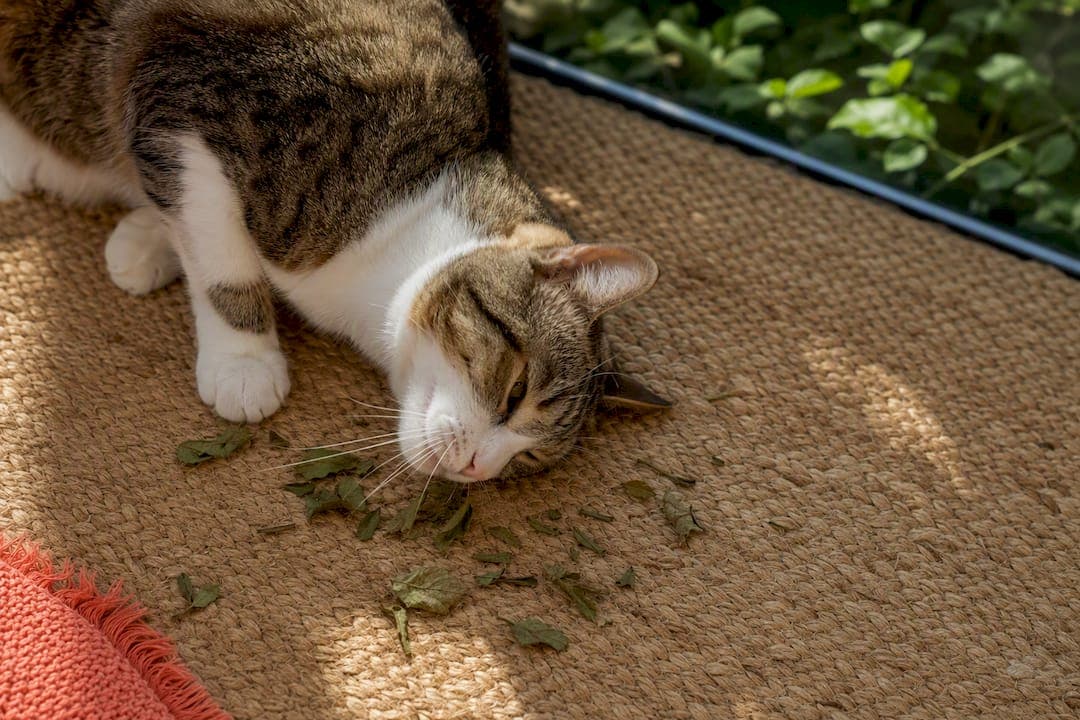
Silvervine is an effective, generally safe alternative to catnip, and for a lot of cats it works better. Research shows about 79% of cats respond to silvervine compared to roughly 68% for catnip, and much catnip nonresponders react strongly to it anyway. The main thing to watch is chew sticks: supervise them so your cat doesn't gnaw off a splinter, and check with your vet first if your cat has a chronic illness.
TL;DR:
- Silvervine responds more cats than catnip, with about 79% of domestic cats reacting compared to 68% for catnip, and nonresponders often do react to it.
- It contains multiple iridoids that activate different scent receptors, making it effective even for cats genetically insensitive to nepetalactone.
- Supervised, short sessions with dried leaves or fruit galls are safest, as prolonged exposure leads to habituation and potential physical risks from splintered sticks or overconsumption.
- Regular rotation between silvervine and catnip enhances response and reduces habituation, with usage best spaced every few days.
- Long-term safety is supported by research showing no biomarkers of addiction or organ damage in cats, but physical hazards from chews and overingestion should be monitored.
Table of Contents
- What Silvervine Is: Plant, Compounds, and Product Forms
- How Silvervine Affects Cats — And Why It Happens
- What Silvervine Actually Does for Your Cat
- Silvervine vs. Catnip: What the Numbers Actually Show
- How to Introduce Silvervine Safely
- Is Silvervine Safe? What the Research Actually Found
- What to Look for When Buying Silvervine
- What Kiblco Found Testing Silvervine Products
- When Silvervine Is the Right Tool
- Where to Find Vetted Silvervine Picks
- Sources
- FAQ
What Silvervine Is: Plant, Compounds, and Product Forms
Silvervine comes from Actinidia polygama, a woody vine native to Japan and other parts of East Asia. You'll see it sold under a few names, most commonly silvervine and matatabi, the Japanese term still used on a lot of imported packaging.
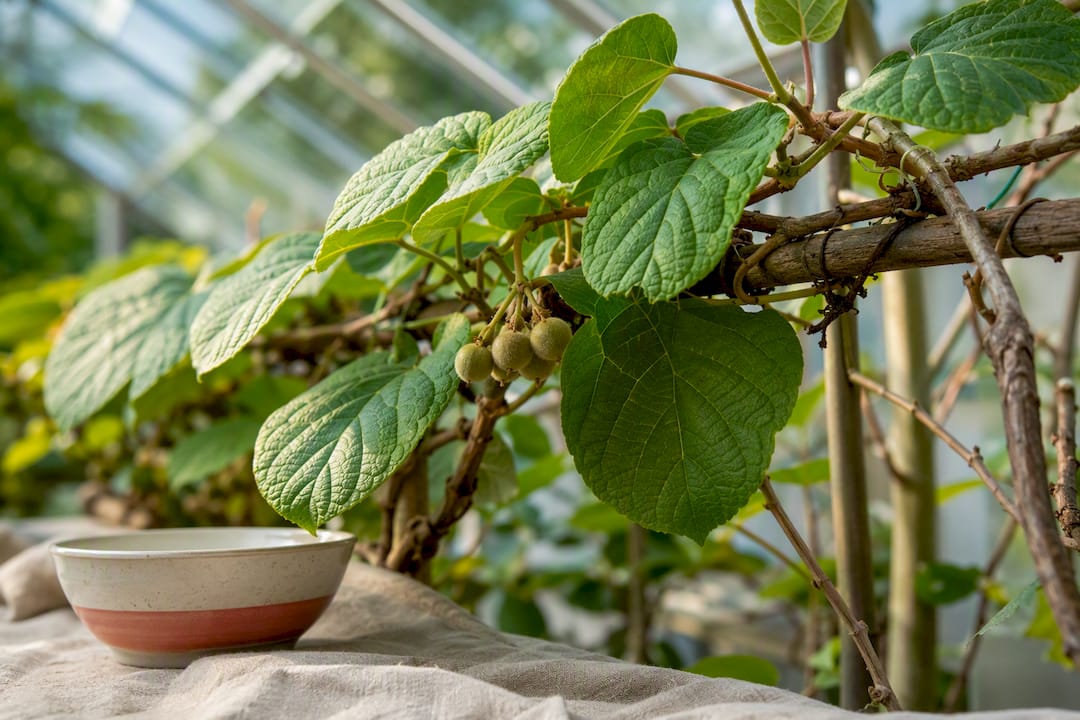
Where catnip relies almost entirely on one compound, nepetalactone, silvervine carries a mix of iridoids, including actinidine, nepetalactol, and isoiridomyrmecin. That chemical variety is likely why silvervine reaches cats that catnip never does. Different iridoids bind differently to feline scent receptors, so a cat whose nose essentially shrugs at nepetalactone can still light up for actinidine.
You'll typically find silvervine in four forms:
- Dried leaves — the most common and easiest to store, with a milder but longer-lasting effect.
- Fruit galls — small, knobby growths formed when a midge invades the fruit, packing a concentrated dose of actinidine.
- Sticks — whole or cut branches meant for chewing, popular for the dental angle.
- Powders and sprays — ground or liquid extracts you rub onto toys, scratchers, or bedding.
Each has trade-offs. Sticks satisfy the urge to chew but need supervision. Sprays are convenient but fade fast. Dried leaves tend to give the best balance of potency and shelf life.
How Silvervine Affects Cats — And Why It Happens
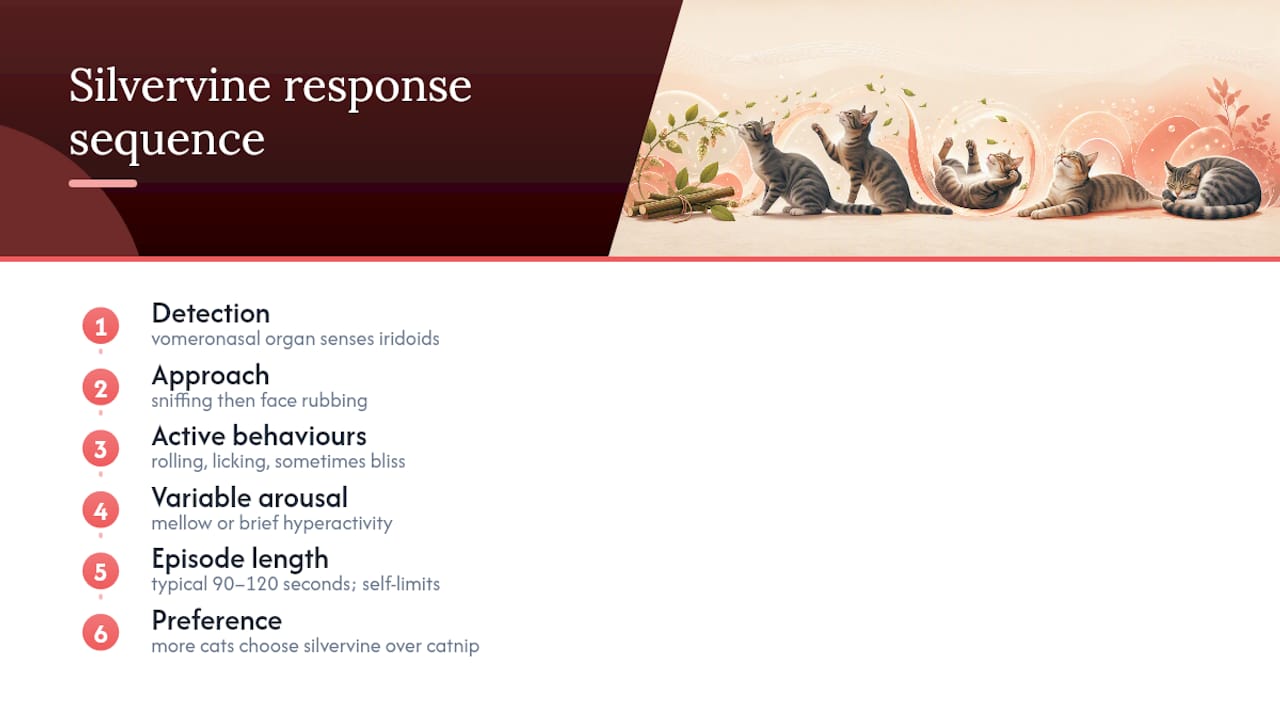
Watch a cat encounter silvervine for the first time and you'll see a fairly predictable sequence: sniffing, face rubbing, rolling, licking, sometimes a few minutes of what looks like pure bliss. Some cats go quiet and mellow. Others get briefly hyperactive, chasing nothing in particular before flopping over.
The mechanism starts in the nose. Cats detect the plant's iridoids through their vomeronasal organ, which routes the signal into reward-related regions of the brain. It's a similar pathway to what catnip triggers, just activated by a different set of chemical keys. This is a scent response, not a drug high in the pharmacological sense, and long-term exposure studies found no biomarkers of addiction in tested cats.
What's notable is how self-limiting the response is. A typical episode lasts around 90 to 120 seconds before the cat wanders off, uninterested for a while afterward. Give a cat continuous, unrestricted access to silvervine for several hours and the enthusiasm fades on its own, well before the four-hour mark in some observations. Cats essentially regulate their own dose. That habituation pattern is one of the stronger arguments against the idea that silvervine creates any kind of dependency; the interest burns out and needs time to reset, the same way a strong smell stops registering once you've been in the room a while.
Free-choice experiments back this up from another angle. When cats can choose whether to engage at all, more of them voluntarily approach silvervine than catnip. Under natural conditions, without a researcher forcing exposure, silvervine's chemical profile just gets more cats to opt in.
What Silvervine Actually Does for Your Cat
For an indoor cat with nothing to hunt and nowhere to climb, boredom is a real behavior problem, not just a mood. Silvervine gives you a cheap, low-effort way to interrupt that boredom on demand.
- Enrichment. A few minutes of intense sniffing and rolling breaks up long stretches of inactivity and can reduce the destructive behaviors that come from an under-stimulated cat.
- Exercise. The brief bursts of chasing and pawing that silvervine triggers are useful if your cat needs to move more, especially heavier cats who won't chase a wand toy on their own initiative.
- Dental support. Chew sticks work through mechanical scouring; gnawing on the fibrous stick can help scrape at plaque and tartar buildup. It's a supplement to brushing, not a substitute for it.
- Situational stress relief. Some owners use a light dusting of silvervine powder on a carrier or in a new environment to ease a nervous cat through travel, vet visits, or introducing a new pet.
Pro Tip: Rub a little dried silvervine into a plush toy before a stressful event, like a vet visit or moving day. The scent gives your cat something familiar and rewarding to focus on instead of the unfamiliar surroundings.
Silvervine vs. Catnip: What the Numbers Actually Show
Silvervine outperforms catnip by response rate, and it's not a small gap. In a widely cited BMC Veterinary Research trial, about 79% of domestic cats responded to silvervine, versus roughly 68% for catnip. More important than the raw numbers: many of the cats that ignored catnip entirely still responded to silvervine.
That gap comes down to chemistry, not potency. Catnip depends almost entirely on nepetalactone, and a cat's sensitivity to it is genetically inherited. If a cat doesn't carry the right receptor variant, no amount of catnip will change that. Silvervine's mix of iridoids gives a cat multiple chemical doors to respond through, so a nonresponse to one compound doesn't mean a nonresponse to all of them.
A few practical rules follow from this:
- If your cat has never reacted to catnip, try silvervine before writing off scent-based enrichment entirely.
- If your cat already loves catnip, silvervine is still worth rotating in. Different active compounds mean less habituation over time.
- Alternate between the two every week or two rather than leaving one out constantly. Cats fatigue on repeated exposure to the same scent profile.
How to Introduce Silvervine Safely
Start small and watch closely the first time. Here's a straightforward way to do it:
- Offer it inside a toy or sock. Sprinkle a small amount of dried leaf or powder into a fabric toy rather than handing over a loose pile. This contains the mess and limits how much your cat can eat in one go.
- Watch the reaction for a few minutes. Most cats show interest within seconds. If nothing happens after five minutes, your cat may just not be a responder to this batch or form. Try a fruit gall or a different processing type before giving up.
- Remove it once the episode winds down. A typical bout runs a couple of minutes. Once your cat loses interest, put the toy away rather than leaving it out.
- Reintroduce it every few days, not constantly. Short, spaced sessions keep the novelty intact and avoid the fading response that comes with nonstop access.
For kittens, hold off until they're a bit older. Responsiveness to iridoid plants often doesn't show up reliably until somewhere around 6 to 8 months, so a kitten's flat reaction now doesn't predict how it'll react later. If you have a pregnant cat or one managing a chronic condition, talk to your vet before adding silvervine to the routine. It's a low-risk product for most healthy cats, but "most" isn't "all," and a quick check costs you nothing.
Is Silvervine Safe? What the Research Actually Found
No biomarkers of hepatic or renal injury turned up in cats studied for long-term silvervine exposure, and researchers found no signs of addiction either. Combined with the fact that cats spontaneously stop engaging after a short bout and lose interest under prolonged access, the safety picture for typical use is solid.
The real risks with silvervine aren't chemical, they're physical. Chew sticks can splinter if they're low quality or if your cat gnaws aggressively, and a swallowed splinter or fragment can cause choking or, worse, a gastrointestinal obstruction. Eating a large amount of dried leaf or powder in one sitting, rather than the small doses meant for sniffing and rolling, can also cause stomach upset in some cats.
Watch for these red flags and call your vet if you see them:
- Vomiting or diarrhea after silvervine exposure
- Lethargy that lasts well beyond the normal short episode
- Gagging, drooling, or signs your cat is struggling to swallow something
Cats with cardiac, hepatic, renal, or gastrointestinal disease should only get silvervine after a vet gives the go ahead, since none of the safety research specifically covers cats with those preexisting conditions.
What to Look for When Buying Silvervine
Read the label before you buy. It should specify Actinidia polygama and state clearly whether the product is dried leaf, fruit gall, or a blend of both. Vague packaging that just says "natural cat attractant" without naming the plant is a sign to skip it.
- Favor dried leaves for everyday use. They're shelf-stable, easy to portion, and the drying process actually shifts the iridoid profile in a way that often strengthens the response.
- Fruit galls pack a more concentrated dose of actinidine, useful for a stubborn nonresponder, but they cost more per use.
- Skip products with unlisted fillers or additives, and inspect chew sticks for rough, splinter-prone wood before handing them over.
- Store any form in a sealed, resealable bag away from humidity and out of your cat's reach between sessions.
If your cat's interest starts fading over a few months, rotating between leaf, gall, and stick formats usually revives the response better than just buying more of the same product.
What Kiblco Found Testing Silvervine Products
Testing pairs a vet-informed protocol with real pet-parent testers running short, supervised sessions and checking product durability along the way. Across multiple households, dried leaves and fruit-gall powders consistently triggered the strongest, most reliable play compared to sprays. Chew sticks were more hit or miss: several splintered under aggressive chewing, so solid, non-splinter designs performed noticeably better in hands-on use. For readers ready to shop, Kiblco's catnip alternative comparisons cover more ground on picking the right format.
When Silvervine Is the Right Tool
Silvervine earns its spot for catnip nonresponders and indoor cats stuck in a stimulation rut, but it's not a fix for everything. A cat that's suddenly withdrawn or destructive might be dealing with a medical issue or deep-seated anxiety that no amount of sniffing a leaf will resolve. Treat silvervine as one tool in a bigger enrichment plan, not a stand-in for a vet visit or a play routine.
— Chris
Where to Find Vetted Silvervine Picks
Kiblco tests pet products the way an actual pet owner would use them: hands-on, supervised, and checked against what a vet would flag as a concern. If you're trying to figure out which dried leaf, fruit gall, or stick actually holds up instead of falling apart after two sessions, that's the gap Kiblco's reviews are built to close.

Beyond silvervine itself, Kiblco covers the gear that pairs well with it, from interactive wand toys that extend the play session silvervine kicks off, to dental treats that back up what a chew stick starts. Enrichment also matters for the people doing the caretaking; research on pet ownership and senior mental health points to real benefits on both ends of the leash. Head to Kiblco to browse current picks and see which silvervine products actually held up in testing before you buy.
Sources
This article draws on the BMC Veterinary Research study on feline response rates, PMC's safety and suitability research on iridoid exposure, free-choice engagement data from the Journal of Chemical Ecology, and vet-reviewed guidance from PetMD.
- Silvervine Plant: An Alternative to Catnip — PetMD
- Responsiveness of cats to silver vine, Tatarian honeysuckle, valerian and catnip — BMC Veterinary Research
- Assessing the safety and suitability of using silver vine as an olfactory enrichment for cats — PMC
FAQ
What does silvervine do to cats?
It triggers a short euphoric response through scent detection, causing sniffing, rubbing, rolling, and licking that typically lasts around 90 to 120 seconds before the cat loses interest.
Do vets recommend silvervine for cats?
Vet-reviewed sources generally support silvervine as a safe enrichment option for healthy cats, though vets recommend checking in first if a cat has cardiac, hepatic, renal, or GI disease.
Is it okay for cats to eat silvervine?
Small amounts of dried leaf or gall are considered safe, but large ingestions can cause stomach upset, and chew sticks carry a choking or obstruction risk if they splinter.
How often can my cat have silvervine?
Offer it in short, supervised sessions every few days rather than leaving it out constantly. Continuous access causes the response to fade, since cats naturally habituate to prolonged exposure.