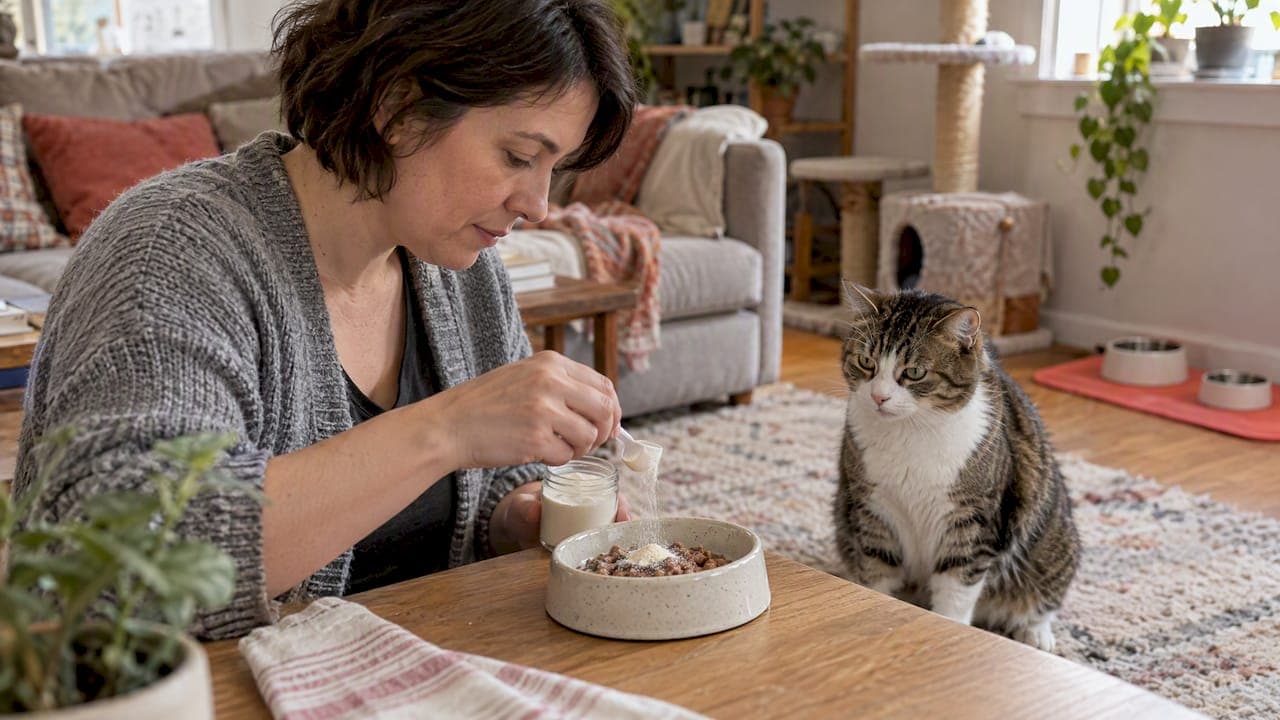
Collagen may help some cats with achy joints, but the evidence covers one specific form, undenatured type II collagen (UC-II), in cats with mild to moderate joint disease. It is not a general-purpose cat supplement, and it is not a substitute for a diagnosis. If your cat is slowing down, the first step is a vet visit. Collagen comes after that, if at all.
This guide covers what the best available trial found, how the different types of collagen differ, what to look for on a label, and which signs mean you should skip the supplement aisle and call your vet.
TL;DR
- The strongest evidence is for undenatured type II collagen in cats with mild to moderate degenerative joint disease. In a 2026 placebo-controlled study, 57% of supplemented cats had a clinically meaningful pain reduction at 12 weeks, versus 28% on placebo.
- Human collagen powders are not the same product. Cat-specific formulas are the safer starting point, and your vet should approve any choice.
- Cats hide pain well. Less jumping, litter box trouble or a messy coat can signal arthritis, so get an exam before you treat anything yourself.
- Pet supplements are not pre-approved by the FDA, so look for brands that use voluntary third-party quality testing.
- There is no universal dose or schedule. Follow your vet's instructions and the product label.
Table of Contents
- What collagen actually is, and why people give it to cats
- What the 2026 cat study found
- Is your cat's slowing down really a joint problem?
- Safety: what to check before the first scoop
- How to choose a collagen supplement for your cat
- How to tell whether it is working
- Comfort changes that help arthritic cats now
- Our take on collagen for cats
- Find vetted cat health picks at Kiblco
- FAQ
- Sources
What collagen actually is, and why people give it to cats
Collagen is the main structural protein in cartilage, tendons, skin and bones. Supplements for cats usually come as capsules, chews, or powder you sprinkle on food. VCA Animal Hospitals describes undenatured collagen type II as a nutritional supplement used to support healthy joints and flexibility in dogs, cats and horses.
The pitch is simple: cartilage wears down in arthritic joints, so feeding the building block should help. Reality is less tidy. Different collagen products work in different ways, and the research does not treat them as interchangeable.
The two forms you will meet on labels
Undenatured type II collagen (UC-II). The protein is kept in its native structure. It is not meant to be a building block. According to VCA, it is designed to help modulate the immune response in arthritic joints. This is the form with the clearest feline trial data.
Hydrolyzed collagen (collagen peptides). The protein is broken into small fragments so it is easy to absorb. It shows up in powders, treats and combination formulas. For cats, a 2024 study in the journal Animals tested a diet enriched with EPA and DHA, turmeric extract and hydrolyzed collagen in cats with naturally occurring osteoarthritis. Because the diet combined several ingredients, that study cannot tell you what collagen alone does.
If you see a label that lists "collagen" with no type, no source and no amount per serving, treat that as a gap in information, not a bargain.

What the 2026 cat study found
The most useful piece of evidence for this keyword is a randomized, placebo-controlled crossover field study of undenatured type II collagen in cats. Here is what the published findings report:
- The cats had mild to moderate degenerative joint disease.
- They received daily UC-II supplementation.
- Owners reported better mobility and less musculoskeletal pain.
- After 12 weeks, 57% of the supplemented cats reached a clinically meaningful drop in pain scores, compared with 28% in the placebo group.
Two honest caveats. First, outcomes were reported by caregivers, and people can see improvement they hope for. That is why the placebo group matters: more than a quarter of placebo cats also looked better. Second, the result applies to that specific form in cats with diagnosed joint disease. It does not tell you a healthy young cat needs collagen, or that a generic powder will do the same thing.
For wider context, a review of UC-II in companion animals summarizes the knowledge on osteoarthritis, which it calls the most common joint disease in humans and animals. Much of the pet data there is in dogs, so cat-specific trials like the one above are valuable.
Is your cat's slowing down really a joint problem?
Most owners reach for collagen because their cat "is getting old." That assumption is the first thing to question.
Cornell's Feline Health Center says slowed-down, reclusive behavior can indicate a joint problem in cats of any age. Cats mask discomfort, so the signs are subtle. Watch for:
- No longer jumping onto counters, beds or window perches
- Hesitating before stairs, or taking them one at a time
- Missing the litter box, especially if the sides are high
- Less grooming, which can lead to matting and skin problems
- Irritability when touched, or hiding more than usual
A cat that stops jumping is not just old. Cornell's guidance on senior cats notes that older cats are prone to several conditions at once, including arthritis, hypertension and hyperthyroidism, and that regular checkups matter because cats are expert at hiding pain and weakness. Chronic kidney disease can also be insidious. A supplement can sit in the bowl for months while the real problem goes untreated.
The same Cornell page on cognitive dysfunction lists excessive sleeping and lack of interest in play among signs in cats 10 and older, which can look like joint pain from the couch. Only an exam sorts out which it is.

Safety: what to check before the first scoop
Talk to your vet first
VCA's guidance on joint nutraceuticals for cats with osteoarthritis says these products are not tested and regulated like pharmaceuticals and recommends healthy skepticism. If your cat takes any medication, especially for kidney, heart or thyroid disease, ask your vet whether a supplement is appropriate before you start. A clinic that does full senior workups, such as this veterinary practice in Hobe Sound, Florida, shows what a thorough exam looks like: diagnostics, imaging and nutritional counseling in one place. Your own local vet is the person to ask.
Side effects are possible
VCA notes that collagen supplements can cause temporary stomach upset, and sensitivities can develop even if the first doses go fine. Watch for vomiting, diarrhea or a drop in appetite. Stop and call your vet if you see irregular breathing, a rash or facial swelling, which can point to an allergic reaction.
Skip human collagen products
Human collagen powders and gummies are made for people. They may include flavorings, sweeteners or other additives that were never assessed for cats. Many cat-focused forum threads recount owners being told by their vet to stop human collagen. That is anecdotal, but the principle is sound: choose a product made for cats and confirm it with your vet.
Natural does not mean safe
A veterinary article in the Journal of the American Veterinary Medical Association points out that, although human supplements fall under a specific law, the FDA's approach to animal products is different. That means label accuracy and contamination are real concerns.
The FDA explains in its page on regulation of pet food that a product is generally considered food when its effect comes mainly from nutrition, taste or aroma. There is no pre-market approval step, so quality can vary by brand. Your best protection is to favor manufacturers that publish third-party testing for potency and purity, and to ask the company for it if they do not.
How to choose a collagen supplement for your cat
Use this checklist when comparing products. Nothing here replaces your vet's recommendation, but it will help you ask better questions.
| What to check | Why it matters |
|---|---|
| Collagen type named (UC-II vs. hydrolyzed) | Only UC-II has the clearer cat trial results above |
| Amount per serving listed | "Proprietary blend" hides the actual dose |
| Made for cats, with feline dosing | Dog and human products may use different amounts and ingredients |
| Third-party testing or quality certification | Supplements are not pre-approved, so verification falls to the brand |
| Simple ingredient list | Fewer flavorings and additives means fewer variables if your cat reacts |
| Form your cat will accept | A chew or powder is no use if it ends up untouched |
| Return or refund policy | Cats can be picky, and you may need to switch forms |
Forms: chews, capsules, powders
Powder can be mixed into wet food, which suits cats that refuse anything else. Use a small test portion first so you can spot any stomach upset.
Capsules can often be opened and sprinkled, which gives you flexibility on dose when your vet adjusts it.
Chews and tablets are convenient, but many are flavored for dogs, and some cats simply will not eat them. Check the ingredient list for anything your cat is sensitive to.
What about dosing and the "3-3-3 rule"?
The "3-3-3 rule" people ask about is a rescue-cat adjustment guideline (3 days, 3 weeks, 3 months in a new home). It has nothing to do with collagen. For supplements, there is no universal schedule, so follow your vet and the label. The 2026 trial used daily dosing for 12 weeks, a reasonable window for judging whether anything is working, but your vet decides what suits your cat.
How to tell whether it is working
Because owner reports drive the evidence, keep your own records to cut down on wishful thinking.
- Before starting, take a short video of your cat jumping onto a favorite spot and walking up stairs.
- Write a baseline of how often your cat jumps, plays and uses the litter box without accidents.
- Change one thing at a time. If you start collagen, a new food and a heated bed in the same week, you will not know what helped.
- Recheck at four, eight and twelve weeks with new videos and notes.
- Share the log with your vet at the next visit. If there is no improvement by the end of the trial window, ask about other options rather than increasing the dose on your own.
Supplements are one tool. Weight management, comfortable surroundings and, when needed, prescription pain relief from your vet can matter more.
Comfort changes that help arthritic cats now
While you wait to see whether a supplement helps, make the home easier on sore joints:
- Use a litter box with a low entry, so your cat does not have to climb to go.
- Add ramps or pet steps to favorite perches and the bed.
- Put food, water and a bed on every floor your cat uses.
- Brush your cat gently if grooming has slipped.
- Offer warmth. Our guide to heated cat beds for arthritic and senior cats covers what we would look for.
If you want a food-based extra rather than a capsule, read our vet-safe bone broth guide for cats, which includes a label checklist. And if you share a home with a dog too, remember the dosing, products and risks differ: see our joint supplements for senior dogs and collagen sticks for dogs pages. Never give your cat a dog product without asking your vet.
Our take on collagen for cats
We test pet products in real homes and check health picks with veterinary input, so here is where we land on this one.
Collagen is a reasonable thing to discuss with your vet for a cat with confirmed mild to moderate joint disease. It is a poor idea as a guess for a cat that is simply quieter than before. The 2026 trial is encouraging, but it supports one form in one group of cats, and the placebo response in that study was not small. We would not promise a result to any owner.
What we do care about is what happens around the supplement: a proper diagnosis, an honest label, a cat-specific product and a way to measure whether it helps. When we cover supplements, we write down the downsides next to the benefits, we do not accept payment for coverage, and we disclose our affiliate relationships. Our readers should be able to walk into a vet visit with better questions, not a shopping cart full of hope.
— Chris
Find vetted cat health picks at Kiblco
If your vet gives the go-ahead and you are ready to compare options, browse our Cat Health reviews. Each review lists pros and cons, how the product held up in real homes and any health concerns we noticed. For the gear that makes life easier on sore joints, see Cat Gear and Cat Litter.
FAQ
Is collagen okay for cats?
It can be, if your vet agrees and the product is made for cats. A 2026 trial found benefit from undenatured type II collagen in cats with joint disease, but side effects such as stomach upset can occur. Stop and call your vet if you see vomiting, diarrhea, rash or facial swelling.
Can I give my cat human collagen peptides?
We would not. Human products are formulated for people and may contain additives that were never evaluated for cats. Ask your vet about a cat-specific product and dose instead of using a human powder.
What is the silent killer of cats?
There is no single one. Veterinary sources point to conditions that creep up quietly in older cats, such as chronic kidney disease, along with arthritis, hypertension and hyperthyroidism. Because cats hide pain, regular vet checkups are the best protection.
How long before collagen works in cats?
The 2026 trial measured results after 12 weeks of daily use, so do not judge it after a few days. Track mobility with videos and notes, and review progress with your vet. If you see nothing by the end of that window, ask about other options.
Can kittens or healthy cats take collagen?
The cat evidence we found is in cats with joint disease, not healthy kittens or young adults. Without a diagnosed need, there is no strong reason to add it, and growing kittens have specific nutritional needs your vet should guide.
Sources
- Undenatured type II collagen enhances mobility in cats (2026 randomized placebo-controlled study)
- Undenatured Collagen Type II, VCA Animal Hospitals
- Nutraceuticals for Joint Support in Cats with Osteoarthritis, VCA Animal Hospitals
- Is Your Cat Slowing Down? Cornell Feline Health Center
- The Special Needs of the Senior Cat, Cornell Feline Health Center
- Cognitive Dysfunction, Cornell Feline Health Center
- FDA's Regulation of Pet Food
- Timely Topics in Nutrition, JAVMA
- Diet with EPA, DHA, turmeric and hydrolysed collagen in feline osteoarthritis, Animals (2024)
- UC-II in Joint Health and Disease: Review in Companion Animals, PMC