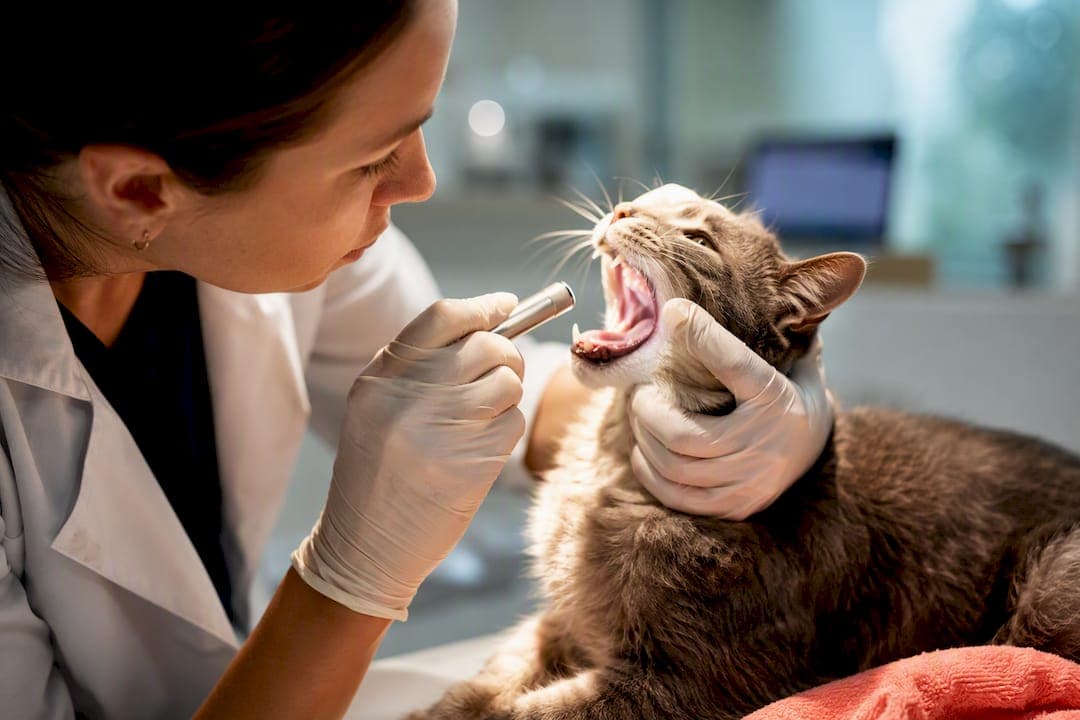
Lactoferrin has trial-backed benefits for cats with lymphocytic-plasmacytic gingivitis-stomatitis and for supporting immune development in kittens, but it works best as a veterinarian-guided adjunct, not a standalone fix. The strongest data comes from small clinical trials pairing it with existing treatments like piroxicam. Any cat showing oral pain, drooling, or appetite changes needs a vet visit before you reach for a supplement bottle.
TL;DR:
- Lactoferrin shows specific promise mainly for lymphocytic-plasmacytic stomatitis and for supporting immune development in kittens, usually as an adjunct to other treatments.
- Delivery methods in studies vary between topical, spray, and dietary supplementation, with localized application best for active lesions and oral formulas suited for systemic support.
- Safety appears reassuring based on small trials, but long-term safety and effects in larger populations require caution, especially in cats on immunosuppressants or with kidney or liver issues.
- Proper diagnosis and vet guidance are crucial before starting lactoferrin, as its benefits are condition-specific and poorly supported for general immune boosting or allergy relief.
- Owners should verify product quality with source transparency and dosing clarity, and use vet-approved protocols to match the delivery method to the targeted condition.
Table of Contents
- What the research says: lactoferrin for cats in clinical trials
- Which conditions has lactoferrin actually been studied for?
- How is lactoferrin given to cats: sprays, topicals, or food?
- Is lactoferrin safe for cats, and what should owners watch for?
- How do veterinarians actually use lactoferrin in treatment plans?
- What should you look for in a lactoferrin product?
- Getting the dosing and routine right at home
- Kiblco's perspective: what we hear from pet parents
- Our take: the evidence is real, but it's narrower than the marketing suggests
- Where to find vetted lactoferrin picks for your cat
- Sources
What the research says: lactoferrin for cats in clinical trials
Most of what we know about lactoferrin in cats comes from three studies, none of them large, all of them worth taking seriously. Cats are obligate carnivores with immune physiology that doesn't map cleanly onto findings from dogs, rodents, or humans, so researchers have had to test the compound directly in feline subjects, rather than borrowing conclusions from other species.
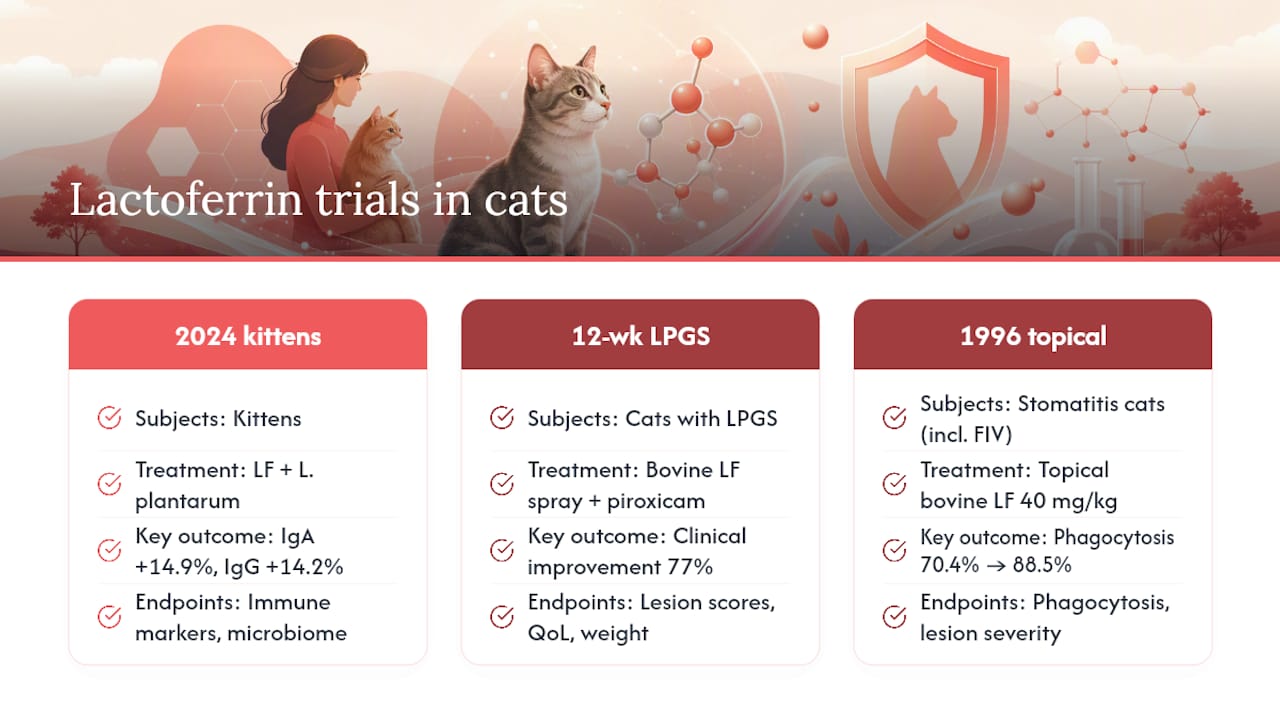
The most recent and most quantitative trial looked at kittens rather than adult cats with disease. Published in 2024, it tested lactoferrin combined with the probiotic Lactobacillus plantarum against a control diet. The results were striking for a supplement study: IgA rose by 14.9% and IgG by 14.2%, two antibody classes that do a lot of the frontline work in mucosal and systemic immunity.
Trial snapshot: Kittens fed lactoferrin plus L. plantarum showed IgA +14.9%, IgG +14.2%, catalase +28.7%, and Lactobacillus abundance rising nearly twentyfold (4.13% → 79.03%).
That is a large relative shift in gut flora composition, though it is worth remembering this is one trial, in kittens, using a specific probiotic pairing, not a blanket claim about what supplementing an adult cat's food will do.
The second major trial, and arguably the one most owners searching for lactoferrin actually care about, tested it against lymphocytic-plasmacytic gingivitis-stomatitis (LPGS), a painful and frustrating oral condition that causes severe inflammation of a cat's gums and mouth tissue. This randomized, double-blind, 12-week trial combined bovine lactoferrin oral spray with piroxicam, an anti-inflammatory drug already used in feline oral disease. The combination produced significant clinical improvement in 77% of treated cats, along with measurable gains in quality of life and body weight, both of which tend to drop sharply in cats too sore to eat normally.
The oldest study, from 1996, used a different route entirely: topical application directly to the oral lesions rather than a spray or diet additive. Researchers applied bovine lactoferrin at 40 mg/kg daily for 14 days to cats with intractable stomatitis, including FIV-positive cats. They tracked neutrophil phagocytosis, a measure of how effectively immune cells engulf and destroy pathogens, and saw it rise from roughly 70.4% to 88.5% within about a week of treatment, alongside visible clinical improvement in lesion severity.
Here's the honest caveat that gets buried in a lot of supplement marketing: these are small trials. None of them enrolled hundreds of cats. Endpoints varied across studies, some tracking immune markers, others tracking clinical lesion scores or owner-reported quality of life, which makes it hard to stack the findings into one unified dose-response curve. What we're left with is a consistent direction of effect across three independent studies spanning almost 30 years, using different formulations and routes, all pointing the same way. That consistency counts for something even without a single mega-trial to lean on.
Which conditions has lactoferrin actually been studied for?
Lactoferrin isn't a general-purpose immune booster you sprinkle on kibble and forget about. The evidence clusters around a handful of specific conditions, and knowing which ones matters more than knowing the ingredient's name.
Caudal stomatitis and LPGS have the best-documented response. The anti-inflammatory and lesion-reducing effects seen in both the 1996 topical study and the 2014 oral spray trial make this the condition where a vet is most likely to actually recommend lactoferrin as part of a treatment plan.
FIV-associated immune dysfunction is a more nuanced case. Lactoferrin doesn't function as a blunt immune stimulant in FIV-positive cats. Research on its mechanism suggests it can protect overactivated immune cells from apoptosis, acting more like a regulator that calms inappropriate immune activity than a booster that cranks everything up. That distinction matters clinically, because FIV involves a immune system that's already deregulated, not simply weak.
Kitten immune development is where the newest data lives. The 2024 trial's IgA, IgG, and microbiota results suggest lactoferrin paired with probiotics may support a young cat's developing gut and immune system during a window when that system is still calibrating itself.
GI and IBD contexts, plus allergy support, sit furthest from solid evidence right now. The mechanistic case is plausible. Lactoferrin appears to support intestinal barrier proteins and can dial down inflammatory signaling through pathways like NF-κB, which theoretically helps explain why gut integrity and systemic inflammation both seem to respond. But there's no dedicated feline IBD or allergy trial backing this up yet. Treat any product marketed specifically for feline IBD or allergies as running ahead of the evidence, not confirmed by it.
If your cat has chronic dental sensitivity alongside oral inflammation, pairing supplement strategy with the right dental treats for cats can support the same goal from a different angle.
How is lactoferrin given to cats: sprays, topicals, or food?
The route matters as much as the dose. Studies have used three distinct delivery methods, and each one targets a different part of the problem.
-
Oral spray, applied directly to inflamed tissue. The 2014 LPGS trial used a bovine lactoferrin spray applied to the mouth alongside oral piroxicam, over 12 weeks. This route puts the active compound in direct contact with the inflamed gum tissue, which likely explains part of why the combination outperformed piroxicam-only comparisons in similar research.
-
Topical application at 40 mg/kg daily. The 1996 study applied lactoferrin topically to lesions for 14 days straight, and the phagocytosis improvement showed up within roughly a week. Topical dosing concentrates the effect locally, which makes sense for a condition that's fundamentally a localized inflammatory process, even when the underlying trigger (like FIV) is systemic.
-
Dietary supplementation mixed into food. The kitten trial folded lactoferrin into the diet alongside L. plantarum, targeting systemic immune modulation and gut microbiota composition rather than a specific lesion. This route makes sense when the goal is general immune support during development rather than treating an active oral lesion.
The practical implication: local delivery (spray, topical) makes sense when there's a visible inflammatory site like stomatitis lesions, because you're getting concentrated exposure right where the problem lives, as detailed on Litter Room's veterinary nutrition topics. Systemic delivery through food makes more sense for immune support goals that aren't tied to one visible lesion, like a kitten's developing gut flora or general antioxidant status.
This is also why a vet's choice of route isn't arbitrary. A cat with severe LPGS lesions and one with no oral disease at all but a compromised immune system from FIV are candidates for genuinely different lactoferrin protocols, even though both cats are technically "taking lactoferrin." Absorption and local concentration differ enormously between rubbing a topical formula on inflamed gum tissue and mixing a powder into wet food.
Is lactoferrin safe for cats, and what should owners watch for?
Short-answer: the trial data looks reassuring, but the sample sizes are small enough that "reassuring" shouldn't be confused with "fully characterized." Across the studies reviewed here, few adverse effects turned up, and none of the trials reported serious safety signals during the treatment windows tested. That said, small trial safety data is not the same thing as long-term, large-population safety data, and no supplement should be treated as risk-free just because a 12-week study didn't flag problems.
A few groups warrant extra caution:
- Cats on immunosuppressant medications. Since lactoferrin has immunomodulatory effects, layering it onto drugs that already suppress immune function needs veterinary oversight, not guesswork.
- Cats in unclear stages of viral disease. FIV and FeLV status, and where a cat sits in disease progression, can change how appropriate lactoferrin supplementation is. This is exactly the kind of individual variable a vet needs to weigh, not something to standardize from an internet dosing chart.
- Cats already on NSAIDs like piroxicam. The 2014 trial deliberately combined the two, but that combination was designed and monitored by researchers. Replicating it at home without lab monitoring skips the safety net that made the trial data trustworthy in the first place.
- Any cat with kidney or liver issues, since NSAID pairings in particular carry their own separate risk profile that needs bloodwork to track safely.
Pro Tip: Ask your vet whether baseline bloodwork makes sense before starting lactoferrin, especially if it's being paired with an anti-inflammatory. It's a cheap way to catch a problem before it becomes symptomatic.
Watch for changes in appetite, excessive drooling, visible oral pain (pawing at the mouth, reluctance to eat hard food), behavior shifts, or unexplained weight loss or gain. Any of those, especially a sudden appetite drop in a cat already being treated for stomatitis, deserves a call to the clinic rather than a wait-and-see approach.
How do veterinarians actually use lactoferrin in treatment plans?
Lactoferrin rarely shows up as a solo prescription. In the trial that produced the clearest results, it was paired with piroxicam, and that combination outperformed the anti-inflammatory alone in controlling LPGS symptoms. That pattern, lactoferrin as an addition rather than a replacement, seems to be how the evidence supports using it.
Timelines matter for setting realistic expectations. Owners and clinicians in several small studies have reported early symptomatic changes, like reduced drooling or improved appetite, within 7 to 14 days of starting treatment. But full lesion remission and the kind of sustained improvement trials actually measure typically gets assessed at the 8 to 12 week mark, matching the duration of the LPGS trial itself.
- Expect early behavioral cues (eating more comfortably, less pawing at the mouth) in the first two weeks.
- Expect the vet to reassess lesion severity and overall response closer to the 2 to 3 month mark.
- If there's no meaningful improvement by that point, lactoferrin plus the current medication regimen probably isn't enough on its own, and it's time to discuss escalation.
When lactoferrin and NSAID combinations don't get a cat's stomatitis under control, the next steps usually involve more aggressive dental intervention, sometimes full-mouth extractions, which remain the closest thing to a definitive treatment for severe, refractory LPGS. A vet documenting outcomes carefully at each stage, rather than adjusting the plan reactively, tends to produce better long-term results because it's clear which intervention is actually driving improvement.
What should you look for in a lactoferrin product?
Not every bottle labeled "lactoferrin" on a pet store shelf reflects the formulations or concentrations used in the trials that actually back this ingredient. A few checks separate a legitimate product from a marketing exercise.
- Source specification. Look for bovine lactoferrin explicitly named on the label, since that's the form every cited trial used. Vague terms like "lactoferrin complex" without a source species is a yellow flag.
- Third-party testing. Products that disclose independent lab verification of purity and concentration are worth trusting more than ones that just claim quality on the front of the package.
- Clear absolute dosing. A label should state milligrams per serving, not just a vague "supports immune health" claim. If you can't calculate mg/kg from the label and your cat's weight, you can't compare it to trial dosing at all.
- Formulation matched to purpose. An oral spray designed for direct application to gum tissue serves a different goal than a palatable powder mixed into food for long-term immune support. Buying the wrong format for your goal wastes money and the cat's patience.
Pro Tip: If a product's packaging leans hard on words like "miracle" or "cure" without citing any dosing rationale, that's a bigger red flag than the price. Trial-backed ingredients don't need to oversell themselves.
Bring any product you're considering to your vet before starting it. A quick photo of the label and the ingredient panel takes thirty seconds and can save weeks of guessing whether the dose you're giving even resembles what worked in a clinical trial.
Getting the dosing and routine right at home
Before buying anything, get a firm diagnosis. Lactoferrin's best evidence is specific to conditions like LPGS, so starting a supplement without confirming that's actually what your cat has means you're guessing at the wrong problem.
- Book a vet consult first. Confirm the diagnosis, review any current medications for interaction risk, and ask what outcome you're actually targeting, symptom relief, immune support, or lesion remission.
- Apply topical or spray formulations exactly as directed, usually meaning direct contact with affected oral tissue rather than mixing into food, since the local concentration is the point.
- Make dietary powders or liquids palatable by mixing into wet food or a small amount of broth if your cat resists the taste. A vet or the product's own guidance can confirm whether mixing changes absorption.
- Track weekly, not just daily, changes in appetite, drooling, weight, and any signs of oral discomfort. Trends over a week tell you more than a single good or bad day.
- Store products as labeled. Most lactoferrin supplements need a cool, dry environment and have a defined shelf life once opened, so check the expiration date each time you refill a dose.
Contact your clinic promptly if you notice worsening drooling, sudden appetite loss, or any new lethargy, rather than waiting for the next scheduled check-in.
Kiblco's perspective: what we hear from pet parents
Kiblco combines veterinary input with hands-on feedback from real cat owners who've actually used these products, not just marketing copy from the manufacturer. That combination surfaces trade-offs that clinical trials don't always capture.
The most common one owners report is palatability versus concentration. Higher-dose powders sometimes taste worse to cats, leading to spit-outs and wasted supplement, while more palatable formulas sometimes come in lower concentrations that may not match trial dosing. The second trade-off is convenience versus targeted delivery: a food-mixed powder is far easier to administer daily than a topical spray applied directly to sore gum tissue, but the spray delivers concentrated exposure right where an LPGS lesion actually is.
Kiblco earns commissions when readers purchase through some of the links in our reviews. That relationship never changes which pros and cons we report, and it never turns a mediocre product into a recommended one.
Our take: the evidence is real, but it's narrower than the marketing suggests
The trial data on lactoferrin for cats is genuinely encouraging, but it supports a narrower claim than most supplement marketing implies. This isn't a general wellness powder. It's an adjunct therapy with the clearest evidence in one specific disease, LPGS, and a promising but early signal in kitten immune development.
Where conventional advice falls short is treating "lactoferrin helps immune health" as a blanket statement. The mechanism research on FIV cats shows it acts as a regulator, not a stimulant, which means expecting it to simply "boost" a compromised immune system misreads how it actually works.
Prioritize the diagnosis before the supplement. A cat with confirmed stomatitis and a vet-guided piroxicam pairing has a real shot at the outcomes these trials documented. A cat given lactoferrin on spec, with no diagnosis and no monitoring, is just an uncontrolled experiment with an $ 30 price tag.
— Chris
Where to find vetted lactoferrin picks for your cat
Kiblco built its review process around one problem: pet supplement shelves are full of products making claims that outrun the actual research. We combine vet-informed guidance with hands-on testing by real cat owners, and we publish the pros and cons plainly, including where a product's concentration or format doesn't match what clinical trials actually used.

On Kiblco, you'll find product reviews that break down dosing per serving against trial benchmarks, notes on which formats owners found palatable versus which ones got spit back out, and vet-informed commentary on when a supplement makes sense versus when it's better spent on a clinic visit. If your cat's immune support routine already includes probiotics, our breakdown of probiotics for sensitive stomachs covers pairing strategies similar to the ones used in the kitten trial above. Head to Kiblco to compare current lactoferrin options before you buy, and check the dosing notes against what your vet recommends for your cat's specific condition.
This article is general information, not a substitute for advice from a qualified doctor. Consult a qualified healthcare professional about your own circumstances before acting on anything here.
Sources
- Effects of Lactoferrin and Lactobacillus Supplementation on Immune Function, Oxidative Stress, and Gut Microbiota in Kittens
- Bovine lactoferrin and piroxicam as an adjunct treatment for lymphocytic-plasmacytic gingivitis stomatitis in cats
- Oral administration of bovine lactoferrin for treatment of intractable stomatitis in feline immunodeficiency virus (FlV)-positive and FIV-negative cats