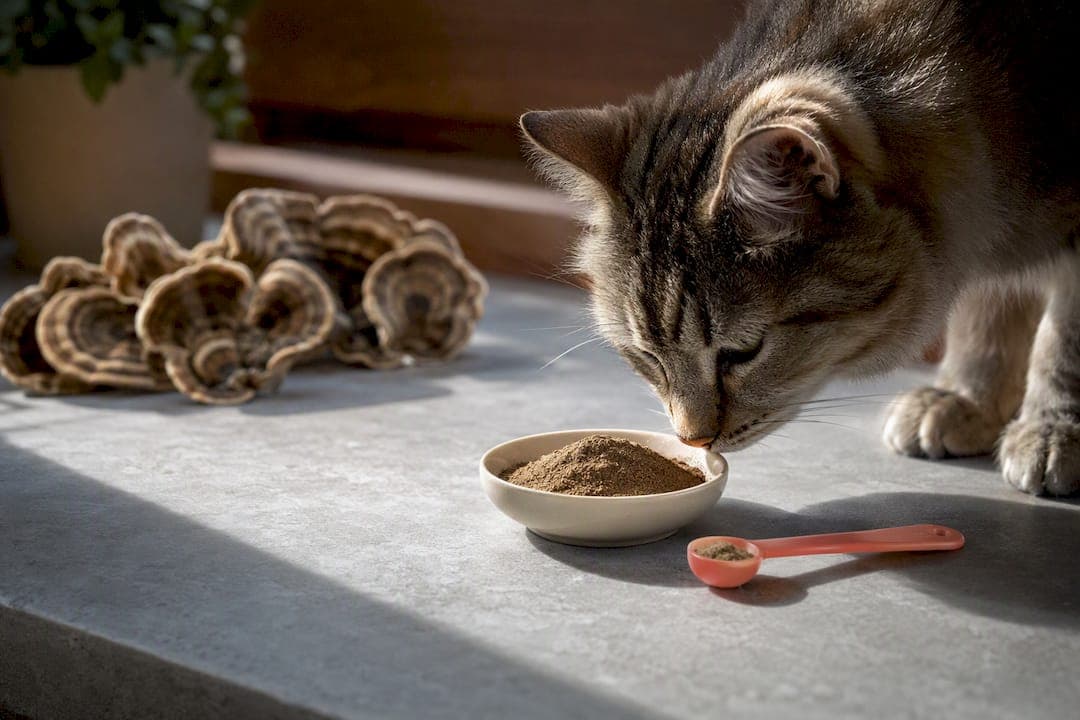
Turkey tail mushroom can be a reasonable option to discuss with your veterinarian as an immune-support add-on, but the evidence in cats specifically is thin, borrowed mostly from lab and rodent studies. It is not a proven treatment for cancer or any feline disease. Before you buy anything, talk to your vet, bring the product label to that appointment, and read on for what the research actually supports, how to dose conservatively, and what to check before you spend money on a supplement.
TL;DR:
- Most research on turkey tail in cats is based on lab or rodent studies, with no clinical trials confirming safe or effective dosing in felines.
- Turkey tail may support immune function as an adjunct during conventional therapy but does not prevent or treat cancer reliably in cats.
- Use only species-specific, well-labeled products with transparent extract ratios and avoid multi-mushroom blends or wild-harvested options.
- Always vet-approve the supplement, start with a low dose, and monitor for adverse effects such as vomiting or lethargy within the first week.
- Avoid products with artificial sweeteners, xylitol, or unverified formulations, especially if your cat is on chemotherapy or immunosuppressants.
Table of Contents
- What the Research Actually Shows About Turkey Tail for Cats
- Benefits and Realistic Expectations
- Safety, Side Effects, and Drug Interactions to Watch For
- How to Choose a Safe Turkey Tail Product for a Cat
- How to Give Turkey Tail to Your Cat Safely
- Powders, Liquid Extracts, and Blends: Which Format Fits a Cat
- Kiblco's Take on Vet-Informed Mushroom Supplements
- Where to Find Vetted Turkey Tail Products for Cats
- Sources
- FAQ
What the Research Actually Shows About Turkey Tail for Cats
Turkey tail (Trametes versicolor) contains two compounds that show up in almost every product pitch: PSK (polysaccharide K) and PSP (polysaccharide peptide), both derived from beta-glucans, the long-chain sugars found in the mushroom's cell walls. In lab and cell-culture studies, beta-glucans appear to interact with immune receptors and may stimulate certain white blood cell activity. That is a real, documented mechanism. It is not the same thing as a proven clinical benefit in a living cat.
Here's the gap most product listings gloss over: most of the supporting research comes from human cell lines, mice, or rats, not cats. A PMC review of medicinal mushroom compounds documents these immune mechanisms clearly, but the underlying studies rely on non-feline models. That explains why the ingredient is biologically plausible. It does not establish that a cat eating turkey tail powder will see the same effect.
Dogs have slightly more to point to. A Veterinary Evidence appraisal of turkey tail use in canine lymphoma looked at case series where the mushroom was used alongside conventional cancer therapy. The finding was cautious: case-series data suggests a possible adjunct role, but the authors were clear that controlled trials are needed before anyone can call it effective. And canine results, however limited, do not transfer automatically to cats. Feline metabolism and immune signaling differ enough from canine that veterinarians treat cross-species extrapolation with real skepticism.
VCA Animal Hospitals puts it plainly: "medicinal mushroom" is a marketing category, not a guarantee of proven medicine. Species differ, some mushrooms are toxic, and evidence in companion animals lags well behind the claims on the bottle.
What this means practically:
- No feline clinical trial has established a standard turkey tail dose for cats.
- PSK and PSP research is strongest in non-feline lab settings, not in live cat outcomes.
- Canine case series hint at a possible supportive role but stop short of proof.
- Marketing language ("boosts immunity," "fights cancer") consistently outpaces what any study has confirmed in cats.
There is no authoritative, cat-specific dosage backed by clinical trials, which is precisely why copying a dog or human dose off a forum post is a bad idea. Whatever the label says for cats, that's the number your vet should sign off on.
Benefits and Realistic Expectations
The most defensible benefit claim is immune modulation, meaning the beta-glucans in turkey tail may nudge certain immune pathways into more active states. Call this a low-to-moderate evidence claim, and mostly borrowed from non-feline research. It is a real biological signal, not a guarantee of a healthier, more resistant cat.
Where turkey tail seems to have the most defensible use is as a possible adjunct during conventional therapy, not a replacement for it. The canine lymphoma case series mentioned earlier looked at turkey tail used alongside chemotherapy, never instead of it. If your vet is managing a chronic illness or supporting your cat through cancer treatment, turkey tail might come up as a supplement worth discussing. It should never be the plan on its own.
A few things worth separating out clearly:
- Supported idea: beta-glucans interact with immune cells in lab and animal models.
- Unsupported idea: turkey tail prevents, cures, or reliably treats cancer in cats.
- Supported idea: some owners and case reports describe cats tolerating the supplement without incident.
- Unsupported idea: anecdotal improvement (more energy, better coat) proves a causal effect rather than coincidence, diet change, or the placebo effect owners experience on behalf of their pet.
Why does the marketing outrun the science so consistently? Partly because "medicinal mushroom" sounds authoritative, and partly because supplement companies aren't required to run the kind of controlled trials a prescription drug needs before it reaches a shelf. That's not necessarily bad faith. It just means the burden of judgment falls on you and your vet, not on the label copy.
Read anecdotal success stories with a healthy dose of caution. A cat that seems brighter after starting a supplement may be responding to something else entirely: a diet tweak, resolved dental pain, or simply the natural waxing and waning of a chronic condition. None of that makes turkey tail worthless. It just means one improved cat isn't evidence, and your vet is better positioned than a product review to tell the difference.
Safety, Side Effects, and Drug Interactions to Watch For
Watch for these signs and stop the supplement immediately if you see them: vomiting, diarrhea, loss of appetite, lethargy, unusual drooling, or any behavior change that doesn't resolve within a day. Call your veterinarian, or a poison-control line, right away if symptoms are severe or persistent.
Two safety issues deserve more attention than they usually get. First, human-formulated or flavored mushroom products sometimes contain ingredients that are fine for people and dangerous for cats, most notably xylitol and alpha-lipoic acid, both of which have turned up in reformulated pet and human supplements. The AVMA has reported that supplement companies change formulations without much warning, and that toxicity risk isn't always easy to catch even for products you've bought before. That's a strong argument for rechecking the label every time you repurchase, not just the first time.
Second, wild-foraged mushrooms are a real hazard. Misidentifying a wild mushroom can expose a cat to toxins that cause severe gastrointestinal, neurologic, liver, or kidney damage, according to poison-control guidance on mushroom toxicity. Never substitute anything foraged for a commercially tested, cat-labeled product.
Interactions matter too. If your cat is on chemotherapy or any immunosuppressive medication, turkey tail's immune-modulating action could theoretically interfere with treatment, which is exactly why you disclose every supplement to your vet before starting, not after.
Pro Tip: Keep the product box or a photo of the full ingredient label on your phone. If you ever need to call poison control or an emergency vet, having the exact formulation on hand saves precious minutes.
Quick reference for red flags:
- Vomiting, diarrhea, or appetite loss lasting more than 24 hours.
- Lethargy or behavior changes that appear within hours of a new dose.
- Any product listing xylitol, alpha-lipoic acid, or artificial sweeteners.
- A cat currently on chemotherapy or immunosuppressants without vet sign-off on the supplement.
How to Choose a Safe Turkey Tail Product for a Cat
Skip anything marketed generically for "pets" or "immune support" without species-specific dosing. A product built for cats will say so on the front label, not bury it in fine print, and will give you a clear milligram-per-pound or drop-count instruction instead of a vague "adjust as needed."
Run through this checklist before you buy:
- Species confirmed on the label. Look for Trametes versicolor named explicitly, not just "turkey tail" or "mushroom blend."
- Part used is disclosed. Fruiting body extracts generally carry higher concentrations of the active polysaccharides than mycelium grown on grain, and a transparent label says which one you're getting.
- Extract ratio is listed. A ratio like 8:1 or 30:1 describes concentration, not proof of potency, but its absence is a red flag for a low-quality product.
- Inactive ingredients are fully listed. Scan for xylitol, alpha-lipoic acid, artificial flavors, or sweeteners, and walk away if you see any.
- Lot number, batch testing, and expiration date are printed. Reputable manufacturers third-party test for contaminants and post the results, or at least reference them.
- Cat-specific dosing instructions exist. If the label only gives a dog or human dose, this isn't the product for your cat.
A few more things worth knowing before you shop:
- Avoid multi-mushroom blends when you're testing tolerance for the first time. If your cat reacts, you won't know which ingredient caused it.
- Skip anything sold as "wild-harvested" with no lab verification; foraged mushrooms carry real misidentification risk.
- Prefer manufacturers that publish contact information and respond to questions about sourcing and testing.
- Marketing ratios like "30:1 concentrate" sound impressive but aren't standardized across brands, so don't use them as your only comparison point.
Kiblco's own cat health category reviews products against exactly this kind of checklist, comparing label transparency and dosing clarity across brands rather than taking marketing claims at face value.
How to Give Turkey Tail to Your Cat Safely
Getting the introduction right matters more than the supplement itself. Here's a conservative protocol most vets would recognize:
- Get veterinary approval first. Bring the exact product and its label to the appointment so your vet can check the extract ratio, inactive ingredients, and interactions with any current medications.
- Start below the label's suggested amount, only if your vet agrees. A cautious starting dose lets you catch a bad reaction before it becomes a serious one.
- Mix it into a small portion of a food your cat already loves. A spoonful of wet food your cat reliably finishes works better than hiding it in a full meal, where a picky cat might just skip eating altogether.
- Watch for four to seven days before increasing anything. Track appetite, stool consistency, energy level, and any behavior shifts in a simple note on your phone.
- Stop immediately and call your vet if you see vomiting, diarrhea, lethargy, or appetite loss. Don't wait to see if it resolves on its own.
If your cat is a chronic supplement-dodger, a treat paste designed for pill-hiding can mask powder or liquid extract far more reliably than crumbling it into dry kibble.
Pro Tip: Dose in the morning rather than at night for the first week. If a reaction does show up, you'll catch it during waking hours instead of discovering a mess (or a sick cat) at 3 a.m.
Powders, Liquid Extracts, and Blends: Which Format Fits a Cat
Powders mix easily into wet food but vary widely in potency between brands, and some cats detect the earthy flavor and refuse the bowl outright. Liquid extracts give you more precise, drop-by-drop dosing, which matters for a small animal where a rounding error is a bigger percentage of body weight, but check every liquid product for added flavoring, since that's where xylitol or artificial sweeteners tend to sneak in.

Multi-mushroom blends create an attribution problem: if your cat reacts, you have no way to know whether turkey tail, reishi, or a filler ingredient caused it. For a first trial, a single-ingredient product beats a blend every time. It's easier to judge tolerance, easier to compare against label claims, and easier to explain to your vet if something goes wrong.
Kiblco's Take on Vet-Informed Mushroom Supplements
We test supplement claims against label transparency and real handling in real homes, not marketing copy. Turkey tail earns a place on the "discuss with your vet" list, not the "buy blindly" list. A conservative approach is recommended: cat-specific dosing, veterinary sign-off, and single-ingredient products that can be verified. Products that hide their extract ratio or part-used detail lose points fast in our reviews, because that opacity is exactly what creates avoidable risk for a small animal with a narrow margin for error.
— Chris
Where to Find Vetted Turkey Tail Products for Cats
Kiblco is the alternative to guessing your way through a shelf of mushroom supplements: our cat health category reviews each product against the same label checklist covered above, so you don't have to decode extract ratios or dig for batch-testing claims on your own.

Some product reviews are based on products purchased and tested in real homes, assessing tolerance, dosing clarity, and label transparency. Reviews may flag vague "proprietary blend" labeling, missing species identification, or added sweeteners as red flags. If you're comparing turkey tail products or looking at other immune or joint support options for your cat, start with our cat health reviews to see which brands actually disclose what's in the jar before you spend a dollar on one.
This article is general information, not a substitute for advice from a qualified doctor. Consult a qualified healthcare professional about your own circumstances before acting on anything here.
Sources
- Medicinal Mushrooms | VCA Animal Hospitals
- Supplements’ toxicity risks not easy to determine as new, reformulated products hit shelves | AVMA
- Veterinary Evidence appraisal of turkey tail adjunct use in canine lymphoma
- PMC article on medicinal mushrooms and bioactive compounds
FAQ
Is Turkey Tail Okay for Cats?
It can be reasonable for some cats when a cat-specific, transparently labeled product is used under veterinary guidance, but feline clinical evidence remains limited. VCA Animal Hospitals notes that most supporting research comes from lab or rodent studies rather than cats, so treat it as a supplement to discuss, not a proven remedy.
What Are the Side Effects of Turkey Tail in Cats?
The most commonly reported issues are mild gastrointestinal upset: vomiting, diarrhea, or reduced appetite, along with occasional lethargy. Stop the supplement and call your vet if any of these signs last more than a day or appear alongside other symptoms.
What Do Vets Say About Turkey Tail?
Veterinarians generally describe turkey tail as biologically plausible but clinically unproven in cats, since most immune-related research relies on non-feline models. VCA's guidance stresses that "medicinal mushroom" is a marketing term, not confirmation of a proven treatment, and that species identification and dosing accuracy matter more than brand claims.
What Should Not Be Mixed With Turkey Tail?
Avoid combining turkey tail with chemotherapy or immunosuppressive drugs without direct veterinary approval, since its immune-modulating action could interfere with treatment. Also avoid any product containing xylitol, alpha-lipoic acid, or artificial sweeteners, ingredients the AVMA has flagged in reformulated supplements.
How Do I Know if a Turkey Tail Product Is High Quality?
Check for Trametes versicolor named specifically, a disclosed fruiting-body or mycelium source, a listed extract ratio, and a visible lot number with batch testing. Kiblco's cat health reviews evaluate exactly these label details before recommending any supplement.