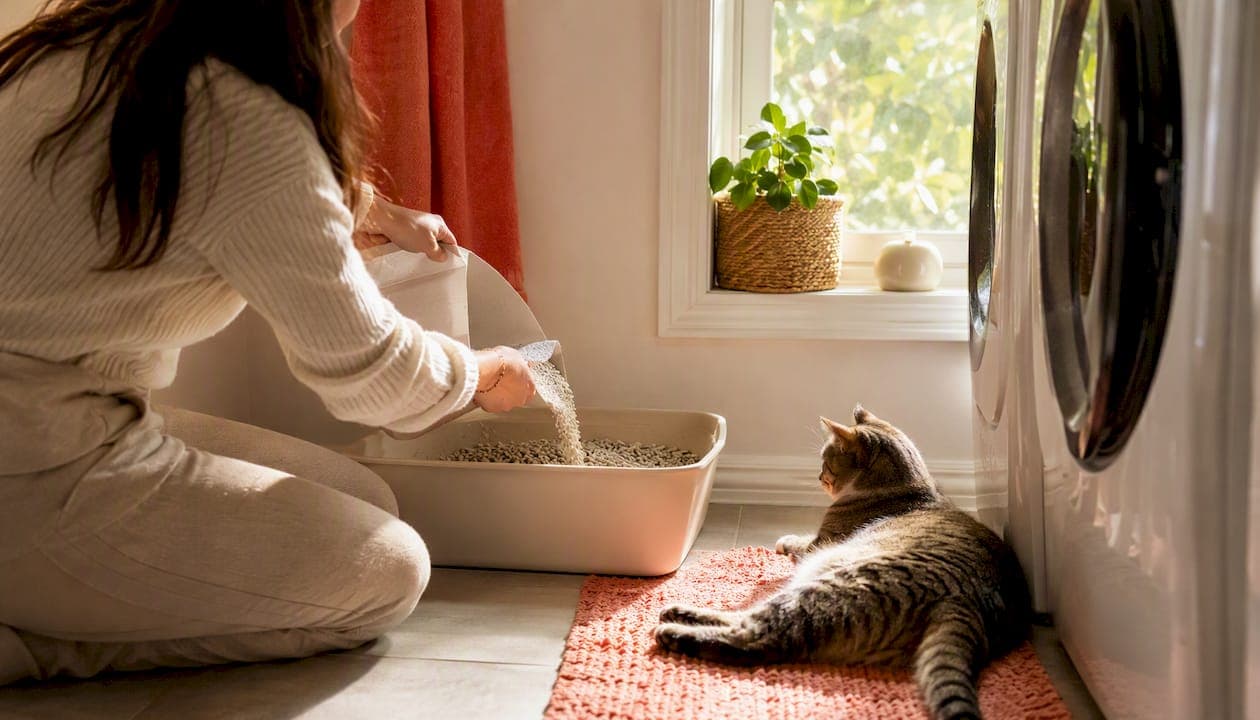
For a cat with asthma, the right litter isn't a preference — it's a medical decision. Go with a truly dust-free, unscented option: silica gel crystals or paper/pellet litters are the safest materials available. Both produce little to no airborne fine particles when poured or disturbed, which is exactly what inflamed feline airways need. Clay and clumping litters, even those labeled "low dust," often fall short for cats with diagnosed respiratory conditions.
Start here before reading further:
- Swap to a silica crystal or paper pellet litter today, and toss any scented litter immediately.
- Move the litter box to a well-ventilated room, away from bedrooms and high-traffic areas.
- If your cat is still coughing, wheezing, or breathing with effort after the switch, call your vet — don't wait it out.
Key Takeaways
Silica gel crystals and paper pellets are the safest litter materials for cats with asthma — both produce minimal airborne particles and contain no added fragrance.
| Point | Details |
|---|---|
| Choose dust-free and unscented | Only "dust-free" and fragrance-free litters reliably protect inflamed feline airways. |
| Best material categories | Silica gel crystals and paper/pellet litters generate the fewest airborne particles. |
| Set up for ventilation | Place the box in a ventilated room, scoop daily, and use a HEPA air purifier nearby. |
| Switch gradually | A 10–14 day transition reduces stress and lets you monitor for respiratory reactions. |
| Call your vet if needed | If breathing doesn't improve within 2–4 weeks of environmental changes, seek veterinary care. |
| Kiblco's role | Kiblco tests litters for visible dust, cat acceptance, and odor control — browse vetted picks at kiblco.com. |
Table of Contents
- Why litter dust and fragrances make feline asthma worse
- Which litter materials are actually safe for cats with asthma?
- How to set up the litter area to reduce airborne triggers
- How to switch litters without stressing your cat
- What to expect after switching: timeline and rough costs
- How Kiblco evaluates litters for asthma safety
- A note from the reviewer
- Kiblco's tested picks for cats with respiratory conditions
- Sources
Why litter dust and fragrances make feline asthma worse
Feline asthma is a chronic inflammatory airway disease. When a cat breathes in fine particulates or volatile compounds, those particles land on already-irritated bronchial tissue and trigger spasms, mucus production, and narrowing of the airways. The smaller the particle, the deeper it travels — which is why the dust from a clay litter pour can cause more damage than visible debris.
According to Cornell University College of Veterinary Medicine, feline asthma affects roughly 1% of domestic cats in the U.S. and litter dust is among the most commonly cited environmental triggers. That's a significant number of cats whose daily bathroom routine is actively worsening their condition.
VCA Animal Hospitals lists the following household triggers to eliminate alongside litter changes:
- Cigarette and candle smoke
- Aerosol sprays (hairspray, air fresheners, cleaning sprays)
- Scented candles and essential oil diffusers
- Carpet cleaners and fabric softener sheets
- Perfumes applied near the cat
Fragrance is a separate problem from dust. Even a litter that produces zero visible dust can still irritate airways if it contains added scents — natural or synthetic. "Unscented" is non-negotiable, not optional.
Which litter materials are actually safe for cats with asthma?
PetMD recommends low-dust, unscented litters for cats with respiratory sensitivity and notes that many clay litters are dustier than alternatives. Here's how the main material categories break down.
Silica gel crystals
Silica gel crystals are large, porous granules that absorb moisture and trap odor without crumbling into fine dust. The granule size is key: unlike fine-particle clay, silica crystals don't generate respirable dust when poured or dug. That said, NIOSH guidance from the CDC confirms that respirable crystalline silica is an inhalation hazard — which is precisely why the large-granule format of silica gel litters is preferred over fine-particle alternatives.
- Respiratory safety: Minimal airborne particles; no visible dust cloud when poured
- Texture/paw comfort: Firm, smooth granules — some cats love it, others need a slow transition
- Maintenance: Crystals change color as they saturate, giving you a useful visual cue for when to change the box
Paper pellets and recycled paper
Compressed paper pellets are made from recycled newspaper or paper pulp. They absorb liquid and swell rather than crumble, which keeps fine particles out of the air. This is one of the most widely recommended formats for cats with respiratory conditions.
- Respiratory safety: Virtually no airborne dust; safe for post-surgical and asthmatic cats
- Texture/paw comfort: Soft and gentle — a good option if your cat has sensitive paws
- Maintenance: Odor control is moderate; daily scooping matters more here than with crystals
Pine and wood pellets
Pine pellets break down into sawdust when wet, which does introduce some fine material. The key is scooping liquid waste before the pellets fully disintegrate. Unscented versions are widely available and the natural wood odor is mild enough that most asthmatic cats tolerate it — though a small number react to pine compounds.
- Respiratory safety: Good when managed well; avoid scented or chemically treated versions
- Texture/paw comfort: Firm pellets that some cats find unfamiliar; a gradual switch helps
- Maintenance: Requires a sifting box or frequent scooping to remove broken-down sawdust
What to avoid
Dusty clay and bentonite clumping litters are the biggest offenders. They produce fine airborne particles during pouring, digging, and scooping. Even products marketed as "99% dust-free" vary widely in practice — reviewer testing observations consistently show that "low-dust" claims don't always hold up when you actually pour the bag. Scented litters of any material are off the table. And fine-grain clumping litters, even plant-based ones, can generate enough airborne particles to be problematic for severe cases.
Pro Tip: Pour new litter slowly into the box outdoors or in a garage, away from your cat. Even the safest litter can kick up a small cloud during the initial fill — let it settle before your cat uses the box.
How to set up the litter area to reduce airborne triggers
Choosing the right material is step one. Where and how you set up the box matters almost as much.
Selection checklist before you buy:
- Confirm the litter is labeled unscented — not "lightly scented" or "natural fragrance."
- Look for "dust-free" rather than "low-dust," especially for cats with diagnosed asthma.
- Check the particle size: larger pellets or crystals are safer than fine-grain formats.
- Choose packaging that lets you pour slowly and with control (avoid bags with wide openings).
Setup steps:
- Place the box in a room with good airflow — a bathroom with a window or a laundry room works well. Avoid closets and enclosed spaces where particles accumulate.
- Skip the covered box if your cat tolerates an open one. Covered boxes trap dust and ammonia inside, concentrating exactly what you're trying to reduce. If your cat insists on privacy, choose a top-entry design over a front-entry hood.
- Put a litter mat directly outside the box to catch tracked particles before they spread through the house.
- Scoop at least once daily. Waste sitting in the box breaks down and releases ammonia and fine particles with every subsequent dig.
- Position a HEPA air purifier within 6–8 feet of the box to capture airborne particles between cleanings.
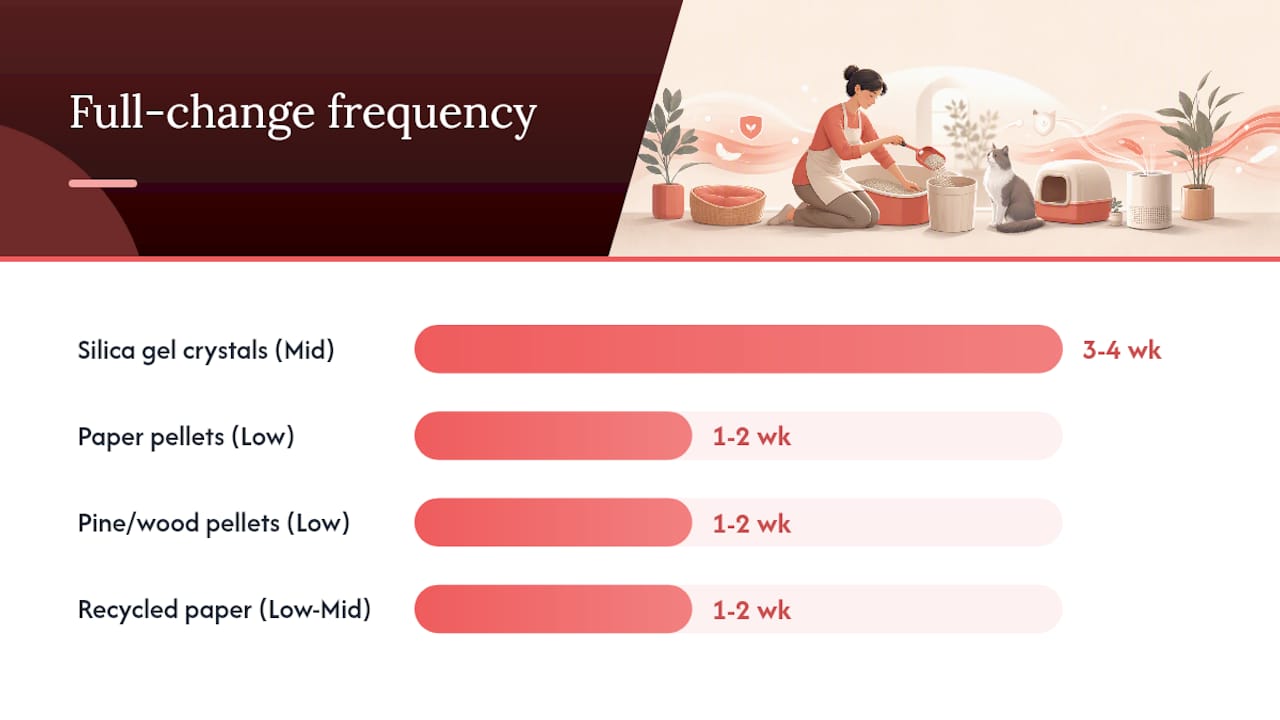
- Do full litter changes on a schedule: every 1–2 weeks for paper pellets, every 3–4 weeks for silica crystals (or when crystals are fully saturated).
For odor between full changes, skip sprays near the box entirely. If you need help managing pet odors elsewhere in the home, odor-eliminating sprays designed for pet spaces are a safer alternative to aerosol air fresheners.
How to switch litters without stressing your cat
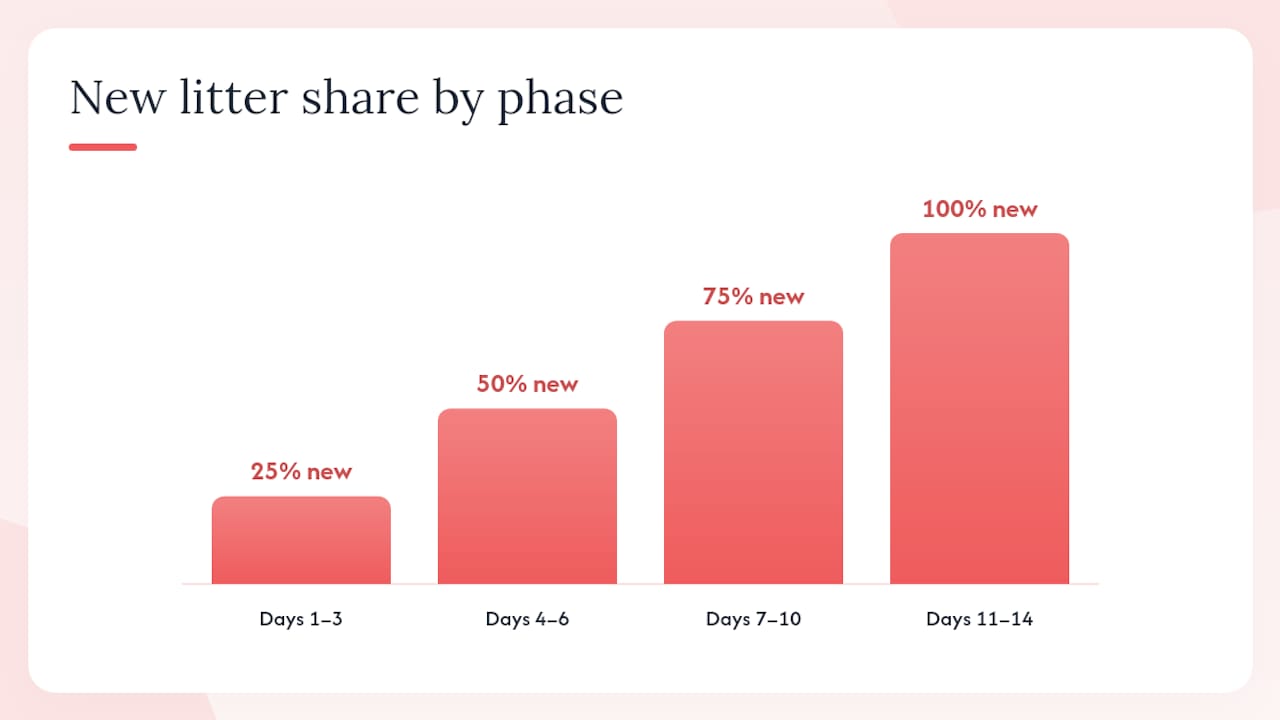
A sudden swap can cause litter box avoidance, which creates its own problems. A gradual transition over 10–14 days gives your cat time to adjust while you monitor for any reaction to the new material.
- Days 1–3: Fill the box with 75% current litter and 25% new litter. Watch for normal use and no new sneezing or coughing.
- Days 4–6: Move to a 50/50 mix. Continue monitoring box use and respiratory symptoms.
- Days 7–10: Shift to 25% old litter and 75% new. At this point, most cats have accepted the texture.
- Days 11–14: Complete the switch to 100% new litter.
Stop and revert to the previous litter if you notice: increased sneezing or coughing, open-mouth breathing, lethargy, reduced appetite, or complete avoidance of the box. Any of those signs warrants a call to your vet, not just a litter change.
In multi-cat households, run the transition in one box at a time while keeping at least one unchanged box available. Cats that share a space don't always share preferences, and a stressed cat avoiding the box creates hygiene problems that worsen air quality.
What to expect after switching: timeline and rough costs
Environmental changes don't replace medical treatment, but they do reduce the frequency and severity of episodes. Here's a realistic picture of what to expect.
Symptom timeline:
- Within hours: Immediate irritant reduction once the dusty litter is gone. If your cat was reacting to a specific litter, you may notice less sneezing the same day.
- Days 1–7: Reduced baseline inflammation as the airway irritant is removed consistently. Coughing episodes may become less frequent.
- Weeks 2–4: Meaningful improvement in cats whose asthma is primarily trigger-driven. Cats with moderate-to-severe asthma will still need veterinary management — inhaled corticosteroids like fluticasone, delivered via a spacer mask, are the primary medical treatment alongside environmental control.
Rough cost ranges (U.S. market):
| Material | Relative cost tier | Full-change frequency | Notes |
|---|---|---|---|
| Paper pellets | Low | Every 1–2 weeks | Widely available; flushable in some formulas |
| Pine/wood pellets | Low | Every 1–2 weeks | Compostable; sifting box recommended |
| Silica gel crystals | Mid | Every 3–4 weeks | Higher upfront, lower ongoing use |
| Recycled paper (loose) | Low–Mid | Every 1–2 weeks | Soft texture; good for post-op cats too |
Multi-cat households go through litter faster regardless of material, so factor that into your budget. Silica crystals often work out cheaper per month for single-cat homes because of their longer change cycle.
How Kiblco evaluates litters for asthma safety
Kiblco's testing process for litters used by cats with respiratory conditions focuses on a few specific signals that matter most for asthma safety.
- Dust observation during pouring: Testers pour each litter into a clean box in a controlled setting and observe for any visible dust cloud. A product that produces visible airborne particles at this stage fails immediately.
- Dust during digging: Simulated digging and scooping reveal whether a litter that pours clean still generates fine particles under use.
- Clump integrity: For any clumping format, testers check whether clumps hold firm or crumble during scooping — crumbling releases the fine particles that make clay litters problematic.
- Cat acceptance and paw comfort: A litter your cat refuses to use is no help at all. Texture acceptance is tracked during the transition period.
- Odor retention without fragrance: Testers confirm that odor control comes from the material's absorption properties, not added scent.
This testing is paired with veterinary guidance on feline asthma triggers. The goal isn't just a clean box — it's a box that doesn't make your cat's airways worse.
For cats with diagnosed asthma, VCA Animal Hospitals recommends environmental control as a core part of management: low-dust litter, removing scented products, and air filtration used together produce better outcomes than any single change alone. If your cat's breathing doesn't improve within two to four weeks of environmental changes, a vet visit is the right next step — not a different litter brand.
A note from the reviewer
Managing a cat's asthma is genuinely stressful. You're making decisions about your pet's health with incomplete information, and the litter aisle doesn't make it easier — every bag claims to be "dust-free." What Kiblco's testing process tries to do is cut through that noise: pour the litter, watch what happens, and report honestly. Owners dealing with an asthmatic cat deserve straight answers, not marketing copy.
Kiblco's tested picks for cats with respiratory conditions
Choosing the right litter is easier when someone has already done the dust-cloud test for you. Kiblco's vetted product guides cover silica crystal, paper pellet, and plant-based litter options — each evaluated for dust generation, cat acceptance, and odor control without fragrance. Every pick comes with transparent pros and cons so you know exactly what you're getting before you buy.

If you're also considering an automatic box to reduce how often the litter is disturbed, Kiblco's automatic litter box guide covers which designs work best with low-dust litters. Browse the full category to find a tested option that fits your cat's needs and your household setup.
Sources
- Feline Asthma: A Risky Business for Many Cats | Cornell University College of Veterinary Medicine
- Asthma and Bronchitis in Cats | VCA Animal Hospitals
- Best litter for cats — PetMD
This article is general information, not a substitute for advice from a qualified doctor. Consult a qualified healthcare professional about your own circumstances before acting on anything here.