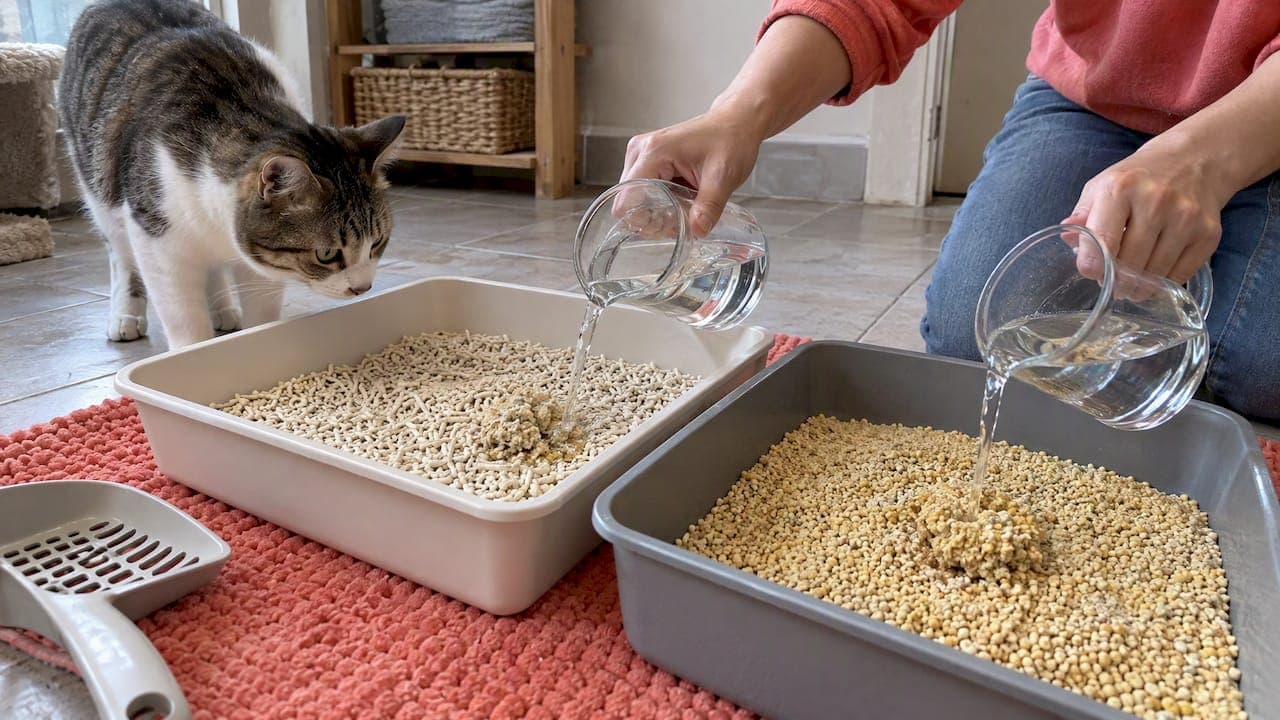
For most homes wanting low dust and low tracking, tofu based litters are a good first try. If you need firmer clumps and higher raw absorbency, a tested corn formula can perform better, but the finished formula matters more than the base crop. Run a short side by side test before committing to a full bag.
TL;DR:
- Compare specific bags by wetting samples, scooping after five minutes, pressing clumps gently, then checking whether they still hold shape after 24 hours.
- Test acceptance with two unscented boxes filled two to three inches deep, and observe use for three to five days while keeping familiar litter available.
- Store corn litter sealed and off damp floors; discard bags that become wet or show mold, since grain products can develop aflatoxin.
- Treat flushable labels cautiously: older plumbing, septic tanks, and some municipal systems can clog, so check local wastewater guidance and bag clumps when uncertain.
- Larger tofu granules and pelleted corn usually create less airborne dust than powder, while higher starch corn formulas tend to produce firmer clumps.
Table of Contents
- What tofu and corn litters are made of
- Clumping performance: what drives clump strength and how to test it
- Odor control and the daily habits that matter more than the bag
- Dust, tracking, and what it means for sensitive households
- Eco claims, disposal, and what flushable really means
- Cat comfort and a simple preference test to run at home
- Storage safety for corn-based litter: what the aflatoxin research says
- A simple 7-day comparison checklist you can run at home
- How to choose between tofu and corn for your home
- What our hands-on testing shows about tofu vs corn
- Balancing performance and sustainability
- Where to find vetted tofu and corn litter picks
- FAQ
- Sources
What tofu and corn litters are made of
Tofu litter starts as okara, the fibrous soy pulp left over from making tofu. Manufacturers dry and press this byproduct into small granules that absorb liquid and bind into clumps. Corn litter starts from ground corn kernels or corn starch, processed into pellets, granules, or a finer meal that reacts with moisture to form clumps.

Both are marketed as plant based alternatives to clay, but the raw material only tells part of the story. What happens after processing, the binders added, the particle size chosen, and how tightly the granules are compacted, shapes how the litter actually performs in a box.
Common formats you will see on shelves:
- Pellets: larger, rounder pieces that resist tracking but sometimes clump less tightly.
- Granules: medium sized grains, the most common form for both tofu and corn, balancing clumping and tracking.
- Powder or fine meal: higher surface area for faster absorption but more dust potential.
A bag labeled "tofu" or "corn" does not guarantee a specific texture or clump strength. Two corn litters from different brands can behave completely differently depending on starch concentration and how the granules are bound together. Reading the ingredient list and particle description on the package tells you more than the headline crop name ever will.
Clumping performance: what drives clump strength and how to test it
Clump strength comes down to chemistry and particle construction, not the plant source alone. Starch acts as the main binding agent in most corn formulas, and higher starch concentration generally produces a firmer, more scoopable clump. Tofu litters rely more on the natural fiber structure of okara, which tends to form a softer clump that still holds together for scooping but may crumble more easily under pressure.
Neither pattern is universal. A corn litter with low starch content can clump weakly, while a well formulated tofu litter with tighter compaction can hold a clump nearly as firm as corn. The only reliable way to know is to test the specific bag in front of you.
Try this three step test at home:
- Scoop test: pour water onto a small pile of litter, wait five minutes, then scoop. Note whether the clump lifts in one piece or breaks apart.
- Press test: gently press the clump between two fingers. A durable clump resists light pressure without crumbling.
- Wet sit test: leave a formed clump in the box for 24 hours, then scoop again. Good formulas hold shape even after extended contact with surrounding litter.
Score each test on a simple scale: solid clump, partial crumble, or full breakdown. Run the same three tests on both a tofu and a corn sample from the same shopping trip for a fair comparison.
Pro Tip: Test with room temperature water, not cold tap water straight from the fridge line, since temperature can slightly affect how fast starch based litters set.
Odor control and the daily habits that matter more than the bag
Both tofu and corn litters absorb urine into their granules, which traps moisture and some odor at the source. What separates a good odor result from a bad one is usually the additive package and your cleaning routine, not the base plant.
Some formulas add baking soda or enzyme blends that break down ammonia compounds as they form. Others rely on fragrance to mask smell temporarily, which can backfire with cats sensitive to scented products and does nothing to address the underlying bacteria. Unscented formulas with active odor-neutralizing ingredients tend to perform more consistently over a full week than heavily perfumed ones.
Daily habits make a bigger difference than brand choice in most households:
- Scoop once or twice daily to remove waste before it sits and off-gasses ammonia.
- Keep one litter box per cat plus one extra, spread across different locations rather than clustered together.
- Do a full litter change and box wash every two to four weeks depending on how many cats share the home.
- Add ventilation, even a cracked window or a small fan near the box, to keep odor from concentrating in one room.
If you are weighing scented versus unscented additives for a multi-cat household, our breakdown of litter deodorizer safety covers which additive types are worth adding and which to skip.
Dust, tracking, and what it means for sensitive households
Dust comes from two main sources: fine particles created during manufacturing and breakage of larger pellets as cats dig and walk through the box. Powder-form litters, regardless of crop, generate the most visible dust cloud when poured. Pelleted corn litters and larger tofu granules tend to produce less airborne dust because there is less surface area exposed to friction.
For households with asthma, allergies, or a cat with respiratory sensitivity, a low-dust formulation is worth prioritizing over other features. Pouring litter slowly and at a low height into the box reduces the initial dust cloud significantly, and keeping the box in a ventilated area limits buildup over time.
- Choose granule or pellet forms over powder if dust is a concern in your home.
- Pour litter gently rather than dumping the bag from height.
- Place a mat under the box to catch tracked granules before they spread to flooring.
- Wear a mask when changing a full box, especially if you have respiratory sensitivity yourself.
Daily scooping also plays a safety role beyond odor. Scooping removes feces before the Toxoplasma parasite becomes infectious, which typically takes one to five days after shedding, so a daily routine lowers that exposure window along with keeping the box cleaner.
If tracking is already a problem in your carpet or flooring, a professional carpet cleaning service can handle deep-set litter dust and stains that regular vacuuming misses. For readers managing a cat with diagnosed respiratory issues, our dedicated guide to dust-free litter for asthma goes deeper into formulation choices.
Eco claims, disposal, and what flushable really means
"Biodegradable" means the material will break down naturally over time, but it says nothing about how fast or under what conditions. "Compostable" is a narrower claim, meaning the material meets specific standards for breaking down in a composting environment, usually one that is actively managed rather than a backyard pile. "Flushable" is the claim that causes the most confusion and the most plumbing calls.
Many plant-based litters are labeled flushable because the base material breaks down in water faster than clay. That does not mean every septic system or municipal sewer line can handle it. Older plumbing, septic tanks, and some municipal systems can clog or back up even with a litter labeled flushable, and the safest approach is checking with your local wastewater provider before flushing anything beyond toilet paper.
Practical guidance for disposal:
- Bag and trash small clumps as the default safe option for any home.
- Compost only in a dedicated outdoor system away from food gardens, never a backyard pile used for vegetables, since cat feces can carry pathogens.
- Avoid flushing unless your specific plumbing and local regulations confirm it is safe.
- Check packaging claims against your own system rather than assuming a flushable label applies universally.
Manufacturing and packaging also factor into the real environmental footprint. A litter that is biodegradable but shipped in heavy plastic packaging from overseas carries a different impact than one processed and bagged closer to where it is sold. Weigh the full picture rather than a single label on the front of the bag.
Cat comfort and a simple preference test to run at home
Cats are particular about where they go to the bathroom, and forcing a litter switch without checking their reaction often backfires into house-soiling. Feline VMA guidance on house-soiling recommends soft, unscented, clumping litters as the safest starting point, along with box setups that give cats real choice rather than a single option.
A straightforward preference test:
- Set up two boxes side by side, one with tofu litter and one with corn litter, both unscented.
- Fill each to about two to three inches deep, the depth most veterinary guidance points to as comfortable for digging and covering.
- Place both boxes in quiet, accessible locations, away from food and noisy appliances.
- Observe for three to five days, noting which box gets used more consistently and whether your cat digs, covers, or lingers in one over the other.
If your cat avoids one litter entirely, scratches at the box edge instead of stepping in, or starts eliminating outside the box, that is a clear signal to switch rather than push through. Veterinary guidance also recommends keeping one box per cat plus one extra, since a shortage of boxes can mask what looks like a litter preference problem but is really a spacing issue.
Pro Tip: Never swap both boxes to a new litter at once; keep one box with the old litter during the trial so your cat always has a familiar fallback.
Storage safety for corn-based litter: what the aflatoxin research says
Corn and other grain-based litters carry a storage consideration that tofu litter does not: aflatoxin, a toxin produced by certain molds that can grow on stored grain. Research from agricultural extension programs shows these fungi thrive in warm temperatures around 77 to 90 degrees Fahrenheit with high humidity, and keeping stored grain moisture below about 15% sharply reduces fungal growth.
This matters most if a bag of corn litter gets wet, stored in a humid garage, or left open for extended periods. Extension factsheets on aflatoxin management describe screening damaged kernels, low-moisture storage, and monitoring as standard practices for anyone handling grain products, and the same logic applies to corn litter stored at home.
Practical steps for corn litter owners:
- Store bags sealed and off the floor, away from damp basements or garages.
- Discard any litter that got wet or shows visible mold or clumping in the bag itself.
- Buy brands that document raw-material testing on their packaging or website rather than ones that stay silent on sourcing.
- Avoid stockpiling large quantities for months at a time; buy what you will use within a reasonable window.
Tofu litter does not carry this same grain-storage risk profile, which is worth factoring in if you live somewhere humid or store litter in a garage rather than a climate-controlled space.
A simple 7-day comparison checklist you can run at home
Before committing to a full case of either litter, a one-week trial with a single bag of each gives you real data specific to your cat and your home.
Shopping checklist before you start:
- Buy one unscented tofu formula and one unscented corn formula, both with clear ingredient lists on the bag.
- Confirm neither has scent additives, since fragrance can skew your cat's preference independent of litter performance.
- Purchase enough of each to fill a full box, not just a sample bag.
Daily tracking items for each litter:
- Rate odor on a simple scale each evening, same time each day.
- Run the clump test every two to three days to check consistency over time, not just on day one.
- Note dust visible when pouring or scooping.
- Count tracked granules on the mat or floor nearby each morning.
- Log your cat's behavior: which box they use, how long they linger, any avoidance signs.
| Day | Tofu notes | Corn notes |
|---|---|---|
| 1 to 2 | Initial dust and odor baseline | Initial dust and odor baseline |
| 3 to 4 | Clump durability recheck | Clump durability recheck |
| 5 to 7 | Cat preference pattern, tracking totals | Cat preference pattern, tracking totals |
By day seven, a clear pattern usually emerges: one litter will show less dust, firmer clumps, or stronger cat preference. That pattern, specific to your home, is more useful than any general claim about tofu versus corn.
How to choose between tofu and corn for your home
Match your decision to the conditions you actually live with rather than general marketing claims.
- If you or a family member has asthma or allergies, prioritize the lowest-dust option, often a larger-granule tofu or pelleted corn formula.
- If you have an older septic system or municipal plumbing with a history of clogs, skip flushing regardless of label and bag everything instead.
- If your cat has rejected litters before, start with a soft, unscented clumping formula as Feline VMA guidance recommends, and run the preference test above.
- If composting matters to you, confirm the specific product is certified compostable rather than assuming from the word "plant-based" on the bag.
When reading labels, check for particle form, any flushability claim and whether it is qualified or unqualified, a statement about raw-material testing, and a full additive list.
Switch litters gradually over seven to ten days by mixing increasing amounts of the new litter into the old rather than swapping all at once, which reduces the odds of a stressed cat avoiding the box. If house-soiling, straining, or any behavior change appears during a switch, stop and check with your veterinarian before continuing, since those signs can also point to a medical issue unrelated to the litter itself.
What our hands-on testing shows about tofu vs corn
Our testing approach pairs real-home trials with veterinary input, tracking the same metrics across every litter we review: dust produced during pouring and scooping, clump durability over 24 to 48 hours, odor control across a full week, and how readily cats in multi-cat households accept each formula.
Across the plant-based litters we have tested:
- Tofu formulas tend to win on dust and tracking, especially larger-granule versions that resist breaking into fine particles.
- Corn formulas with higher starch content tend to win on clump firmness, holding shape better during extended box time.
- Exceptions show up often enough that crop alone is not a reliable predictor; a loosely bound corn litter can underperform a tightly compacted tofu one.
The pattern holds strongly enough to use as a starting point, but it is not a substitute for testing the exact bag you are considering. Our full tofu litter testing notes, covering four brands across clumping, dust, and cat acceptance, go deeper into specific product results if you want more detail before buying.
Balancing performance and sustainability
Neither crop wins outright, and anyone claiming otherwise is selling a label rather than a litter. The honest answer is that formula quality, your cat's personal preference, and your home's plumbing and air quality needs decide this far more than whether the bag says tofu or corn.
My practical bias leans toward starting soft, unscented, and clumping, in line with veterinary guidance, and staying cautious about flushing regardless of what the packaging promises. Test one bag of each before buying in bulk, trust what your cat actually uses, and buy from sources that document their testing rather than relying on marketing claims alone.
— Chris
Where to find vetted tofu and corn litter picks
We test tofu and corn litters in real homes, tracking the same dust, clumping, odor, and cat-acceptance metrics covered throughout this guide, so you do not have to run every test yourself before narrowing down a short list.
Our picks in this space prioritize a few things consistently:
- Low measured dust and documented raw-material testing, not just a claim on the front of the bag.
- Clear testing notes on clumping and odor performance across a full week, not a single-day impression.
Browse our current cat litter picks for the specific tofu and corn formulas that performed best in our testing, each with the pros and cons laid out so you can match a product to your own household priorities.
FAQ
What are the downsides of using tofu litter?
Tofu litter clumps tend to be softer than high-starch corn clumps, which can make scooping slightly messier if the formula is weak. It also typically costs more per bag than traditional clay, and some cats take time adjusting to its lighter texture underfoot.
Do vets recommend tofu cat litter?
Veterinary guidance does not endorse one crop over another by name, but Feline VMA guidance recommends soft, unscented, clumping litters generally, a description many tofu formulas meet well. The better approach is testing specific formulas against your cat's preference rather than choosing by crop alone.
What cat litter should you stay away from?
Avoid heavily scented litters, since fragrance can discourage box use in cats sensitive to strong smells, and avoid any grain-based litter that has gotten wet or shows mold in the bag. Checking for documented raw-material testing on the packaging helps you skip less transparent brands.
What are the downsides of using corn litter for cats?
Corn litter requires careful dry storage because grain products can develop aflatoxin-producing mold in warm, humid conditions, as extension research on stored grain documents. Some corn formulas also produce more dust than larger-granule tofu options, depending on how finely the corn is processed.
Sources
- Aflatoxin facts and management (Extension, University of Missouri)
- Feline VMA — Treatment and management of house-soiling (Feline VMA guidance)
- CDC — Preventing toxoplasmosis
- Aflatoxin producer fact sheet (Kansas State / ASI)