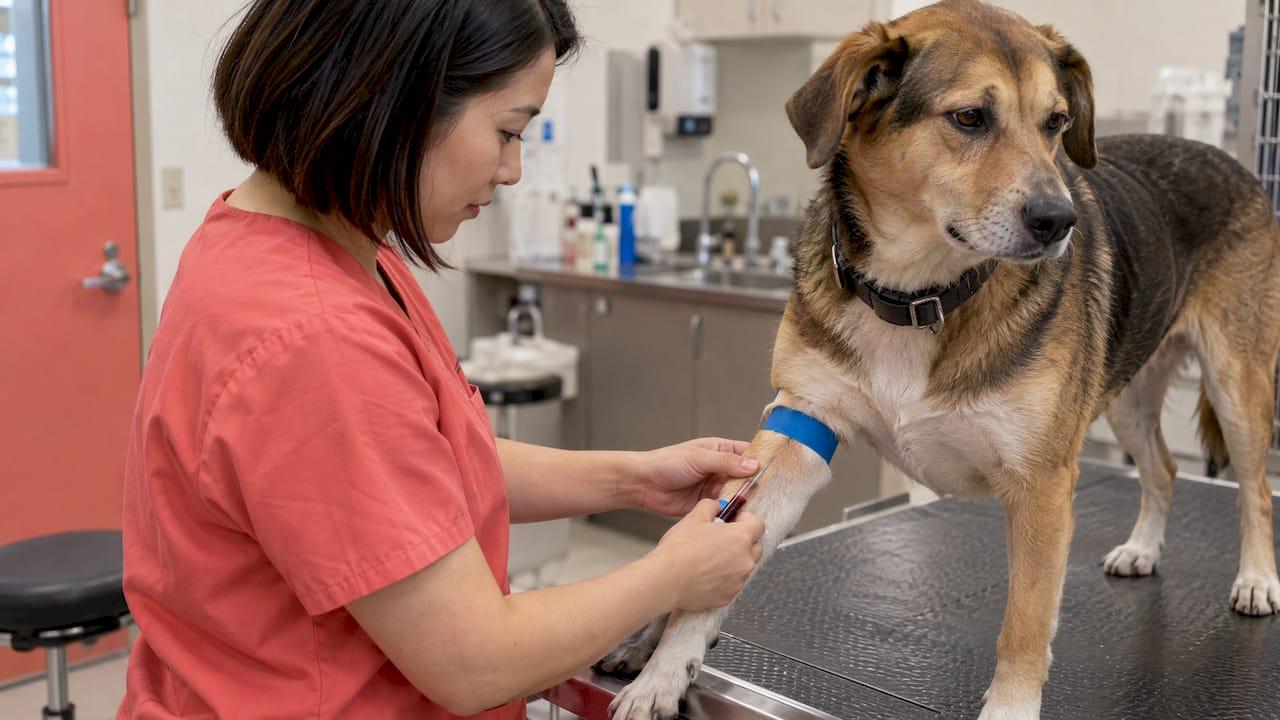
Taurine is an amino acid that supports a dog's heart, eyes, brain and muscles. Most dogs make enough of it from the protein in a complete diet. A supplement makes sense when your vet finds a deficiency, diagnoses a heart condition like dilated cardiomyopathy (DCM), or flags a breed or diet risk. This guide covers what taurine does, who may need more, how vets test for it, what dosing looks like in the clinical literature, and how to pick a product once your vet says yes.
TL;DR
- Taurine is a conditionally essential amino acid in dogs. It is especially concentrated in the heart, retina and brain.
- Dogs build taurine from methionine and cysteine, so many never need extra. Certain breeds and some diets carry more risk.
- Taurine-deficient DCM is the main medical reason for supplementing. Doses used in treatment are set by a vet and followed with blood tests and heart scans.
- Taurine has a wide safety margin, but pet supplements are not reviewed by the FDA before sale. Choose products carefully and tell your vet what you give.
- Don't start high doses on your own if you suspect a heart problem. Coughing, tiring easily or fainting need a vet visit.
Table of Contents
- What taurine does in dogs
- Does your dog need a taurine supplement?
- Signs of taurine deficiency
- How vets test and monitor taurine
- What the evidence says taurine can do
- Taurine dosage for dogs
- Safety, side effects and interactions
- Choosing a taurine supplement with confidence
- Our perspective
- Find vet-informed picks for your dog
- FAQ
- Sources
What taurine does in dogs
Taurine is one of the most abundant free amino acids in canine tissue. A 2026 review in Frontiers in Veterinary Science describes exceptionally high concentrations in the heart muscle, retina and brain. It supports calcium handling in the heart muscle, retinal function and the nervous system.

The same review calls taurine "conditionally essential" in dogs. Dogs can synthesize it from methionine and cysteine, but that capacity varies between dogs. Dietary supplementation is described there as a key strategy for keeping taurine in balance when demand rises.
That is why you will see two statements that sound opposed and are both accurate. The University of Wisconsin School of Veterinary Medicine notes that dogs usually make taurine from dietary precursors, so eating taurine itself is not required. The research on conditionally essential status explains why some dogs still fall short.
Heart, eyes and everything else
The heart is the best-studied target. Taurine-deficient DCM is a condition in which the heart's muscular walls thin and stretch, and the heart pumps blood less efficiently. Taurine also plays a role in eye health: a veterinarian writing for The Vet Desk notes that it helps protect against retinal degeneration.
You will see supplement labels promising support for digestion, energy, kidneys and immunity too. Heart and eye roles have the strongest backing in the sources we reviewed, so treat the rest as a bonus rather than the reason to give it.
Does your dog need a taurine supplement?
For most healthy dogs eating a complete and balanced commercial diet, the answer is that their body handles it. Supplementation becomes a real question in three situations:
- A diagnosis. Your vet finds low whole-blood taurine or DCM.
- A breed predisposition. Your dog belongs to a breed where taurine deficiency shows up more often.
- A diet that raises questions. Your dog eats a boutique, grain-free, vegetarian, vegan or home-prepared diet and your vet wants to check taurine.
The common thread is that the vet makes the call. A blood test tells you something a label cannot.
Breeds that come up most often
The 2018 AVMA Journal review of diet-associated DCM names Golden Retrievers, Cocker Spaniels and Newfoundlands as possibly predisposed. The Vet Desk article extends the list to Labrador Retrievers, Dalmatians and English Bulldogs. If you share your life with one of these breeds, bring it up at the next wellness visit and ask whether a taurine blood test fits your dog.
Diet, grain-free food and the DCM story
In 2018 the FDA began investigating reports linking certain diets to DCM. These were often labeled grain-free and contained high proportions of peas, lentils, other legumes or potatoes. The agency describes the issue as complex and possibly involving several factors. Its testing found similar average taurine, cystine and methionine levels in grain-free and grain-containing products.
The University of Wisconsin adds a useful nuance: most dogs with diet-associated DCM do not have low taurine. So taurine is not the whole explanation, and other features of those diets may contribute. In the Frontiers review, clinicians separate genetic DCM, which may show low blood taurine, from diet-associated DCM, which can occur with normal or only mildly low taurine.
What this means in practice:
- Don't assume a taurine supplement makes any diet safe.
- If your dog has been diagnosed with DCM, your vet will look at the diet and may ask for a taurine blood test.
- If you feed a grain-free, vegetarian, vegan or home-prepared diet, talk to your vet about it. The AVMA review advises measuring plasma and whole-blood taurine in dogs with DCM on those diets, and consulting a board-certified veterinary nutritionist when a home-prepared diet is needed.
One research note on why labels can mislead: a 2018 paper on pulse ingredients points out that AAFCO amino acid recommendations rest on total content. They do not account for how well the dog digests and absorbs those amino acids, which may reduce what is actually available, sulfur amino acids included.
Signs of taurine deficiency
Deficiency often develops quietly, and the signs overlap with other heart and eye conditions. Watch for:
- Tiring quickly on walks or losing interest in play
- Coughing, fast breathing or labored breathing at rest
- Fainting or collapse
- Reduced appetite or visible weight loss
- Changes in vision
None of these proves a taurine problem. Every one of them deserves a vet visit, and the breathing and fainting signs are urgent. Don't try to treat them at home with a supplement.
How vets test and monitor taurine
The preferred test is whole-blood taurine. MSPCA-Angell's clinical guidance notes that whole-blood levels are a more accurate indicator of long-term taurine status than plasma levels, which can swing in the short term. That guidance also recommends rechecking whole-blood taurine and doing an echocardiogram three months after supplementation begins.
That pairing matters. The blood number shows whether the supplement is raising taurine. The echocardiogram shows what the heart is doing. VCA Animal Hospitals also says veterinarians may reassess the dog and monitor whole-blood taurine to confirm the supplement works and is not causing side effects.
What the evidence says taurine can do
The best evidence is in dogs with taurine-deficient DCM:
- In a study of Golden Retrievers with taurine-deficient DCM, supplementation along with a diet change was associated with significant improvement in echocardiographic measures.
- The Morris Animal Foundation reports that taurine supplementation often reverses heart muscle abnormalities from DCM secondary to taurine deficiency, and that many dogs can be weaned off heart medications.
Those results apply to dogs with a confirmed deficiency, under veterinary care. They are not a promise for a healthy dog taking a daily scoop.
Taurine dosage for dogs
Here is the honest answer: the doses in the literature are treatment doses for diagnosed DCM, and a vet sets them.
MSPCA-Angell's guidance for DCM lists 500 to 1,000 mg by mouth two to three times daily for dogs under 25 kg (about 55 lb). For dogs over 25 kg it lists 1 to 2 g by mouth two or three times daily. In the Golden Retriever study above, the median dose was 1,500 mg orally twice daily.
| Dog size | Dose in MSPCA-Angell guidance for DCM | Given |
|---|---|---|
| Under 25 kg (55 lb) | 500 to 1,000 mg | 2 to 3 times daily |
| Over 25 kg (55 lb) | 1 to 2 g | 2 to 3 times daily |
These are clinical figures, not a maintenance dose for a healthy pet. Your vet adjusts for your dog's weight, diagnosis and test results. If a product label gives a smaller general-wellness amount, that is a different use, and the same rule applies: run it by your vet first.
Practical tips for giving it
- Use the right form. Powder can be mixed into wet food. Capsules and chewables work for dogs that eat them readily. Ask your vet which suits the dose.
- Keep a log. Write down the product, dose and start date. You will want it at the recheck.
- Don't stack products blindly. Many heart-support supplements combine taurine with L-carnitine, CoQ10 or omega-3s. Tell your vet exactly what is in each.
- Keep the recheck. The three-month blood test and echocardiogram are how you know it is working.
Safety, side effects and interactions
Taurine has a strong safety record in the sources we reviewed. VCA lists mild vomiting as a possible effect, notes that serious allergic reactions are rare, and reports no documented drug interactions. It still advises telling your vet about every medication and supplement your dog takes. That matters most for dogs already on heart medication.
A widely quoted figure, from a veterinarian in Daily Paws, puts acute toxicity at 5 g/kg of body weight. By that estimate a 30 kg Labrador would need to swallow about 150 g to be at risk. That is a wide margin, but it is not a license to guess at doses. If your dog gets into a whole bottle, call your vet or a pet poison hotline.
Choosing a taurine supplement with confidence
The FDA does not review non-drug pet supplements for safety or effectiveness before they are sold, according to VCA. A veterinary specialty practice makes the same point about quality control. That makes your own label reading more important.
There is reassuring older data. A 2009 JAVMA study of commercial taurine products found 10 of 11 within 10% of the labeled amount, with no substantial mercury, arsenic or selenium contamination. It is a snapshot of products from that time, so use it as encouragement to look for quality signals, not as a guarantee about any product on the shelf today.
Our checklist when we look at a taurine product:
- Clear amount per serving. The label states milligrams of taurine per scoop, capsule or chew, not a vague "blend."
- Few extras. A plain taurine powder or capsule is easier to dose than a multi-ingredient chew, especially if your vet gives you a specific number.
- Batch testing. Look for third-party testing or a certificate of analysis the company shares.
- Quality seals and transparent manufacturing. A named manufacturer and lot number make recalls and questions easier to handle.
- A form your dog will take. A dose that ends up on the floor does nothing.
- No unproven claims. Be wary of products that promise to cure heart disease.
Taurine is also an ingredient in some complete diets. The USDA added taurine to the National List of allowed substances for organic pet food, effective March 21, 2025. If you are shopping for food, check the label and ask your vet whether the formula suits your dog's breed and health.
If you share your home with a cat, the picture is different, because cats cannot make enough taurine and must get it from food. We cover that in taurine for cats.
Our perspective
We review pet products the way we would want someone to review them for our own dogs: we buy them, use them at home, and write down the downsides as plainly as the upsides.
Taurine is a good example of why that matters. The science supports it for a specific job, helping dogs with confirmed taurine-deficient heart disease. It does not support a blanket "every dog needs it" message, and a bottle with a heart on the label tells you nothing about what is inside.
Our approach is to cross-check health picks with veterinary input, then compare products on the things you can verify: amount per serving, ingredient list, form, and how easily a dog accepts it. When a product earns a spot in our health reviews, you will see the pros and cons next to it.
If your vet recommends taurine, a well-chosen product and a steady routine are what turn that advice into results. That is where we try to save you time.
Chris
Find vet-informed picks for your dog
Once your vet has given you a plan, you can compare products without wading through hundreds of listings. Our Dog Health reviews cover supplements and treats tested in real homes, with pros and cons spelled out and affiliate relationships disclosed.

Bring your vet's dose and form to the comparison. You will be able to check quickly whether a product's amount per serving fits. Browsing for other supplement topics? Our guides on MSM for dogs and spirulina for dogs follow the same vet-first approach.
FAQ
What does taurine do for dogs?
Taurine supports the heart muscle, retina, brain and nervous system. It is highly concentrated in those tissues. Dogs make it from methionine and cysteine in their food, and some dogs need extra because of genetics, diet or disease.
What are the side effects of taurine in dogs?
Mild vomiting is the main reported effect, and serious allergic reactions are rare, according to VCA. No drug interactions are documented, but tell your vet about any medications and supplements. If your dog vomits repeatedly or seems unwell after starting it, call your vet.
Which dog breeds need more taurine?
Golden Retrievers, Cocker Spaniels and Newfoundlands are the breeds most often named in veterinary literature. Some sources add Labrador Retrievers, Dalmatians and English Bulldogs. Being one of these breeds does not mean your dog is deficient. Ask your vet about a whole-blood taurine test.
What are the symptoms of taurine deficiency in dogs?
Look for fatigue, coughing, fast or labored breathing, fainting, reduced appetite, weight loss and vision changes. These signs overlap with many other conditions. A vet needs to confirm the cause with an exam, blood test and often a heart scan.
Can I give my dog taurine without a vet's approval?
Taurine has a wide safety margin, but the right amount depends on your dog's size, diet and health. Doses in the clinical literature are for diagnosed DCM, and monitoring includes blood tests and an echocardiogram. Get your vet's guidance first so you treat the right problem.
Sources
- Frontiers in Veterinary Science: Taurine in canine physiology and metabolism
- University of Wisconsin School of Veterinary Medicine: Diet-Associated Cardiac Disease in Dogs
- The Vet Desk: Taurine for Dogs
- JAVMA: Diet-associated dilated cardiomyopathy in dogs
- FDA: Investigation into potential link between certain diets and canine dilated cardiomyopathy
- Special topic: The association between pulse ingredients and canine DCM
- MSPCA-Angell: What is New with Taurine?
- VCA Animal Hospitals: Taurine
- Taurine deficiency and dilated cardiomyopathy in golden retrievers
- Morris Animal Foundation: Understanding Taurine for Dogs and Heart Disease
- Daily Paws: What You Should Know About Taurine Supplements for Dogs
- Vetspecialists.com: Dietary Supplements in Dogs and Cats with Heart Disease
- JAVMA 2009: Composition, disintegrative properties, and labeling of taurine products
- USDA Agricultural Marketing Service: Taurine