
Curcumin, the active compound in turmeric, can genuinely help some dogs manage inflammation and joint discomfort, but only when it's delivered in a form your dog can actually absorb. Plain turmeric powder sprinkled on kibble almost never gets there. Before starting any curcumin product, talk to your veterinarian, especially if your dog takes other medications, has a bleeding disorder, or has gallbladder disease.
TL;DR:
- The most promising evidence for curcumin in dogs comes from a 2026 trial showing pain and mobility improvements with a standardized turmerosaccharide extract at 300 mg per 20 kg daily over 42 days.
- Ordinary kitchen turmeric powder provides only tiny, inconsistent curcumin doses and has poor absorption without specialized delivery systems like liposomal or phytosome formulations.
- Forms enhanced for bioavailability, especially those with piperine, may cause drug interactions in dogs on medications metabolized by the liver, so veterinarian guidance is essential.
- Commercial curcumin products with clear curcuminoid content and proven delivery mechanisms offer more reliable dosing and absorption than unstandardized supplements or homemade golden paste.
- Veterinary research in dogs remains limited and short-term, so owners should see curcumin as a supportive, rather than primary, treatment for joint issues, and pair it with comprehensive care.
Table of Contents
- What the Science Actually Says About Turmeric for Dogs
- Why Kitchen Turmeric Doesn't Work the Way People Think
- How Much Turmeric Should You Give Your Dog?
- Turmeric Safety for Dogs: What Can Go Wrong
- Choosing a Turmeric Supplement That Actually Delivers
- What the Key Studies on Turmeric for Dogs Actually Show
- Why Kiblco Treats Curcumin Products Differently Than Most Review Sites
- Find Vetted Turmeric and Joint Supplements Through Kiblco
- Sources
What the Science Actually Says About Turmeric for Dogs
The honest answer is promising, but thinner than the marketing suggests. Most of what gets cited as "turmeric benefits for dogs" comes from cell studies, rodent models, or human trials, and only a handful of studies have tested curcumin directly in dogs with real joint disease.
That gap matters. Curcumin's anti-inflammatory activity is well documented at the molecular level. It interferes with NF-κB signaling and suppresses COX-2 activity, the same inflammatory pathway that NSAIDs like carprofen target, and it acts as an antioxidant by neutralizing free radicals that contribute to tissue damage. That mechanism is real and well characterized in research comparing curcumin's health-promoting properties in humans versus dogs. Mechanism, though, is not the same thing as proof that a dog with hip arthritis will limp less after eight weeks on a supplement.
The canine evidence, while limited, has gotten more encouraging recently. A randomized trial using a standardized turmerosaccharide-rich Curcuma longa extract dosed at 300 mg per 20 kg of body weight once daily found meaningful improvements in pain scores and weight-bearing in dogs with osteoarthritis over 42 days, with no major adverse events and results that compared favorably to glucosamine and chondroitin, according to a 2026 trial published on PubMed. That's about as clean a signal as this ingredient has produced in dogs to date.
Other trials complicate the picture rather than confirm it. A three month randomized, placebo-controlled study using a curcuminoid-phosphatidylcholine combination reported reduced pain on manipulation, which sounds like a win, but the objective gait analysis results came back mixed, according to the trial published in BMC Veterinary Research. And because the product combined curcumin with a phospholipid delivery system, researchers couldn't cleanly separate what curcumin did on its own from what the combination did as a whole. That's a recurring problem in this field: most positive canine trials test blended formulas, not curcumin in isolation, so attributing the benefit to "turmeric" specifically is often an oversimplification.
Here's a comparison that puts turmeric's evidence base in perspective:
- Omega-3 fatty acids have more consistent, better-replicated analgesic evidence for canine osteoarthritis across multiple meta-analyses than curcumin does, according to a 2023 review in the International Journal of Molecular Sciences.
- Curcumin shows directional improvement in some trials, particularly newer ones using enhanced-absorption extracts, but the evidence base is smaller and more mixed.
- NSAIDs remain the most studied and most reliably effective pharmaceutical option for canine joint pain, with a much larger body of veterinary trial data behind them.
None of that means skip turmeric. It means think of curcumin as a supporting player, not the star. Skin and coat benefits and dental applications get discussed online but rest on even thinner canine-specific data, mostly extrapolated from its antioxidant and anti-inflammatory properties rather than direct trials in dogs with skin conditions.
Quick fact: a landmark canine trial used 300 mg of turmerosaccharide extract per 20 kg of body weight daily and showed measurable pain and mobility improvement in six weeks, a rare case of a single-ingredient curcumin product (not a blend) producing a clear result in dogs.
The practical takeaway: curcumin has real anti-inflammatory activity and a growing base of canine-specific trial data behind it. Treat claims about coat shine, dental health, or "immune support" with more skepticism than claims about joint inflammation, where the trial data is more established.
Why Kitchen Turmeric Doesn't Work the Way People Think
Here's the detail that changes everything about how you shop for a turmeric product: curcumin is only one of several curcuminoids in turmeric, and turmeric itself is a poor vehicle for delivering it.
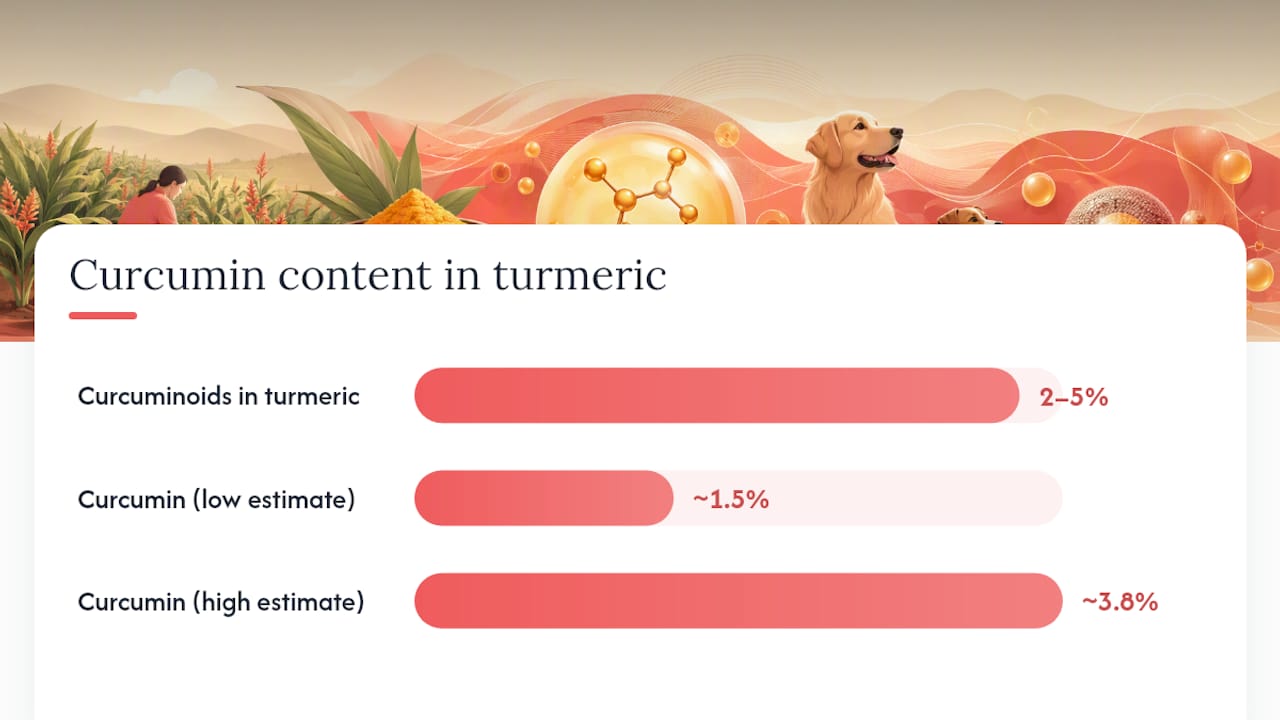
Culinary turmeric powder, the stuff in your spice rack, contains only about 2 to 5% curcuminoids by weight, and curcumin makes up roughly 75% of that curcuminoid fraction, according to a detailed breakdown of turmeric and curcumin dosing for dogs. Do the math and a teaspoon of turmeric delivers a genuinely tiny curcumin dose, nowhere close to what clinical trials use. This is why Purina's own guidance notes that turmeric mixed into commercial kibble is unlikely to produce any therapeutic effect at the concentrations typically present.
Even if you got a concentrated curcumin extract, a second problem shows up: absorption. Curcumin is poorly soluble in water, and whatever does get absorbed through the gut gets rapidly broken down by the liver through a process called glucuronidation before it reaches meaningful blood levels. Oral curcumin, in its plain form, has famously low bioavailability. This is not a dog-specific quirk. It's the same reason human curcumin supplements went through a similar formulation evolution over the past two decades.
Supplement makers have developed several workarounds:
- Piperine (black pepper extract) inhibits the liver enzymes that break curcumin down, and has increased curcumin bioavailability up to 20-fold in some human studies, per the same PMC review on curcumin pharmacology.
- Fat-based delivery takes advantage of curcumin's fat solubility, since pairing it with oil during preparation improves how much gets absorbed through the gut.
- Phytosome and liposomal formulations wrap curcumin in a phospholipid shell, improving absorption without piperine's broad enzyme-inhibiting side effects.
- Cyclodextrin complexes and micronization shrink curcumin particles or bind them to carrier molecules, increasing solubility and surface area for absorption.
The piperine caveat deserves its own callout, because it's the enhancement strategy most likely to cause a problem you didn't see coming.
Pro Tip: If your dog takes any prescription medication metabolized by the liver, ask your vet whether a piperine-enhanced curcumin product is appropriate. Piperine inhibits the same hepatic enzymes (cytochrome P450 pathways) that process many drugs, which can raise blood levels of those medications unpredictably. Phytosome-based products sidestep this risk because they improve absorption through a physical delivery mechanism rather than enzyme inhibition.
The practical lesson: a product boasting "500 mg turmeric" tells you almost nothing useful. A product listing "100 mg standardized curcuminoids in a phytosome complex" tells you what you're actually getting and how it's designed to reach your dog's bloodstream.
How Much Turmeric Should You Give Your Dog?
Dosing depends entirely on the formulation, which is exactly why generic "turmeric dosage" charts you find online are often misleading. A dose that works for a piperine-enhanced extract will be wrong for a phytosome product, and both will be wrong for plain turmeric powder.
Veterinary guidance and published trial data point to a few workable reference ranges, though your veterinarian should confirm the right choice for your dog's weight, health history, and current medications.
| Formulation | Typical Dosing Reference | Notes |
|---|---|---|
| Standardized curcumin extract (turmerosaccharide-rich) | ~300 mg per 20 kg body weight, once daily | Based on the dosing used in the 2026 osteoarthritis trial; well tolerated over 42 days |
| Piperine-enhanced curcumin supplement | Follow product label; typically formulated for small-to-large breed ranges | Confirm no interacting medications before use |
| Phytosome/liposomal curcumin | Follow product label; often lower mg dose due to higher absorption | Preferred for dogs on multiple medications |
| Golden paste (DIY) | No standardized dose; content varies batch to batch | Not recommended for precise dosing; see recipe caveats below |
Golden paste is the most popular DIY approach, and it does work better than dry turmeric powder alone, since heating turmeric with oil and black pepper improves absorption mechanisms compared with sprinkling raw powder on food. The typical recipe simmers turmeric powder with water into a paste, then mixes in a carrier oil (coconut oil is common) and a pinch of black pepper for its piperine content.
The catch: home-cooked golden paste has no standardized curcuminoid measurement. Turmeric potency varies by brand and batch, cooking time affects extraction, and there's no way to know exactly how many milligrams of curcumin your dog is actually getting from one batch to the next. If you want predictable dosing, especially for a therapeutic goal like osteoarthritis, a standardized commercial product beats a kitchen recipe every time.
If you and your veterinarian decide to try a curcumin supplement, a cautious rollout looks like this:
- Start at half the labeled dose for the first three to five days to watch for gastrointestinal upset.
- Split the full dose into two feedings (morning and evening) rather than one large dose, which tends to reduce stomach irritation.
- Give it with a meal, since fat from food improves curcumin absorption regardless of formulation.
- Track symptoms weekly using a simple mobility or comfort log, since curcumin's effects, when present, generally build gradually.
- Expect four to eight weeks before judging whether it's helping. Clinical improvements in the trials cited above didn't show up overnight, and neither will they in your living room.
Don't escalate the dose early because you don't see results in the first week. Pairing curcumin with other evidence-backed supports, like omega-3 fatty acids or weight management for overweight dogs with joint stress, tends to produce better outcomes than curcumin alone, according to guidance from VitaDog's veterinary-reviewed overview.
Turmeric Safety for Dogs: What Can Go Wrong
Turmeric is generally well tolerated in dogs at appropriate doses, but "generally safe" is not the same as "safe for every dog in every situation." A handful of side effects and contraindications deserve real attention before you start.
Common, usually mild side effects:
- Gastrointestinal upset (loose stool, gas, or reduced appetite), typically resolved by lowering the dose or giving it with food
- Yellowish stool discoloration from the pigment itself, which is harmless but can alarm owners unfamiliar with it
- Rare allergic reactions (itching, hives) in dogs sensitive to turmeric or black pepper
Contraindications that should stop you from starting without veterinary guidance:
- Bleeding disorders. Curcumin has mild antiplatelet activity and may prolong bleeding time, according to Chewy's veterinary-reviewed guidance. Dogs with clotting disorders, or those scheduled for surgery, should avoid curcumin unless a veterinarian clears it.
- Gallbladder disease. Curcumin stimulates bile production and contraction of the gallbladder, which can worsen gallstones or biliary obstruction in dogs with existing gallbladder problems.
- Oxalate urolithiasis. Turmeric contains oxalates, and dogs prone to calcium oxalate bladder stones may face increased risk with regular high-dose supplementation.
- Pregnancy and nursing. There's insufficient safety data in pregnant or lactating dogs, so most veterinary sources recommend avoiding supplementation during these periods.
Drug interaction risks worth flagging to your vet:
- NSAIDs (carprofen, meloxicam, deracoxib): combining with curcumin may theoretically compound gastrointestinal or bleeding risk, since both affect similar inflammatory pathways.
- Anticoagulants (like clopidogrel, if your dog is on one): curcumin's antiplatelet effect can add to bleeding risk when stacked with a blood thinner.
- Medications metabolized by the liver: piperine-enhanced curcumin products can slow the breakdown of other drugs by inhibiting hepatic enzymes, potentially raising blood levels of those medications unpredictably.
A one-line stat worth remembering: the 2026 canine osteoarthritis trial using 300 mg per 20 kg of turmerosaccharide extract reported no major adverse events over 42 days, which is reassuring, but it's a single trial with roughly 20 dogs, not a large-scale safety database.
If your dog is scheduled for any surgical procedure, tell your veterinarian about curcumin supplementation at least a week or two ahead of time, since the bleeding-risk concern applies to elective and emergency surgery alike. Stop the supplement and call your veterinarian promptly if you notice unusual bruising, blood in urine or stool, persistent vomiting, or signs of abdominal pain, which could indicate a gallbladder issue.
Choosing a Turmeric Supplement That Actually Delivers
Most turmeric products for dogs fail before the dog even takes the first dose, because the label doesn't tell you enough to judge whether it will work.
Here's what to look for before adding anything to your cart:
- Standardized curcuminoid content in milligrams, not just "turmeric root powder" listed by weight. A product should tell you how many milligrams of curcuminoids (ideally curcumin specifically) are in each serving.
- Named delivery technology. Look for "phytosome," "liposomal," "piperine-enhanced," or a similar bioavailability claim backed by an actual mechanism, not just marketing language like "enhanced absorption."
- Weight-based dosing instructions, ideally with separate guidance for small, medium, and large breeds rather than a one-size-fits-all scoop.
- Third-party testing or a certificate of analysis confirming the curcuminoid content matches the label.
- No xylitol or other dog-toxic excipients, which occasionally sneak into flavored chews marketed for pets.
On price: a phytosome or liposomal product will usually cost more per serving than a plain turmeric powder capsule, and that price gap often reflects real formulation cost rather than markup. Given how much bioavailability differs between an unenhanced powder and an engineered delivery system, paying more for the version your dog can actually absorb is usually the better value, not the more expensive mistake.
Red flags worth walking away from: labels that only list "turmeric extract" without a curcuminoid percentage, dosing charts clearly copied from a human supplement, or any product implying it treats or cures a diagnosed condition rather than supporting comfort or mobility. For dogs already managing joint issues, it's worth comparing curcumin products against the broader field of joint supplements built for senior dogs, since some combine curcumin with glucosamine or omega-3s in a single formulation.
Before buying, ask your veterinarian: does my dog's current medication list create any interaction risk, is my dog's weight and health history a good fit for this specific formulation, and how long should we trial it before deciding whether it's working.
What the Key Studies on Turmeric for Dogs Actually Show
Reading past the headline claims matters here, because a lot of what circulates about turmeric for dogs traces back to a small number of studies, each with its own limitations worth understanding.
- The 2026 turmerosaccharide osteoarthritis trial used a single-ingredient standardized extract, not a blend, at 300 mg per 20 kg daily for 42 days in roughly 20 dogs, and found improved pain scores and weight-bearing compared to glucosamine and chondroitin. Its strength is isolating curcumin's effect; its limitation is sample size and a relatively short follow-up window, per the study on PubMed.
- The Comblain et al. trial in BMC Veterinary Research ran three months, was randomized and placebo-controlled, and reported reduced pain on manipulation but mixed objective gait results. Its main limitation is the combination formulation (curcuminoid plus phosphatidylcholine), which makes it impossible to know how much of the benefit came from curcumin alone versus the delivery compound, according to the published trial.
- The PMC review on curcumin pharmacology in humans versus dogs isn't a clinical trial at all, but a mechanistic and pharmacokinetic analysis explaining why bioavailability enhancement matters and flagging piperine's drug interaction profile, based on the full review.
- Omega-3 meta-analyses, by comparison, draw on a larger and more consistent body of canine trial data for joint pain, which is part of why veterinary guidance often frames curcumin as an add-on rather than a replacement, per the 2023 molecular sciences review.
The pattern across all of this: canine-specific curcumin research is real but young, disproportionately reliant on combination products, and short on large, long-term trials. That doesn't invalidate the positive signals. It means owners should treat curcumin as one part of a joint-support plan, expect modest and gradual effects rather than dramatic ones, and stay skeptical of any product or article claiming curcumin alone is a proven cure for canine arthritis.
Why Kiblco Treats Curcumin Products Differently Than Most Review Sites
Most turmeric supplement reviews rank products by star rating and ignore the one variable that actually determines whether the product works: what happens to curcumin after it hits your dog's stomach.
Kiblco's approach starts from the pharmacology, not the packaging. When we evaluate a curcumin product, the first question is whether the label discloses standardized curcuminoid content in milligrams, because a supplement that only lists "turmeric root" by weight tells you nothing about dose. The second question is what bioavailability technology, if any, the product uses. A phytosome-based capsule and a plain turmeric powder capsule can carry the same headline "turmeric" claim while delivering wildly different amounts of usable curcumin.
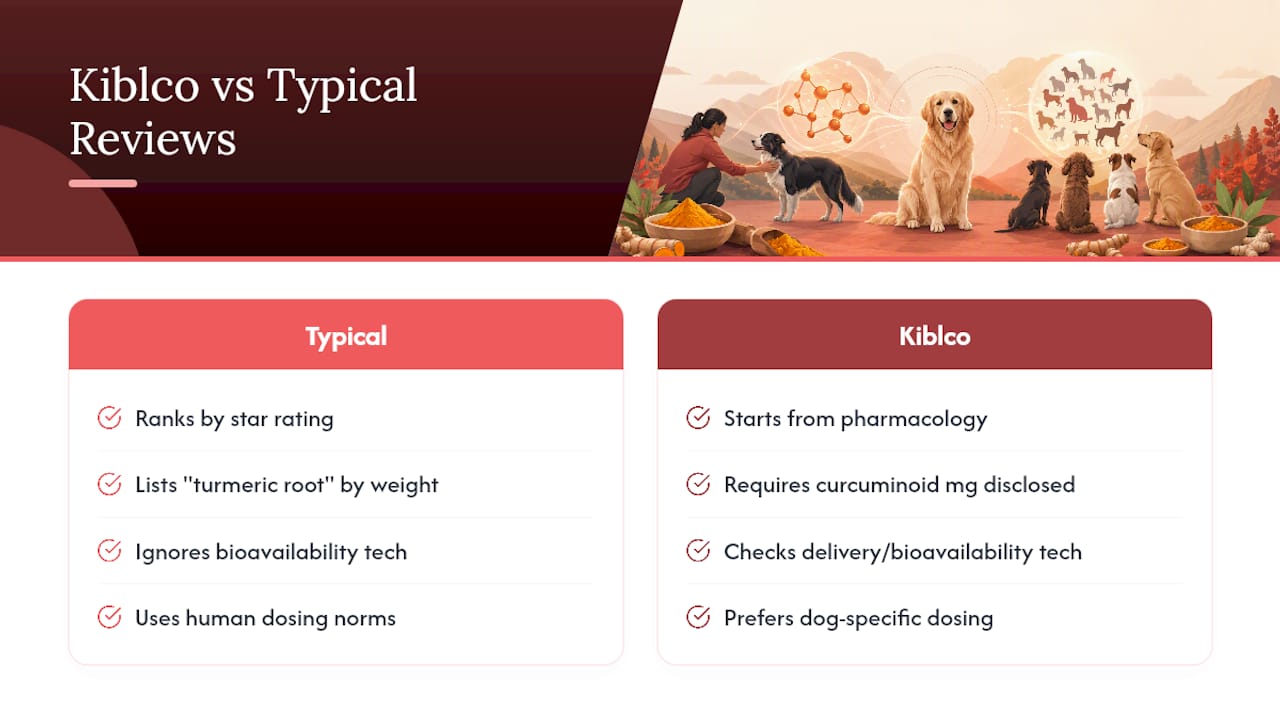
This is also why our recommendations lean toward dog-specific formulations over repurposed human supplements. Human curcumin products are dosed for human body weights and often paired with piperine at levels that make sense for a 150-pound adult, not a 20-pound terrier on three other medications. A dog-formulated product with clear weight-based dosing and a disclosed delivery mechanism gives owners something they can actually act on.
We'd also push back gently on the framing that turmeric is a stand-alone fix for joint pain. The stronger, more consistent evidence sits with omega-3s and weight management, and readers comparing options may find our guide to orthopedic dog beds for arthritis as useful a companion piece as any supplement review, since comfort and mobility support work alongside, not instead of, whatever's in the food bowl.
— Chris
Find Vetted Turmeric and Joint Supplements Through Kiblco
Kiblco tests supplement claims the way a skeptical pet parent would, by checking what's actually in the bottle against what the label promises, and flagging when a "turmeric" product is really just turmeric powder with no meaningful curcumin dose. That hands-on, vet-informed review process is the difference between guessing at a supplement aisle and knowing which formulations are built to actually absorb.

If you're ready to compare curcumin and joint-support products side by side, with honest pros and cons instead of marketing copy, Kiblco's product reviews break down formulation, dosing clarity, and real-world usability for dogs at every life stage. For dogs with existing joint issues, multimodal approaches sometimes pair supplements with therapies like veterinary acupuncture, and it's worth asking your vet whether that combination fits your dog's situation. Before adding any curcumin product to your dog's routine, run it by your veterinarian, especially if your dog takes other medications. Start browsing Kiblco's vetted supplement picks to find a formulation with real dosing transparency behind it.
This article is general information, not a substitute for advice from a qualified doctor. Consult a qualified healthcare professional about your own circumstances before acting on anything here.
Sources
- Turmeric and Curcumin—Health-Promoting Properties in Humans versus Dogs
- Benefits of Turmeric for Dogs | Purina
- Comblain et al., BMC Veterinary Research, 2017 (canine osteoarthritis trial)