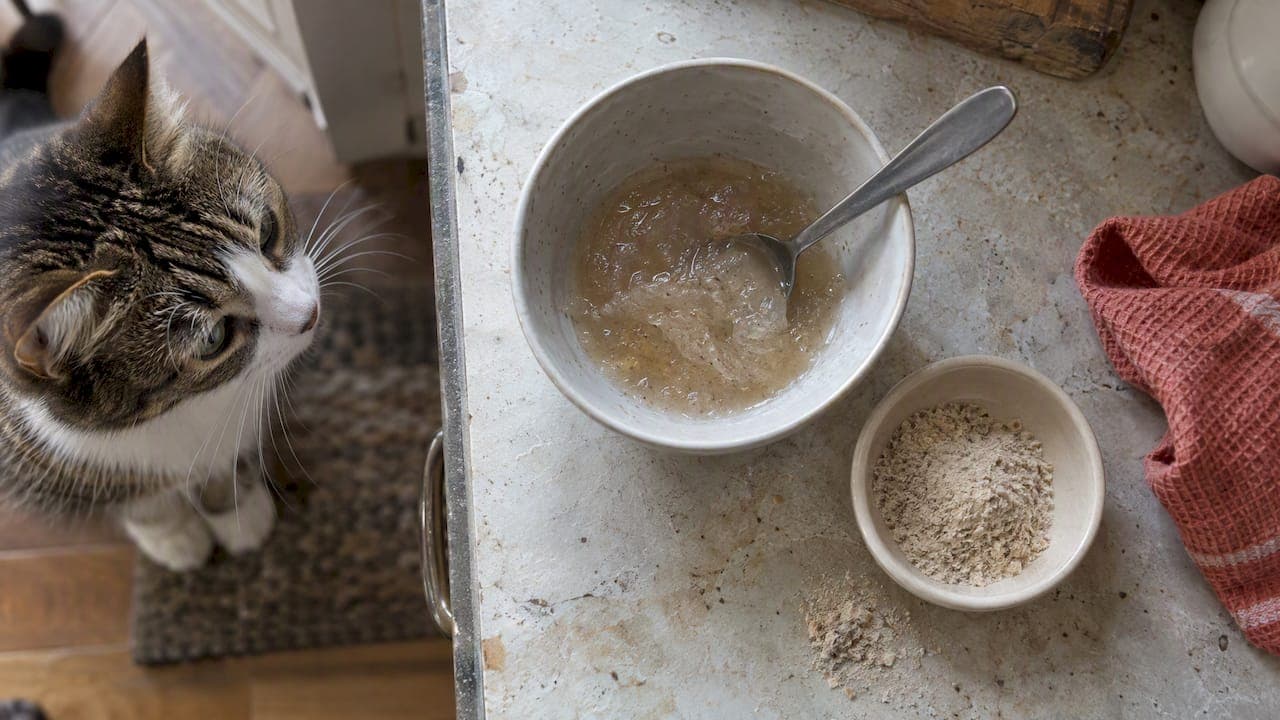
Slippery elm bark can be given to many cats as a soothing, gel-forming supplement. The commonly cited veterinary-herbal dose is about 1/4 teaspoon of powder per 10 lb of body weight, mixed into a smooth slurry. There is no FDA-approved feline dose, though, and the evidence is thin. It is a short-term helper for mild tummy upsets, never a substitute for finding out why your cat is sick. Below: what it does, how to prepare it, what can go wrong, and when to stop and call your vet.
TL;DR
- Slippery elm (Ulmus rubra) turns into a mucilage gel when wet. That gel may coat irritated digestive tissue, but cat-specific proof is limited.
- A commonly cited reference dose is about 1/4 teaspoon powder per 10 lb, or half of a 200-mg capsule per 10 lb. These are practitioner recommendations, so your vet and the product label come first.
- Give it apart from medications and other supplements, at least 1 hour and sometimes 2.
- Skip it, or ask first, if your cat has kidney or liver disease, is pregnant, is elderly, or takes any medication.
- Repeated vomiting, blood, appetite loss, or trouble urinating means a vet visit, not a supplement.
Table of Contents
- What slippery elm does in a cat's body
- What the evidence says
- When it might be worth discussing with your vet
- Slippery elm dosage for cats
- How to prepare slippery elm for cats
- Timing: before meals, after meals, apart from medicine
- Slippery elm for cat diarrhea and kidney cats
- Side effects and the real cons
- When to skip it and call a vet
- How to choose a slippery elm product
- Our take
- Find vet-informed picks for your cat
- FAQ
- Sources
What slippery elm does in a cat's body
Slippery elm is the inner bark of a North American tree. Ground to a powder and mixed with water, it swells into a slippery gel called mucilage. Veterinarian Jean Hofve explains the mechanism simply: the hydrated bark forms a gel that can soothe irritated tissue. That is why you see it recommended for throat, mouth, stomach and bowel irritation.
Think of it as a gentle coating, not a drug. It does not kill pathogens, fix organ disease or heal an ulcer on its own. It may give a bit of comfort while the real cause is dealt with.
What the evidence says
Honest answer: some signal, no proof.
The best-known data is a 2013 observational study in which 197 small animal veterinarians prescribed an elm mucilage preparation to 3,952 dogs and 2,248 cats. Among the cats, 77% of 1,064 with vomiting and 79% of 1,184 with diarrhea reportedly responded within 2 days or 4 doses. The authors used it as a mucosal protectant, similar in idea to sucralfate.
Before you get excited, read the fine print:
- It was not a randomized, controlled trial. There was no placebo group.
- The product was a specialized, potency-enhanced preparation, not the plain powder in your pantry.
- Some cats took longer than 2 days to respond.
The fair takeaway: a mucilage coating may offer supportive relief. It does not show that slippery elm cures GI disease. VCA Animal Hospitals makes the same point about supplements in general: "natural" is not automatically safe, and few herbs and supplements have been through rigorous trials.
When it might be worth discussing with your vet
Cat owners and vets most often raise slippery elm for:
- Mild, short-lived loose stool. The mucilage may firm things up slightly.
- Occasional nausea or mild vomiting in an otherwise bright, eating cat.
- Mouth or throat irritation, where a short coating contact is the point.
- Constipation, sometimes, when given with or just after food.
It is not a proven treatment for kidney disease, urinary obstruction, inflammatory bowel disease, hairballs or chronic vomiting. Those need a diagnosis and condition-specific care.
If your cat has loose stool, a gentler first step may be a food-based one. Our guide to pumpkin for cat constipation covers the vet-reviewed amounts and when to call. If a recent food change is the likely culprit, see our steps for switching cat food safely.
Slippery elm dosage for cats
Let's be clear first: there is no FDA-approved or validated feline dose. What follows is what practitioners commonly cite, and your veterinarian's instructions override it.
The commonly cited veterinary-herbal reference, relayed by VCA, is:
| Cat weight | Powder (about) | 200-mg capsule (about) |
|---|---|---|
| 5 lb | 1/8 teaspoon | 1/4 capsule |
| 10 lb | 1/4 teaspoon | 1/2 capsule |
| 15 lb | 3/8 teaspoon | 3/4 capsule |
The 5 and 15 lb rows are simple proportional scaling of the 10 lb figure, so treat them as a conversation starter with your vet, not a prescription.
A few practical notes:
- Product directions vary a lot. Some labels give very different amounts. Follow your vet's number or, lacking one, the label of a single-ingredient product.
- Measure carefully. Bark powder is fluffy, so a heaping spoon can double the dose. Use a level measuring spoon, or weigh it if you can. Hofve also warns against extrapolating herbal doses from human amounts, which is a common mistake with cats.
- Frequency. Your vet will set it. Do not keep going indefinitely if your cat does not improve in a day or two.
How to prepare slippery elm for cats
Texture is the usual obstacle, not toxicity. The powder gels fast and absorbs many times its weight in water.
A basic slurry
- Measure the powder for your cat's weight with a level spoon.
- Stir in enough cold water to make a smooth, moderately thick gel. Add water gradually and whisk so it does not clump.
- Draw it into a small oral syringe, or stir it into a tiny amount of a wet food your cat loves.
- Offer it slowly. Never force a large volume into the mouth. Liquid pushed in too fast can be inhaled (aspiration).
A simple syrup
One commonly cited recipe uses 1/2 cup cold water and 1 teaspoon of powder. You whisk it, simmer gently for 1 to 2 minutes, cool it, and refrigerate it for 7 to 8 days. In that reference, an average-size cat gets 5 mL about 5 minutes before a meal for diarrhea or mouth ulcers. That is one practitioner's recipe and not a universal dose, so confirm the preparation and storage with your vet.
Picky cats
If your cat refuses it, do not escalate to force. Try a smaller amount in a spoonful of strongly flavored wet food, and mix only what the cat will actually eat. A cat that stops eating because of what you added to the bowl is a new problem.

Timing: before meals, after meals, apart from medicine
Timing depends on what you hope to soothe. Practitioner guidance commonly places it about 30 minutes before meals for upper-GI irritation or inflammatory bowel symptoms. For throat or mouth irritation, some sources say 5 to 30 minutes before meals. For lower-GI issues like constipation, giving it with or just after food may be used. These intervals reflect practice, not a controlled feline study.
The rule that matters most is separation from medications. The mucilage coats mucous membranes and may reduce or delay absorption of oral drugs. Conservative guidance, as summarized here, separates slippery elm from medicines and supplements by at least 1 hour, and some practitioners say 2. Do not stir it into a meal that also hides a pill. Ask the prescribing vet or pharmacist for the interval for your cat's specific drug.

The same logic applies to other supplements. If your cat is also on a probiotic, joint chew or herb, space them out. Our Cat Health reviews note ingredients and directions so you can plan a schedule with your vet.
Slippery elm for cat diarrhea and kidney cats
Diarrhea. In a bright, eating cat with one or two loose stools, a vet may be fine with a short trial. Watch the clock. If diarrhea persists beyond a day or two, if you see blood, or if your cat is lethargic, stop guessing and call. Dehydration moves fast in cats.
Kidney disease. You will find forum posts from owners of cats with chronic kidney disease who say slippery elm helped appetite and vomiting. Those are anecdotes, and one is a reminder of why caution matters: a popular warning says slippery elm contains calcium that could raise calcium levels in cats with kidney disease or mineral metabolism disorders. I could not find controlled feline data settling that either way. If your cat has CKD, do not start it on your own. Your vet manages phosphorus and calcium, and a supplement can interfere.
Side effects and the real cons
Adverse effects are not well quantified in cats. The practical concerns:
- Stomach upset or vomiting. The ASPCA notes that even plants listed as non-toxic can cause vomiting or GI upset when eaten.
- Refusal because of the gel texture.
- Choking or aspiration if liquid is forced.
- Allergy or sensitivity.
- Reduced absorption of oral medicines.
- Delayed diagnosis, probably the biggest risk of all. A cat that looks a little better may still be sick.
VCA says to stop a supplement and contact your veterinarian if anything unusual happens, and that the vet is the best source for safety information on non-drug supplements.
The cons in one line: weak clinical evidence, no standardized feline dosing, possible drug interactions, hard administration, and the chance it hides a real problem.
When to skip it and call a vet
Check with your vet before starting if your cat is elderly, pregnant, has kidney or liver disease, or takes any medication.
Seek urgent veterinary care, and do not mask the signs with a supplement, if your cat has:
- Repeated vomiting or vomiting with blood
- Blood in stool
- Collapse, severe lethargy or breathing difficulty
- Signs of dehydration
- Straining or inability to urinate (an emergency, especially in male cats)
- A refusal to eat
Getting a cat to the clinic is stressful, and some owners delay for that reason. If that is you, ask whether a mobile vet serves your area. Many practices schedule house calls, and the workflow behind house call vet scheduling shows how quickly a visit can be arranged. A call is free; a delay can cost your cat days.
How to choose a slippery elm product
If your vet approves, shop with a checklist:
- Single ingredient. Look for slippery elm bark (Ulmus rubra or Ulmus fulva) without added sweeteners, flavors, or other herbs. Never use anything with xylitol, and do not add honey for a cat.
- Clear amount per serving. You need milligrams or a weight-based instruction, not just "one scoop."
- Powder or capsule you can open. Powder lets you dose by weight. Capsules are easier to measure when split, but check the capsule size.
- Organic and tested. Third-party testing or a lot number adds confidence. A label that promises to treat or cure a disease is a red flag.
- A form your cat will accept. An unpalatable product that goes unused is wasted money.
Our review process follows the same logic. When we check a supplement, we read the label, test it at home with real cats, and have vet input on health picks. If you want a template for reading labels, our turkey tail label checklist walks through six points that apply to most feline supplements. For dog households, see slippery elm for dogs, since dosing differs.
Our take
We test products in real homes, and slippery elm is a good example of why we write pros and cons side by side. The pros are real: it is a single-ingredient bark, many vets are comfortable with it for mild cases, and cats that tolerate the slurry seem to get some comfort from it.
The cons are just as real. The research is thin, the dose is a practitioner's estimate, and the most common failure is not a bad product but a hopeful owner who waits too long. When a cat's stool or appetite changes, the question that matters is why. A soothing coat can buy a little comfort. It cannot answer that question.
Our rule of thumb: use it for a day or two on a cat who is still bright and eating, with your vet's blessing, and keep it away from medication times. If nothing improves, you have your answer, and it is time for an exam. We accept no payment for coverage, and we disclose our affiliate relationships, so you can weigh our picks accordingly.
— Chris
Find vet-informed picks for your cat
If you are shopping for digestive or general wellness support, browse our Cat Health reviews. Each one lists pros, cons, usability and how the product held up in real homes. If you are also upgrading the litter box, our Cat Litter picks are a good next stop, since litter box changes are often the first thing you notice when a cat's digestion is off.
FAQ
Can you give slippery elm to cats?
Many vets accept it as a mild, short-term supplement, and veterinary sources describe the inner bark as generally well tolerated. There is no FDA-approved feline dose, and it is not safe to assume it suits every cat. Ask your vet first, especially with kidney disease, medications, pregnancy or old age.
What are the side effects of slippery elm in cats?
Side effects are not well studied in cats. The practical risks are GI upset, refusal because of the gel texture, choking if liquid is forced, allergy, and slower absorption of oral medicines. Stop and call your vet if anything unusual happens.
How do I prepare slippery elm for my cat?
Mix a level, weight-based amount of powder with enough cold water to make a smooth gel, then give it with a small oral syringe or in a tiny bit of wet food. Never force a large volume. One cited recipe uses 1 teaspoon of powder in 1/2 cup of water, simmered briefly and refrigerated for up to 7 to 8 days, but confirm that with your vet.
Is slippery elm good for cat diarrhea?
It may offer supportive coating for mild, short-lived loose stool, and one 2013 observational study of a specialized elm preparation reported improvement in many cats. It was not a controlled trial and does not prove plain powder works. Blood, lethargy, repeated vomiting or diarrhea lasting beyond a day or two means a vet visit.
Can slippery elm be given with my cat's medicine?
Not at the same time. The gel may reduce or delay absorption, so guidance commonly separates it from medicines by at least 1 hour, sometimes 2. Ask the prescribing vet or pharmacist for the right gap for your cat's drug.
Sources
- Expedited Management of Canine and Feline Vomiting and Diarrhea, observational study (SCIRP, 2013)
- Medicinal Mushrooms, VCA Animal Hospitals
- Slippery Elm, Little Big Cat (Dr. Jean Hofve)
- A Complete Guide to Using Slippery Elm for Pets, Dr. Axe
- Toxic and Non-Toxic Plant List for Cats, ASPCA