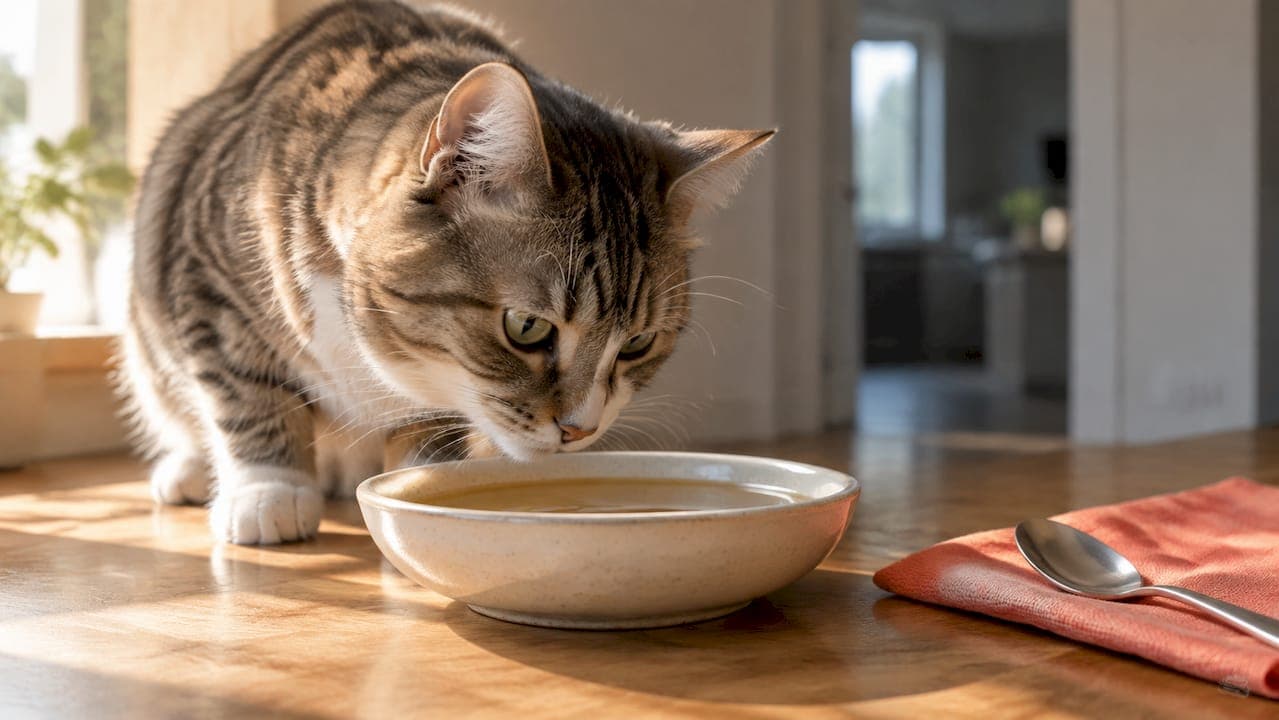
Yes, cat-safe bone broth can be a genuine hydration and appetite booster, as long as it's made or bought without onion, garlic, or added salt. It should never replace a meal. Cats with kidney disease, hyperthyroidism, or pancreatitis need a vet's sign-off before you add it to their bowl, since even small changes in sodium or mineral content can matter for those conditions.
TL;DR:
- Most store-bought broths contain onion, garlic, or excessive salt, which are unsafe for cats and require vet approval before use, especially for those with health issues.
- Bone broth should simmer for 12 to 48 hours depending on the protein source to extract collagen, but it must never include added seasoning or cooked bones due to health risks.
- Small cats can safely have 1 to 2 tablespoons of broth, and it is best used as an occasional supplement rather than a daily treat, with vet guidance for chronic conditions.
- Homemade vet-approved broth requires removing impurities, simmering bones in filtered water with vinegar, and discarding bones afterward to prevent splintering risks.
- The broth’s gel-like consistency after refrigeration indicates proper collagen extraction, ensuring it is a quality, safe option for hydration and appetite boosting.
Table of Contents
- What Is Bone Broth for Cats, and How Is It Different From Stock?
- Can Cats Have Bone Broth Safely?
- What Are the Benefits of Bone Broth for Cats?
- How to Make Vet-Safe Bone Broth for Cats at Home
- How to Serve, Portion, and Store Bone Broth
- How to Choose a Store-Bought Bone Broth for Cats
- Kiblco's Testing Notes on Bone Broths and Toppers
- Why We Push Safety First on Bone Broth
- Find Vetted Bone Broth Picks and Toppers on Kiblco
- Sources
- FAQ
What Is Bone Broth for Cats, and How Is It Different From Stock?
Stock and bone broth start the same way, with bones, water, and heat, but time changes everything. Stock simmers for a couple of hours and stays thin. Bone broth simmers far longer, sometimes a full day or two, which pulls collagen out of the connective tissue and cartilage and turns it into gelatin. That gelatin is what gives cooled bone broth its jiggly, jelly-like texture, and it's the whole reason cat owners bother making it at home instead of just running the tap.
The protein source changes the result too. Chicken produces a milder, thinner broth. Beef and turkey bones tend to release more collagen and give a richer, heavier broth with a stronger smell, which some cats find more appealing and others find off-putting.
- Chicken broth: mild flavor, faster to prepare, generally well tolerated by picky cats
- Beef broth: deeper flavor, more marrow-collagen, needs a longer simmer to fully extract
- Turkey broth: similar profile to chicken, slightly richer
The collagen and gelatin in a well-made broth are the basis for joint- and gut-support claims you'll see on packaging and in recipe blogs. The theory holds up biologically. Whether it delivers a measurable benefit in a cat's actual joints or gut is still an open question, which is worth keeping in mind before you treat broth as medicine rather than a supplement.
Can Cats Have Bone Broth Safely?
The short answer is yes, but only broth made without a handful of specific ingredients that show up in almost every human recipe. Before you pour anything into your cat's bowl, run it through this checklist.
- Check for onion, garlic, chives, or leeks. Every plant in the allium family is toxic to cats, and traces show up in most human-style broths and stocks, even ones labeled "low sodium." Unless the label explicitly says no alliums, assume it has some.
- Check the sodium content. Store-bought broths and bouillon cubes made for human cooking are often loaded with salt, which is hard on a cat's kidneys and heart over time.
- Check for other seasonings. Black pepper, excessive herbs, and flavor bases marketed as "savory" or "seasoned" are red flags for cats with sensitive stomachs.
- Confirm your cat's health status. Cats with kidney disease, hyperthyroidism, pancreatitis, or known food allergies need veterinary clearance before regular broth feeding, since mineral content and phosphorus levels can complicate those conditions.
A quick reality check: most broths sold in the human food aisle contain onion or garlic in some form, whether as a whole ingredient or a hidden flavor base. That single fact rules out the vast majority of what's already in your pantry.
Watch for vomiting, diarrhea, or pale gums after introducing any new broth. Those symptoms warrant a call to your vet, not a wait-and-see approach.
What Are the Benefits of Bone Broth for Cats?
The most well-documented benefit is hydration, and it's a real one for a simple reason: cats evolved as desert animals with a weak thirst drive, and most on a dry-kibble diet chronically under-drink. A splash of broth mixed into food, or poured into a separate bowl, gets moisture into a cat that would otherwise ignore a full water dish. Even small amounts can nudge water intake upward in cats eating mostly dry food, which matters over months and years, not just one afternoon.
Appetite stimulation is the second practical benefit, and it shows up most clearly in specific situations rather than as a daily magic trick.
- Senior cats who've grown bored with regular food often respond to the smell of warm broth
- Cats recovering from surgery or illness, when appetite is the first thing to go, sometimes eat again once broth is drizzled over their usual meal
- Picky drinkers who ignore fountains and bowls will often lap up broth without hesitation
- Kibble can be softened with broth for cats with dental pain or missing teeth
Joint and gut support are the benefits with the least direct evidence behind them. The logic makes sense on paper: broth contains collagen and glucosamine-related compounds, and both have documented roles in cartilage and gut lining health. But most of the supporting research on hydration and appetite comes from general veterinary and pet-health sources rather than controlled feline studies, so treat joint claims as a reasonable theory rather than a guarantee. If joint health is your main goal, a dedicated collagen supplement built for that purpose may deliver a more consistent dose than broth alone.
Pro Tip: If your cat has a sensitive stomach on top of picky eating habits, introduce broth in tiny amounts, a teaspoon at first, and watch stool consistency for two or three days before increasing the portion.
How to Make Vet-Safe Bone Broth for Cats at Home
A basic, vet-approved recipe needs only three ingredients: raw meaty bones, filtered water, and a splash of apple cider vinegar, which helps pull minerals out of the bone during the simmer.
- Blanch the bones in boiling water for a few minutes first to remove surface impurities, then discard that water.
- Place bones in a stockpot or slow cooker, cover with filtered water, and add a tablespoon or two of apple cider vinegar.
- Simmer chicken bones for 12 to 24 hours; beef bones need 24 to 48 hours since denser marrow-collagen takes longer to break down.
- Strain the liquid twice through a fine mesh strainer or cheesecloth, discarding every bone fragment.
- Cool the broth completely in the fridge, then skim off the hardened fat layer from the top.
A few steps are non-negotiable, not optional. Never add onion, garlic, salt, or herbs of any kind. Never feed your cat a cooked bone, since cooking makes bones brittle and prone to splintering, which creates a choking or intestinal puncture risk. Discard every bone once the simmer is done, no matter how tempting it looks.
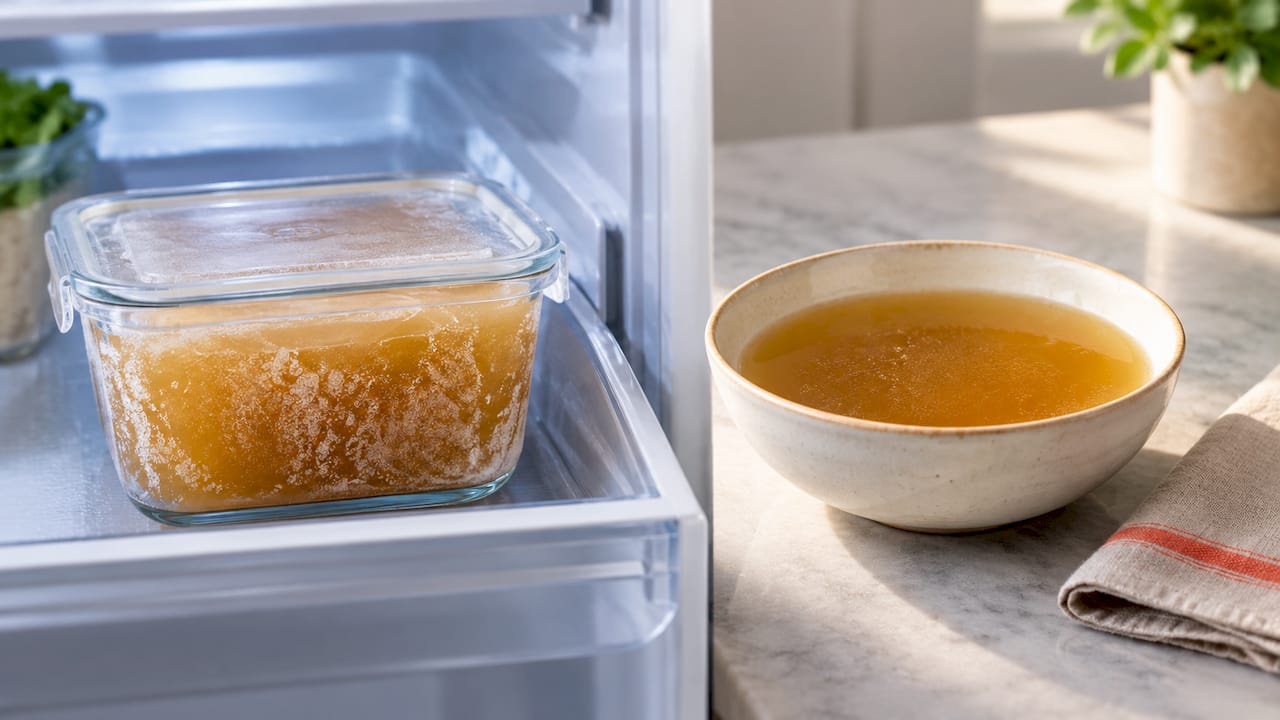
- Confirm your broth worked with the gel-test: refrigerate a small spoonful, and if it firms into a soft jelly, the collagen extraction was successful
- Kittens and small cats need only a teaspoon at a time to start
- Adult cats under 10 pounds do fine with a tablespoon
- Larger cats can handle slightly more, scaled to their size and your vet's input
How to Serve, Portion, and Store Bone Broth
Plain broth in a separate bowl works, but most owners get better results pouring a small amount over dry or wet food as a topper. Frozen "broth-cicles," broth poured into an ice cube tray and frozen solid, double as enrichment on hot days and a slow-release treat that keeps a cat occupied.
Portion size depends heavily on your cat's weight and how often you're serving it.
- Small cats (5 to 8 pounds): 1 to 2 tablespoons per serving
- Medium cats (9 to 12 pounds): 3 to 4 tablespoons per serving
- Most cats do well with broth 2 to 3 times a week rather than daily
Vet guidance worth repeating: portion recommendations from veterinary sources consistently point to small, tablespoon-sized servings used occasionally rather than as a daily habit, and daily use should get a vet's approval first, especially for cats managing a chronic condition.
Homemade broth keeps in the fridge for 5 to 7 days and in the freezer for 3 to 4 months. Thaw a portion in the fridge overnight rather than at room temperature, and warm it to roughly body temperature before serving. Cold broth straight from the fridge is far less appealing to most cats than something that smells warm and fresh.
How to Choose a Store-Bought Bone Broth for Cats
Reading the label matters more than the marketing on the front of the package. A few checks separate a genuinely cat-safe product from one that just looks the part.
- The ingredient list should explicitly state no onion, no garlic, not just "natural flavors"
- Sodium should be low or absent; if a number isn't listed, that's a reason for caution rather than confidence
- The animal protein source should be named clearly (chicken, beef, turkey), not hidden behind vague terms like "meat broth"
- Human-grade sourcing and transparent manufacturing are good signs of quality control
- A properly made broth should gel when chilled, which you can check yourself if the product is refrigerated or sold frozen
- Resealable packaging cuts down on waste and keeps the product fresher between servings
Skip anything labeled "seasoned," "flavored," or built on a bouillon base. Those terms almost always signal added salt or spice blends that were never formulated with a cat's kidneys in mind.
Kiblco's Testing Notes on Bone Broths and Toppers
When evaluating a bone broth or food topper, important considerations include ingredient transparency: no alliums, no unnecessary sodium, and a clearly named protein source. The evaluation may include a hands-on gel-check in the fridge, since a broth that never firms up likely skipped the long simmer that makes it worth buying in the first place.
- Ingredient label review before opening
- Palatability testing with cats, including picky eaters
- Packaging usability, resealability, and mess factor
- Clear pros and cons, plus a note to check with your vet for cats with kidney or thyroid conditions
For readers digging deeper into gut health alongside broth, Kiblco's guide to probiotics for sensitive stomachs covers a related piece of the digestive puzzle.
Why We Push Safety First on Bone Broth
Bone broth earns its place in a cat's routine when it's made or chosen carefully, not because it's trendy. Kiblco leans on vet-informed guidance and hands-on testing because a jar with the wrong seasoning blend can undo any benefit fast. Introduce it slowly, and get your vet involved if your cat has an existing condition.
— Chris
Find Vetted Bone Broth Picks and Toppers on Kiblco
Reading labels line by line takes time most cat owners don't have, especially when half the packaging on a pet store shelf uses vague terms like "natural flavor" to dodge listing what's actually inside. Kiblco tests bone broths and food toppers by hand, checking ingredient lists for hidden alliums and sodium, running the gel-test in a real fridge, and noting how cats actually respond to the smell and texture, not just what the packaging promises.

If hydration is your main goal and your cat still ignores broth, a cat water fountain built for picky drinkers might solve the problem from a different angle, and Kiblco's freeze-dried treat picks pair well with broth for cats that need extra coaxing at mealtime. For safe handling around feeding stations, pet-safe cleaning guidance is worth a look too, since what you use to wipe down bowls matters as much as what goes in them. Head to Kiblco's full lineup of vet-informed reviews to see which broths and toppers made the cut before you add one to your cart.
Sources
This guide draws on veterinary and pet-health explainers, including Chewy's cat nutrition guide, Cats, Hopewell Animal Hospital's recipe guide, Felina Care Hub, and The Vet Desk. Always consult your veterinarian for advice specific to your cat.
- Bone Broth for Cats: Benefits and How To Serve It — Chewy
- Easy DIY Bone Broth for Cats Recipe — Hopewell Animal Hospital
- Bone Broth For Cats Recipe: Easy, Safe & Vet-Approved Guide — Felina Care Hub
- Is Bone Broth Good for Cats? Vet-Verified Nutrition Facts & Recipe — The Vet Desk
FAQ
Are Bone Broths Good for Cats?
Yes, when made or bought without onion, garlic, or added salt, bone broth can support hydration and appetite, though cats with kidney disease, hyperthyroidism, or pancreatitis need vet clearance first.
How Much Bone Broth Can I Give My Cat Per Day?
Small cats can have 1 to 2 tablespoons and medium cats 3 to 4 tablespoons, ideally served 2 to 3 times a week rather than daily unless your vet approves more frequent use.
What Bone Broth Can I Feed My Cat?
Feed only broth labeled explicitly free of onion and garlic, low in sodium, and made from a clearly named single protein like chicken, beef, or turkey, or make it yourself with raw meaty bones and filtered water.
How Do I Prepare Bone Broth for Cats at Home?
Blanch raw meaty bones, simmer them in filtered water with a splash of apple cider vinegar for 12 to 24 hours (chicken) or 24 to 48 hours (beef), then strain twice, cool, and skim off the fat before serving.