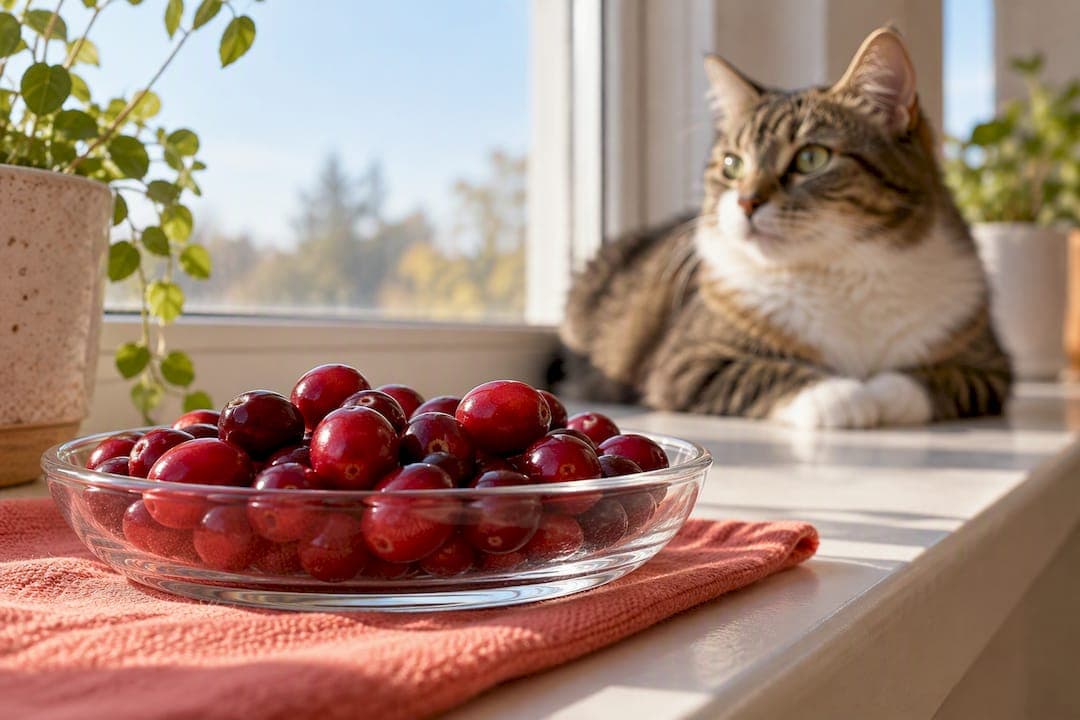
Short answer: there is currently insufficient clinical evidence that cranberry prevents or treats urinary tract infections in cats. A 2026 systematic review found the existing studies too small and too weak to support a recommendation either way. If your cat is straining, licking excessively, or urinating outside the litter box, call your veterinarian before reaching for a supplement.
TL;DR:
- The small number of clinical studies, just three involving 122 animals, provides no statistically significant evidence that cranberry prevents or treats urinary tract infections in cats.
- Laboratory findings suggest cranberry compounds can reduce bacterial adhesion to urinary cells, but this does not translate into proven clinical benefits in live cats.
- Cranberry's mechanism only applies to confirmed bacterial infections and offers no help for stress-related urinary issues or bladder stones in cats.
- Given the lack of standard dosing, unregulated product quality, and potential side effects, owners should consult a veterinarian before giving cranberry supplements to their cats.
- Diagnostic tests such as urinalysis and urine culture are essential to identify actual infections, as cranberry does not replace appropriate veterinary treatment.
Table of Contents
- What owners need to know right now
- Review of the research: systematic review and key trials
- How cranberry might work and why that doesn't guarantee benefit
- When cranberry could plausibly help, and when it won't
- Safety, side effects, and the reality of dosing
- How to introduce a cranberry product safely
- What to do if your cat actually has a UTI
- Where the evidence still leaves owners guessing
- Where to find vetted cat health reviews
- Sources
- FAQ
What owners need to know right now
The research on cranberry and feline urinary health is thin, and what exists doesn't point to a clear clinical benefit. Here's what actually matters if you're weighing whether to try it.
- The strongest available evidence, a systematic review of cranberry supplementation, found no studies showing statistically significant clinical benefit in dogs or cats.
- Lab and ex vivo work suggests cranberry compounds can reduce bacterial adhesion to urinary cells, but that finding hasn't translated into proven treatment outcomes in live animals.
- Cranberry, even if it works at all, would only be relevant to a confirmed bacterial infection, not the more common stress related or idiopathic urinary problems in cats.
- Watch for vomiting, loose stool, or appetite changes if you try a cranberry product, and stop immediately if your cat's urinary signs worsen or urine output stops.
None of this means cranberry is dangerous or useless. It means nobody has proven it does what the marketing implies, and a cat with real urinary symptoms needs diagnosis first.
Review of the research: systematic review and key trials
The most rigorous look at this question comes from a systematic review published in 2026, which searched the veterinary literature for clinical studies testing cranberry against infectious urinary tract disease in dogs and cats. The reviewers found only three studies that qualified, covering 122 animals total, of which just 16 were cats. That is a strikingly small evidence base for a supplement sold widely as a urinary health aid.
None of the three studies reported a statistically significant clinical benefit from cranberry supplementation, and the systematic review rated the overall certainty of evidence as low to very low. Two of the three studies carried a high risk of bias, meaning their design left room for results to be skewed by factors other than the treatment itself. Only one was judged low risk. When a field has this few animals and this much uncertainty, "no proven benefit" is the honest conclusion, not "cranberry doesn't work."
A separate piece of research, a blind randomized cross-over trial in cats, adds a mechanistic clue rather than a clinical answer. Researchers fed six neutered domestic cats diets containing 0.1% and 0.3% cranberry powder, then tested whether Escherichia coli adhered less readily to feline uroepithelial cells exposed to their urine. The higher cranberry concentration produced a stronger reduction in bacterial adherence for many of the cats, and the effect tracked with dose. That is a genuinely interesting result: it shows cranberry compounds can reach the urinary tract in a form that interferes with bacterial attachment, at least under lab conditions.
Statistic: Only three qualifying clinical studies covering 122 animals, including 16 cats, have tested cranberry for infectious urinary tract disease in cats and dogs, a small enough sample that firm conclusions aren't yet possible.
The gap between these two findings is the whole story. The feline cross-over trial measured bacterial adhesion in urine samples outside the body, an ex vivo model, in six cats over a matter of weeks. It did not measure whether cranberry prevented an actual infection, cured one, or reduced symptoms in a sick cat. Ex vivo anti-adhesion is a plausible first step toward a clinical effect, but plausible mechanisms fail to pan out in real patients more often than marketing copy admits. Dose, gut metabolism, individual variation in how much active compound reaches the bladder, and the difference between a controlled trial and a cat with an actual infection all stand between a lab result and a bottle that helps your cat.
The practical takeaway from the current research: cranberry has a biologically reasonable mechanism and a couple of small studies pointing toward it, but nothing yet resembling proof that giving it to a cat prevents or treats a urinary tract infection. Owners who want a supplement with demonstrated clinical outcomes in cats are, for now, out of luck with cranberry.

How cranberry might work and why that doesn't guarantee benefit
Cranberries contain proanthocyanidins, specifically a type called PAC-A, that in lab studies interfere with the tiny hair-like structures, or pili, bacteria used to grip the lining of the urinary tract. If bacteria can't attach, they get flushed out with normal urination instead of colonizing the bladder wall. That is the entire theoretical basis for cranberry as a urinary aid, in cats, dogs, or people.
For this to matter clinically, the PAC-A compounds have to survive digestion, get absorbed, undergo whatever metabolic processing the body performs on them (often broken down by gut microbes into phenolic acids), and then show up in urine in a concentration high enough to affect bacteria sitting in the bladder. That is a long chain of steps, and each one introduces a chance for the effect to weaken or disappear entirely.
Three practical gaps stand between the lab result and a bottle on a shelf. First, nobody has established a validated dose-response relationship for PAC-A in cats specifically. The feline cross-over trial used two doses and saw a stronger effect at the higher one, but two data points in six cats does not define a therapeutic dose. Second, commercial products vary widely in how much PAC-A they actually contain, and labels often don't state it reliably, since nutraceuticals aren't regulated the way drugs are. Third, a controlled trial in healthy young cats fed a defined diet looks nothing like a middle-aged cat with an actual infection, other health conditions, and an unpredictable diet. Mechanism plausibility is real. It is not the same as clinical proof.
When cranberry could plausibly help, and when it won't
Cranberry's proposed mechanism only applies to one specific problem: a true bacterial infection. Most cats with urinary symptoms don't have one. According to VCA Animal Hospitals, bacterial UTIs are relatively uncommon in cats, and a large share of lower urinary tract signs are actually feline lower urinary tract disease (FLUTD), often idiopathic cystitis driven by stress, which responds to environmental changes and diet rather than anything antibacterial.
Bacterial infections do happen more often in specific groups: older cats, cats with diabetes or chronic kidney disease, cats with anatomical abnormalities, or cats who've had a urinary catheter. If your cat falls into one of these categories and shows urinary signs, a bacterial cause is worth ruling out with a veterinarian.
- A positive urine culture is the only reliable way to confirm a bacterial infection, not symptoms alone.
- Blood in the urine combined with a risk factor like diabetes, older age, or kidney disease raises suspicion for a bacterial cause worth investigating.
- Straining and frequent urination in an otherwise young, healthy cat point more toward stress related cystitis than bacteria.
- Bladder stones or crystals can mimic infection symptoms and need imaging to diagnose, not a supplement to treat.
- A blocked urethra, almost always in male cats, is a surgical emergency that cranberry has no role in addressing.
If your cat's situation looks like idiopathic cystitis, stones, or an obstruction, cranberry is aimed at the wrong target entirely. It cannot loosen a blockage, dissolve a stone, or calm a stress response.
Safety, side effects, and the reality of dosing
There's no standardized, evidence-backed dose of cranberry for cats, which makes safety guidance somewhat conservative by necessity. A few rules reduce the risk of doing harm even where benefit is unproven.
Skip cranberry juice entirely. Juice blends are often loaded with sugar, and some human formulations contain xylitol or other additives that are unsafe for cats. Human supplements and gummies are formulated for human bodies and dosed for human weight, not a 4 to 5 kilogram cat, so they should never be substituted for a feline-labeled product without your veterinarian's input.
Possible side effects reported anecdotally with cranberry supplementation include vomiting, loose stool, and reduced appetite. There's also a theoretical concern about oxalate content contributing to certain types of urinary crystals in susceptible cats, though the evidence behind that concern is limited rather than settled. If your cat shows any of these signs after starting a new supplement, stop and call your vet.
Because cranberry nutraceuticals aren't regulated as drugs, PAC content on the label can be inaccurate or simply absent. The systematic review specifically flags this as a limitation of the whole category: without third-party testing or a manufacturer's PAC assay documentation, you often can't know what you're actually giving your cat. Veterinary commentary from Worms & Germs makes a similar point: a lack of clinical evidence isn't proof that cranberry does nothing, but commercial products are marketed without the efficacy data that drugs require, so a healthy dose of buyer skepticism is warranted.
If you decide to try a cranberry product anyway, loop in your veterinarian first, especially if your cat has a history of urinary crystals, kidney disease, or is on any other medication.

How to introduce a cranberry product safely
If your veterinarian is comfortable with you trying a cranberry supplement alongside standard care, favor feline-specific, vet-formulated products over human juice, gummies, or capsules designed for people. A product intended for cats will at least be dosed with a cat's size and metabolism in mind, even without perfect clinical backing.
- Choose a cat-specific product your veterinarian has reviewed or approved, ideally one with third-party PAC testing listed.
- Start with the lowest labeled dose rather than the full recommended amount.
- Watch for vomiting, diarrhea, or appetite changes over the first several days.
- Keep a simple log of symptoms, litter box habits, and any side effects.
- Bring that log back to your veterinarian and reassess whether it's worth continuing.
Pro Tip: Avoid stacking a cranberry supplement with other urinary support products containing overlapping active ingredients unless your vet has specifically approved the combination.
This approach treats cranberry as a low-risk add-on at best, never as a replacement for diagnosis or prescribed treatment. Reassessing with your vet after a couple of weeks keeps you from continuing something that isn't helping, or missing a worsening condition because a supplement gave a false sense of security.
What to do if your cat actually has a UTI
If you suspect a real infection rather than stress-related cystitis, the standard path runs through diagnostics, not the supplement aisle.
- Bring a fresh urine sample to your veterinarian for a urinalysis, the first step in identifying infection or crystals.
- A urine culture and sensitivity test identifies the specific bacteria present and which antibiotics will actually work against it.
- Imaging such as an ultrasound or X-ray may be recommended for cats with recurrent symptoms to rule out stones or anatomical issues.
- Antibiotics, selected based on the culture and sensitivity results, treat a confirmed bacterial infection. Cranberry is not a substitute for prescribed antibiotics.
- A male cat straining with little or no urine output is a true emergency. Untreated urethral obstruction can lead to kidney failure within a day or two, according to AVMA guidance on feline lower urinary tract disease, and needs immediate veterinary care, not a wait-and-see approach.
Nothing about cranberry supplementation changes this sequence. It might be a reasonable adjunct once a vet has ruled out an emergency and confirmed what you're actually dealing with, never a first response to urinary symptoms.
Where the evidence still leaves owners guessing
The honest position on cranberry for cats sits in an uncomfortable middle ground, and that discomfort is exactly what a lot of product marketing tries to paper over. Cranberry isn't a scam. The anti-adhesion mechanism is real, and it's been demonstrated in feline cells. What's missing is the unglamorous part: a trial large enough and well-designed enough to show it changes outcomes for actual sick cats.
What owners consistently underestimate is how rarely feline urinary symptoms mean what they assume. A cat straining in the litter box looks like a textbook UTI to most people, yet a large share of these cases are stress-related cystitis that antibiotics and cranberry alike do nothing for. The bigger risk isn't that cranberry fails to help. It's that treating a supplement as a diagnosis delays the actual workup a cat needs, whether that's a culture, imaging, or emergency care for a blockage.
A useful mental checklist before trusting any urinary supplement claim: does it cite a clinical study in cats specifically, does the label state actual PAC content, has a veterinarian reviewed the recommendation, and are tolerability reports available rather than just marketing claims. Cranberry currently fails the first test, not because it's been disproven, but because nobody has run the study yet.
— Chris
Where to find vetted cat health reviews
At Kiblco, we look at pet supplements the way this article treats cranberry: read the actual research, flag what's unproven, and never dress up a thin evidence base as a guaranteed fix. That approach carries over into how we cover the wider cat health category, from litter and gear to the nutraceuticals owners ask about most.

If you're weighing a cranberry supplement or comparing it against other urinary support products, our cat health reviews break down what's backed by research versus what's just well-marketed, so you can make a call your vet will actually sign off on. Start there before you add anything new to your cat's routine.
Sources
- Effectiveness of Cranberry Supplementation for Prevention and Treatment of Infectious Urinary Tract Disease in Dogs and Cats: A Systematic Review
- The effect of consumption of cranberry (Vaccinium macrocarpon) on Escherichia coli adherence to feline uroepithelial cells in a blind randomised cross-over trial in cats
- Does cranberry reduce or help treat urinary tract infections in dogs and cats? (Worms & Germs blog)
FAQ
Is there a natural way to get rid of a UTI in a cat?
Increasing water intake, feeding wet food, and reducing stress can support urinary health, but a confirmed bacterial infection needs veterinary diagnosis and, when indicated, antibiotics chosen from a urine culture. No natural remedy, including cranberry, has demonstrated clinical benefit in cats to date.
Can cranberry juice flush out a bladder infection?
No. Cranberry juice is not recommended for cats because of its sugar content and potential additives, and even cranberry supplements lack proven clinical benefit for bladder infections according to a 2026 systematic review. A suspected infection should be diagnosed and treated by a veterinarian instead.
What is the best supplement for cats with urinary tract infections?
There is currently no supplement, cranberry included, with proven clinical evidence for treating feline UTIs. The systematic review found only three small studies and no statistically significant benefit, so prescribed antibiotics based on a urine culture remain the standard treatment.
What are the potential side effects of cranberry supplements for cats?
Reported side effects include vomiting, loose stool, and appetite changes, along with a theoretical concern about oxalate content in cats prone to certain urinary crystals. Evidence on these risks is limited, so any new supplement should be introduced gradually and stopped if your cat shows adverse signs, per veterinary caution from Worms & Germs.