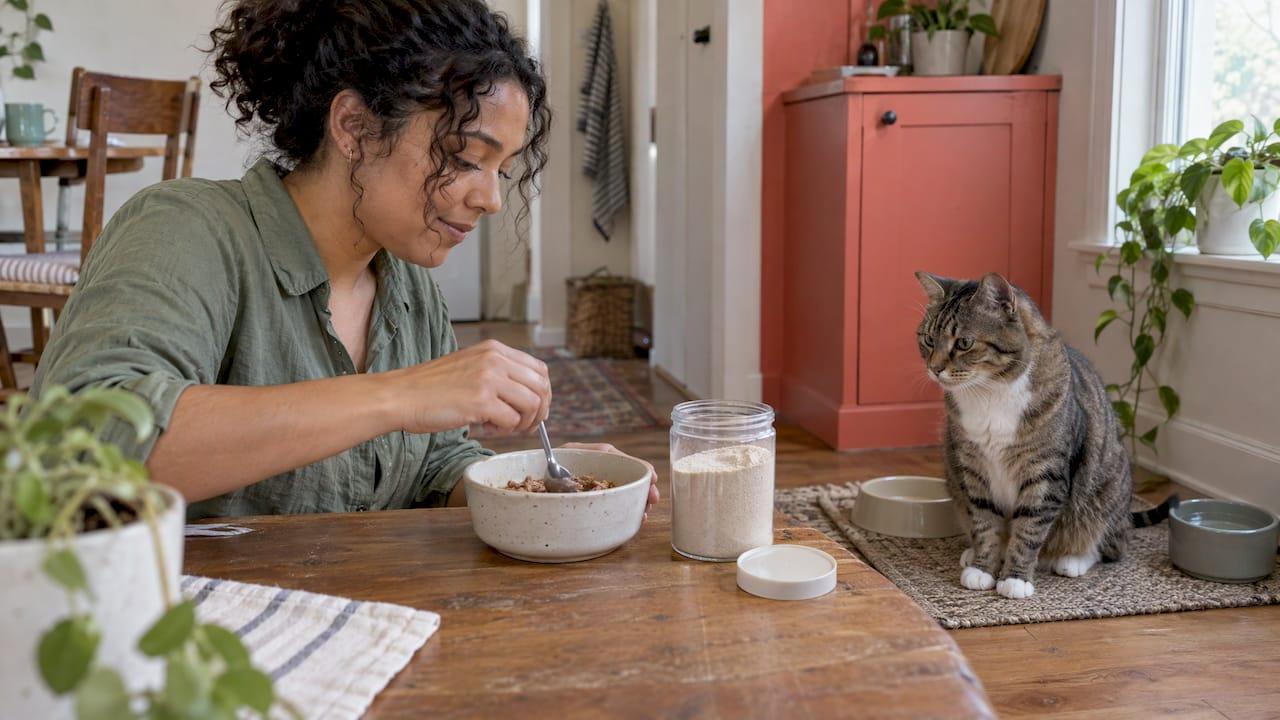
Psyllium husk is one of the most studied fiber supplements for cats, and veterinary sources describe it as a reasonable option for mild, occasional constipation in a cat that is well hydrated. Published veterinary guidance puts the usual range at about 1 to 4 teaspoons mixed into canned food, once or twice a day. A cat with a blockage, severe straining or no stool for days needs a vet, not a fiber trial. Below we cover what the research found, how to give psyllium, what to know about Metamucil, and the signs that mean the kitchen-counter approach is over.
TL;DR
- A 2026 controlled trial found that a diet with 6% psyllium led to far fewer diet failures in constipated cats than a similar diet with 0.5% psyllium: 26.9% versus 73.3%.
- Veterinary guidance lists psyllium powder at 1 to 4 teaspoons in canned food, once or twice daily. Confirm the amount with your vet for your cat's size and health.
- Plain, unflavored, unsweetened psyllium is the form used in the sources. Always give it with food and plenty of fresh water.
- Skip home fiber and call your vet if you suspect a blockage, or if your cat has gone 48 to 72 hours without a bowel movement.
Table of Contents
- What psyllium does in a cat's gut
- What the studies show
- Is psyllium safe for cats?
- How much psyllium to give a cat
- How to give psyllium without choking risk
- Can cats have Metamucil?
- Psyllium versus pumpkin and other options
- When to call the vet instead
- Our perspective
- Find vet-informed picks for your cat
- FAQ
- Sources
What psyllium does in a cat's gut
Psyllium comes from the husk of the Plantago ovata seed. Today's Veterinary Practice describes it as a soluble, nonfermentable fiber that forms a gel-like mass in the colon. That gel holds water, which is the main reason stool gets softer and bulkier.
Not every veterinary source describes it quite the same way. Cornell's Feline Health Center notes that psyllium and canned pumpkin are fermented in the colon, producing short-chain fatty acids that may help the colon muscle contract. In practice, both descriptions point to the same outcome: softer, better-formed stool that is easier to pass.
A JAVMA review of dietary fiber lists psyllium husk, cellulose and canned pumpkin as the fiber sources most commonly given to cats, and notes that psyllium is a far more concentrated fiber source. That concentration explains why a small amount goes a long way, and why measuring matters.

What the studies show
The evidence here is better than for most cat supplements. Here is what each study tested.
The 2026 controlled trial
In a multicenter, blinded trial published in 2026, client-owned cats with chronic constipation were randomly assigned to a gastrointestinal diet with 6% psyllium or a similar control diet with 0.5% psyllium. Over six months, 7 of 26 cats (26.9%) on the psyllium diet dropped out for gastrointestinal reasons, compared with 22 of 30 (73.3%) on the control diet. Stool consistency also improved more in the psyllium group at most visits after day 7.

Note what this tested: a complete diet formulated with psyllium, not a spoonful of powder added to any food. The result supports psyllium as part of a nutrition plan. It does not turn a teaspoon of powder into a guaranteed fix.
Earlier diet studies
A 2011 uncontrolled study in 66 cats used a moderate-fiber, psyllium-enriched dry diet. Most cats improved at two months: 14 of 15 (93%) in the first trial and 42 of 51 (82%) in the second. Stool consistency improved significantly in both. Today's Veterinary Practice reports the same 82% to 93% range but points out that the diet contained other fiber sources and additives, so the effect cannot be credited to psyllium alone.
Healthy cats and stool quality
A 2024 study fed nine healthy neutered adult cats diets with either 6% psyllium or 6% cellulose for 10 days each. Psyllium produced more bowel movements per day, softer stool, higher stool wet weight and more stool moisture. The authors credit psyllium's water-holding and gel-forming properties, and add that results would depend on the root cause of constipation. In people, slow-transit constipation responds less to extra fiber, and the same may be true for cats.
Is psyllium safe for cats?
For most healthy adult cats, psyllium given with food and water is considered a standard veterinary fiber option. VCA Animal Hospitals lists the situations where it should not be used:
- Allergy to any component of the supplement
- Suspected or possible intestinal blockage
- Difficulty swallowing
Rare but serious allergic reactions can show up as irregular breathing, rash, fever or facial swelling. If you see any of these, contact your vet or an emergency clinic right away.
VCA also advises caution when psyllium is combined with antidiabetic medication (a higher risk of low blood sugar), aspirin, digoxin and nitrofurantoin. If your cat takes any of these, ask your vet before starting fiber. VCA notes the effects are short-acting, lasting less than 24 hours, though they may last longer in pets with kidney or liver disease.
Hydration comes first
Fiber needs water to work. DVM360 says fiber should only be considered when a patient is well hydrated, and recommends more wet food and more water stations around the house. Dr. Jane Armstrong, writing in DVM360 proceedings, notes that in cats with normal hydration and a functioning colon a fiber-enhanced diet works well, while in cats that are marginally dehydrated it may make the problem worse.
Cornell adds that too much soluble fiber can cause diarrhea and interfere with nutrient absorption. Start low, and do not raise the amount just because a day passes without results.
Cats who should not get extra fiber
Armstrong's guidance is that cats with severe colonic muscle failure (obstipation or megacolon) should avoid high-fiber diets entirely. She prefers a canned, highly digestible diet for older cats with chronic constipation, adding a laxative or a colonic motility drug if that is not enough. Those are prescription decisions. If your cat has had repeated episodes, a vet visit is the right starting point, because the right plan depends on why the colon is struggling.
How much psyllium to give a cat
The numbers below come from veterinary proceedings written for clinicians, not from a product label. Treat them as the range your vet may work within, and ask about your own cat.
| Source | Form | Amount |
|---|---|---|
| Armstrong, DVM360 proceedings | Psyllium powder in canned food | 1 to 4 teaspoons, once or twice daily |
| DVM360 proceedings, 2010 | Metamucil (psyllium product) | 1 to 4 teaspoons per meal |
That is a wide range, and the low end is the sensible place to begin. A cat that is small, old, or has kidney or liver disease may need less. Pure psyllium husk is concentrated, so a level measuring spoon beats eyeballing. Veterinary sources also pair fiber with careful follow-up: DVM360 stresses that the cat should be reassessed to confirm the diet is working, and that individualization is critical.
A simple way to start
- Check with your vet first, especially if your cat has any health condition or takes medication.
- Use plain psyllium with no flavoring, sugar or sweetener.
- Start at the low end of the range your vet gives you, mixed thoroughly into canned food.
- Offer fresh water in several spots, and add more wet food if your cat eats mostly kibble.
- Watch the litter box for a few days: stool should look softer and pass without straining.
- Report back to your vet if nothing changes, or if stool turns loose.
How to give psyllium without choking risk
Psyllium swells quickly when it meets liquid. VCA says it is given orally with food. If a pet will not take a capsule, VCA says to open it, mix the contents with an adequate volume of liquid and give it immediately. It also warns never to mix it into thickened liquids or food, which can lead to choking, and says ample fresh water must always be available.
With powder, the practical version is simple: stir it well into a portion of moist canned food that your cat eats right away, rather than letting a thick paste sit in the bowl. Wet food adds water, which is exactly what the fiber needs. If your cat refuses, tell your vet instead of increasing the amount.
Can cats have Metamucil?
A psyllium product is named in veterinary literature. The DVM360 proceedings mention Metamucil at 1 to 4 teaspoons per meal as a long-recommended option, alongside canned pumpkin and wheat bran. The same source notes that fiber has been shown in humans to be only moderately effective as a laxative, so set expectations accordingly.
If you are comparing products at home, the main things to look at on the label:
- Active ingredient: the sources describe plain psyllium husk, so a single-ingredient product is the clearest match.
- Flavoring and sweeteners: choose unflavored and unsweetened. Added flavors and sugar substitutes are not what the veterinary sources discuss.
- Form: powder, capsules and fiber-enriched diets all appear in veterinary practice. Powder gives the most flexibility in dosing, while a diet with psyllium built in is the form tested in the 2026 trial.
A vet-formulated capsule or powder made for pets keeps the measuring simple. Whatever you choose, ask your vet to confirm the amount.
Psyllium versus pumpkin and other options
Psyllium is not the only gentle fiber. The JAVMA review cautions that single fiber sources may not give the same benefit as diets that combine soluble, insoluble and prebiotic fibers. That is a good reason to treat the supplement as one piece of a plan that also covers diet and water.
If you want to compare options, we have written about several:
- Pumpkin for cat constipation covers vet-sourced amounts and the signs that mean it is time to call.
- Safe amounts and types of pumpkin explains which cans to pick and which to skip.
- Slippery elm for cats looks at another gentle gut-soothing option.
- If a food change is part of the plan, our guide to switching cat food safely covers how to do it gradually.
- Dog owner too? Our piece on psyllium dosing for dogs covers the canine side.
When to call the vet instead
Home fiber is for mild, occasional constipation. VCA says to call a veterinarian if a cat has not passed stool within 48 to 72 hours of the previous bowel movement. Most cats go about once a day. Signs of constipation include:
- Straining or crying in the litter box
- Small, hard, dry stool
- Reduced appetite
- Lethargy
- Vomiting
Vomiting, lethargy and painful straining together are not a fiber problem. They can point to obstruction or a serious colon condition, and fiber can make an obstruction worse, which is why VCA lists suspected blockage as a contraindication. Go to a vet the same day.
Our perspective
Most psyllium articles stop at a dose. We think the bigger question is what happens in your cat's litter box after the first week. That is why we review pet products the way a pet parent actually lives with them: bought, tested in real homes, and cross-checked with veterinary input on anything that touches health.
For constipation, that means three habits. Measure instead of guessing, because psyllium is concentrated. Pair fiber with water and wet food. And write down what you see in the litter box, because that record is the most useful thing you can bring to your vet.
When we cover health products for cats, we list the pros and cons plainly and we accept no payment for coverage. If a product is the right fit for your cat, you should be able to tell from our write-up, and if your cat's symptoms sound serious, we will say so.
Chris
Find vet-informed picks for your cat
If you are shopping for digestive support, we keep our hands-on reviews of cat supplements and related products in one place. Each review lists the pros and cons, how the product held up in real homes, and what to check on the label. Browse our Cat Health reviews to compare options before you buy, or see our guide to the best probiotics for cats with sensitive stomachs if loose stool is your cat's problem.

We earn commissions when you buy through our links to retailers, and our reviews stay independent of that. Our homepage shows everything we cover for dogs and cats.
FAQ
Is psyllium husk a laxative for cats?
It works as a bulk-forming fiber more than a stimulant laxative. It holds water in the stool, making it softer and bulkier. VCA notes its effects are short-acting, lasting less than 24 hours. Your vet decides whether it suits your cat.
Is psyllium safe for cats?
Veterinary sources treat it as a standard fiber option for hydrated cats, with precautions. VCA lists suspected blockage, swallowing difficulty and allergy as reasons not to use it. It also advises caution with antidiabetic drugs, aspirin, digoxin and nitrofurantoin. Always give it with food and fresh water.
How much psyllium husk can I give my cat?
Veterinary proceedings cite 1 to 4 teaspoons mixed into canned food once or twice daily for constipation. Begin at the low end and mix it in thoroughly. Ask your vet for the amount that fits your cat's size, age and health.
Can I give my cat Metamucil for constipation?
Veterinary literature mentions a Metamucil psyllium product at 1 to 4 teaspoons per meal. Choose a plain, unflavored, unsweetened version and check with your vet first. A cat with straining, vomiting or no stool for 48 to 72 hours should see a vet.
What other fiber can help a constipated cat?
Canned pumpkin and wheat bran appear alongside psyllium in veterinary guidance, and cellulose is another common fiber source. More wet food and extra water stations also help. Your vet can tell you which mix is right for your cat.
Sources
- A psyllium-supplemented gastrointestinal diet is effective (2026 trial)
- Uncontrolled study of a psyllium-enriched diet (2011)
- Psyllium husk powder increases defecation frequency in healthy cats (2024)
- Nutrition and Feline Idiopathic Constipation, Today's Veterinary Practice
- Constipation, Cornell Feline Health Center
- Dietary fiber in canine and feline management, JAVMA
- All bunged up: Unclogging the constipated cat, DVM360
- Medical and Nutritional Management of Constipation in Cats, DVM360 proceedings
- Constipation in cats (Proceedings), DVM360
- Constipation in Cats, VCA Animal Hospitals
- Psyllium Fiber Capsules, VCA Animal Hospitals
- Psyllium Fiber Capsules (administration), VCA Animal Hospitals