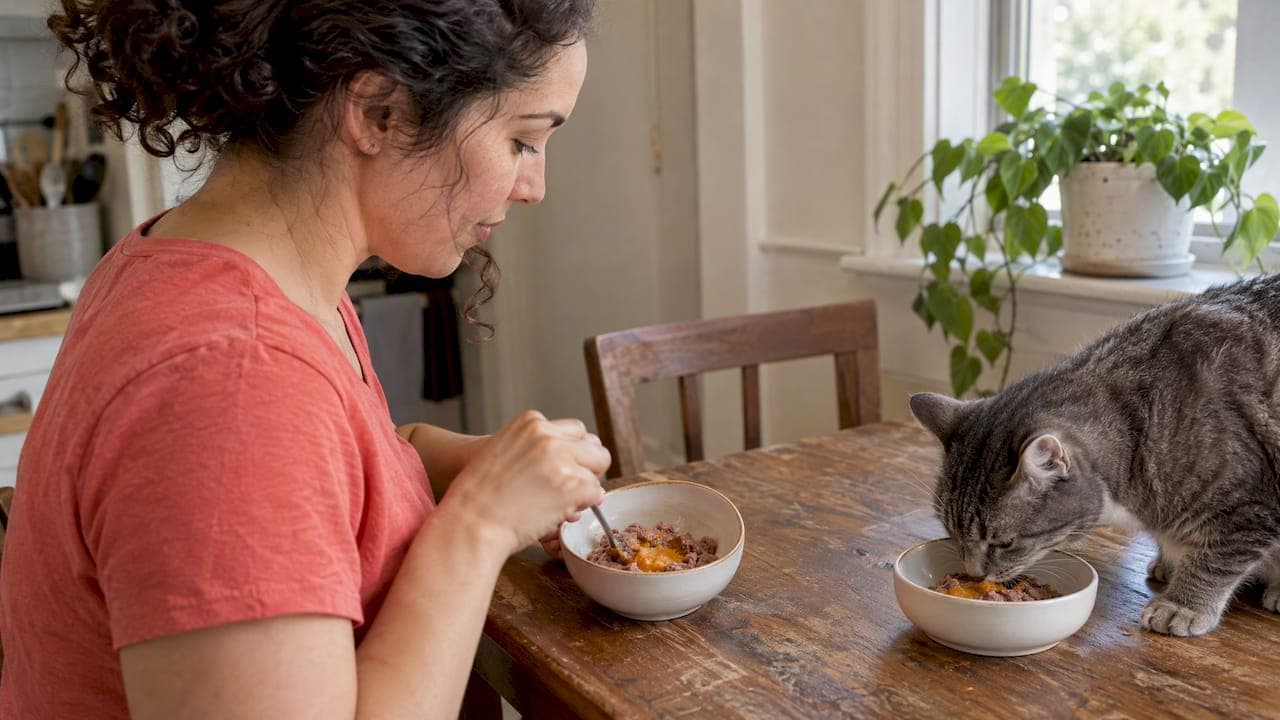
Plain, 100% canned pumpkin is safe for most cats in small amounts, and vets do suggest it for mild constipation or short-lived loose stools. The key words are plain, small and mild. Pie filling is dangerous, a few teaspoons is a typical serving, and pumpkin is never a stand-in for finding out why your cat's stool is off.
Below we cover which pumpkin to buy, how much to give, what to do about diarrhea versus constipation, how pumpkin puree compares with powder, and the signs that mean you should skip the pantry and call the clinic.
TL;DR
- Buy a can that lists one ingredient: pumpkin. Pumpkin pie filling can contain xylitol, spices and added sugar and must stay away from cats.
- Typical vet-cited amounts for an adult cat run from 0.5 to 1 teaspoon to start, up to 1 to 4 teaspoons a day, depending on symptoms and size. Start at the low end.
- Pumpkin is a mild aid for mild, short problems. It does not treat chronic or severe digestive disease.
- Too much can cause or worsen diarrhea, and it should not be given to a cat that is eating poorly.
- Call your vet if your cat is lethargic, vomiting, refusing food, very young or senior, or has diabetes or kidney disease.
Table of Contents
- Is pumpkin good for cats?
- Which pumpkin is safe: puree, pie filling, fresh and seeds
- How much pumpkin to give a cat
- Pumpkin for cat diarrhea
- Pumpkin for cat constipation
- Pumpkin puree, powder and other forms
- How to serve it
- When to skip pumpkin and call the vet
- Our take: pumpkin is a nudge, not a fix
- Finding gut and digestive products worth buying
- FAQ
- Sources
Is pumpkin good for cats?
Cats are obligate carnivores, so they do not need fiber the way people do. Tufts veterinary nutrition experts note that dogs and cats do not require fiber in the diet, but it can help with problems such as diarrhea and constipation. That is the real case for pumpkin: it is a cheap, easy source of soluble fiber and moisture, not a vitamin supplement.
You will see claims about vitamin A, potassium and beta-carotene. Pumpkin does contain potassium, phosphorus, calcium and vitamins A, C and K, but in the few teaspoons a cat eats, those amounts are trivial next to a complete cat food. Think of pumpkin as a tool for the litter box, not as a health food.
How it works is simple. Soluble fiber absorbs excess water in the colon, which can firm up loose stool. The same fiber plus water content can soften hard stool. That is why the Cornell Feline Health Center describes plain canned pumpkin as a mild aid for both constipation and mild, transient diarrhea.
Which pumpkin is safe: puree, pie filling, fresh and seeds
The label is everything. Here is how the common forms stack up.
| Form | Safe for cats? | Notes |
|---|---|---|
| Plain canned pumpkin (100% pumpkin, one ingredient) | Yes, in small amounts | The standard choice. Check there is no salt, sugar or spice. |
| Canned pumpkin pie filling | No | Can contain xylitol, nutmeg, cinnamon, clove, allspice and lots of sugar. |
| Homemade steamed or roasted pumpkin flesh | Yes, in small amounts | Plain only: no salt, oil, spices or sugar. |
| Raw pumpkin, stems, skin | Avoid | Hard to digest, and stems and skin can cause choking or blockage. |
| Raw seeds | Avoid | Can irritate the mouth and GI tract. |
| Pumpkin pie or baked goods | No | Sugar, spices, dairy and sometimes xylitol. |
Why pie filling is a real danger
The difference is not just flavor. Tufts reports that a cup of pie filling can carry up to 281 calories, against 83 calories in a cup of plain canned pumpkin. Beyond the sugar, pies and fillings can include spices such as nutmeg, cinnamon, clove and allspice, and sugar-free versions may use xylitol. Rover's guidance on pumpkin pie warns that xylitol can cause a dangerous blood sugar drop, seizures or liver failure. If your cat has eaten any pie or filling that might contain it, treat it as an emergency and call your vet or a pet poison hotline right away.
Making your own
You can skip the can. Animal Humane Society advises steaming or roasting raw, plain pumpkin flesh with no salt, oil, spices or sugar, and leaving out the stems, skin and raw seeds. Mash it smooth, cool it, and portion it. Homemade pumpkin has more water and varies in thickness from batch to batch, so a can is easier if you want consistent servings.

How much pumpkin to give a cat
There is no single official dose, and anything you read online is a range, not a prescription. What vet sources agree on is to start small.
- Starting point: Cornell's feline health information gives 0.5 to 1 teaspoon for an adult cat as a typical start, rising to 1 to 4 teaspoons a day depending on symptoms and size.
- Mild constipation: PetMD says many cats respond to 2 to 4 teaspoons of canned pumpkin mixed into canned food.
- Ceiling: keep pumpkin to no more than about 10% of daily calories, the limit tied to those same dosing guidelines.
- Kittens: there is no reliable at-home dose. A kitten with loose stool can dehydrate fast, so ask your vet before offering any.
A worked example
Say you have a 10 lb adult cat with a day or two of slightly soft stool, who is eating, playing and drinking normally. A cautious plan:
- Mix half a teaspoon of plain canned pumpkin into one wet-food meal.
- Watch the next two or three stools and your cat's appetite.
- If things are going well, you can stay at that amount or step up gradually toward 1 teaspoon, never leaping to the top of the range.
- If stool is not improving after a day or two, or anything else changes, stop and call your vet.
For the constipation side specifically, we wrote a separate walkthrough: pumpkin for cat constipation, with vet dose guidance and when to call.
Why more is not better
It is tempting to scoop extra. Don't. PetMD notes that too much pumpkin can cause diarrhea, and that it takes up stomach room that should go to complete, meat-based food. Tufts also points out that matching the fiber of a therapeutic high-fiber veterinary diet would take more than 2.5 cups of pumpkin a day, which would crowd out protein and other essential nutrients. A teaspoon or two is a gentle nudge, not a substitute for a proper diet.
Pumpkin for cat diarrhea
For a cat that is otherwise bright and eating, with a day or so of mild loose stool, a small spoonful of plain pumpkin is a reasonable thing to ask your vet about. PetMD's guidance is that after a stool check and other tests, your vet may include pumpkin in a plan, with about 1 to 4 teaspoons mentioned for diarrhea.
But diarrhea is a symptom. The Merck Veterinary Manual explains that added fiber can help mild, self-limiting cases, yet the cause (parasites, infection, inflammatory bowel disease, organ problems) needs a proper diagnosis when the problem persists. Using pumpkin to cover up a symptom can delay care that matters.
Also keep in mind what VCA Animal Hospitals stresses: during a stomach upset, the priorities are a bland, easily digestible diet and good hydration, and a vet may suggest a veterinary gastrointestinal diet rather than extra fiber. For many cats, especially sensitive ones, fiber alone gives inconsistent results.
If diarrhea keeps coming back, ask about the gut as a whole. Our roundup of probiotics for cats with sensitive stomachs covers what to look for, and if a food change is behind it, our guide to switching cat food safely explains how to transition gradually.
Pumpkin for cat constipation
Constipation is where pumpkin has its longest track record. PetMD notes that vets often use canned pumpkin as part of a constipation plan, and it works best alongside wet food, which adds water. Hydration matters as much as fiber here.
There is a limit, though. Cornell warns that fiber like pumpkin is rarely effective for severe constipation, and that constipation should be treated fairly aggressively to stop it progressing. A cat that strains repeatedly in the box, passes nothing, cries, vomits or hides needs a vet visit, not another spoonful.
Pumpkin puree, powder and other forms
Most searches are for puree, and canned plain pumpkin is exactly that. Here is how the forms compare in practice.
- Canned puree: easiest to measure, widely sold in US grocery stores, and keeps for several days once opened and refrigerated. Read the label every time: some cans sit right beside pie filling on the shelf.
- Homemade puree: fine if plain, but portion and freeze it, because a big batch spoils.
- Pumpkin powder: sold as a pet supplement and as a baking ingredient. We found no vet source that gives a cat dosing for powder, so follow the product label and your vet's advice. Check the ingredient list for added flavors, sweeteners or other herbs, and rehydrate it as directed rather than sprinkling dry powder on food, since dry fiber with too little water is the opposite of what a constipated cat needs.
- Pumpkin treats and mixed supplements: useful only if the label is short and clean. If pumpkin is the fifth ingredient behind fillers, it is not doing much.
Storing leftovers
Spoon the rest of the can into an ice cube tray, freeze, and thaw one cube at a time. A cube is usually a bit more than a teaspoon, so you can portion with a spoon first. Do not leave opened canned pumpkin out for the day.
How to serve it
Most cats take pumpkin better when it is hidden. Stir it into a wet food they already like, or warm the food slightly. If your cat is picky, start with a tiny smear on top rather than mixing it through the whole bowl. Do not force it by syringe unless your vet has told you to.
If your cat prefers dry food, know that wet food is the better vehicle for a digestive issue, because the extra water helps. Some cats will also lick pumpkin off a spoon. That is a bonus, not a requirement.
When to skip pumpkin and call the vet
This is the part many pumpkin articles bury. Skip the home remedy and call your veterinarian if:
- Your cat has a poor appetite or refuses food. PetMD warns that pumpkin should not be given to a cat that is not eating well, because it fills the stomach without feeding them properly.
- There is lethargy, vomiting, blood in stool or weight loss alongside the stool change. Dr. Emily Swiniarski of the Anti-Cruelty Society says that in those cases pumpkin is not the solution and your cat should see a vet.
- Your cat has diabetes or chronic kidney disease. The same source advises introducing pumpkin only with veterinary guidance, since dietary balance is critical for these cats.
- Your cat is a kitten, a senior, or has another health condition that makes dehydration riskier. PetMD's guidance is to call the vet right away for young, old or already unwell cats.
- The problem lasts more than a day or two or keeps returning. Recurring stool trouble points to a cause worth finding.
- Your cat strains with no results. That can signal a blockage, and in male cats straining can also be a urinary emergency.
Our take: pumpkin is a nudge, not a fix
At Kiblco we review pet products that owners actually buy, and our health picks are cross-checked against veterinary input. Pumpkin is one of the most common things owners ask us about, and also one of the most misunderstood. We see three patterns.
First, the label mistake. The fall shelf puts pie filling beside plain pumpkin, and the cans look nearly identical. We read the ingredient line on every purchase, and we suggest you do too.
Second, the "more must be better" mistake. Owners who see a firm stool on a teaspoon often double the dose, then wonder why things loosen again. The research backs the small-amount approach: pumpkin is a mild, occasional aid, and the fiber math says it can never replace a therapeutic diet.
Third, the masking mistake. If a cat has had soft stool for a week and the owner is still adjusting pumpkin, the real answer is a stool sample and a vet visit. Fiber that calms a symptom is not a diagnosis.
So our advice is plain: use plain pumpkin in teaspoon amounts for brief, mild issues in an otherwise healthy, eating adult cat, and let your vet make the call on anything bigger. If you are shopping for gut support products after that conversation, we put the pros and cons in the open, including the downsides.
— Chris
Finding gut and digestive products worth buying
If pumpkin turns out not to be enough, or your vet suggests a supplement, a litter-box-friendly food or a specific product, our Cat Health reviews list the pros, cons and real-home results for each one we test. You can also browse everything for cats on our Cats page, from treats to toys, and our guide to freeze-dried cat treats for picky eaters helps if your cat turns up their nose at anything new. We earn commissions when you buy through some links, we accept no payment for coverage, and we state the downsides of every product.
FAQ
Can pumpkin help with cat diarrhea?
For mild, short-lived diarrhea in an otherwise healthy adult cat, a small amount of plain canned pumpkin may firm up stool, since its soluble fiber absorbs extra water. It does not treat the cause, and too much can make diarrhea worse. If diarrhea lasts beyond a day or two, or comes with vomiting, lethargy or not eating, call your vet.
Is pure canned pumpkin good for cats?
Yes, in small amounts. The can should list pumpkin as the only ingredient. Treat it as an occasional aid rather than a daily food, and keep it to roughly 10% of calories or less. Cats with diabetes or kidney disease should only get it on veterinary advice.
How much pumpkin should I give my cat?
Cornell-cited guidance for adult cats starts at 0.5 to 1 teaspoon, going up to 1 to 4 teaspoons a day depending on symptoms and size. Begin at the bottom and watch the stool for a day or two before increasing. For kittens, ask your vet first.
Can cats eat raw pumpkin, seeds or pie filling?
No to all three. Raw pumpkin, stems, skin and seeds can irritate the digestive tract or cause blockages, and pie filling can contain xylitol, spices and sugar. Stick to plain canned pumpkin or cooked plain flesh.
Can I give my cat pumpkin every day?
Some vets recommend a daily spoonful for a short time, but there is no need for long-term use in a healthy cat. If your cat seems to need it constantly, the underlying cause is worth investigating with your vet.
Sources
- Cornell Feline Health Center: Constipation
- Tufts Now: People like giving pets pumpkin, but is it good for them?
- PetMD: Can Cats Eat Pumpkin?
- PetMD: Cat Diarrhea Treatment
- Animal Humane Society: Is pumpkin safe for dogs and cats?
- Great Pet Care: Pumpkin for Cats
- Merck Veterinary Manual: Disorders of the Stomach and Intestines in Cats
- VCA Animal Hospitals: Diarrhea in Cats
- Rover: Can I Share Some Pumpkin with My Cat?