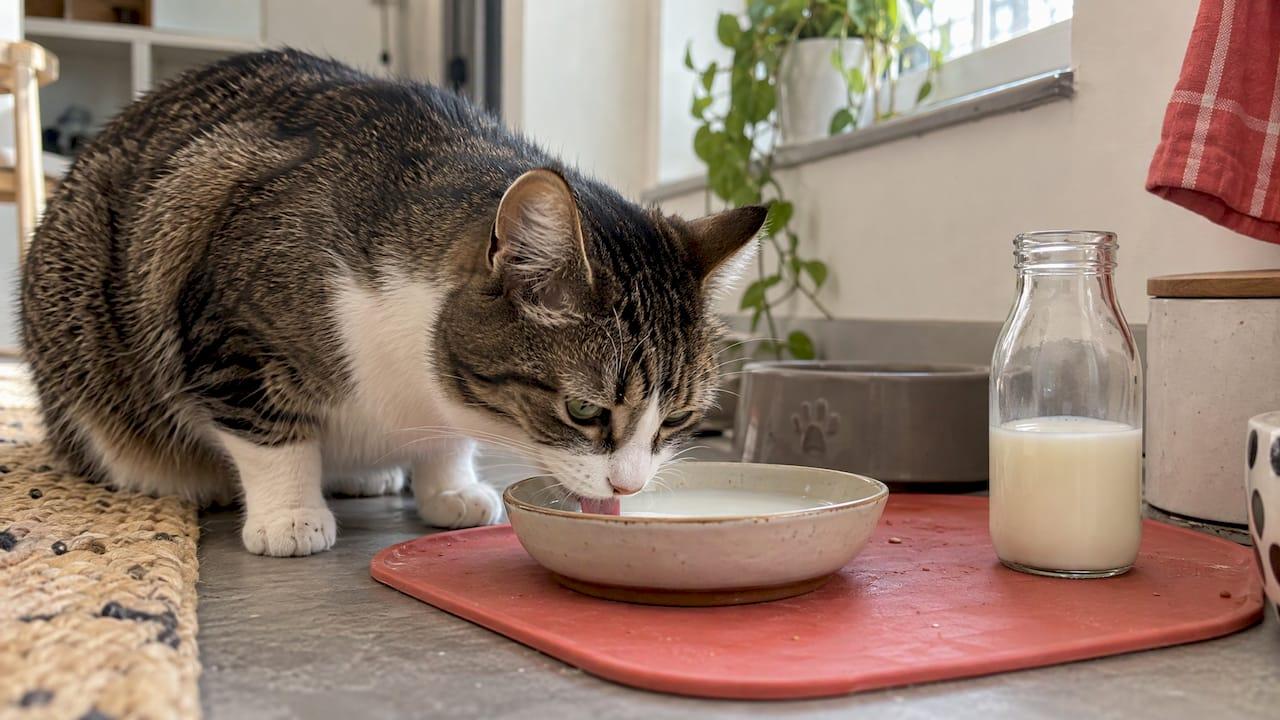
Plain, pasteurized goat milk is generally safe as an occasional small treat for a healthy, fully weaned adult cat. It is not a health food, it is not a medicine, and it is not a substitute for water or a complete cat diet. Kittens are a different story: goat milk does not replace queen's milk or kitten milk replacer. Below, we cover what vets and nutrition references say, how to serve it if you choose to, and what to reach for when the real problem is a cat with loose stool.
TL;DR
- Pasteurized, plain goat milk can be an occasional treat for a healthy adult cat, in small amounts. Ask a Vet says it is not necessary and not a proven treatment for any condition.
- Never give raw milk. Five cats in Los Angeles County died of H5 bird flu after drinking recalled raw milk.
- Kittens need queen's milk or kitten milk replacer. Goat milk is too low in protein and fat for them.
- Goat milk still contains lactose, so watch for soft stool, gas, or vomiting after the first sip.
- For diarrhea, plain canned pumpkin is a common fiber helper, but a cat with active diarrhea should be seen by a vet.
Table of Contents
- Is goat milk safe for adult cats?
- Why raw goat milk is off the table
- Can cats have organic goat milk?
- Can kittens drink goat milk?
- How to serve goat milk to a cat, if you choose to
- Goat milk powder for cats
- What is the best goat milk for cats?
- Pumpkin for cats with diarrhea
- Our perspective
- Find cat-safe treats and supplements
- FAQ
- Sources
Is goat milk safe for adult cats?
For most healthy adult cats, a few licks or a spoonful of plain pasteurized goat milk will not cause harm. Vet sources describe it as an occasional, calorie-containing treat rather than something a cat needs. Ask a Vet states that it is neither necessary nor a proven treatment for digestive disease, allergies, or poor immunity.
That last point matters because many pages promise immune boosts, shinier coats, and better joints. Those claims are marketing more than medicine. Goat milk is food, and a small treat is all it needs to be.
Goat milk versus cow milk
Goat milk has less lactose than cow milk and some vets describe it as easier to digest. AdoptAPet cites Dr. Turano saying it may help gut flora and reduce inflammation, while advising owners to talk with a veterinarian before adding it to a cat's diet.
"Less lactose" is not "no lactose." Ask a Vet points out that the differences from cow milk do not make goat milk lactose-free, hypoallergenic, or guaranteed gentle on the gut. Many adult cats lose much of their ability to digest lactose, so the same rule applies as with any dairy: start tiny and watch.
How goat milk compares with what cats need
A reference table in Small Animal Clinical Nutrition (5th edition) lists goat's milk at 3.6 g protein and 4.1 g fat per 100 g, against 7.5 g protein and 8.5 g fat in queen's milk. Taurine, an amino acid cats must get from animal sources, is only a trace in goat milk, while queen's milk has 27 mg per 100 g. Lactose is the same at 4.0 g per 100 g.

In plain terms: goat milk is thinner in protein and fat than cat milk, and it is not built for a carnivore. That is fine for a lick of treat. It is not fine as a meal.
Why raw goat milk is off the table
If you remember one safety rule, make it this one. In January 2025, the Los Angeles County Department of Public Health reported that five cats died of H5 bird flu after drinking raw milk that was part of a recall for H5N1 contamination. The department recommended that veterinarians strongly advise owners not to feed pets raw dairy, raw meat, raw poultry, or raw pet food diets.
That case involved raw cow milk, but the lesson is the same for any raw dairy. Raw goat milk from a farm stand or a "fresh" bottle is a gamble you do not need to take. Check that the label says pasteurized before it goes anywhere near your cat's bowl.
Can cats have organic goat milk?
Yes, in the same way and the same amounts as conventional goat milk, provided it is pasteurized. "Organic" describes how the animals were raised and fed. It does not tell you the milk is safer for a cat's digestion, and it does not add the taurine and fat that cats need. Read the label for two things: the word pasteurized, and an ingredient list that is just milk, with no added sugar, flavoring, or sweeteners.
We would not pay extra for organic goat milk on the theory that it is better for cats. If organic suits your household for other reasons, the serving rules below stay exactly the same.
Can kittens drink goat milk?
No, not as a regular food. This is where vets are most consistent. A 2024 review of neonatal milk replacers says commercial replacers made for kittens are preferred over cow or goat milk, neither of which meets a growing kitten's needs. For the first 3 to 5 weeks, kittens should have only queen's milk or milk replacer.

The orphan kitten guide from Helping Strays is blunt: do not substitute cow or goat milk for kitten milk replacer, because they are not equivalent.
Why it falls short for kittens
- Too little protein and fat. VCA Animal Hospitals says goat's milk is far too low in both for kittens.
- Trace taurine. GoatsAuthority notes that goat milk has only trace taurine and lacks arachidonic acid, a fatty acid cats can only get from animal sources.
- More lactose per calorie. Dr. Emmanuel Fontaine reports goat milk at 710 kcal per liter, compared with 1170 kcal per liter for cat milk, and higher in lactose per unit of energy.
The emergency exception
VCA notes that pasteurized goat's milk can be used only in an emergency, until you can get kitten milk replacer, which should be as soon as possible. If you have found a kitten and the stores are closed, that is the one situation where goat milk is a bridge. Call a vet or a rescue the same day.
For older kittens past weaning, Dr. Hannah Godfrey says she does not recommend goat milk because it is not necessary. Her advice is formula for kittens at or below weaning age, and water for older kittens.
How to serve goat milk to a cat, if you choose to
If your adult cat is healthy and you want to offer a treat, keep it simple.
- Choose plain, pasteurized goat milk. No flavors, no sweeteners, no added ingredients.
- Start with a teaspoon or less. Offer it on its own or drizzled over wet food.
- Wait 24 hours. Watch for loose stool, gas, vomiting, or reduced appetite.
- Keep it occasional. Treat it like any other treat, a small part of the day's calories. Do not let it replace water or meals.
- Stop at any sign of upset. Then talk to your vet if symptoms continue.
Cats with kidney disease, pancreatitis, diabetes, or weight problems should skip dairy treats unless their vet agrees. The fat and calories add up, and these conditions are exactly where a vet should set the diet.
What about goat milk for extra hydration?
A common question is whether goat milk can add liquid to a cat's day. It can contribute a few spoonfuls of fluid, but it also brings lactose and calories. A better route for cats that drink little is wet food, a water fountain, or a vet-approved topper such as a little low-sodium broth. Our guide to bone broth for cats covers amounts and a label checklist.
Goat milk powder for cats
Goat milk powder is shelf-stable, which makes it convenient for tiny treat portions. Products are marketed for intermittent or supplemental feeding, not as a complete diet. Follow the mixing ratio and serving size printed on the label of the product you buy, and scale down for a cat, since many labels are written with dogs in mind.
The same rules from above apply. Choose a powder with a short ingredient list, avoid anything with added sugars or flavorings, and do not use powder as a kitten formula. A reconstituted goat milk powder is still goat milk: still has lactose, still low in taurine, still a treat.
If you want a supplement for a specific goal, such as gut or joint support, that is a conversation for your vet. Our cat health picks are where we collect the products we have tested for those needs.
What is the best goat milk for cats?
There is no single best brand, because the best option is the plainest one. In order of preference:
- Pasteurized goat milk with nothing added. The shortest ingredient list wins.
- Plain goat milk powder with a feeding guide that includes cats.
- Avoid raw milk, flavored milk, anything sweetened, and any "goat milk formula" sold as a kitten food replacement unless it is labeled as a complete kitten milk replacer.
If your goal is a treat your cat will love, there are plenty of options that are formulated for cats. We review those in our cat categories, with the pros and cons written out.
Pumpkin for cats with diarrhea
Many owners land on goat milk searching for a gut fix, then wonder about pumpkin. Pumpkin is the more established tool, though still a modest one. A 2022 JAVMA review notes that canned pumpkin may be used as a fiber source in clinical practice for dogs and cats, and that evidence-based dosing guidelines are limited.
Which pumpkin to use
Use plain canned pumpkin, 100 percent pumpkin with nothing else in the can. Pumpkin pie filling is a different product, with sugar and spices, and does not belong in your cat's bowl.
How much pumpkin
Because research on doses is limited, vets tend to start low. Newtown Square Veterinary Hospital says that small dogs and cats begin with a small daily amount of plain canned pumpkin, adjusted up or down depending on stool quality. For a specific starting dose for cats, see our guide to pumpkin for cats and our pumpkin for cat constipation article, which gives the vet dose and when to call.
More is not better. The JAVMA review warns that too much fiber can reduce mineral absorption, dilute calories, and sometimes cause diarrhea itself. Fiber should be raised gradually to avoid gas, bloating, and cramping.
When to call the vet instead
Pumpkin is for a mild, short-lived stool upset in an otherwise bright, eating, drinking cat. Call your vet if your cat has diarrhea with vomiting, lethargy, blood, or not eating, if it lasts more than a day or two, or if the cat is a kitten, a senior, or has a chronic condition. Diarrhea in a kitten can become serious quickly. Dairy is also a common cause of loose stool, so if your cat has just had milk, stop the milk first.
Pumpkin fiber versus goat milk
If you are choosing between the two for stool trouble, pumpkin is the better-established helper, and goat milk can be the cause. Fiber adds bulk to stool. Goat milk adds lactose. That alone is a reason to hold off on goat milk when your cat's stomach is already unsettled.
Our perspective
We test products in real homes with real cats, and goat milk is a good example of why we do it. Search results are full of glowing claims about immunity, coat, and joints. When we look at what vets actually say, the picture is plainer: a small, plain, pasteurized serving is a treat, and that is a perfectly fine thing for it to be.
Our rule is that a product earns a recommendation by doing what it says, with its downsides written next to its benefits. For health topics, we cross-check our picks with veterinary input. If your goal is real digestive, joint, or hydration support, we would rather point you toward a product built for cats than a kitchen workaround. Our cat health reviews lay out the pros and cons so you can choose with confidence.
We earn commissions when you buy through our links, and we accept no payment for coverage.
Chris
Find cat-safe treats and supplements
If you came here looking for something to spoil your cat or soothe an upset stomach, browse our hands-on reviews of cat health products, each with its pros and cons spelled out.
For play, enrichment, and a happier routine, our cat toys reviews are a good next stop. Planning a food change? Read how to switch cat food safely first.
FAQ
Is goat milk good for cats every day?
No. Daily goat milk adds fat, calories, and lactose that a cat does not need, and it can crowd out balanced food. Vet sources describe it as an occasional treat for healthy adults. If you want a daily supplement for a specific goal, ask your vet which product suits your cat.
Can cats have raw goat milk?
No. Raw milk can carry dangerous pathogens, and Los Angeles County reported cat deaths from H5 bird flu linked to recalled raw milk in 2025. Choose pasteurized only, or skip dairy altogether.
Can kittens drink goat milk?
Not as a regular food. Kittens under weaning age need queen's milk or a kitten milk replacer, and older kittens do well on water and kitten food. Pasteurized goat milk is only an emergency stopgap until you can get replacer, and a vet visit is wise.
How much pumpkin should I give my cat with diarrhea?
Start small, with plain canned pumpkin and nothing added, and adjust to stool quality. Dosing guidance is limited, so see our pumpkin guide for starting amounts. If diarrhea continues beyond a day or two, or comes with vomiting or lethargy, call your vet.
Sources
- Los Angeles County Department of Public Health: H5 Bird Flu animal health alert (January 2025)
- Ask a Vet: Is Goat Milk Good for Dogs and Cats?
- AdoptAPet: Can Cats Drink Milk?
- Today's Veterinary Nurse: From Birth Through Weaning
- Helping Strays: How to Care for an Orphan Kitten
- Small Animal Clinical Nutrition, 5th edition, page 408
- VCA Animal Hospitals: Raising Kittens
- GoatsAuthority: Can Baby Kittens Drink Goats Milk?
- Dr. Emmanuel Fontaine: How to Make Kitten Milk
- PetsRadar: Can kittens drink milk?
- JAVMA: Dietary fiber in canine and feline management (2022)
- Newtown Square Veterinary Hospital: Every Season is Pumpkin Season