
A dog food bag carries two kinds of text: marketing on the front and regulated information on the back and sides. Read the regulated parts in the right order and you can compare any two foods in about two minutes. Start with the nutritional adequacy statement, then the guaranteed analysis, calories, feeding directions and the ingredient list. That is the order a veterinarian-written guide at PetMD recommends, and it is the order this guide follows. At Kiblco we test the dog foods and treats we review in real homes and check our health picks with veterinary experts, so label reading is where every review starts.
TL;DR
- Find the nutritional adequacy statement first. It tells you whether the food is complete and balanced and for which life stage.
- The guaranteed analysis lists legal minimums and maximums, not exact amounts. Convert to dry matter before comparing a canned food with a kibble.
- Ingredients are listed by weight as fed, so water-heavy ingredients look more important than they are.
- Product names follow set rules: the 95%, 25% and 3% ("with") rules change how much of an ingredient the food has to contain.
- Treats and supplements are exempt from the adequacy statement, so do not use them as a main meal.
Table of Contents
- What a dog food label has to show
- Step 1: Read the nutritional adequacy statement
- Step 2: Decode the guaranteed analysis
- Step 3: Check calories and feeding directions
- Step 4: Read the ingredient list for what it can and cannot say
- Step 5: Understand the name rules (95%, 25%, 3%)
- Claims on the front of the bag
- A 2-minute label check you can use in the pet aisle
- Our view
- Find vet-informed picks
- FAQ
- Sources
What a dog food label has to show
In the United States, dog food labels are regulated twice. The FDA sets the federal requirements in 21 CFR part 501: product identification, net quantity, the name and place of the manufacturer or distributor, and every ingredient by its common name in descending order of weight. States add their own rules, and many base them on model regulations published by AAFCO, the Association of American Feed Control Officials, a body of state and federal feed regulators.
AAFCO's Reading Labels guide lists the full set of elements:
- Product and brand name
- Species statement ("dog food") on the front of the package, the principal display panel
- Quantity statement, in both English and metric units
- Guaranteed analysis
- Ingredient statement
- Nutritional adequacy statement (snacks, treats and supplements are exempt)
- Feeding directions
- The guarantor's name and address
The AKC's guide adds the calorie statement to its list. Some states are now adding more. Washington's rules, for example, adopted the 2025 AAFCO publication and now call for a "Pet Nutrition Facts" panel, a purpose statement on the front and the guarantor's phone number, per the FDA page above. If your bag looks different from an older one, that is probably why.
Step 1: Read the nutritional adequacy statement
AAFCO calls this statement "perhaps the most important part of a label", because it matches the food to your dog's needs and uses a standard format that makes foods easy to compare.
The Merck Veterinary Manual says the statement takes one of four forms:
- The food is formulated to meet the nutrient levels in the AAFCO Dog Food Nutrient Profiles for a named life stage.
- Animal feeding tests using AAFCO procedures show the food provides complete and balanced nutrition for that life stage.
- The food is comparable to a related product that has passed one of those routes.
- The food is for intermittent or supplemental feeding only.
The blank is filled with a life stage: gestation/lactation, growth, maintenance or all life stages. "Complete" means the food contains every required nutrient, and "balanced" means those nutrients are in the right ratios, according to AAFCO's Selecting the Right Pet Food page. A complete and balanced food can be the sole diet for that life stage. A food labeled for intermittent or supplemental feeding cannot.
Life stage, and the large-breed line
"All life stages" means the food meets the minimums for pregnancy and nursing, growth and adult maintenance. NC State's veterinary hospital points out that growing puppies need more protein, fat, calcium and phosphorus than adults, and those levels may be too high for adult dogs, so it recommends a diet matched to the dog's life stage. Talk to your veterinarian about large-breed puppy, mature adult and senior diets.
If you have a large puppy, look for one extra sentence. Per the Merck manual, foods claiming growth or all life stages must say either that they include growth of large-size dogs (70 lb or more as an adult) or that they exclude it. A puppy who will grow past 70 lb needs the "including" version.
Step 2: Decode the guaranteed analysis
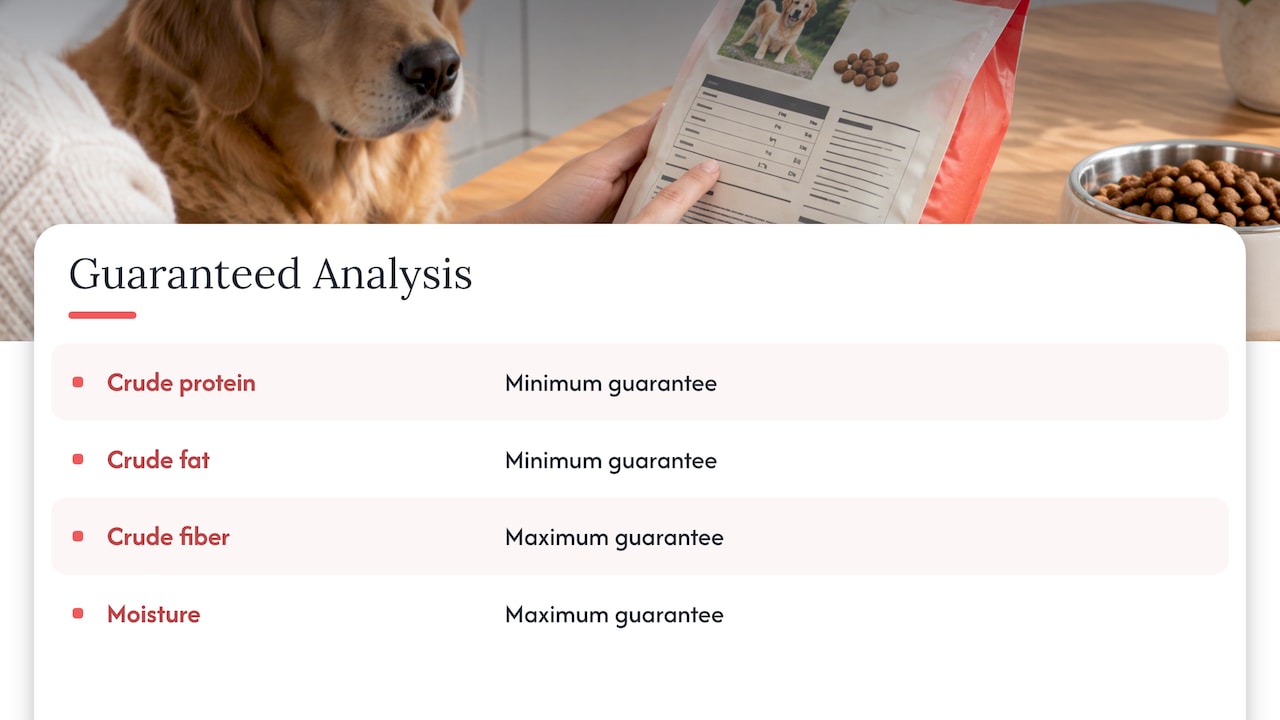
The guaranteed analysis usually sits on the back or side panel near the ingredient list. AAFCO requires four basic guarantees: minimum crude protein, minimum crude fat, maximum crude fiber and maximum moisture. "Crude" describes the lab method, not the quality. Crude protein, for instance, is estimated from nitrogen content multiplied by 6.25.
Two details trip people up.
The numbers are floors and ceilings. The Merck manual explains that these are minimum protein and fat and maximum fiber and water on an as-fed basis, not the actual amounts. A food guaranteeing 25% protein usually contains a bit more, and two foods with the same guaranteed analysis can differ in lab results. Merck suggests using the manufacturer's average nutrient profile when you can get it. VCA's hospital guide says the same thing in different words: look for a "typical analysis" on the company's website or ask the manufacturer for it.
Meeting a minimum does not make a food complete. That is the adequacy statement's job, which is why we read it first.
Compare foods on a dry matter basis
Because water dilutes everything, a canned food and a kibble cannot be compared straight off the panel. The handbook by veterinarian Dr. Rameez Bloch gives the conversion: dry matter % = nutrient % ÷ (100 − moisture %) × 100.
A worked example:
| Moisture | Protein as fed | Protein on dry matter | |
|---|---|---|---|
| Kibble | 10% | 25% | 25 ÷ 90 × 100 = 27.8% |
| Canned food | 78% | 8% | 8 ÷ 22 × 100 = 36.4% |
On the label the kibble looks three times richer in protein. On a dry matter basis the canned food is higher. Neither number says which is better for your dog. It only lets you compare like with like.
Other rules worth knowing: if a low-fat claim appears, both minimum and maximum fat must be guaranteed. Ash, if listed, appears as a maximum right after moisture.
Step 3: Check calories and feeding directions
Calories matter more than most owners expect. PetMD notes that the calorie statement is given in kilocalories per kilogram and per familiar unit such as a cup, can or biscuit. Use the per-cup number to see what the directions really give your dog in a day.
Feeding directions are a starting point, not a prescription. VCA's guide says they are based on averages. AAFCO adds that the right food still fails if the amount is wrong: calorie-dense puppy food can make a less active adult overweight, while a working or pregnant dog may be underfed on a sedentary-adult formula. Weigh your dog every few weeks, watch body condition, and ask your veterinarian to adjust the amount.
Switching foods? Go gradually. We lay out a 7 to 10 day vet-backed switching plan for U.S. dog owners.
Step 4: Read the ingredient list for what it can and cannot say
AAFCO requires ingredients to be listed individually, in descending order by weight, using standard or common names, all in the same type, size and color. Collective terms such as "grain products" are not allowed, and the list cannot state quality or grade.
The key detail comes from the Merck manual: weight is counted as fed. Fresh chicken is roughly three-quarters water, so it can top the list yet contribute far less dry nutrient than the same chicken as a meal (cooked and dried). A list that starts with "chicken" is not automatically more meaty than one that starts with "chicken meal." Merck also notes that comparing ingredient lists has limited value because dogs need nutrients, not ingredients. Use the list to spot something your dog is sensitive to, and use the adequacy statement and analysis to judge the diet.
Step 5: Understand the name rules (95%, 25%, 3%)
The product name tells you how much of a named ingredient the food contains. AAFCO's Pet Food Labeling Guide arranges these as the 100%, 95%, 25% and 3% rules. Colorado's regulations, which follow the AAFCO model, spell them out. Your state's wording may differ in detail.
| Name looks like | Rule | What it requires |
|---|---|---|
| "Beef Dog Food" | 95% rule | The named meat, poultry or fish is at least 95% of the total weight excluding water added for processing, and at least 70% of total weight |
| "Beef Dinner," "Beef Recipe," "Beef Formula" | 25% rule | The ingredient is at least 25% of weight (at least 10% with water included), and the descriptor is in the same size and style as the ingredient |
| "Dog Food with Beef" | 3% ("with") rule | The ingredient is at least 3% of weight excluding processing water, in restricted type size |
That is the answer to the 95% rule question people search for. A name with "dinner" or "recipe" signals the 25% rule, not a mostly-beef food, and "with" signals just 3%. None of this is good or bad on its own. It tells you what the name is promising.
Claims on the front of the bag
Wisconsin's pet food label guide notes that drug claims such as "eases joint pain" are not allowed on dog food. A nutritive claim such as "enriched with vitamins and minerals" requires extra nutrient guarantees on the label. If a food promises a health benefit in drug-like terms, that is a cue to look at the real label panels rather than the claim. When you want joint, gut or skin support beyond the diet, that is a supplement conversation to have with your veterinarian first, and pet vitamins and supplements deals show the kind of products people compare.
Treats and supplements work differently. Kentucky's rules, for instance, require an adequacy or purpose statement unless the front clearly says snack, treat or supplement. Treat them as extras, not the base diet.
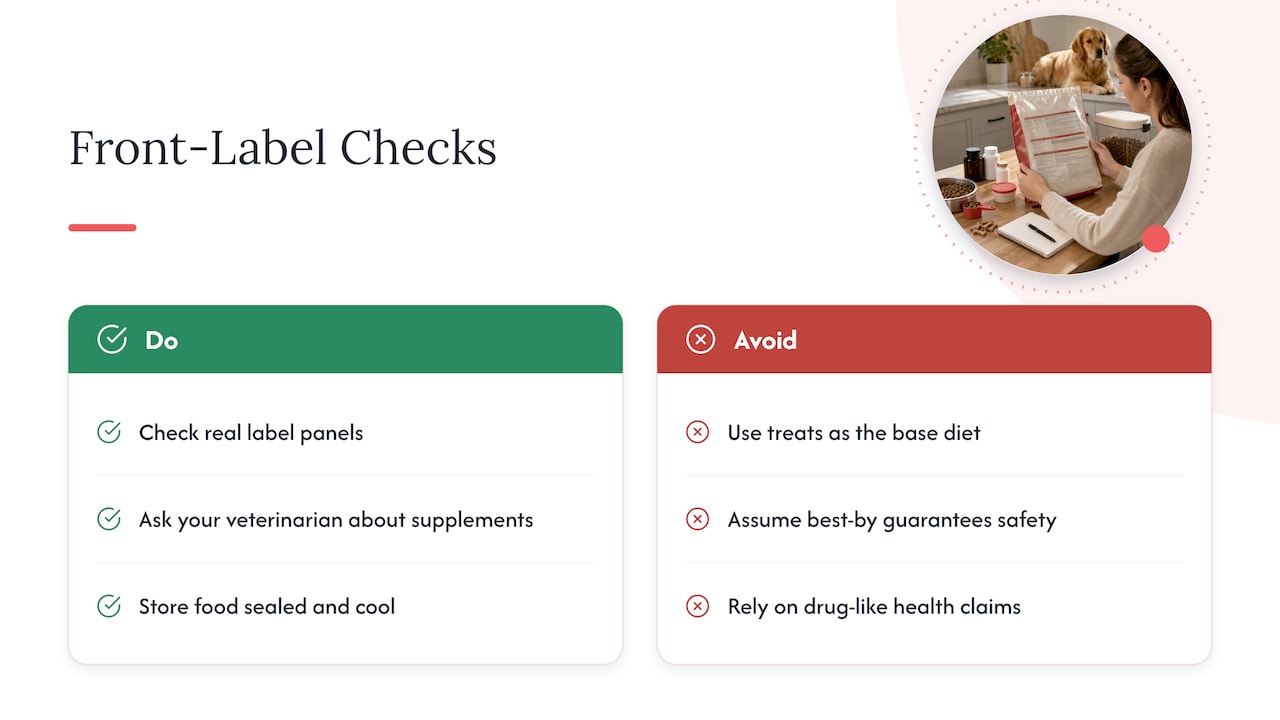
One more date to find: the best-by date. PetMD explains it marks expected quality under proper storage and is not a safety guarantee, so store food sealed and cool.
A 2-minute label check you can use in the pet aisle
- Adequacy statement: complete and balanced for your dog's life stage? Large-breed puppy? Look for "including growth of large-size dogs."
- Calories per cup: multiply by the daily amount in the feeding directions.
- Guaranteed analysis: convert protein and fat to dry matter if you are comparing wet with dry.
- Name: which rule does it follow?
- Ingredients: anything your dog reacts to? Remember water-heavy ingredients are overstated by weight.
- Manufacturer: is there a name, address and phone number on the bag?
If the numbers still leave you unsure, a veterinarian or a board-certified veterinary nutritionist can match a diet to a dog with a health condition, a very large breed or an unusual activity level. For how the standards behind these statements work, see our guide to AAFCO dog food standards. If you are weighing fresh food, our fresh dog food cost breakdown shows monthly spend.
Our view
Most owners do not need a nutrition degree, they need a sequence. Every food we review gets the same first pass: adequacy statement, life stage, calories, then the analysis on a dry matter basis. Only then do we look at how the food performed at home: how dogs took to it, how the bag stored, what the pros and cons were.
We buy the products we review, we do not accept payment for coverage, and we cross-check our health picks with veterinary experts. A label tells you what a food claims and must contain. Real testing at home tells you how it goes in a real kitchen with a real dog. We think you need both before you buy.
Chris
Find vet-informed picks
Once you know what to look for on the label, our reviews of dog foods, treats and supplements put it to work, with pros and cons spelled out and our affiliate relationships disclosed. Browse them in Dog Health and Dog Treats.
FAQ
What does "complete and balanced" mean on dog food?
It means the food contains all required nutrients in the right ratios for the life stage named in the adequacy statement. The AKC quotes a veterinarian explaining that the food meets government standards set through AAFCO. A complete and balanced food can serve as the whole diet for that life stage.
Is the guaranteed analysis the exact amount of protein in the food?
No. Protein and fat are guaranteed minimums, and fiber and moisture are maximums, so the real values are usually a little different. Use the dry matter formula above to compare foods fairly, and ask the maker for its typical analysis when you need precision.
What is the 95% rule in dog food?
When a name such as "Beef Dog Food" uses just the ingredient, that ingredient must make up at least 95% of the weight excluding processing water. A name with "dinner" or "recipe" falls under the 25% rule, and "with beef" under the 3% rule.
Does the first ingredient tell me the best food?
Not by itself. Ingredients are listed by weight as fed, so a fresh meat full of water can rank first while contributing less dry nutrient than a meal further down. Judge the food by the adequacy statement, calories and analysis, and use the list to spot ingredients your dog should avoid.
Sources
- Reading Labels, AAFCO
- Selecting the Right Pet Food, AAFCO
- Introduction to the Pet Food Labeling Guide, AAFCO
- Animal Food Labeling and Pet Food Claims, FDA
- Dog and Cat Foods, Merck Veterinary Manual
- Evaluating Pet Food, NC State Veterinary Hospital
- A Guide to Dog Food Ingredients and Reading Dog Food Labels, PetMD
- How to Read Dog Food Labels, American Kennel Club
- Deciphering Dog Food Labels, VCA
- Pet Nutrition Handbook, Dr. Rameez Bloch
- Code of Colorado Regulations, pet food rules
- Pet Food Labels, Wisconsin DATCP
- 12 KAR 3:039, Kentucky Administrative Regulations