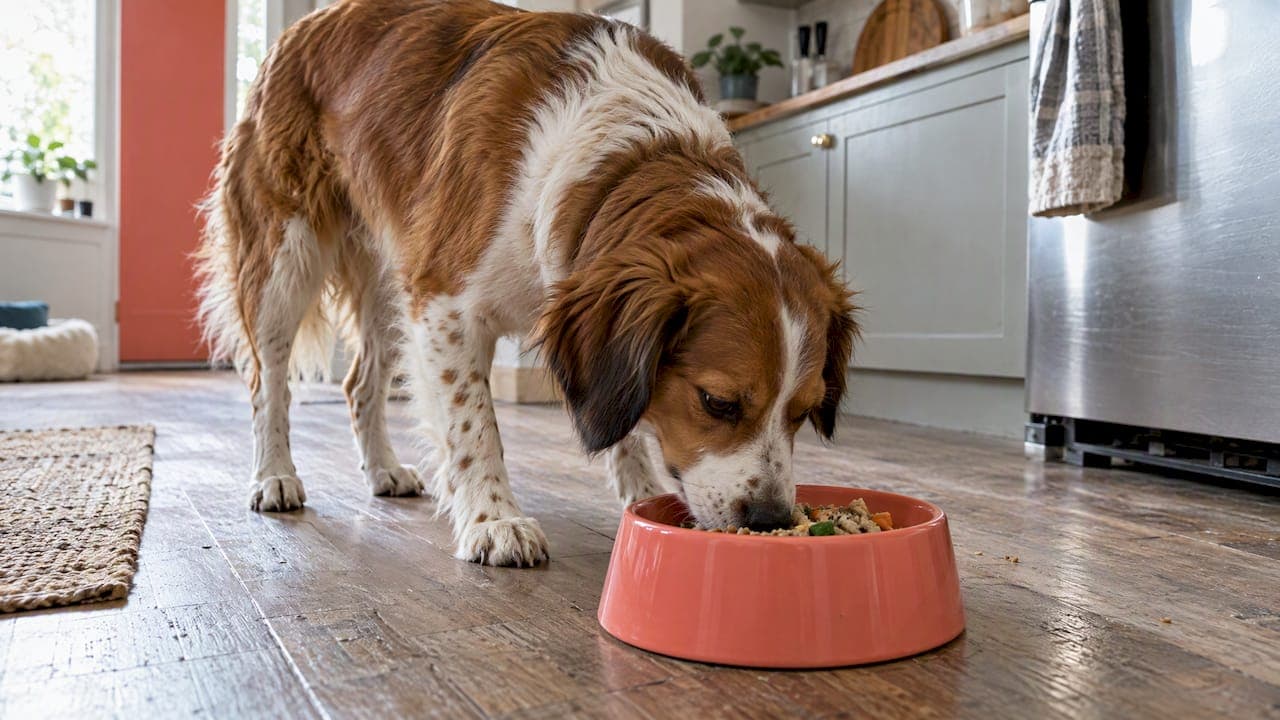
Fresh dog food costs roughly $80 to $500 a month in the U.S., and where you land depends mostly on your dog's size, age and activity level. Small dogs sit near the bottom of that range, large dogs near the top, and a first-box discount makes the early weeks look cheaper than the months that follow. Below you'll find the numbers by size, a per-day formula you can run on your own dog, and the levers that actually bring the bill down.
TL;DR
- Expect about $80 to $175 a month for a small dog, $125 to $320 for a medium dog and $260 to $500 for a large dog, according to a 2026 cost guide from Vety.
- Fresh food runs about $1.40 per 100 calories, against about $0.25 for dry food, per PetMD.
- Intro discounts apply to the first box. Budget from the regular price, not the trial price.
- Partial plans, neutered-dog calorie needs and cheaper proteins are the biggest ways to trim the bill.
Table of Contents
- What fresh dog food costs per month by dog size
- How to estimate your own dog's daily cost
- What pushes the price up or down
- Fresh dog food vs. kibble: how big is the gap?
- Intro offers vs. ongoing cost
- Ways to pay less without feeding worse
- Our perspective: is fresh worth it?
- Find food, treats and health picks you can trust
- FAQ
- Sources
What fresh dog food costs per month by dog size
Fresh dog food is cooked or gently processed food, usually delivered refrigerated or frozen, and portioned for your dog. It is priced by the calorie, so the bill follows how much your dog needs to eat.
Vety's 2026 guide puts the overall range at $80 to $500 a month and breaks it out by size (Vety):
| Dog size | Typical monthly cost | Approximate per day (30-day month) |
|---|---|---|
| Small | $80 to $175 | $2.67 to $5.83 |
| Medium | $125 to $320 | $4.17 to $10.67 |
| Large | $260 to $500 | $8.67 to $16.67 |
The per-day column is our own division of those monthly figures, so you can compare them with the daily prices companies advertise. The ranges are wide for a reason. A sedentary 12-pound dog on a half-fresh plan and a lean, active 70-pound dog on an all-fresh plan can both be in the "fresh dog food" market and differ in spend by several hundred dollars.
You may also see higher or lower numbers elsewhere. Roundups often quote the lowest advertised daily price, which applies to the smallest dogs on the cheapest recipe, or a promotional rate. Treat those as a floor, not a forecast.

How to estimate your own dog's daily cost

The cleanest way to budget is by calories, not by pounds of food. Cost per pound can mislead you, because a lower-calorie recipe means a bigger portion to deliver the same energy.
Here is the method:
- Find your dog's daily calorie target. Ask your vet, or use the feeding guide the company generates for your dog. Dogs of the same weight can differ widely.
- Find the recipe's price per 100 calories. Divide the price of a pack by its total calories, then multiply by 100.
- Multiply. Calories per day divided by 100, times the price per 100 calories.
A worked example with PetMD's typical figures of about $1.40 per 100 calories for fresh and about $0.25 for dry (PetMD). Say your dog needs 700 calories a day. That number is for illustration only.
| Feeding approach | Math | Per day | Per 30 days |
|---|---|---|---|
| All fresh | 7 × $1.40 | $9.80 | $294 |
| All dry | 7 × $0.25 | $1.75 | $52.50 |
| Half fresh, half dry | (3.5 × $1.40) + (3.5 × $0.25) | $5.78 | about $173 |
The all-fresh line lands inside the medium-dog range above, which is a useful sanity check. If your own math lands far outside the range for your dog's size, recheck the calorie target.
What pushes the price up or down
Several things move your monthly bill, and some are in your control.
Your dog's size, age and activity
Bigger, younger and more active dogs eat more. Neutering matters too: Vety notes that spayed or neutered dogs typically need fewer calories, which can cut monthly food costs by 10% to 25% compared with intact dogs of the same size (Vety). If your dog has gained weight or slowed down, the calorie target, and the bill, should shift with it.
Protein choice
Beef and lamb typically cost more than chicken or turkey, and novel proteins such as venison or duck cost the most, per Vety. Unless your dog has a diagnosed allergy or intolerance, a poultry recipe is usually the cheapest way into fresh feeding.
Brand and ingredient claims
Premium positioning and organic ingredients add cost, according to the same guide. Check what you are paying for. A label that says human-grade or organic is a pricing signal, not automatically a nutrition upgrade. What matters nutritionally is that the recipe is complete and balanced for your dog's life stage.
Full plan or partial plan
Putting every meal on a fresh plan is the most expensive route. A partial plan, where fresh replaces part of the diet and your usual food covers the rest, is one of the main levers listed in Vety's cost breakdown.
Delivery and packaging
Most fresh food ships in insulated boxes with frozen or refrigerated packs, and many services fold shipping into the per-meal price. Before you subscribe, read the checkout total, not just the per-day price on the landing page. Ask whether shipping is included, whether there is a minimum order, and how easily you can skip or pause a delivery.
Fresh dog food vs. kibble: how big is the gap?
Substantial. At PetMD's typical figures, fresh food costs more than five times as much per 100 calories as dry food (PetMD). PetMD also notes that fresh food may not make economic sense for every pet parent, and it advises checking that any food meets AAFCO nutrition standards.
That last point deserves attention. A price tag tells you nothing about whether a recipe is complete. Our guide to AAFCO dog food standards explains how to read the nutritional adequacy statement so you know what you are paying for.
If you are weighing fresh against other formats, two more reads help:
- Our raw vs. kibble guide covers the evidence on each style.
- If you are curious about a middle path, our practical guide to cold-pressed dog food looks at a format that sits between kibble and fresh.
Intro offers vs. ongoing cost
Fresh-food services commonly advertise a large discount on your first box. The deal can be real, but it only affects the first order, and the lowest "starting at" daily price usually describes the smallest dog on the least expensive recipe.
I can't give you a current promotion here because they change constantly, and any discount we quoted would be out of date soon. What you can do is run the numbers on the regular price:
- Use the post-discount price. If a first box with a 50% discount costs $100, plan on $200 for the same box next time.
- Check the fine print. Look for what happens after the trial: the renewal cadence, whether the plan auto-ships, and what the second box costs.
- Price your exact dog. Enter your dog's weight, age and body condition rather than reading the headline rate.
- Find the cancel or pause path before you pay. If it is hard to find, that is a signal.
Treat the first box as a low-cost test. Watch how your dog handles the switch, whether they finish the meals and how their stool looks, then decide whether the ongoing price fits your budget. Moving a dog to new food is best done gradually, and our 7 to 10 day food-switch plan lays out how.
Ways to pay less without feeding worse
You do not have to choose between full fresh and none. These approaches stretch the budget:
- Go partial. Feed fresh for one meal and a complete kibble for the other. The 700-calorie example above drops from about $294 to about $173 a month.
- Use fresh as a topper. A small amount mixed into kibble adds appeal at a fraction of the cost. We rounded up options in our best dog food toppers review.
- Pick a cheaper protein. Chicken or turkey recipes typically cost less than beef, lamb or exotic meats (Vety).
- Keep your dog lean. Overfeeding wastes money and can hurt health. Feed to the calorie target and recheck it with your vet when your dog's weight changes.
- Order the right cadence. Shipping more often than you use food leads to freezer clutter. Shipping too rarely can leave you scrambling.
- Compare services on vet oversight, not only price. Our look at two popular fresh-food services on cost and vet involvement shows how to weigh both.
Our perspective: is fresh worth it?
We test products in real homes and cross-check health picks with veterinary input, so here is how we think about fresh food. It can be a good choice for picky eaters, for owners who want less processed meals, and for dogs a vet has steered toward a specific diet. It is not a requirement for a healthy dog. A complete and balanced kibble that meets AAFCO standards remains a sound, far cheaper way to feed most dogs.
The mistake we see most is people subscribing on a trial price, then cancelling in frustration when the real price lands. The second is paying for a premium recipe without checking that it is complete and balanced. Our advice is to set a monthly budget first, then work backward to the format: all fresh if it fits comfortably, partial or topper if it doesn't. A modest fresh portion on top of good kibble beats a full plan you abandon in month three.
We earn commissions when readers buy through links to retailers. We don't accept payment for coverage, and each review lists its downsides plainly.
— Chris
Find food, treats and health picks you can trust
If you are sorting through dog food, supplements and treats, our Dog Health reviews cover hands-on tests with clear pros and cons. For the wider picture, browse everything on Kiblco.
FAQ
How much does fresh dog food cost per month?
Most owners should expect about $80 to $500 a month. Small dogs typically run $80 to $175, medium dogs $125 to $320 and large dogs $260 to $500, per Vety. Your final number depends on calories, protein and plan type.
Is fresh dog food more expensive than kibble?
Yes. PetMD cites about $1.40 per 100 calories for fresh food and about $0.25 for dry (PetMD). That makes fresh more than five times the price per calorie. Mixing fresh with kibble narrows the gap.
Is the first-box discount the real price?
No. An intro discount typically applies to the first box only, and later boxes ship at the regular rate. Base your budget on the regular per-day price for your dog's size and read the renewal terms before checkout.
Is there a cheaper alternative to a fresh dog food subscription?
Yes. You can feed a partial plan, use fresh as a topper on a complete kibble, or choose a chicken or turkey recipe instead of beef or lamb. Cooking at home can also be inexpensive, but recipes must be complete and balanced, so ask your veterinarian or a board-certified veterinary nutritionist before you try it.
Sources
- How Much Does Fresh Dog Food Cost? (2026), Vety
- What Is Fresh Dog Food, and Is It Right For Your Dog?, PetMD