
Neither raw nor kibble is universally the healthier choice. A well-formulated kibble meeting AAFCO standards is the safer, more predictable baseline for most dogs. A carefully managed raw diet can offer real short-term benefits, particularly around digestibility and stool quality, but it carries measurable pathogen and nutritional-balance risks that owners need to take seriously before switching.
Three facts set the stakes clearly:
- FDA surveillance sampling found Salmonella and Listeria in commercial raw pet food products, while contamination rates in heat-treated commercial diets were far lower.
- A 2026 observational dataset reported that raw-fed dogs tended to have a lower median body condition score than kibble-fed dogs, but many of those raw rations showed calcium:phosphorus and trace-mineral shortfalls.
- Peer-reviewed digestibility trials show higher apparent total tract digestibility for some raw and fresh meat-based diets compared with standard extruded kibble.
Raw feeding may suit your dog if:
- Your dog is healthy, adult, and not on immunosuppressive medication
- You use a commercially prepared, AAFCO-complete raw formula rather than a homemade recipe
- Your household has no infants, pregnant people, elderly individuals, or immunocompromised members
- You can commit to strict food-safety handling protocols
Raw feeding carries higher risk if:
- You plan to build your own recipe without a board-certified veterinary nutritionist
- Anyone in your home is medically vulnerable
- Your dog has a history of pancreatitis, certain immune disorders, or is undergoing chemotherapy
Key Takeaways
A well-formulated AAFCO-complete kibble is the safer, more predictable baseline for most dogs; raw feeding can offer real short-term digestibility benefits but requires strict food-safety discipline, household risk assessment, and ideally a commercially prepared complete formula rather than a homemade recipe.
| Point | Details |
|---|---|
| Kibble is the safer default | AAFCO-complete kibble from reputable brands is nutritionally reliable and carries far lower pathogen risk than raw. |
| Commercial raw beats homemade raw | Homemade raw rations frequently show mineral and trace-element shortfalls; use AAFCO-complete commercial raw if you go this route. |
| Household risk comes first | Homes with infants, pregnant individuals, elderly adults, or immunocompromised people should avoid raw feeding due to asymptomatic pathogen shedding. |
| Digestibility benefits are real but explainable | Higher apparent digestibility in raw diets is driven by higher meat content and lower carbohydrate load, not rawness; fresh-cooked high-meat diets achieve similar results with less risk. |
| Kiblco for vetted product picks | Kiblco's vet-informed reviews cover kibble, raw toppers, and feeding accessories tested by real pet owners with transparent pros and cons. |
Table of Contents
- How do raw and kibble diets compare across key factors?
- What does the peer-reviewed science actually show?
- What are the real benefits and risks of raw diets?
- Why is kibble the predictable baseline for most dogs?
- How do commercial kibble, commercial raw, and homemade raw differ nutritionally?
- What are the food-safety risks of raw feeding, and how do you reduce them?
- Who should avoid raw, and who might genuinely benefit?
- How do you transition to raw safely, and what should you ask your vet?
- What does raw vs kibble actually cost, and how do the logistics compare?
- Decision checklist: which feeding approach is right for your dog?
- The raw vs kibble debate rewards nuance, not tribalism
- Kiblco helps you find vetted products for any feeding approach
- Sources
How do raw and kibble diets compare across key factors?
The table below covers the dimensions that matter most to real feeding decisions. Study details are in the evidence section that follows.
| Dimension | Raw diet | Kibble (extruded dry) | Recommendation |
|---|---|---|---|
| Health outcomes / clinical markers | Leaner BCS in observational data; short-term digestibility gains | Consistent body condition when properly portioned | Neither has long-term RCT data; kibble has more safety history |
| Nutritional completeness | Commercial raw can meet AAFCO; homemade raw frequently deficient | AAFCO-formulated kibble is reliably complete | Choose commercial AAFCO-complete products for either approach |
| Pathogen & household safety risk | High: Salmonella, Listeria, ESBL-producing bacteria documented | Low: heat processing eliminates most pathogens | Prefer kibble if any household member is medically vulnerable |
| Digestibility / stool quality | Higher apparent digestibility; smaller, firmer stools | Moderate digestibility; stool volume varies by fiber content | Raw or fresh-cooked diets show an edge here |
| Cost | Commercial raw: generally higher daily cost than kibble; homemade raw: variable | Quality kibble: typically lower daily cost than raw diets | Kibble is significantly more affordable for most households |
| Convenience / storage | Requires freezer space, thawing time, strict sanitation | Shelf-stable, easy to portion, no prep | Kibble wins on convenience for busy or multi-dog households |
| Life stage / medical suitability | Not recommended for puppies, seniors, or immunocompromised dogs without vet oversight | Suitable for all life stages when correctly formulated | Kibble is the lower-risk default across life stages |
What does the peer-reviewed science actually show?
The honest answer is that the evidence base for raw feeding is thinner than advocates and critics both tend to admit. There are no long-term randomized controlled trials linking diet type to lifespan or chronic disease outcomes in dogs. What exists is a mix of short-term digestibility trials, observational datasets, and contamination surveillance studies, each with real limitations.
Digestibility and body condition
A peer-reviewed study (PMID 33939804) found higher apparent total tract digestibility for protein and fat in raw and fresh meat-based diets compared with standard extruded formulas. Dogs on these diets also produced smaller fecal volumes and firmer stools. The mechanism is largely explained by higher meat content and lower carbohydrate load, not rawness itself. A lightly cooked, high-meat diet tends to produce similar digestibility gains without the same pathogen exposure.
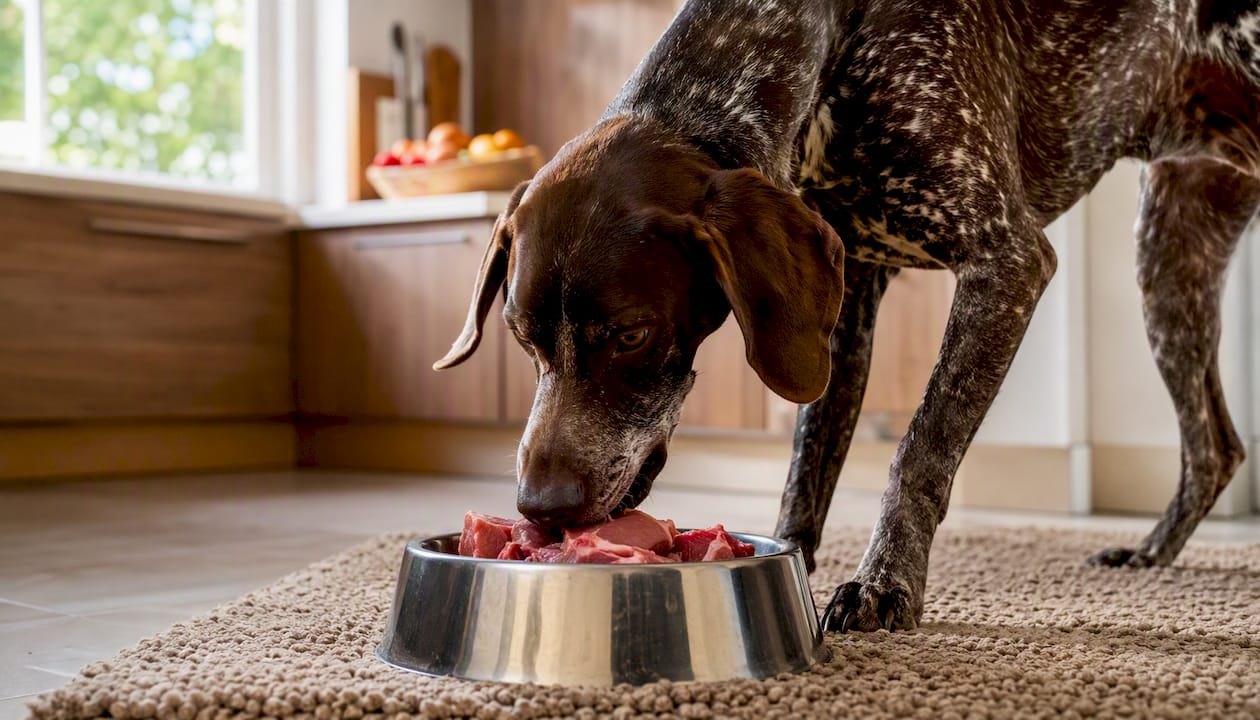
A 2026 cross-sectional observational dataset reported a median body condition score of 5 for raw-fed dogs versus 6 for kibble-fed dogs on a standard 9-point scale. Raw-fed dogs ran leaner. But the same dataset flagged that many of those raw rations were deficient in calcium:phosphorus ratios and trace minerals, which means the leaner body condition came with a nutritional trade-off that is not visible from the outside.
Pathogen contamination and shedding
Surveillance studies (PMID 32330232) document that dogs fed raw products shed Salmonella and other pathogens at higher rates than kibble-fed dogs. The public-health concern is not primarily that the dog gets sick. It is that an asymptomatic dog can contaminate surfaces, hands, and household members who are more vulnerable than a healthy adult dog.

A 2019–2021 body of work also detected extended-spectrum beta-lactamase (ESBL)-producing E. coli in a meaningful fraction of commercial raw pet food samples sold in North America and Europe, raising antimicrobial-resistance concerns that go beyond individual household risk.
What the evidence cannot tell you
No study has tracked dogs on raw versus kibble diets over their full lifespan under controlled conditions. Most observational data relies on owner-reported feeding practices and body condition assessments, which introduce recall and measurement bias. Short-term digestibility improvements are real and consistent, but whether they translate to longer life or lower chronic disease rates remains unknown.
What are the real benefits and risks of raw diets?
Raw feeding has a vocal community behind it, and some of the reported benefits are backed by actual data. Others are extrapolated from short-term observations or anecdote. Here is what holds up and what does not.
Documented short-term benefits
- Higher apparent digestibility. Peer-reviewed trials consistently show improved protein and fat digestibility coefficients on high-meat, low-carbohydrate rations compared with standard extruded kibble.
- Smaller, firmer stools. A direct consequence of higher digestibility and lower fiber load. Many owners notice this within weeks of switching.
- Higher moisture content. Raw meat is roughly 60–70% water, compared with kibble's 10% or less. Dogs on raw diets often drink less water but maintain better hydration through food.
- Palatability. Most dogs find raw food highly palatable. For picky eaters or dogs recovering from illness, this can matter.
- Leaner body condition. The 2026 observational data suggests raw-fed dogs tend to run leaner, though portion control on any diet achieves the same outcome.
Documented risks
- Salmonella, Listeria, and ESBL-producing bacteria. FDA sampling and peer-reviewed surveillance confirm contamination in commercial raw products at rates far exceeding heat-treated diets.
- Asymptomatic shedding. Your dog may carry and shed pathogens without appearing sick, creating ongoing household exposure.
- Mineral and trace-element shortfalls. Homemade raw recipes, including those following the popular 80/10/10 framework (80% muscle meat, 10% bone, 10% organ), frequently lack adequate iodine, manganese, and calcium:phosphorus balance without targeted supplementation.
- Bone-related injuries. Raw bones can cause dental fractures, esophageal obstruction, and gastrointestinal perforations. Ground bone in commercial raw formulas reduces but does not eliminate this risk.
- Nutritional imbalance over time. A diet that looks complete on paper can still miss micronutrient targets. Without analytic verification or a board-certified veterinary nutritionist, homemade raw is a nutritional gamble.
Pro Tip: Treat every raw product, including freeze-dried and dehydrated formats, as if it were raw meat from the grocery store. That means separate cutting boards, immediate refrigeration, and thorough handwashing after every contact.
Why is kibble the predictable baseline for most dogs?
Kibble's biggest advantage is not glamorous: it is consistency. A bag of AAFCO-complete kibble from a reputable manufacturer delivers the same nutrient profile every time, requires no prep, and carries minimal pathogen risk. For most households, that predictability is worth a lot.
What kibble does well
AAFCO nutrient profiles and feeding-trial frameworks create the regulatory baseline for "complete and balanced" claims in U.S. pet foods. A kibble that has passed an AAFCO feeding trial, not just been formulated to the profile on paper, has been tested in actual dogs over time. That is a meaningful quality signal that homemade raw recipes rarely match.
Kibble is also shelf-stable for months, easy to portion, and affordable. For multi-dog households, working owners, or anyone traveling with a dog, the logistics alone make kibble the practical choice.
Legitimate concerns about kibble
Not all kibble is equal. Ingredient quality varies widely across price points, and the extrusion process (cooking at high heat and pressure) can reduce heat-sensitive vitamins and some amino acid bioavailability. Manufacturers typically compensate by adding synthetic nutrients post-extrusion, but the quality of those additions varies.
The unresolved DCM (dilated cardiomyopathy) signal is also worth knowing about. The FDA investigated a potential association between grain-free, legume-heavy kibble formulas and DCM cases in dogs. The investigation did not establish causation, and the signal has not been definitively resolved, but it is a reason to be cautious regarding grain-free formulas that rely heavily on peas, lentils, or chickpeas as primary ingredients.
Quality checklist for buying kibble
- Named protein source listed first (e.g., "chicken," not "poultry by-product meal" as the lead ingredient)
- AAFCO "complete and balanced" statement on the label, specifying the life stage
- Feeding trial statement preferred over "formulated to meet" when available
- Company employs a board-certified veterinary nutritionist (check the manufacturer's website)
- Avoid formulas where legumes appear multiple times in the first five ingredients
- Check for a published food-safety and quality-control protocol on the manufacturer's site
How do commercial kibble, commercial raw, and homemade raw differ nutritionally?
The gap between these three options is wider than most owners realize, and it is almost entirely about who is responsible for getting the nutrient math right.
AAFCO nutrient profiles define minimum and maximum levels for protein, fat, vitamins, and minerals across life stages (growth/reproduction and adult maintenance). A product "formulated to meet" these profiles has been calculated to hit those targets. A product that has "passed an AAFCO feeding trial" has been fed to real dogs under controlled conditions and shown to maintain health. The feeding trial is the higher bar.
Commercial kibble from established manufacturers almost always meets AAFCO profiles. Commercial raw products from reputable brands increasingly do too, and that is the version of raw feeding that carries the lowest nutritional risk. The problem is homemade raw.
A 2026 observational dataset found calcium:phosphorus imbalances and trace-mineral shortfalls in many owner-fed raw rations. The 80/10/10 framework addresses the meat portion of the diet but does not guarantee a complete diet without additional supplementation. Common shortfalls in homemade raw include iodine (especially when no fish or kelp is included), manganese, zinc, and vitamin D.
| Diet type | AAFCO completeness | Nutritional oversight required | Typical mineral-balance risk |
|---|---|---|---|
| Commercial kibble (reputable brand) | Yes, typically feeding-trial verified | Minimal — follow label portions | Low |
| Commercial raw (AAFCO-complete label) | Yes, if label states it | Low — verify AAFCO statement | Low to moderate |
| Homemade raw (80/10/10 or similar) | Rarely without supplements | High — veterinary nutritionist recommended | High |
| Freeze-dried / dehydrated raw (complete label) | Varies — check label | Moderate — verify AAFCO statement | Moderate |
If you want to feed raw but cannot commit to working with a veterinary nutritionist, a commercially prepared AAFCO-complete raw formula is the responsible middle ground.
What are the food-safety risks of raw feeding, and how do you reduce them?
The safety risk from raw feeding is not hypothetical. Cornell's Riney Canine Health Center explicitly recommends treating raw pet food the same way you would treat raw meat intended for human consumption. That means the same cross-contamination controls, the same handwashing discipline, and the same surface sanitation.
Surveillance data (PMID 32330232) documents contamination with Salmonella, Listeria monocytogenes, and ESBL-producing bacteria in commercial raw products. Freeze-dried and dehydrated formats are not safer: drying preserves bacteria in a dormant state and does not eliminate the risk.
Who should not handle raw pet food
- Infants and young children
- Pregnant individuals
- Adults over 65
- Anyone on immunosuppressive medication or with a compromised immune system
- Anyone with an active gastrointestinal illness
Step-by-step safe handling protocol
- Thaw in the refrigerator only. Never thaw raw pet food on the counter or in warm water.
- Use dedicated prep surfaces. Keep a separate cutting board and knife for raw pet food. Do not use the same surfaces for human food preparation.
- Wash hands immediately. Use soap and warm water for at least 20 seconds after touching raw food, packaging, or your dog's bowl.
- Serve in stainless steel or ceramic bowls. These are easier to sanitize than plastic. Wash the bowl with hot soapy water after every meal.
- Refrigerate leftovers within 30 minutes. Discard any uneaten raw food left out longer than that.
- Sanitize all surfaces. After prep and after your dog eats, wipe down surfaces with a diluted bleach solution (1 tablespoon bleach per gallon of water) or an EPA-registered disinfectant.
- Bag and seal waste. Dispose of packaging and uneaten food in a sealed bag before placing it in the trash.
- Wash your dog's face and paws after eating if young children or vulnerable adults are present in the home.
Who should avoid raw, and who might genuinely benefit?
Household composition is the single most important variable in this decision, and it is the one most raw-feeding guides underweight. The risk is not only that your dog might get sick. It is that an asymptomatic dog can shed pathogens onto floors, furniture, and hands, exposing household members who are far more vulnerable than a healthy adult dog.
Households that should avoid raw feeding
- Any home with infants or toddlers who crawl on floors or put hands in their mouths
- Households with pregnant individuals (Listeria poses serious fetal risk)
- Homes where elderly adults live, particularly those with reduced immune function
- Any household member on chemotherapy, organ-transplant immunosuppression, or HIV treatment
- Multi-person households where not everyone can reliably follow the handling protocol
Clinical scenarios requiring specialist oversight
Dogs undergoing chemotherapy or on long-term corticosteroids have suppressed immune function and face higher risk from pathogen exposure. Dogs with a history of pancreatitis may struggle with the high fat content of many raw rations. Puppies and senior dogs have less immune resilience and more to lose from nutritional imbalance.
Middle-ground options worth considering
You do not have to choose between a homemade raw diet and a standard bag of kibble. Several practical alternatives exist:
- Commercially prepared AAFCO-complete raw (frozen or freeze-dried): lower nutritional risk than homemade, though pathogen handling rules still apply
- Fresh-cooked, high-meat diets: achieve similar digestibility benefits to raw without the same pathogen load; some commercial fresh-food brands meet AAFCO standards
- Kibble with quality toppers: adding a small amount of cooked meat, eggs, or a commercial topper to a quality kibble can improve palatability and moisture without the full raw-feeding risk profile; see Kiblco's guide to best dog food toppers for vetted options
How do you transition to raw safely, and what should you ask your vet?
If you have assessed your household risk, chosen a commercially prepared AAFCO-complete raw product, and decided to proceed, a structured transition reduces the chance of digestive upset and gives you a clear baseline to evaluate outcomes.
Transition protocol
- Get a baseline vet visit first. Before changing your dog's diet, ask for a complete blood count (CBC), chemistry panel, thyroid screening, and a body condition score (BCS) assessment. These numbers give you something to compare against at the 3-month mark.
- Start at 25% raw, 75% current diet for the first week. Mix thoroughly.
- Move to 50/50 in week two if stools remain firm and appetite is normal.
- Increase to 75% raw in week three, watching for loose stools, vomiting, or appetite changes.
- Full transition by week four if no issues have appeared.
- Freeze-thaw hygiene from day one. Thaw only what you will use in 24 hours. Never refreeze thawed raw meat.
- Weigh portions accurately. Use a kitchen scale. Most commercial raw products provide feeding guidelines by body weight; follow them and adjust based on BCS, not appetite alone.
- Recheck with your vet at 3 months. Repeat the CBC and chemistry panel to catch any early nutritional deficiencies.
Questions to ask your veterinarian
- Does my dog's current health status make raw feeding higher risk?
- Should I involve a board-certified veterinary nutritionist (DACVN) before starting?
- Which commercial raw brands do you consider nutritionally complete?
- What BCS and weight range should I target, and how often should we recheck?
- Are there any medications my dog takes that interact with dietary changes?
Simple monitoring log (first 3–6 months)
Track these weekly and bring the log to your vet appointment:
- Weight (weigh at home or at the vet monthly)
- Body condition score (use the 9-point Purina BCS chart)
- Stool score (1 = watery, 7 = very hard; target 2–3)
- Appetite (normal, reduced, or increased)
- Vomiting or diarrhea episodes (date, frequency, severity)
- Coat and skin condition (dull, normal, or improved)
What does raw vs kibble actually cost, and how do the logistics compare?
Cost is where raw feeding loses most owners who were otherwise interested. The gap between kibble and commercial raw is real, and it compounds over time.
The figures below use a 50–60 lb adult dog as the reference point. Costs are U.S. market estimates based on typical retail pricing ranges and will vary by brand, region, and where you buy.
Beyond cost, raw feeding requires a dedicated freezer (a standard refrigerator freezer fills quickly for a large dog), daily thawing planning, and consistent bowl and surface sanitation. For a household with two working adults and one large dog, the daily time commitment for raw feeding is roughly 10–15 minutes more than kibble, not counting the weekly batch-prep time for homemade raw.
Practical ways to reduce cost or friction:
- Buy commercial raw in bulk when it goes on sale and store in a chest freezer
- Use raw as a topper on quality kibble rather than a full replacement (reduces cost and pathogen exposure)
- Batch-prep homemade raw in large quantities and freeze in daily-portion bags
- Compare cost per calorie, not cost per pound, when evaluating brands
Decision checklist: which feeding approach is right for your dog?
Work through these questions in order. A "stop" answer means raw feeding carries too much risk for your current situation.
- Does your household include infants, pregnant individuals, elderly adults, or immunocompromised people? If yes, stop. Kibble or fresh-cooked is the right choice.
- Does your dog have a history of pancreatitis, immune disorders, or is currently on chemotherapy or immunosuppressive drugs? If yes, consult your vet before considering raw.
- Can you commit to the full safe-handling protocol (dedicated surfaces, immediate refrigeration, bleach sanitation after every meal)? If no, stop.
- Do you have freezer capacity for at least a week's supply of raw food? If no, consider kibble with quality toppers instead.
- Are you planning to use a homemade recipe rather than a commercial AAFCO-complete raw product? If yes, you need a board-certified veterinary nutritionist involved before you start.
- Is your budget above approximately $150/month for a 50 lb dog? If no, raw feeding will likely be financially unsustainable.
- Is your dog an adult in good health with no known immune or digestive conditions? If yes, and you have passed the above checks, you are a reasonable candidate for a commercially prepared raw diet with vet oversight.
Red flags that should stop DIY raw immediately
- No plan for supplementing iodine, manganese, and calcium:phosphorus balance
- No refrigerator or freezer capacity beyond a standard kitchen fridge
- Presence of any high-risk household member
- No access to or budget for a veterinary nutritionist consultation
What to track and when to call your vet
Monitor weight, BCS, stool score, and appetite weekly for the first three months.
The raw vs kibble debate rewards nuance, not tribalism
The loudest voices in the raw vs kibble debate tend to be on the extremes. Raw advocates frame kibble as processed junk. Kibble defenders treat any interest in raw as irresponsible. Neither position is accurate, and neither serves dog owners well.
The evidence is clear on a few things: raw diets can produce real short-term digestibility benefits, but those benefits are largely explained by higher meat content and lower carbohydrate load, not the fact that the food is uncooked. A lightly cooked, high-meat diet achieves similar outcomes with a fraction of the pathogen risk. That is a fact the raw-feeding community tends to skip past.
Kibble, on the other hand, is not nutritionally equivalent to a bag of chips for dogs. A quality AAFCO-complete kibble from a manufacturer with a veterinary nutritionist on staff is a genuinely complete diet that has kept millions of dogs healthy for decades. The legitimate concerns about kibble, ingredient quality variation and the unresolved DCM signal with legume-heavy grain-free formulas, are real but manageable with label literacy.
What I find most underweighted in this debate is the household risk factor. Most raw-feeding guides spend two paragraphs on pathogen risk and move on. The asymptomatic shedding data changes the calculus entirely for households with young children or medically vulnerable adults. A dog that looks and feels fine can still be a transmission vector. That is not a reason to never feed raw. It is a reason to take the household composition question seriously before you decide.
Kiblco's approach is to give you the evidence, the trade-offs, and the practical steps, then let you decide. The hands-on product reviews at Kiblco are built on the same principle: real testing, vet-informed context, and transparent pros and cons so you can make a call that fits your dog and your household, not someone else's.
Kiblco helps you find vetted products for any feeding approach
Whether you land on kibble, commercial raw, or something in between, the next practical question is which specific products are worth your money. That is exactly what Kiblco is built to answer.

Kiblco's vet-informed review team tests kibble brands, raw food toppers, feeding accessories, and supplements with real dogs and transparent evaluation criteria. If you want to improve your current kibble with a quality topper that mimics some of the palatability and moisture benefits of raw, the best dog food toppers guide is a practical starting point. For a broader look at what Kiblco tests and recommends, visit Kiblco to browse current reviews across food, health supplements, and feeding gear.
Kiblco earns commissions through affiliate links to retailers including Amazon, Chewy, and Petco. This does not affect which products are recommended. Every review reflects independent hands-on evaluation.
Sources
- Raw foods for dogs: Evidence-based advice from the Riney Canine Health Center | Cornell University College of Veterinary Medicine
- Raw Diet for Dogs vs. Kibble: The 2026 Evidence
- PubMed record: study on digestibility differences between raw/fresh and extruded diets (PMID 33939804)
- PubMed record: contamination and pathogen-shedding studies (PMID 32330232)
- PubMed record: context on AAFCO and feeding trials (PMID 29893876)