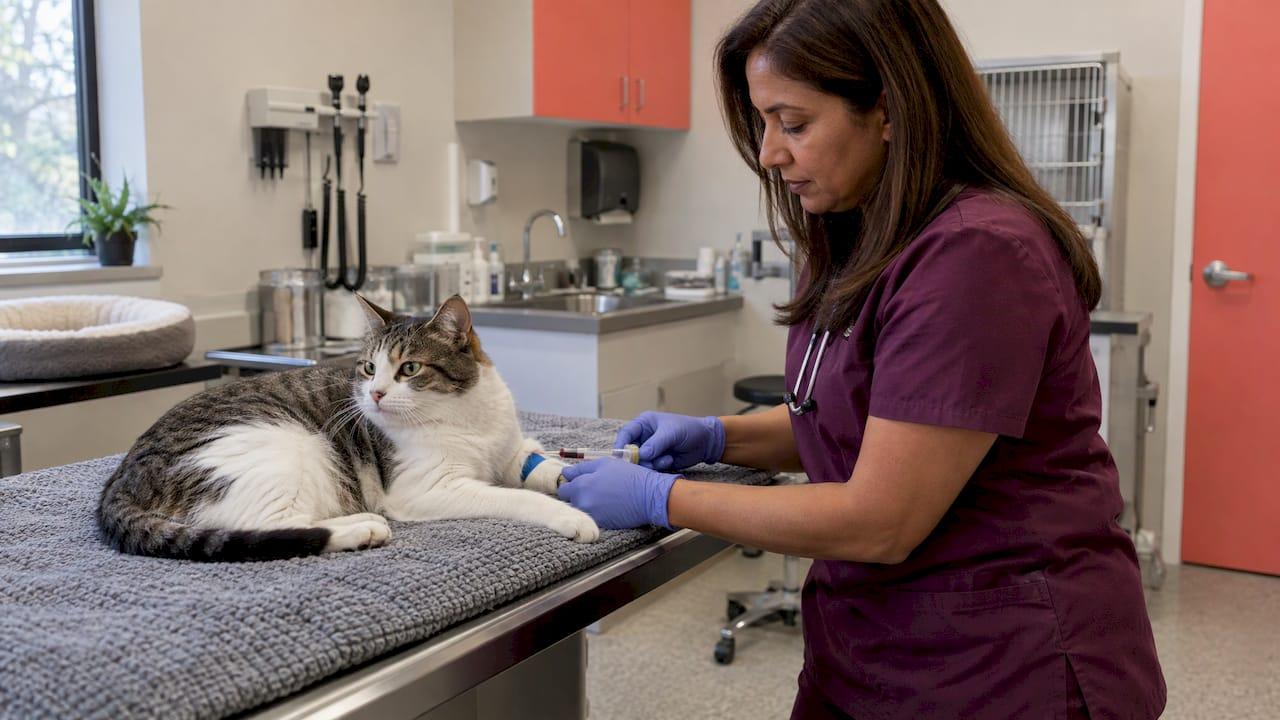
B12 for cats is worth giving when a veterinarian has found, or strongly suspects, low cobalamin, which usually happens alongside chronic gut, pancreas or liver disease. Cats cannot make the vitamin themselves, so a cat that absorbs it poorly can run low even on a good diet. Once your vet confirms the need, the choice comes down to form (injection, chewable or liquid), a dose set for your cat's weight and a plan for rechecking. This guide covers each of those points, so you know what to ask at the appointment and what to look for on a label.
TL;DR
- Cats depend on animal-based foods for B12 and cannot synthesize it, so deficiency usually points to a digestion or absorption problem, not a lack of effort on your part.
- Cobalamin and vitamin B12 are the same thing. Cyanocobalamin is the most common supplement form, and methylcobalamin is an active form that is harder to find and costs more.
- Vets confirm low B12 with a blood test and then choose injections or daily oral dosing. The dose and length of treatment are theirs to set.
- B12 is water-soluble, and high blood levels are not considered dangerous, but a supplement should never replace finding out why your cat is losing weight, vomiting or has diarrhea.
- Choose a product by the form, the micrograms per serving and how easily your cat will take it every day.
Table of Contents
- Why cats need B12 from their food
- Signs and conditions linked to low B12
- Cobalamin, cyanocobalamin and methylcobalamin: what the names mean
- How vets test for low B12
- Dose and duration: what vets use
- Injections, chewables or liquids?
- How to choose a B12 supplement for your cat
- Safe use and when to call the vet
- Our view on B12 for cats
- Find a cat health product with less guesswork
- FAQ
- Sources
Why cats need B12 from their food
Vitamin B12 supports energy metabolism, nerve function and red blood cell production. Cats cannot make it, so they depend on animal tissue to supply it. A 2023 review of B12 in cats, published in the journal literature archive PubMed Central, lays out how the vitamin is absorbed in the small intestine and why disease of the gut, pancreas or liver can interrupt that process.
This is the main thing to understand about B12 for cats. In most cases the problem is not that the cat eats too little B12. The cat cannot take in enough of it from the food it does eat. That is why a vet visit comes before a supplement purchase.
Signs and conditions linked to low B12
The same 2023 review reports that gastrointestinal, pancreatic and liver diseases are frequently associated with deficiency. Examples include inflammatory bowel disease, alimentary lymphoma (a cancer of the gut), pancreatitis, cholangitis (inflammation of the bile ducts) and exocrine pancreatic insufficiency, or EPI, where the pancreas does not make enough digestive enzymes.
The signs linked to deficiency include:
- Poor appetite and weight loss
- Vomiting and diarrhea
- Poor growth in young cats
- Neurological changes
- Low red blood cell counts (non-regenerative anemia) and low white blood cell counts
- Low blood sugar and raised blood ammonia
Today's Veterinary Practice lists a similar set for dogs and cats, adding failure to thrive, weakened immunity and seizures in severe cases.
Notice how general these signs are. A cat that is losing weight, vomiting or having loose stools needs an exam whether or not B12 is part of the story. Giving a vitamin and waiting can delay the diagnosis of the condition that is causing the problem.
How common is low B12 in sick cats?
A 2025 study of cats referred to a UK specialist hospital found that 35% had low cobalamin. The most common diagnosis among those cats was chronic enteropathy (long-term gut disease), at 51%, followed by high-grade lymphoma at 18%. Median survival in the low-B12 group was 274 days.

Keep in mind that these were referral cats, already sick enough to be sent to specialists. The numbers do not describe the average pet cat. They do show that low B12 is a marker of serious illness, which is a good reason to bring it up with your vet early.
Cobalamin, cyanocobalamin and methylcobalamin: what the names mean
Yes, cobalamin and vitamin B12 are the same thing. The NIH Office of Dietary Supplements explains that because the vitamin contains cobalt, compounds with B12 activity are collectively called cobalamins. That is why you see both words on labels and in vet notes.
The forms you will meet are:
| Form | What it is | What to know |
|---|---|---|
| Cyanocobalamin | Stable supplement form that the body converts to an active form | The most common form in supplements, according to Clinician's Brief |
| Methylcobalamin | One of the two metabolically active forms | Used less often, and harder to obtain and more expensive, per the same source |
| Hydroxocobalamin | Converted by the body to an active form | Also harder to obtain and more expensive |
| Adenosylcobalamin | The other active form | Rarely seen in cat products |
The NIH fact sheet notes that methylcobalamin and 5-deoxyadenosylcobalamin are active as they are, while cyanocobalamin and hydroxocobalamin become active after conversion. Some product pages for cat supplements argue that methylcobalamin is absorbed better, especially in senior cats. For a cat with a confirmed deficiency, the more useful question is whether the product delivers a vet-guided dose reliably every day. Veterinary guidance has largely been built around cyanocobalamin, so a methyl B12 product is a reasonable choice to discuss with your vet, not one to switch to on your own.
How vets test for low B12
Your vet will usually measure serum cobalamin, the amount of B12 in a blood sample. The 2023 review says this test is particularly useful for detecting deficiency. A second test, methylmalonic acid (MMA), reflects whether the vitamin is actually available inside cells and can be tracked during treatment.
For cats with EPI, Today's Veterinary Practice recommends checking cobalamin in every case. It suggests supplementing when the level is at or below 400 ng/L, repeating the test in 3 months if it starts out normal, and starting supplementation without a result when testing is not possible, because deficiency is so common and adverse effects are rare.
That last point matters. Your vet may sometimes begin B12 before the number comes back. That decision is theirs, based on your cat's diagnosis, not a reason to start a bottle at home.
Dose and duration: what vets use
Dosing is a veterinary decision, and the figures below are for context so you can follow the conversation. The Merck Veterinary Manual lists two approaches for cats:
- Injection: 20 to 50 mcg/kg under the skin weekly for 4 to 6 weeks, then monthly.
- Oral: 50 mcg/kg by mouth every 24 hours for at least 12 weeks.
It names chronic enteropathy, surgical removal of part of the gut, EPI and long-term antacid use among the reasons to treat, and reports no major toxicity.
Here is what the oral figure looks like for a 9-pound cat. Nine pounds is about 4 kg, and 50 mcg/kg comes to roughly 200 mcg a day. That is in the same range as the 250 mcg tablet or serving size common in cat products. Your vet will round and adjust for your cat's condition.
Why a short course often isn't enough
A summary of a teaching-hospital study, shared through VIN, followed cats with gut disease given six weekly B12 injections. Their cobalamin rose sharply, but levels fell again within 10 weeks. The authors concluded six weeks is likely not enough and that longer-term supplementation is needed. This is why vets recheck levels instead of stopping when your cat looks better.
The 2023 review adds that there is no formal guideline for feline cobalamin supplementation yet, so recommendations rest on clinical experience. Follow your vet's plan and recheck schedule over any general number you read online.
Injections, chewables or liquids?
Injections have long been the standard, and some cats do best on them, particularly those with severe malabsorption. Clinician's Brief reports that recent data show oral supplementation is as effective as injections, and describes daily oral dosing for 3 months with a recheck 3 to 4 weeks after stopping. Today's Veterinary Practice also states oral and subcutaneous routes are equally effective in EPI cats.
The 2023 review is more mixed. Daily 250 µg cyanocobalamin tablets raised levels in cats with gut disease, yet an earlier study found oral dosing ineffective in cats with EPI. Which route suits your cat depends on the diagnosis. That is a decision for your vet.
If your vet approves oral dosing, the practical differences come down to daily life:
- Chewable tablets give a fixed dose per tablet, which makes counting simple. They work for cats that accept a treat-style tablet.
- Liquids can be mixed into wet food and dosed by the milliliter, which suits cats that refuse tablets, though you need to measure carefully each day.
- Injections at home or at the clinic remove the daily dosing chore, but they need a schedule and a comfortable technique.
How to choose a B12 supplement for your cat
Once your vet has said oral B12 is appropriate, a short checklist keeps the shopping simple:
- Read the form. Look for cyanocobalamin or methylcobalamin on the label and match it to what your vet suggested.
- Check micrograms per serving. The label should say how many micrograms are in one tablet or one measured serving, so you can match your vet's daily dose. Many cat products land near 250 mcg per serving.
- Do the math on the container. Divide the container size by your cat's daily dose to see how many weeks it lasts. Treatment often runs 12 weeks or more, so a small bottle may not cover the course.
- Match the format to your cat. A cat that will not eat a tablet will not benefit from one. A flavored liquid that goes in wet food may get used every day, which is what counts.
- Skip intrinsic factor add-ons. The 2023 review notes that products combining B12 with swine-origin intrinsic factor are marketed but untested, because intrinsic factor is species-specific.
- Keep the ingredient list short. A plain B12 product with few extras is easier to read and to compare against your cat's other medications.
- Note storage rules. Some liquids need refrigeration after opening. Check the label before you buy.
Our Cat Health reviews apply these same questions to the products we cover, with pros and cons spelled out for each.
Safe use and when to call the vet
Because cobalamin is water-soluble, the 2023 review states that higher-than-normal blood levels are not considered dangerous. It even notes that vets aim to exceed normal concentrations before stopping supplementation. Merck likewise reports no major toxicity. Within a vet-guided plan, B12 has a wide safety margin.
The real risks are indirect:
- Masking a diagnosis. Vomiting, weight loss, diarrhea and poor appetite can come from IBD, pancreatitis or cancer. Call your vet if your cat shows any of these for more than a day or two, or right away if your cat stops eating, seems weak or has neurological signs such as stumbling or seizures.
- Stopping too soon. Levels can drop again within weeks. Keep your recheck appointments.
- Doubling doses on your own. Ask your vet before changing the amount, even though the vitamin has a wide margin.
- Other medications. Tell your vet about every supplement and drug your cat gets, including long-term antacids, which Merck lists as a reason B12 may be needed.
If you are exploring other supportive supplements, read our guides to psyllium for cats and probiotics for cats with sensitive stomachs. Cats with liver trouble may also want to see our cat liver supplement guide, and none of them replaces a diagnosis.
Our view on B12 for cats
We buy and test the products we write about in real homes, and for health picks we cross-check with veterinary input. B12 is a good example of why.
The vitamin itself is simple. The hard part is everything around it: a supplement only helps if your cat actually takes it every day for weeks or months. That makes the format, the label clarity and the daily routine matter as much as the form of cobalamin on the ingredient list.
So when we review a cat B12 product, we look at what a pet parent lives with: how easily a tablet is accepted, how a liquid measures out, how long a bottle lasts at a typical dose and whether the label states the micrograms per serving plainly. Every review lists pros and cons, and we accept no payment for coverage.
Our advice is to get the diagnosis and the dose from your vet, then use our reviews to pick a product that fits your cat's routine.
Chris
Find a cat health product with less guesswork
Once your vet has set the plan, the next job is choosing a product you will actually use. Kiblco's Cat Health page collects our hands-on reviews of supplements for cats, each with pros, cons and the details that matter in daily use, and our picks for health products are cross-checked with veterinary input.
If you are also looking at the rest of your cat's routine, our Cat Litter reviews cover the products you will handle every day, and our guide to health-monitoring litter shows what each type can tell you about changes at home.
FAQ
Is cobalamin the same as B12?
Yes. Cobalamin is the general name for the family of compounds with vitamin B12 activity, named for the cobalt they contain. Cyanocobalamin, methylcobalamin and hydroxocobalamin are individual forms, according to the NIH Office of Dietary Supplements.
Is methyl B12 better for cats than cyanocobalamin?
Methylcobalamin is an active form, while cyanocobalamin is converted in the body, but cyanocobalamin is the form most used in supplements and in the veterinary studies. Methylcobalamin products are harder to obtain and cost more, per Clinician's Brief. Ask your vet which form suits your cat's condition.
Can I give my cat B12 without seeing a vet?
B12 has a wide safety margin, but the signs of deficiency overlap with serious illness. Cats that are vomiting, losing weight or have diarrhea need an exam first, so the vet can test cobalamin and find the cause. Your vet sets the dose and the recheck schedule.
How long does a cat stay on B12?
It depends on the cause. The Merck Veterinary Manual lists oral dosing for at least 12 weeks, and a VIN summary of a cat study found levels fell again after a six-week injection course. Cats with ongoing gut or pancreatic disease often need longer treatment with periodic blood tests.
Does a cat on a normal diet need extra B12?
Not necessarily. Cats get B12 from animal tissue, and a cat without a disease that interferes with absorption does not usually need more. Extra B12 comes into the picture when a vet finds a deficiency or a condition that causes one.
Sources
- Vitamin B12 in Cats: Nutrition, Metabolism, and Disease (2023 review)
- Prevalence of hypocobalaminaemia and hypercobalaminaemia in cats (2025)
- Cobalamin in Veterinary Health and Disease, Today's Veterinary Practice
- Vitamin B12 Health Professional Fact Sheet, NIH Office of Dietary Supplements
- Canine and Feline Exocrine Pancreatic Insufficiency, Today's Veterinary Practice
- Drugs Acting on the Blood or Blood-Forming Organs in Animals, Merck Veterinary Manual
- Cobalamin supplementation in cats with gastrointestinal disease, VIN
- Management of Cobalamin Deficiency in Dogs and Cats: Oral Supplementation, Clinician's Brief