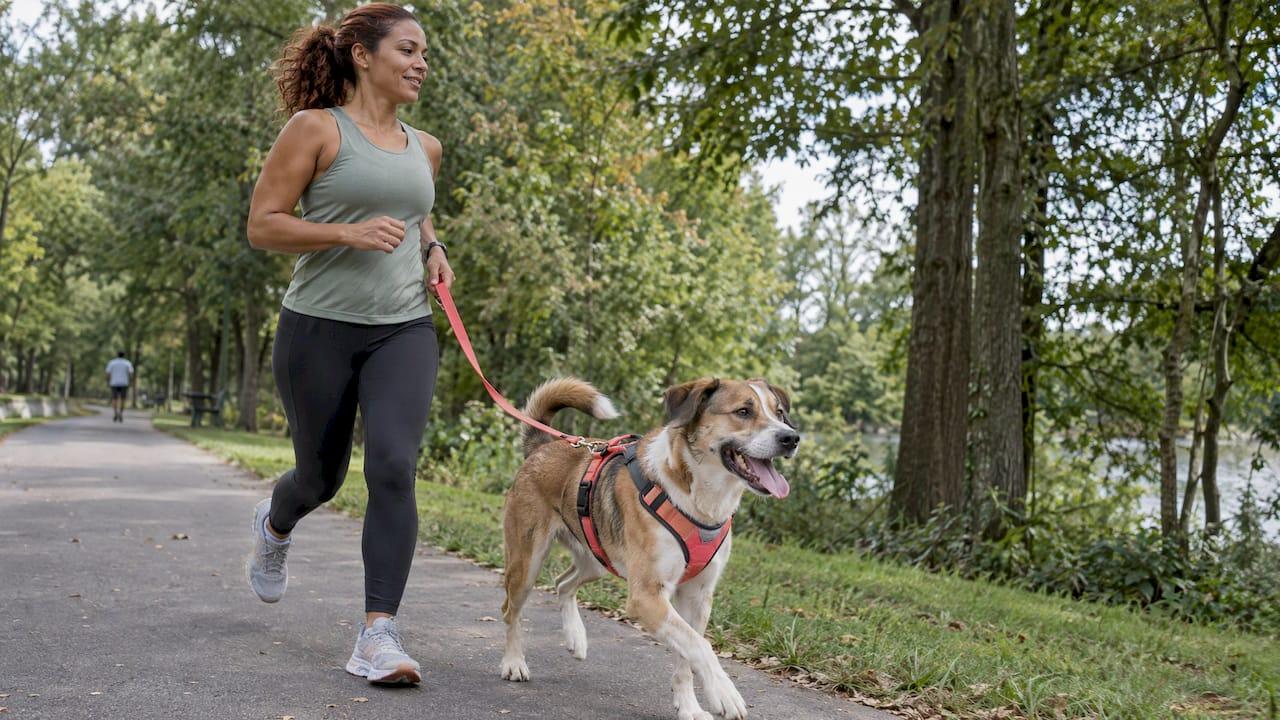
The best running dog harness is one that lets your dog's front legs reach forward freely, sits on the chest and ribcage instead of the throat, stays put without rubbing, and matches how your dog actually runs. For easy jogging beside you, that means a well-fitted, lightweight harness. For a dog that pulls you along, it means a harness made for pulling sports. Below, we explain how to tell them apart, how to measure, what to look for, and how to get your dog used to it.
TL;DR
- Pick the design by running style: a snug, non-restrictive harness for a dog jogging beside you, a pulling-sport harness for canicross.
- Fit matters more than features. Measure the neck base and the widest part of the chest, then check that the legs move freely.
- Reflective material, breathable fabric and a sturdy leash ring are the features worth paying attention to.
- Check with your vet before you start, and hold off on running with a puppy until their growth is finished.
- Introduce the harness over several short, easy sessions before you ask for a real run.
Table of Contents
- Is your dog ready to run?
- Jogging harness or canicross harness?
- Features worth looking for
- How to measure and check the fit
- Introducing your dog to the harness
- Our perspective
- Find your next harness and run gear
- FAQ
- Sources
Is your dog ready to run?
Before you shop, settle the more important question. The American Veterinary Medical Association recommends talking to your veterinarian before starting an exercise program, making sure your dog is healthy enough, and building distance gradually. It also suggests good leash manners first, water for both of you, and avoiding the warm hours of the day in warm seasons.
Puppies need to wait. Young joints are still growing. The American Kennel Club says to hold off on jogging with a puppy on a leash until maturity: roughly 6 to 8 months for small breeds, 12 months for medium, 12 to 18 months for large, and 18 to 24 months for giant breeds. Ask your vet about your dog's own timeline.
Older dogs and flat-faced breeds need a plan. Veterinary hospital guidance notes that older dogs may have arthritis that makes running painful, and that a veterinarian should outline a safe routine at any age. Short-nosed breeds can struggle with breathing and heat during hard exercise, so talk through realistic distances with your vet before you commit to a running habit.
Know the warning signs. The AVMA lists lameness, sudden stopping, reddened gums and labored breathing as reasons to stop right away and contact a veterinarian. The AKC adds that excessive panting or lagging behind means your dog has had enough. Walk for a few minutes before and after each run to warm up and cool down, and give frequent water breaks.
Check the ground too. Try the 10-second test: if the pavement is too hot for the back of your hand for 10 seconds, it is too hot for your dog's paws. Look over the paws after every run for cuts or bruises. On hot-weather routes, our guide to paw balms for dogs in hot weather can help you protect them, and our look at cooling vests for summer hikes covers another way to manage heat.

Jogging harness or canicross harness?
This is the choice that shapes everything else, and it comes down to one question: does your dog run beside you, or pull you?
Harnesses for jogging at your dog's pace
If your dog trots next to you on a short leash, you want a harness that stays out of the way: light, adjustable, comfortable across the chest, and not so wide that it covers the shoulders. Many people reach for this type for mixed use, such as a run, then a walk, then a hike. Our guide to the best no-pull dog harnesses is a good place to compare everyday designs that handle leash manners.
There is one honest wrinkle worth knowing. Research on canine movement found that a harness affects gait whatever the type. A study summarized by the Canine Sports community found the most adjustable harness covering the least body surface interfered with gait the least, and it advised avoiding designs with a large area in contact with the body. So for running, less coverage and more adjustability are the sensible starting points.
Harnesses for canicross
Canicross means running with your dog pulling you, usually with a bungee line to a belt at your waist. The North American Canicross Federation describes the setup as a properly fitted pulling harness, a bungee line and a hands-free belt. The harness should be designed for pulling sports and allow natural movement without restricting breathing or range of motion. Half-back harnesses are accepted when properly fitted and non-restrictive.
The AKC quotes a canicross coach who warns that most ordinary dog harnesses are shaped wrong for pulling and can interfere with breathing, make a dog sore or limit shoulder movement. The same article recommends a six-to-ten-foot bungee leash attached to a waist belt that sits low on your hips, which prevents jarring to your back.
Here is a quick way to decide:
| Your situation | Better fit |
|---|---|
| Dog trots beside you on a loose leash | Lightweight, adjustable running or everyday harness |
| Dog pulls hard and loves to lead | Harness made for pulling sports, plus bungee line and waist belt |
| Dog alternates between pulling and running beside you | Half-back or short-style sport harness, if it fits well |
| Mixed walks, hikes and short jogs | Adjustable harness with a sturdy ring, and a separate canicross harness if you start pulling sports |
If you are not sure which camp your dog belongs to, run a few short, easy sessions in a fitted everyday harness and watch whether your dog drifts ahead and leans into the leash. That tells you more than any label.
Features worth looking for
Marketing language around running gear is loud. These are the features that matter in practice.
Freedom of the shoulders. A small study of nine dogs found that both restrictive and non-restrictive harnesses reduced shoulder extension compared with no harness, so no design is a free pass. The practical takeaway: choose a cut that sits away from the shoulder joint, and watch your dog's stride in the harness rather than trusting a label.
Y-shaped front. The Canine Sports article recommends that the three sections of a Y-shaped harness meet at the front of the sternum so pressure is spread over the whole rib cage. It also recommends adjustability along both sides of the neck and body, as well as the back and sternum, so you can dial in the fit.

Breathable material. The AKC rundown of harness materials is useful here: nylon is inexpensive and durable but not breathable, leather is durable but needs maintenance, mesh is breathable but less durable and less padded, and neoprene is padded but not breathable. For running, where heat builds up, many owners lean toward breathable mesh panels with durable webbing at the stress points. Thin-coated dogs such as greyhounds may benefit from fleece lining in cold weather.
Reflective stitching or trim. The AKC notes reflective stitching or material helps in low light. If you run at dawn or after work, this is one of the few features that is simply about safety.
Clip placement. A back clip suits well-trained dogs, while a dual-clip harness has both front and back attachment points. For a dog who still pulls, a front attachment can help, and the AKC notes that using it with a double-ended lead helps keep the dog balanced. For regular jogging, a rear attachment point that stays out of the legs is easier to manage.
A solid leash ring. Look for a sturdy, easy-to-reach ring that lets you clip on and off without fumbling. Pair it with a durable leash: our comparison of BioThane and leather leashes explains which holds up better to sweat, rain and mud.
No dangling straps. The AVMA says anything your dog wears in cool weather should fit well, have no hanging straps that could tangle in the legs, and not interfere with leg movement, breathing, sight, hearing or the ability to open the mouth. That principle applies to any running gear.
How to measure and check the fit
Sizing varies by brand and style, so always read the size chart for the specific harness. Here is the process.
- Measure while your dog is standing. The AKC measuring guide says to use the two-finger rule when measuring circumferences and to size up if your dog falls between sizes.
- Measure the chest. Take the tape around the widest part of the rib cage, usually just behind the front legs.
- Measure the neck base. That is where the neck meets the shoulders, not up by the throat.
- Fit it snugly, not tightly. You should be able to slide two fingers under any strap.
- Walk the dog. The AKC recommends watching that the legs move freely, then pulling the harness in different directions to make sure your dog cannot slip out. Check that it cannot slide over the head when your dog backs up.
- Check the details. The AKC fit guidance says the girth strap should not sit behind the rib cage or squeeze into the elbows, and the neck opening should sit closer to the top of the sternum rather than around the throat. Watch the front leg reaching forward and out to the side for any hitch.
- Look for rubbing. After the first few sessions, check the armpits, chest and belly for flattened or reddened fur and chafing.
Measure again if your dog gains or loses weight, or grows into adulthood. A harness that fit last spring may not fit now.
Introducing your dog to the harness
How quickly your dog accepts a harness often decides whether running together becomes a habit. The pace below is our practical suggestion, not a veterinary protocol, so adjust it to your dog and ask your vet or a certified trainer about any dog who is anxious or sore.
- Let your dog meet it. Leave the harness on the floor, add treats, and let your dog sniff and investigate.
- Wear it at home. Put it on for a few minutes at mealtime or play, then take it off while your dog is still relaxed.
- Walk first. Take a calm walk in the harness, ideally on familiar ground, and look for rubbing at the end.
- Add short trots. Mix a minute or two of easy jogging into a walk. Reward a loose leash and a dog who keeps pace.
- Build gradually. Follow the AVMA advice to start with shorter distances and build up, and use the AKC's tip of walking for several minutes before and after each run.
During runs, watch your dog's stride and breathing. A dog who suddenly stops, shortens the stride or starts to lag is telling you something. Stop, check the harness for shifting or pinching, and give water. If limping or labored breathing shows up, it is a vet call, not a harness problem to solve at home.
After running in ice or snow, the AVMA advises rinsing your dog's feet thoroughly to wash off road salt and ice melter. Wipe down the harness, too, since sweat, mud and salt wear out webbing and buckles faster.
If you are also working on pulling, our guide on the tether tug for dogs shows another way to build leash skills and burn energy safely.
Our perspective
Running with a dog should feel good for both ends of the leash, and the harness is where most of that comfort is won or lost. The question we ask about any harness is simple: does it stay out of the way of the shoulders, and does it keep working after a month of sweat and mud?
That is why we buy products and put them through real homes and real routes, then write down the downsides alongside the strengths. Health-related picks are cross-checked by veterinary experts, and we take no payment for coverage. Our readers shop on our pages, and we would rather you buy once and get it right than send you toward whatever is trending.
Our advice for most owners: start with the way your dog actually runs, get the measurements right, and give the harness a few easy sessions before the big outing. Then compare options on the features that matter: adjustability, coverage, ventilation, reflective detail and a strong ring. Browse our reviews, read the pros and cons, and pick the one that suits your dog.
Chris
Find your next harness and run gear
Ready to compare? Our Dog Gear reviews cover harnesses, leashes, packs and other hands-on tested equipment, each with clear pros and cons so you can see how a product holds up in real homes and on real routes.

For longer outings, take a look at our guide to dog backpacks and carriers for hiking, and if you want to track your dog's activity and health between runs, see our review of smart collars with health monitoring. New to dog ownership? Our puppy essentials checklist covers gear to buy before the running starts.
FAQ
Can I use a regular walking harness for running?
For easy jogging beside you, a well-fitted, lightweight harness that keeps the shoulders free often works. For a dog that pulls you, canicross organizations say to use a harness designed for pulling sports. Ordinary walking harnesses are often shaped in ways that can limit shoulder movement and breathing under load.
What is the difference between a running harness and a canicross harness?
A running harness is built for comfort and freedom while your dog trots beside you. A canicross harness is made to spread pulling force across the chest and ribcage so your dog can lead you, and it works with a bungee line and a waist belt. Choose by whether your dog runs next to you or in front of you.
How tight should a running harness be?
Snug, but not tight. You should fit about two fingers under the straps, and your dog's legs should move freely when walking and trotting. It should not rub or chafe, and your dog should not be able to back out of it.
When can my puppy start running with a harness?
Not until their bones and joints finish growing. The AKC gives approximate ages of 6 to 8 months for small breeds up to 18 to 24 months for giant breeds. Your vet can tell you when your own dog is ready, and until then short walks and play are the better outlet.
Is it safe to run with my dog in warm weather?
It takes care. The AVMA advises avoiding warm hours in warm seasons, carrying water, and watching for labored breathing. Test pavement with your hand for 10 seconds first, and choose shade, grass or cooler times of day.
Sources
- Walking or running with your dog, American Veterinary Medical Association
- How Much Exercise Does a Puppy Need?, American Kennel Club
- How to Train Your Dog to Run With You, American Kennel Club
- Running with Your Dog, VCA Animal Hospitals
- Harnesses, Canine Sports
- Canicross FAQs, North American Canicross Federation
- How To Get Started In Canicross, American Kennel Club
- Effects of restrictive and non restrictive harnesses on shoulder extension
- How to Find the Right Dog Harness for Your Dog, American Kennel Club
- Dog Harness Sizes: The Importance of a Well-Fitting Harness, American Kennel Club
- The Ultimate Dog Apparel Measuring Guide, American Kennel Club