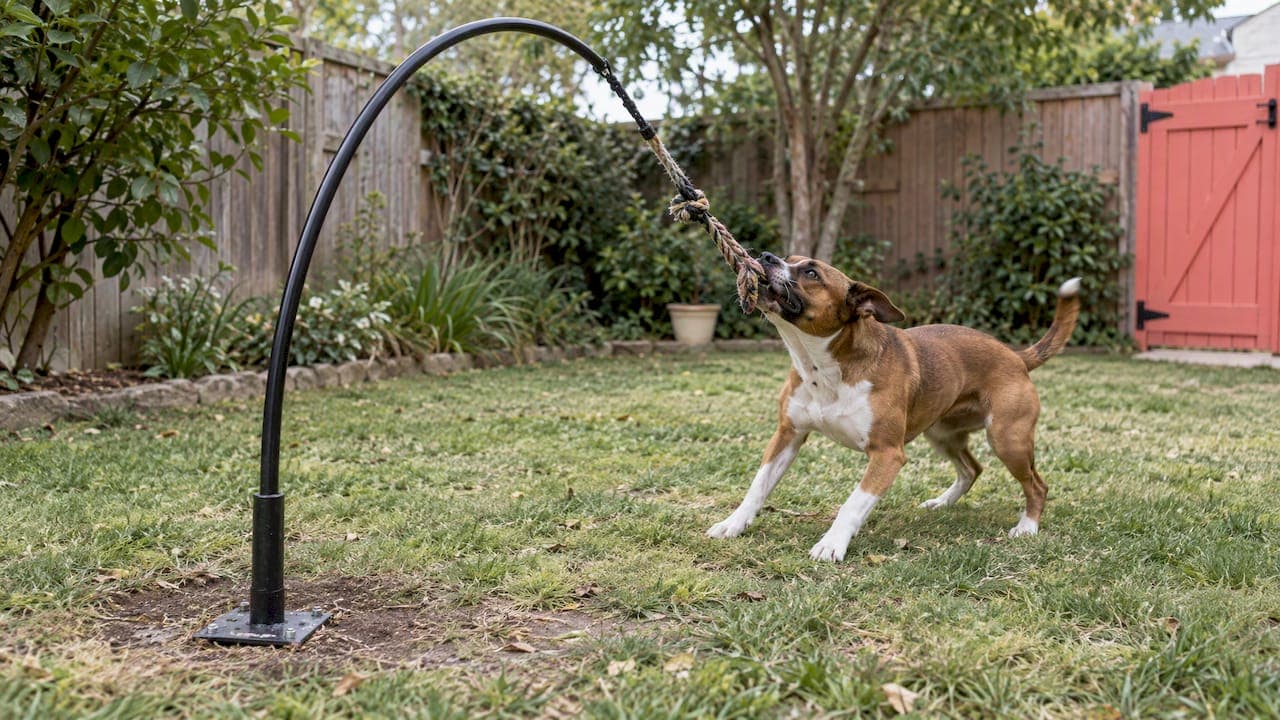
A tether tug is an outdoor tug toy anchored to the ground that lets your dog pull, spin and tussle without a human on the other end. Done right, it gives a high-drive dog a safe outlet for tugging. Done wrong, it can strain a dog's neck, back and teeth. This guide covers how the toy works, which dogs it suits, how to set it up, and when to put it away.
TL;DR
- A tether tug is a ground-anchored rope toy on a flexible pole. A dog spring pole is a related idea: a rope or bite target hung from a spring, usually overhead.
- It suits energetic, tug-loving adult dogs. Puppies, nippy dogs and dogs with joint or neck problems need extra caution or a different toy.
- Supervise every session, keep sessions short, and never let a dog hang from the toy with its feet off the ground.
- Check the rope, the anchor and the spring or pole before each use. Replace anything frayed, soured or loose.
- This is a tug toy, not a way to tie up a dog. Veterinary guidance advises against tethering dogs.
Table of Contents
- What a tether tug is, and how it differs from a spring pole
- Why dogs love them
- Is a dog tether safe? The tethering question
- Which dogs it suits, and which should skip it
- Setting it up
- Playing safely: the rules we use
- Signs to stop
- Inspecting, cleaning and replacing the toy
- Our perspective
- Alternatives if a tether tug is not right for your dog
- Shopping for dog gear and toys
- FAQ
- Sources
What a tether tug is, and how it differs from a spring pole
The Tether Tug is a product name that has become shorthand for the whole category. The manufacturer describes it as an outdoor dog toy with 360-degree tugging and spinning action, with tug attachments you can swap out. A metal base goes into the ground, a flexible pole rises from it, and the rope toy sits on top. When your dog grabs and pulls, the pole bends and snaps back, so the toy fights back a little.
A dog spring pole works on the same principle with different hardware. A rope or bite target hangs from a spring, usually from a sturdy overhead point. According to one maker of spring poles, it is a resistance tool that uses controlled tension so a dog can jump, bite and tug. The same source says it builds strength, grip and conditioning.
The practical differences:
| Ground-anchored tether tug | Overhead spring pole | |
|---|---|---|
| Where the dog works | Pulls sideways and spins at ground level | Jumps up and hangs or pulls downward |
| Typical setup | Base driven into the lawn | Sturdy branch, beam or frame |
| Main stress on the dog | Pulling, twisting, impact on teeth | Jumping, landing, hind-leg and back load |
| Easiest to keep safe | Generally simpler to keep the dog's feet on the ground | Needs careful height setting every time |
Both are "solo tug" toys. That is the appeal: a dog with a lot of drive gets an outlet when you cannot play for 20 minutes. It is also the risk, because nobody is controlling the pull the way a person does in a normal tug game.
Why dogs love them
Tug taps into instinct. The AKC notes that tug is usually enjoyed by highly energetic, focused dogs, and that dogs with working drives, such as Belgian Malinois and Collies, are often big fans. The same article describes well-played tug as a game of impulse control and "shared holding" that can strengthen the bond between dog and owner.
A tether tug adds resistance and movement. The rope moves, bends and pulls back, which is far more interesting than a toy lying on the grass. Spring-pole makers describe the work as a structured outlet for instinctive behaviors that channels energy into focused effort. That is a company's own claim about its product category, so treat it as a description of the idea, not proof of results for your dog.
In our experience as reviewers, the dogs that get the most from these toys fall into a few groups: herding and working breeds, terrier types, and any adult dog that already carries a rope around the yard looking for a fight.

Is a dog tether safe? The tethering question
This is the question people ask, and it deserves a straight answer. The word "tether" here describes a toy anchored to the ground. It does not describe tying your dog to something.
The American Veterinary Medical Association has advised that pet owners should never tether or chain their dogs, because it can contribute to aggressive behavior. That guidance dates from 2003 and concerns chaining dogs as a way of keeping them. It is a good reason to never attach your dog to a tug toy, never clip a leash to the pole, and never leave the dog "working" while you go inside.

Used as intended, the dog is loose in a fenced yard and chooses to grab the toy, then lets go and walks away. If your dog cannot disengage, you have the wrong setup.
Which dogs it suits, and which should skip it
Good candidates
- Healthy adult dogs with a strong tug drive and solid "drop it" skills
- Medium and large dogs sized to the toy (manufacturers sell different sizes by dog weight; the medium unit, for example, is listed for dogs 36 to 69 lbs)
- Dogs that play gently with their mouths and do not redirect onto people when excited
Think twice, or ask your vet first
- Puppies. Their teeth, jaws and growing joints are more vulnerable, and the UC Davis School of Veterinary Medicine cautions that rough play such as tug-of-war with nippy puppies can promote the nipping owners are trying to stop. For a puppy, structured fetch or a treat puzzle is a better start. Our guide to treat-dispensing balls is a good place to look.
- Senior dogs and dogs with arthritis, back or neck problems. Yanking and twisting load exactly those areas. Ask your vet whether tug is appropriate at all.
- Dogs with dental problems or loose teeth. The AKC advises choosing a toy that is easy on the dog's teeth and gums.
- Dogs that guard toys or get overaroused. If your dog snarls, stiffens or snaps when the toy is taken, work with a qualified trainer before adding a toy that encourages intense gripping.
Brachycephalic breeds and heavy-bodied dogs also tire quickly and overheat, so keep sessions even shorter and avoid hot weather.
Setting it up
Follow the instructions that come with your unit first. They override anything general. A few principles apply to nearly every ground-anchored setup.
Pick the spot
- Choose open, level ground inside a fenced yard, away from fences, trees, patios, parked cars and garden beds.
- Tether Tug advises keeping clear of the toy's play radius to avoid collisions or entanglement. That goes for you, kids and other pets.
- Avoid concrete, rocks and hard-packed edges where a dog could fall or twist badly.
Anchor it properly
- The manufacturer says installation means driving the metal base into the ground until only an inch or two is visible, and making sure no sharp edges are exposed.
- Walk around the base after installing. Hard soil, wet ground after rain and sandy lawns all change how firmly it holds.
- Check for any exposed edges again after mowing or heavy use.
If you use an overhead spring pole
Set the bite target so your dog can reach it without forcing a jump, while still needing to stand on the hind legs, as Springpole Supply Co. advises. Never hang it so high that the dog leaves the ground and dangles. Anchor points must be rated and stable: a weak branch or a loose hook is a hazard to your dog and anyone nearby.
Playing safely: the rules we use
These come from veterinary and canine organizations plus the toy makers themselves.
- Supervise every session. Tether Tug recommends supervision during play, and the spring-pole maker says dogs should never be left unattended. "Backyard toy" does not mean "babysitter".
- Keep sessions short. The AKC suggests relatively short tug rounds, around 10 to 15 seconds, with impulse control built in. On a solo toy, adapt that: a few minutes of play, then a break and a reset.
- Teach start and stop cues. A dog that cannot "drop it" on a human tug toy should not be given a toy that rewards harder gripping. Teach "take it" and "drop it" first.
- Keep the spine neutral and feet low. The AKC recommends keeping the dog's spine neutral and its feet low to the ground to help avoid injury. If the dog is leaping or twisting in the air, lower the target or stop.
- Pull side to side, not up and down. Preventive Vet advises playing tug only side to side and avoiding pulling in a way that makes the dog hang off the ground. When your dog works the toy on its own, step in if it starts hanging or dangling.
- One dog at a time. Competition over a high-value toy is how fights start. Take other dogs out of the yard.
- Use it for exercise, not as a replacement for walks. It adds variety. It does not replace sniffing, social time or training.
Signs to stop
Dogs are good at hiding discomfort when they are excited. UC Davis veterinary specialists note that pets may mask pain, so subtle physical cues matter more than assuming the dog is fine. The same newsletter tells owners to watch for reluctance to move or crying during physical activity.
End the session and call your vet if you see:
- Yelping, or stiffness or limping afterward, including the next morning
- Reluctance to climb stairs or jump onto the couch after play
- Pawing at the mouth, bleeding gums, or a chipped or loose tooth
- Panting that will not settle, or a dog that wobbles or lies down heavily
- Growling, stiff posture or snapping when you approach the toy
A single limp after a spirited session may be minor, but a dog with repeated soreness needs an exam before the toy comes out again. Your vet can also tell you whether your dog's joints, spine or teeth are up to resistance play.
Inspecting, cleaning and replacing the toy
A tether tug lives outdoors, so rope and hardware wear faster than a toy kept in a basket. Build a quick routine.
Before each session (30 seconds)
- Pull the rope toy and look for fraying, loose strands or thin spots.
- Wiggle the pole and base. If it moves in the ground, re-seat it.
- Check for rust, cracks or sharp edges on metal parts.
- Look at where the rope attaches. Locking clips and knots should be tight.
Weekly or after rain
- Rinse off mud and saliva. Rope absorbs moisture and can hold bacteria deep in the fibers. A cleaning guide from a household-products company suggests soaking in warm, soapy water, rinsing thoroughly and drying fully, ideally in sunlight.
- Skip bleach, disinfectants and fabric softener, since residues can stay on the toy and your dog will mouth it. Rinse until there is no soap smell.
- Many rope attachments are sold as machine washable, but check the label for your product.
Replace when
- The rope is frayed enough that your dog could swallow strands. Swallowed fibers can cause intestinal problems, so call your vet if you think your dog ate some.
- The rope stays damp or smells sour after washing.
- The pole is bent, cracked or no longer springs back.
- The base cannot be anchored securely any more.
Durability varies enormously. One reviewer on the manufacturer's site reports a unit lasting over five years before their heelers finally destroyed it, but that is one household's experience. Powerful chewers can shred a rope in weeks. Treat any toy as a consumable.
Our perspective
We test pet products in real homes, and we run into the same pattern with tug toys again and again: the toy is rarely the problem, the setup is. A tether tug in a well-fenced yard, with a dog that already knows "drop it" and an owner standing nearby, is a great piece of gear. The same toy used as a way to keep a bored dog busy while nobody watches is where problems start.
Our honest take on three points:
- It is not a substitute for exercise or attention. A dog that is tugging at the end of a pole for 20 minutes is not necessarily a content dog. Mix it with walks, scent games and training.
- Cheap isn't always cheap. A toy that breaks and leaves exposed hardware or loose rope costs far more than the price difference. Look at the anchor, the rope quality and the instructions before you buy.
- Match the toy to the dog's size and mouth. An undersized rope on a large dog is a swallowing hazard. An oversize, stiff one on a small dog can be too heavy to be fun.
We buy and test products ourselves, include the downsides in every review, and cross-check health-related picks with veterinary experts. We accept no payment for coverage. We earn a commission if you buy through our links, and we say so openly.
— Chris
Alternatives if a tether tug is not right for your dog
If your dog is a puppy, a senior, or has a health limitation, you can still meet the same needs with other tools:
- Supervised, interactive tug with you. Our guide to the best dog tug toys for interactive play covers options built for strong jaws, where you control the pull.
- Self-moving toys. Check the best self-rolling activity balls for dogs that like to chase.
- Fetch machines. A dog that loves retrieving may be happier with the best automatic ball launchers.
- Indoor energy burners. When weather is bad or space is tight, see the best dog treadmills for indoor exercise, and train your dog to use one gradually.
Shopping for dog gear and toys
If you are comparing outdoor toys, harnesses and other gear, we keep our hands-on reviews together in the Dog Gear section, with the pros and cons of each product laid out and no sponsored placements. Each review covers durability, how easy it is to use, and any downsides we found while using it. You can also browse our Dog Health and Dog Treats picks if you are building a training and reward routine around tug play.
FAQ
Are dog tethers safe?
A ground-anchored tug toy is a different thing from tying a dog up. The AVMA has advised owners never to tether or chain dogs, since it can contribute to aggressive behavior. Use a tether tug only with a loose, supervised dog in a fenced yard, so the dog can walk away whenever it wants.
What is the best tug toy for puppies?
Puppies do better with soft, short tug toys that you hold, played gently and for a few seconds at a time. UC Davis cautions against rough tug-of-war with nippy puppies, so skip solo spring or tether toys while the teeth and joints are developing. Ask your vet about tug if your puppy is still growing quickly.
Why do dogs like rope toys so much?
Rope gives dogs something to grip, shake and pull against, which suits their natural predatory and play instincts. The AKC says tug appeals most to energetic, focused dogs. Rope fibers also feel good on the teeth, but frayed rope can be swallowed, so inspect it often.
How long should a dog play on a tether tug or spring pole?
There is no official time limit. The AKC suggests short tug rounds of about 10 to 15 seconds in person-to-dog play, so keep solo sessions brief too: a few minutes, then a rest. Stop at the first sign of tiredness, limping or reluctance to move.
Sources
- Tether Tug: interactive outdoor dog toy
- Tether Tug FAQs
- What is a springpole
- AVMA: dog bite prevention week, 2003
- AKC: How to play tug-of-war safely with your dog
- Preventive Vet: play tug of war without encouraging aggression
- UC Davis: nipping in puppies
- UC Davis: keeping your pet safe in the great outdoors
- A safe and easy guide to cleaning dog toys