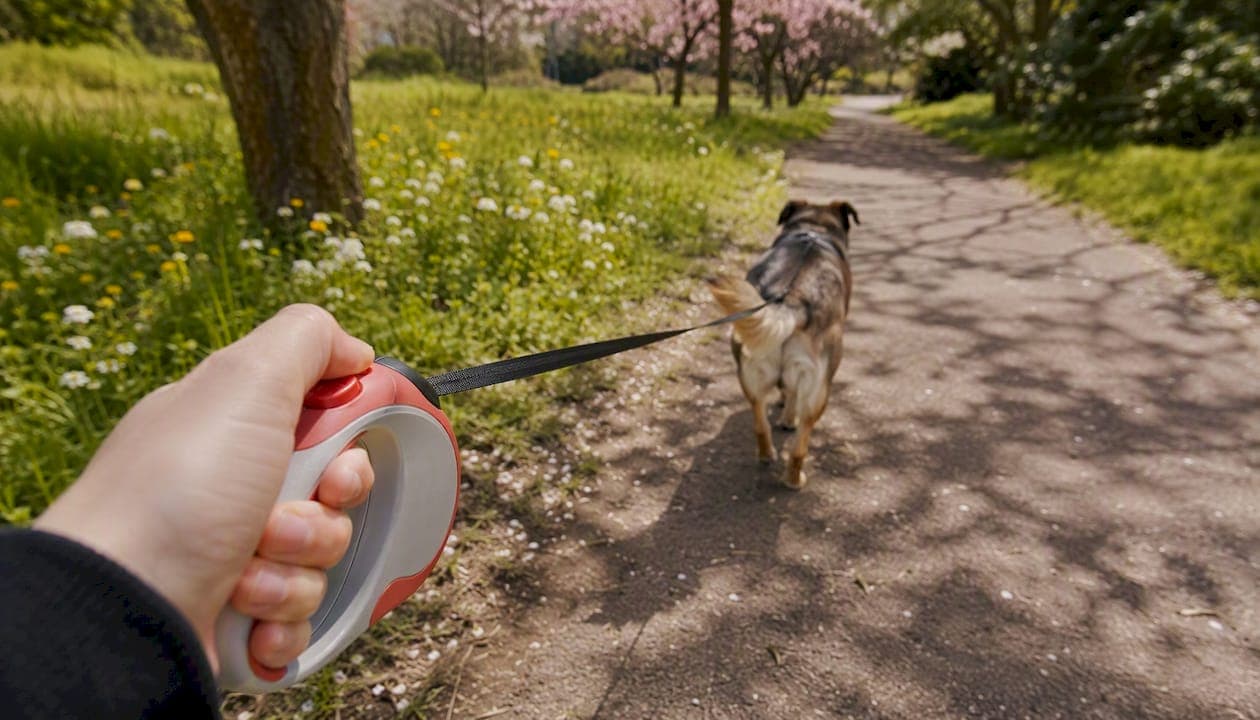
Retractable dog leashes are not the safest choice for most walks. The mechanism that makes them appealing — that long, freely extending cord — is also what creates the most serious risks for dogs, handlers, and bystanders.
Three things to know right now:
- Avoid retractables near traffic, crowds, other dogs, and at vet or grooming visits. You cannot shorten the cord fast enough when something goes wrong.
- A standard 6-foot leash handles most urban and suburban walks better. For off-leash-style freedom, a long fixed-length leash is a safer middle ground.
- If you already own a retractable leash, inspect it before every walk — check the cord for fraying, the lock for stickiness, and the clip for cracks. A short safety checklist appears later in this article.
Key Takeaways
Retractable dog leashes carry real mechanical and injury risks that make them a poor default choice for most walks — a standard 6-foot leash or a long line covers the same needs more safely.
| Point | Details |
|---|---|
| Avoid in high-risk settings | Skip retractables near traffic, crowds, other dogs, vet visits, and any situation requiring fast control. |
| Prefer a 6-ft or long line | A standard leash handles urban walks; a 15–20 ft long line gives open-field freedom without mechanical failure risk. |
| Inspect every single time | Check the cord for fraying, the lock for stickiness, and the clip for cracks before each walk. |
| Attach to a harness D-ring | Clip to a harness, not a collar ring, to protect the dog's neck and reduce recoil risk if the clip fails. |
| Kiblco's tested picks | Kiblco's vet-informed harness and leash guides help you find safer, durability-tested alternatives with direct retailer links. |
Table of Contents
- Are retractable dog leashes safe to use on everyday walks?
- Why do vets and trainers warn against retractable leashes?
- When is a retractable leash acceptable — and when should you skip it?
- What are safer leash alternatives for most dogs?
- How to use a retractable leash more safely, step by step
- Kiblco vet-informed testing: what we observed
- If the leash breaks, tangles, or someone is injured: what to do
- Balancing a dog's freedom with handler safety
- Kiblco's vetted leash and harness picks
- Sources
Are retractable dog leashes safe to use on everyday walks?
A retractable leash is a plastic handle housing a spring-loaded spool that feeds out a thin nylon cord or flat tape as the dog moves forward. The core components are: the handle (which contains the spool and braking mechanism), the cord or tape (typically a long length), a thumb-operated lock/brake button, and a metal snap clip that attaches to the dog's collar or harness.
The way it works is straightforward: the dog walks forward, the cord unspools under light tension, and the owner presses the button to lock the cord at a chosen length within the leash's maximum extension. Release the button and the cord retracts automatically. That sounds convenient, but the single-button lock is also the single point of failure. When the button sticks, the spool jams, or the cord snaps under load, the handler loses all control instantly.
Flexi's own safety instructions recommend using a secondary safety collar in addition to the dog's regular collar or harness, and they explicitly warn that cord recoil can cause serious injury if the collar or clip fails. That warning is printed in the manufacturer's pamphlet — not buried in fine print.
Why do vets and trainers warn against retractable leashes?
The risks are specific, well-documented, and span both ends of the leash.
Primary risk categories:
- Neck and trachea injury in dogs. When a dog hits the end of a fully extended cord at speed, the sudden jerk can damage the cervical spine or crush the trachea. Veterinary clinics report treating animals for neck and back injuries directly linked to retractable leash use.
- Reinforcement of pulling behavior. Every time an owner releases more cord as the dog pulls forward, the dog learns that pulling works. Trainers consistently flag this as a core reason retractables undermine leash manners.
- Human rope burns, lacerations, and finger injuries. Grabbing a moving cord with bare hands — or having it wrap around a finger — can cause deep lacerations. Severe cases have resulted in partial or full finger amputation.
- Entanglement. The thin cord is hard to see and easy to wrap around legs, ankles, other dogs, or strollers. A tangled cord under tension can knock a person down or trap a dog's limb.
- Leash and clip malfunction. PetMD notes that sticky locks, jammed spools, and snapped cords are common failure modes. When the cord breaks, the handle recoils toward the dog or handler at speed.
- Projectile recoil. Peer-reviewed case reports document blunt ocular trauma from leash clip recoil after cord or collar failure. The metal snap clip becomes a projectile.
- False sense of control. Owners often feel in control because they hold the handle, but at full extension, stopping a mid-sized dog mid-sprint is not physically possible with a thumb button.
Trainers also point out that retractables are commonly banned from group training classes. Walking two dogs on retractables simultaneously is widely considered unsafe — the cords cross, tangle, and remove any meaningful control from the handler.
When is a retractable leash acceptable — and when should you skip it?
The short answer: a retractable leash is reasonable only in a large, open, low-traffic area with a well-trained adult dog and an adult handler who knows the equipment.
Conditions that make it more acceptable:
- A wide open field or beach with no foot traffic, cyclists, or other dogs nearby
- A dog with solid recall, no history of neck or tracheal injury, and no reactive tendencies
- An adult handler who has practiced locking and unlocking the mechanism smoothly
- Tape-style retractable (wider, more visible) rather than thin cord
High-risk situations — skip the retractable entirely:
- Near any road or parking lot
- Crowded sidewalks, parks, or trails
- Dog parks or multi-dog environments
- Vet clinics and grooming facilities (most have posted policies against them)
- Walking with children holding the leash
- Low-visibility conditions: dusk, fog, dense brush
- Reactive, frightened, or noisy dogs
- Any dog with a history of neck or back problems
Two quick examples: a retractable works reasonably well for a calm Labrador exploring an empty soccer field on a Sunday morning with an experienced adult handler. The same leash on a reactive terrier mix at a Saturday farmers market is a setup for a cord-wrap injury, a dog fight, or worse.
Pro Tip: If your dog has ever lunged hard enough to jerk your arm, a retractable leash is not the right tool for that dog in that environment. The cord gives no warning before it snaps taut.
What are safer leash alternatives for most dogs?
For the vast majority of walks, a standard 4–6 ft leash gives you more real control and far fewer injury risks than a retractable. For supervised exercise with more freedom, a long line is the better call.
Standard 6-foot leash keeps the dog close enough to redirect quickly, works with both collars and harnesses, and has no mechanical failure points. It's the right tool for urban sidewalks, vet visits, and any environment with other people or dogs nearby.
Long line (15–20 ft) is a fixed-length leash — no spool, no spring, no button. Preventive Vet recommends long lines for giving dogs room to explore while keeping the owner actively engaged in managing length. You hold the slack, you feel the tension, and there's no mechanism to jam. It's the go-to for recall training, sniff walks in open areas, and supervised exercise.
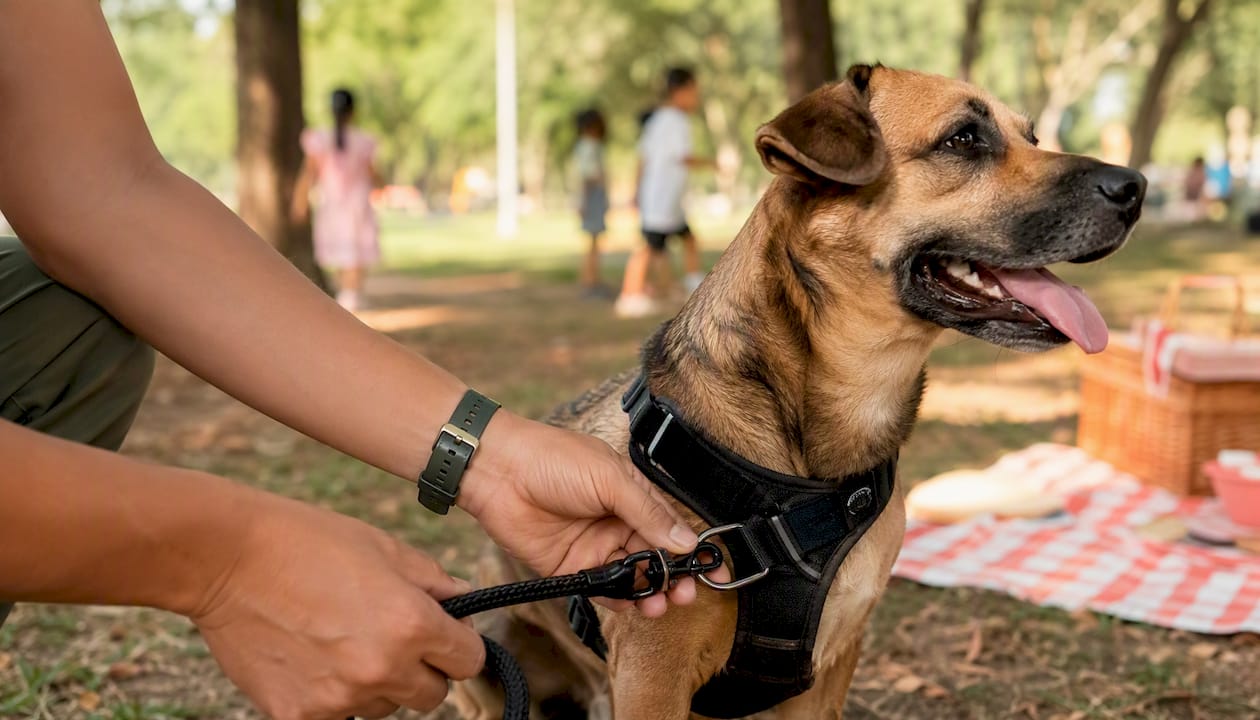
Harness attachment matters regardless of leash type. Attaching any leash to a back or front D-ring on a well-fitted no-pull harness distributes pressure across the chest and shoulders instead of the neck — a meaningful difference for dogs that pull or lunge.
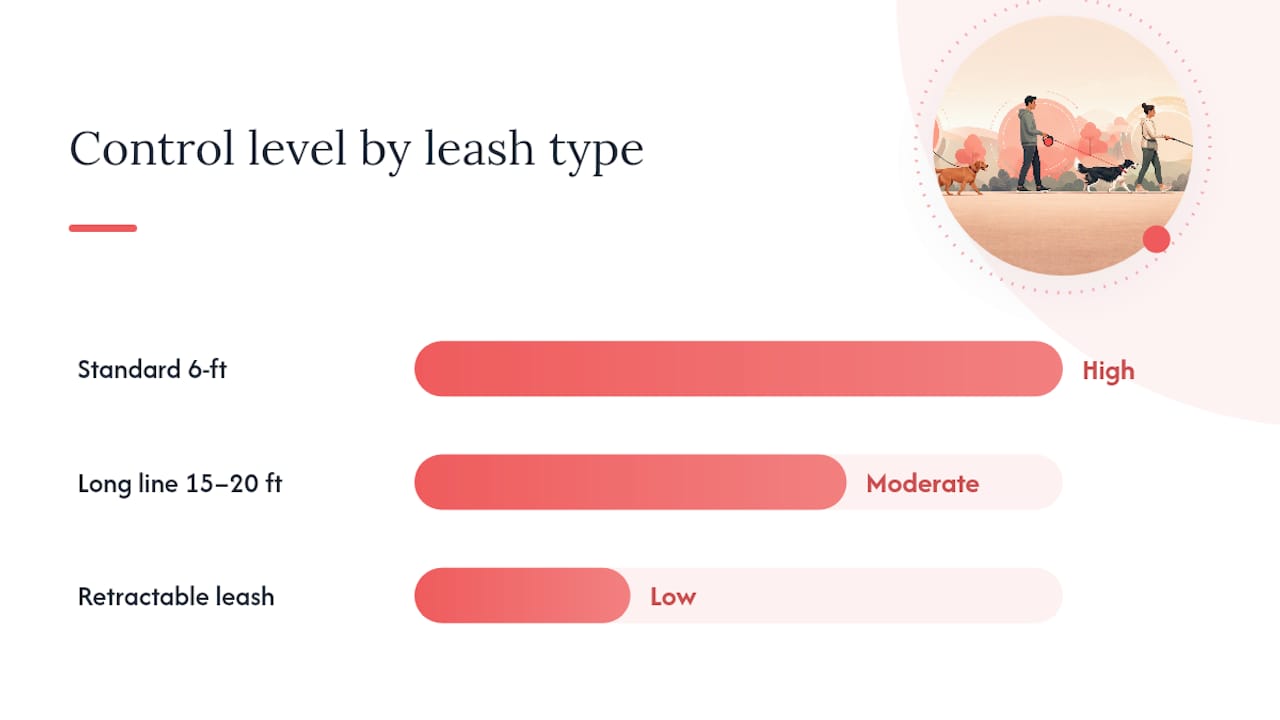
| Category | Control | Freedom | Snap-back/breakage risk | Best use-case |
|---|---|---|---|---|
| Standard 6-ft leash | High | Low | Very low | Urban walks, training, vet visits |
| Long line (15–20 ft) | Moderate (active management) | High | Low | Open fields, recall training, sniff walks |
| Retractable leash | Low | High | Moderate to high | Supervised open areas only, trained dogs |
For nighttime or low-light walks, pairing any leash with reflective collars and leashes addresses the visibility gap that makes retractable cords especially hazardous after dark.
How to use a retractable leash more safely, step by step
The single most important safety action: keep the cord short near any hazard and attach the clip to a harness D-ring, not a collar ring. Everything else builds from there.
- Choose the right size. Every retractable leash is rated for a maximum dog weight. Using a leash rated for a 30-pound dog on a 70-pound dog means the cord and mechanism are already under stress before the walk starts.
- Inspect before every walk. Run your fingers along the cord from handle to clip. Feel for fraying, stiffness, or rough patches. Check the clip for cracks or a loose gate. Press the lock button several times — it should engage and release cleanly with no sticking.
- Attach to the harness D-ring. Per Flexi's manufacturer guidance, attach the clip to the harness or use a secondary safety collar — never to an ID-tag ring, which is not load-bearing.
- Practice the lock before you need it. Lock and unlock the cord at home until the motion is automatic. In an emergency, fumbling with the button costs seconds you don't have.
- Keep two hands ready for strong dogs. One hand holds the handle; the other is free to grab the cord closer to the dog if needed. Never wrap the cord around your hand or fingers.
- Lock the cord short near people, traffic, or other dogs. Treat the lock like a standard leash in any situation that requires control. Extend only when the environment is genuinely clear.
- Retract fully before detaching. Always reel the cord in completely before unclipping. A loose cord under tension can snap back and strike the dog, you, or a bystander.
- Retire the leash at the first sign of damage. A frayed cord or sticky lock does not get better with use. PetMD's guidance is direct: a compromised mechanism is a single-point failure waiting to happen.
Inspection checklist before each walk:
- Cord: no fraying, cuts, or stiff sections
- Lock button: clicks cleanly, holds without creeping
- Clip: no cracks, gate opens and closes fully
- Handle: no cracks in the plastic casing
Pro Tip: If you find yourself reaching for the lock button constantly during a walk, that's a signal the environment calls for a standard leash or long line instead. The retractable's value is freedom in open space — if you're locking it every 30 seconds, you're carrying the worst of both worlds.
Kiblco vet-informed testing: what we observed
Testing showed that the most common failure modes appear before the leash looks obviously damaged. Sticky locks and frayed cords were the two issues that showed up earliest and most consistently.
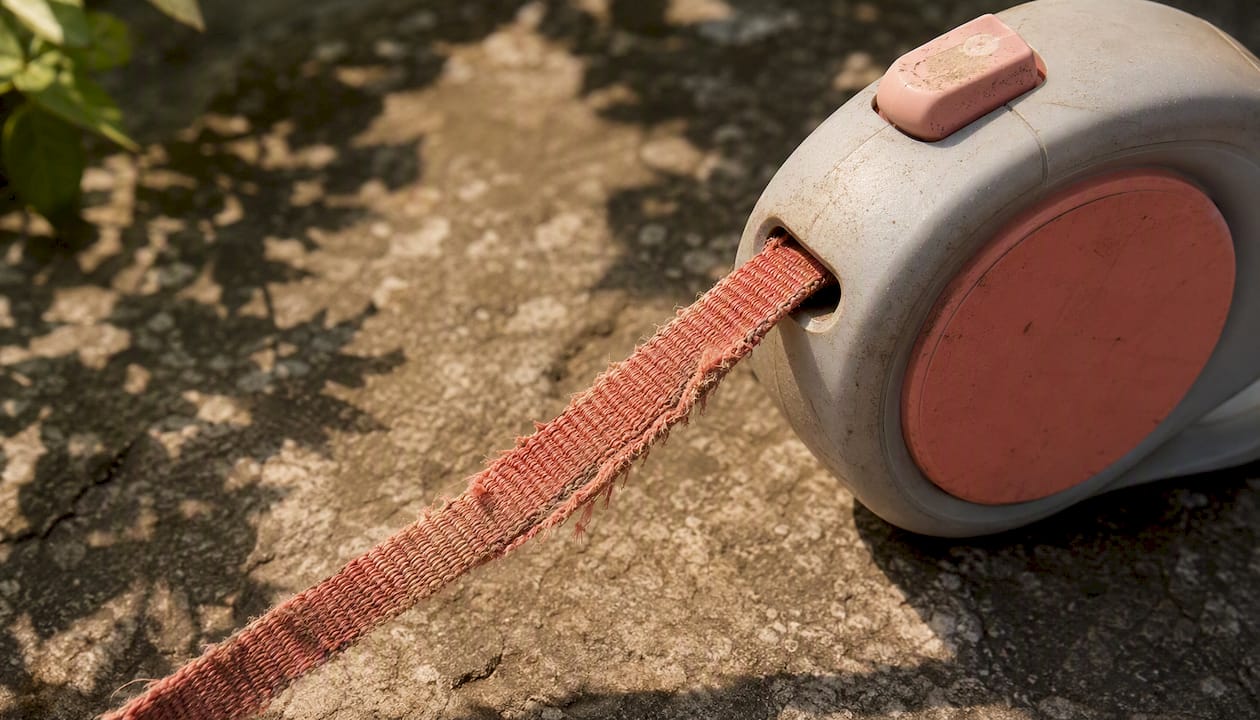
In small field tests with trained dogs, the lock mechanism on several mid-range retractable leashes began showing resistance after repeated use under load. Simulated tangles around a post revealed how quickly cord tension builds to a level that makes manual unwrapping difficult without gloves. Under inspection stress, one clip gate showed visible flex before any visible cracking — a sign that the metal had fatigued.
Key observations:
- Locks that felt smooth at the start of a walk became noticeably stickier after 20–30 minutes of active use in warm weather
- Fraying started at the clip end first, where the cord bends most sharply
- When a collar was removed while the cord was still extended, the clip recoiled toward the handle with enough force to sting a hand
- Stopping a dog mid-bolt at full extension required significantly more force than the handle's ergonomics were designed for
The clear takeaway from testing: use a standard leash for most walks. Reserve the retractable for supervised open areas, attach it to a harness, and inspect it every single time. Walking accessories that complement safer setups — like everyday dog walking essentials including gloves and reflective gear — meaningfully reduce the residual risks when a retractable is the chosen tool.
If the leash breaks, tangles, or someone is injured: what to do
The first priority is always the same: secure the dog and get bystanders clear of the cord.
- Do not grab a tensioned cord with bare hands. A cord under load can cut skin instantly. If the cord is wrapped around a limb, stop movement first — don't pull.
- Secure the dog. If the leash has failed completely, use a belt, a spare leash, or any available restraint. Get the dog behind a barrier if possible.
- Free trapped limbs carefully. If a cord is wrapped around a finger, ankle, or leg, cut it with a small knife or scissors rather than unwrapping under tension. Carry a small safety cutter on walks in areas where entanglement is a real risk.
- Control bleeding. Apply direct pressure to any laceration. Rope burns from cord contact can be deeper than they look.
When to contact a vet:
- Signs of neck pain, reluctance to move the head, or labored breathing after a sudden jerk
- Eye trauma (squinting, discharge, pawing at the face) — peer-reviewed reports document blunt ocular trauma from clip recoil
- Any visible wound on the dog from cord contact
When to call emergency services or seek urgent medical care:
- Human finger amputation or near-amputation
- Deep lacerations that won't stop bleeding
- Eye injury from a recoiling clip or handle
If the incident may require a report — a dog bite triggered by the leash failure, or a serious human injury — preserve the leash exactly as it is. Take photos of the cord, clip, and mechanism before anything is cleaned or discarded. That evidence matters if liability becomes a question.
Balancing a dog's freedom with handler safety
The appeal of a retractable leash is real. Watching a dog range freely, nose to the ground, covering ground at their own pace — that's genuinely good for them. The problem isn't the goal; it's the tool.
Kiblco's vet-informed testing process pushed us toward the same conclusion that trainers and clinicians reach independently: the retractable leash trades handler control for the appearance of freedom, and the mechanical failure modes are serious enough that most owners would be better served by a long line in open spaces and a standard leash everywhere else. That's not a cautious hedge — it's what the injury data and the inspection results both point to.
Owners who love retractables usually love them because they haven't had a cord snap, a clip recoil, or a dog bolt at full extension. Those experiences change the calculation fast. The goal is to give your dog real freedom without putting either of you at risk to get there.
Kiblco's vetted leash and harness picks
The fastest way to find a leash or harness that actually holds up is to skip the guesswork and go straight to gear that's been tested on real dogs. Kiblco's curated guides cover no-pull harnesses, reflective walking gear, and leash alternatives with hands-on durability notes and transparent pros and cons — so you know exactly what you're buying before it ships.

For dog owners moving away from retractables, the no-pull harness guide is the most useful starting point: it covers fit, attachment points, and which styles work best for pullers, reactive dogs, and dogs with neck sensitivities. Every pick links directly to retailers including Amazon, Chewy, and Petco. Head to Kiblco to browse the full library of vet-informed reviews and find the right gear for your dog's size, breed, and walking habits.
Sources
The guidance in this article draws on veterinary clinic reports, manufacturer safety instructions, peer-reviewed injury case studies, and trainer consensus. Key sources are listed below.
- Are Retractable Leashes Good or Bad? | Preventive Vet
- Are Retractable Leashes Bad? 7 Risks and Which Leashes To Use Instead | PetMD
- Flexi safety instructions pamphlet (manufacturer)
- Case reports and analysis of leash recoil-related injuries (peer-reviewed source)
- 4 reasons why retractable leashes are dangerous | Northshore Humane Society