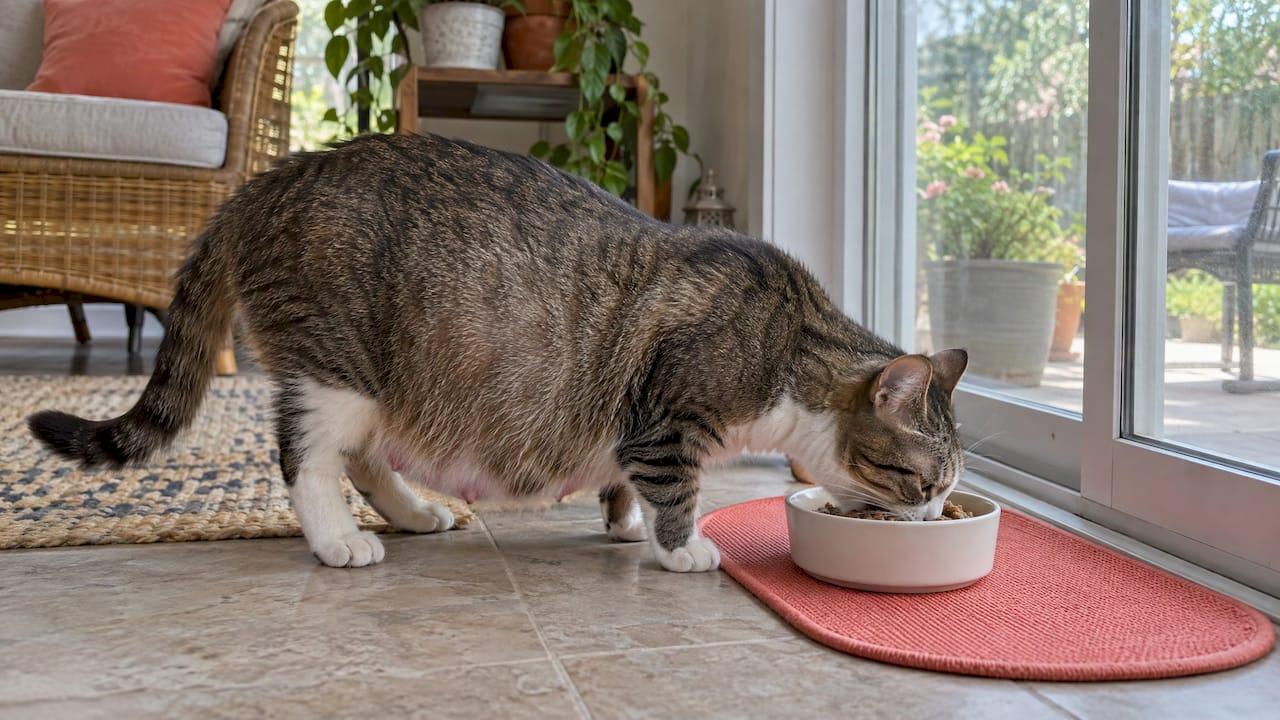
The best food for a pregnant cat is a complete and balanced kitten food, or a food labeled for growth and reproduction, offered in generous, frequent meals from early pregnancy through weaning. Veterinary guidance points the same way: more calories, more protein, a food that already contains everything she needs, and no extra supplements. Below is how to read the label, how much to add as the weeks pass, how to switch foods without upsetting her stomach, and what to leave out.
TL;DR
- Choose a food whose label says it is complete and balanced for growth and reproduction, or for all life stages. Kitten food usually fits.
- Her energy needs climb through pregnancy. The Merck Veterinary Manual says she needs about 25% more food in the last 3 weeks, and 2 to 3 times more while nursing.
- Switch over 7 to 10 days, not overnight, and offer smaller, more frequent meals or free access to food.
- Skip calcium tablets, vitamins and cow's milk unless your veterinarian prescribes something.
- Book a vet visit as soon as you suspect pregnancy. Your vet can confirm it, check her weight and tell you when to change her diet.
Table of Contents
- Why a pregnant cat needs a different diet
- How to read the label
- Nutrients that matter most
- How much to feed as pregnancy progresses
- Wet food, dry food or both?
- Switching foods without upsetting her stomach
- What to keep out of her bowl
- When to call the vet
- Finding the right products
- Our view on feeding a pregnant cat
- FAQ
- Sources
Why a pregnant cat needs a different diet
A pregnant cat, called a queen, is building several kittens while keeping her own body in shape. Then she has to make milk. A maintenance diet for an adult cat is not designed for that workload.
The Merck Veterinary Manual says a veterinarian will likely recommend kitten food while a cat is pregnant and nursing. Kitten food is more concentrated in protein and calories, which is exactly what a growing litter and a hard-working mother need.
A peer-reviewed review in Reproduction in Domestic Animals reports that a queen's energy intake rises about 10% per week from the start of pregnancy, reaching 25% to 50% above her normal level by the end of gestation. That is why "a little extra at the end" is not the whole story. Her appetite starts rising earlier, and a good food and a steady supply let her build reserves while she can.
Cats also have unusually narrow nutritional requirements. The AAHA/AAFP 2021 feline life stage guidelines explain that the domestic cat lost key metabolic enzymes through evolution, which is why they recommend diets carrying an AAFCO nutritional adequacy statement at every life stage. In plain terms: a cat cannot make up for a food that is missing something, so the food itself has to be right.
How to read the label
The label tells you more than the front of the bag. Look for these three things.
1. The nutritional adequacy statement
AAFCO (the Association of American Feed Control Officials) sets the nutrient profiles that U.S. pet foods are measured against. The FDA explains that a food can say it is "complete and balanced" only if it meets an AAFCO nutrient profile or passes an AAFCO feeding trial. AAFCO has two cat profiles: one for growth and reproduction, which covers growing, pregnant and nursing animals, and one for adult maintenance.
So you want to see wording along the lines of "formulated to meet the nutritional levels established by the AAFCO cat food nutrient profiles for growth and reproduction" or "for all life stages." A food labeled only for adult maintenance is the wrong fit for a queen.
2. Meat or seafood first
Cornell's Feline Health Center notes that cats are obligate carnivores, needing high protein, moderate fat and minimal carbohydrate, and advises looking for meat or seafood among the first few ingredients. That is a sensible quick check once you have confirmed the adequacy statement.
3. Calories and protein, compared fairly
Wet and dry foods cannot be compared by the numbers on the front of the can, because water dilutes everything. The FDA points out that canned food is typically 75% to 78% moisture versus 10% to 12% for dry, so nutrient levels must be converted to a dry-matter basis to compare formats. If a label comparison starts to feel like math homework, rely on the adequacy statement and let your vet check the choice.
Nutrients that matter most
You do not need to build a diet from individual nutrients. A complete and balanced kitten food already does that. It helps to know what the numbers behind it mean, though.
Protein. The Fontaine review notes that a diet of at least 4,000 kcal of metabolizable energy per kilogram of dry matter is usually recommended for the whole gestation, which meets AAFCO's minimums of 30% protein, 9% fat, 1% calcium and 0.8% phosphorus. Clinical guidelines summarized by Pet Food Media suggest an even richer target of at least 4,500 kcal/kg dry matter with protein above 32%. Both point to the same place: concentrated, high-protein food.
Taurine and arachidonic acid. These are two amino and fatty acids that cats must get from food. The same guidelines say they are essential to prevent fetal loss. A food that meets the AAFCO profile for growth and reproduction already accounts for them. If you want to understand taurine better, our guide to taurine for cats covers it.
Calcium and phosphorus. Balance is the point, not quantity. The Pet Food Media summary gives an ideal calcium-to-phosphorus ratio of 1:1 to 2:1 and says calcium supplementation is contraindicated because it disrupts that ratio. This is a main reason a complete diet beats add-ons, and we come back to it below.
Nutrition matters in every kind of pregnancy, and the principle that needs rise and quality counts holds across species. If you are curious about the human side, this guide to healthy habits for expectant mothers shows how a similar logic plays out.

How much to feed as pregnancy progresses
A cat's pregnancy lasts roughly nine weeks, so the stages go by quickly. Treat this as a guide and let your vet adjust it for her body condition and litter size.
| Stage | What to do |
|---|---|
| Before or at the start of pregnancy | Keep her on a complete and balanced food and ask your vet about switching to kitten food. |
| First half | Begin the 7 to 10 day transition to kitten food if your vet agrees. Keep portions steady while watching her appetite. |
| Second half | Her energy intake keeps climbing. Offer more frequent meals so she can eat to appetite. |
| Last 3 weeks | The Merck Veterinary Manual advises about 25% more food, in more frequent meals or with free access. |
| Nursing | Expect 2 to 3 times her usual amount of food, according to the same source. |
Weight gain is expected. Pet Food Media's clinical summary describes weight gain of 40% to 50% by the end of pregnancy, with energy needs rising steadily from about week 2. A queen who looks rounder and hungrier is doing what she should. Weigh her weekly on a kitchen or baby scale and note the number, so you can tell your vet if it stalls.
Meal frequency matters as much as the total. Late in pregnancy the kittens crowd her stomach, so she may only manage a small amount at one time. Four to five small meals, or a bowl she can return to, usually works better than two large ones.
The Merck Veterinary Manual also says that even with extra kitten food, a nursing cat will likely lose weight. Reserves built during pregnancy help her face lactation, which is why generous feeding earlier in gestation pays off later.
Wet food, dry food or both?
Both formats can meet the nutritional profile, provided the label carries the right statement. The difference is how she eats them.
- Dry kitten food is calorie-dense, so a small volume delivers a lot of energy. That helps late in pregnancy when her stomach has little room. It also stays fresh in a bowl for free feeding.
- Wet kitten food carries far more water, per the FDA's moisture figures above. That adds hydration, and many queens find the aroma and texture easier to eat when their appetite dips.
A practical approach is to offer a measured amount of wet food at set meal times and keep a bowl of dry kitten food available. Check that both carry the growth and reproduction or all life stages statement, and ask your vet to confirm the daily total. Always leave fresh water out.
The AAHA/AAFP guidelines do not endorse raw or non-sterilized dehydrated animal-origin foods, and a pregnancy is no time to experiment. Stick to commercially prepared food with an AAFCO statement.
Switching foods without upsetting her stomach
The AAHA/AAFP guidelines describe gradual transitioning to a new diet over 7 to 10 days as the recommended approach. A simple schedule:
- Days 1 to 3: about one quarter new food, three quarters old.
- Days 4 to 6: half and half.
- Days 7 to 9: three quarters new, one quarter old.
- Day 10: all new food.
If she refuses the new food or has loose stools, slow down and go back one step. Pregnancy can make her pickier, so start the switch early rather than waiting until she is heavily pregnant. Our step-by-step guide to switching cat food explains how to pace a transition and why cats that stop eating need prompt attention. A cat that eats nothing for a day or more should see a vet.
What to keep out of her bowl
Calcium tablets and vitamins
This surprises many owners, because calcium feels like the obvious thing for growing kittens. The Merck Veterinary Manual says to feed a complete and balanced diet and not give a pregnant cat dietary supplements such as calcium or vitamins. It adds that low blood calcium after delivery, with tremors, spasms or seizures, is more likely in animals receiving calcium supplements or imbalanced diets during pregnancy. A complete kitten food already has the right calcium and phosphorus. Give a supplement only if your veterinarian prescribes it.
Cow's milk
Milk is a common question. PetMD's veterinary-reviewed article explains that most cats lose the lactase enzyme as they mature, so cow's milk can cause vomiting, diarrhea and abdominal pain, and that even tolerant cats should not drink it regularly. Plant-based milks are not a good idea either. Water and a complete food cover her needs. If you are wondering about alternatives, see our article on goat milk for cats.
Homemade and raw diets
Home-made meals rarely hit the calcium and phosphorus balance, taurine and energy density a queen needs, and raw foods are not endorsed in the AAHA/AAFP guidance. A complete commercial food is the safer foundation.
Extra products
Colostrum, liver supplements and B vitamins are popular, but during pregnancy any add-on belongs in a conversation with your vet first. If you are curious about one, our colostrum for cats guide explains who it suits.
When to call the vet
Book a visit early in the pregnancy to confirm it, check her weight and discuss food. Call promptly if she stops eating, vomits repeatedly, seems lethargic, or has any unusual discharge. After birth, tremors, stiffness, restlessness or seizures are an emergency, since they can signal low blood calcium, so go to an emergency clinic right away.
Finding the right products
Once you know what to look for, the shopping gets simpler. Our Cat Health reviews cover cat nutrition and wellness products, tested in real homes with downsides stated plainly. Our Cat Gear and Cat Litter pages help with the rest of a nesting setup.

Our view on feeding a pregnant cat
Most of the questions we hear around a pregnant cat come down to the same worry: am I giving her enough? Our answer is to start with the label, not the marketing. A food that carries the right AAFCO statement does most of the work, and extras rarely add to it.
That is how we approach every review. We buy the products, use them in real homes, and cross-check health picks with veterinary input. We state the downsides next to the upsides, we do not accept payment for coverage, and we disclose our affiliate relationships.
For a pregnant cat, our advice is simple. Pick a complete kitten food, change it gradually, let her eat generously, and keep your vet in the loop. Then use our reviews to compare the options once you know what the label has to say.
Chris
FAQ
Can I keep feeding my pregnant cat her adult food?
It depends on the label and your vet's advice. The Merck Veterinary Manual says a veterinarian will likely recommend kitten food during pregnancy and nursing. If her adult food is labeled for all life stages, it may meet the growth and reproduction profile, so check the adequacy statement and ask your vet.
When should I switch to kitten food?
Ask your vet as soon as you know she is pregnant. Because the AAHA/AAFP guidelines describe a 7 to 10 day transition, starting early lets you finish the switch well before her appetite peaks in the last 3 weeks.
Do pregnant cats eat more?
Yes. Her energy intake rises roughly 10% per week through pregnancy and can end up 25% to 50% above normal, according to the Fontaine review. Offer frequent meals or free access to food. Her intake will then rise again during nursing.
Does a pregnant cat need calcium or milk?
No. A complete and balanced food already contains the calcium she needs, and extra calcium can raise the risk of low blood calcium after delivery. Cow's milk can also upset her stomach, so offer fresh water instead.
Sources
- Management of Reproduction of Cats, Merck Veterinary Manual
- "Complete and Balanced" Pet Food, FDA
- Feeding Your Cat, Cornell Feline Health Center
- Food Intake and Nutrition During Pregnancy, Lactation and Weaning in the Dam and Offspring, Reproduction in Domestic Animals
- Nutrition and Weight Management, 2021 AAHA/AAFP Feline Life Stage Guidelines
- Nutrition during the reproductive stages of dogs and cats, Pet Food Media
- Can Cats Drink Milk?, PetMD