The most reliable way to prevent cat hairballs is to cut down the hair your cat swallows: brush daily, support digestion with fiber and water, and choose hairball products by what the veterinary evidence shows, not by the front of the bag. At Kiblco we buy and test cat products in real homes and cross-check health picks with veterinary input, so this guide sticks to that approach: what is backed, what is unproven, and when a hairball is a vet problem.
TL;DR
- Hairballs come from grooming. Cornell's feline health team says one every week or two is not uncommon, but more often than that deserves attention.
- Daily brushing and combing is the first step Cornell recommends.
- Fiber-enriched diets have the best trial data. Most other hairball products have little published evidence.
- Repeated unproductive retching, lethargy or not eating means a call to your vet, not a new product.
Table of Contents
- Why cats get hairballs
- Step 1: Brush every day
- Step 2: Support digestion with fiber and water
- Step 3: Choose a hairball product with its safety in mind
- A simple four-week routine
- When a hairball is a vet problem
- Our perspective
- Find tested picks for your cat
- FAQ
- Sources
Why cats get hairballs
Cats groom constantly, and their tongues are covered with tiny backward-slanted papillae (small hooks) that pull loose hair off the coat and push it down the throat. Hair is made of keratin, which cats cannot digest, so it can collect in the stomach as a damp clump. Most swallowed hair passes through and leaves in the stool. The hairball you find on the rug is what didn't.
Some cats are more prone than others. Cornell's Feline Health Center notes that kittens and young cats have fewer hairballs than older cats, that long-haired breeds such as Persians and Maine Coons are at significantly greater risk than short-haired cats, and that hairballs are more frequent in shedding seasons. Colorado State University adds that fastidious groomers are also more prone, and that one or two a week can be expected.
VCA Animal Hospitals lists four things that raise the odds: excessive grooming, seasonal shedding, low-fiber diets and underlying digestive conditions. Each one points to a different fix, which is why a single product rarely solves everything.
Step 1: Brush every day
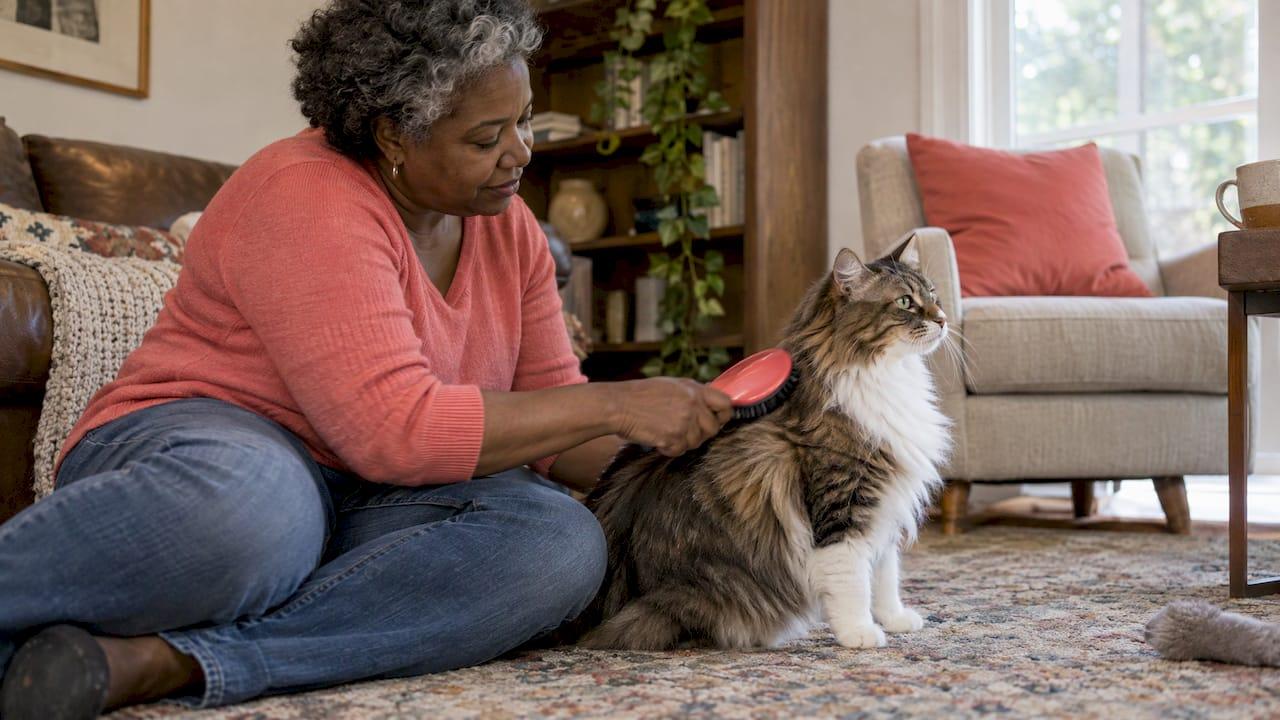
This is the step with the clearest expert backing. Cornell recommends daily brushing and combing to minimize hairball development. Every strand you remove with a brush is a strand your cat doesn't swallow.
How to make it stick:
- Match the tool to the coat. A metal comb works for long coats that mat; a soft rubber brush or glove is easier on short coats and sensitive cats.
- Keep sessions short. Two to five minutes after a meal or during a quiet evening beats a long fight once a week.
- Brush more in spring and fall. Shedding seasons are when hairballs peak.
- Reward it. A lick of a favorite treat after each session turns brushing into routine.
When we review grooming tools, we look at how well they pull loose undercoat, how easy they are to clean and whether a real cat tolerates them. You can browse our tested picks in Cat Gear.
If your cat grooms obsessively, bald patches included, brushing won't be enough. Cornell advises talking to a veterinary nutritionist or dermatologist, because overgrooming can signal a food allergy-related skin problem.
Step 2: Support digestion with fiber and water
Hair moves through the gut more easily when the diet has enough fiber and the cat is well hydrated. VCA's prevention advice includes fiber or lubricant supplements, more water through fresh sources and wet food, and regular checkups.
Practical ways to raise water intake:
- Offer a pet fountain or several wide bowls away from the litter box.
- Add wet food to at least one meal a day.
- Refresh water daily.
If you are comparing food costs while you adjust the diet, a cat food calculator for daily feeding cost helps you work out how much to feed and what each day costs.
What the diet research shows
The strongest evidence comes from fiber. In a 2011 double-blind, placebo-controlled trial of 24 cats, a dry diet enriched with 4% cellulose lowered vomiting, retching and coughing by 79%, 91% and 70% over four weeks, and the drop in vomiting was statistically significant. The authors suggest cellulose slows gastric emptying so hair binds to food particles and moves on into the intestine, where it is excreted in the stool.
That is a small trial, and a veterinary review is candid about the wider picture: Dr. Martha Cannon noted there are no published studies of hairball incidence in pet cats and no objective public data on commercial hairball diets. The practical takeaway is to look for fiber as the working ingredient and to judge any product over several weeks by how many hairballs your own cat actually produces.

Step 3: Choose a hairball product with its safety in mind
Most cat owners reach for a gel, chew, treat or special diet. The options fall into a few types.
| Type | How it is meant to work | What to know |
|---|---|---|
| Fiber-enriched food | Fiber helps hair travel through the gut | Best trial data: the cellulose study above |
| Fiber chews and supplements | Psyllium or similar fibers add bulk | A 2-week psyllium and slippery elm chew study reported a 29% reduction in hairball-related signs, though not in actual vomiting |
| Bromelain treats | Fed daily to cats with a history of hairballs | A patent described in a trade article reported 62.5% fewer vomiting episodes at one month, a company-reported figure rather than an independent trial |
| Lubricant gels (mineral oil, petrolatum) | Coat hair to ease passage | Safe-use limits matter, see below |
If you want to go deeper on a fiber option, we have written about psyllium for cats, including dose and safety and slippery elm for cats. Both come with the vet-backed dosing information you should have before giving anything new.
Safe use of lubricant products
Merck Veterinary Manual lists mineral oil among the ways to limit hairballs, and also notes that oral mineral oil is not advised for constipated cats because of aspiration pneumonia risk. Chronic use of lubricant laxatives may also reduce absorption of fat-soluble vitamins. Practical rules:
- Never force a gel or oil into a cat's mouth; let the cat lick it from a paw or spoon.
- Don't use lubricants as a daily habit without asking your vet.
- Skip them entirely in a cat that is vomiting or constipated and call your vet instead.
- Introduce any new product alone, so you can tell what caused any stomach upset.
If your cat's trouble is hard stools rather than hairballs, our guide to pumpkin for cat constipation covers the vet dose and when to call.
A simple four-week routine
Here is a plan you can follow without changing everything at once.
Week 1: Count your baseline. Note how many hairballs your cat brings up and start daily brushing.
Week 2: Add water: a fountain, a second bowl or one wet meal a day.
Week 3: If you want a fiber boost, switch to a fiber-enriched food gradually over a week, mixing old and new, or add one fiber product. Change one thing at a time.
Week 4: Compare to your baseline. Fewer hairballs and easier stools mean the routine is working. Keep brushing, since it is the foundation.
A healthy pattern is one hairball every week or two. If your cat is clearly above that, or the hairballs are getting worse, move on to the next section.

When a hairball is a vet problem
Most hairballs are a nuisance. A few are not. Cornell's Dr. Goldstein stresses that a hairball lodged in the small intestine is uncommon but very serious, and can be fatal without surgery.
Call your veterinarian without delay if your cat:
- is lethargic or refuses food for more than a day or two
- has repeated unproductive retching or true vomiting
- hacks frequently, which Cornell says may point to another gastrointestinal problem or a respiratory ailment such as asthma
- vomits more than once or twice a day, or vomits with blood, abdominal pain, dehydration, weakness, fever or weight loss, which Merck lists as needing a detailed veterinary exam
- cannot keep down food or water, or has no bowel movements
VCA points out that with an obstructing hairball you may not see any hair in the vomit, so don't wait for proof. Diagnosis involves an exam, X-rays and sometimes ultrasound and blood tests. Treatment is occasionally endoscopy and more often surgery.
Our perspective
When we test products for cats, hairball items are some of the most crowded and confusing on the shelf. Nearly every label promises less mess, and very few explain how.
Our approach is to buy products with our own money, use them in real homes with real shedding cats, and show the downsides next to the upsides. For health items we cross-check with veterinary experts, because a product that sits well with one cat can be the wrong choice for another.
Our advice is the order of this article: brush first, then water and fiber, then a product, and a vet when anything looks off. We don't accept payment for coverage, and we disclose our affiliate relationships, so you can weigh our picks knowing how we earn.
Chris
Find tested picks for your cat
If you are ready to shop, our Cat Health reviews cover supplements and digestive support, each with clear pros and cons, durability, usability and health effects. Grooming tools and other essentials are in Cat Gear.

Every review comes from products purchased and tested in real homes, with health picks cross-checked by veterinary experts. Start from the Kiblco home page to see our latest tests.
FAQ
What can I give my cat to prevent hairballs?
Start with daily brushing, plenty of water and a diet with enough fiber. Fiber-enriched food has the best trial support, and chews or supplements with psyllium or slippery elm are common add-ons. Ask your vet before starting any supplement or lubricant.
How often is it normal for a cat to have hairballs?
Cornell says a hairball every week or two is not uncommon, and Colorado State says one or two a week can be expected in some cats. Long-haired, older and heavy-shedding cats tend to produce more, especially in shedding seasons.
How do I stop my cat from coughing up hairballs?
Reduce the hair your cat swallows by brushing daily, and keep the gut moving with water and fiber. If the coughing is frequent, doesn't produce a hairball or comes with lethargy, see your vet, since it can point to a digestive or respiratory problem.
Are hairball gels safe to use every day?
Lubricant gels are not meant as an everyday habit. Merck warns that chronic use of lubricant laxatives may reduce absorption of fat-soluble vitamins, so check with your vet about how often and how much suits your cat.
Sources
- The Danger of Hairballs, Cornell Feline Health Center
- A Hairy Dilemma, Cornell Feline Health Center
- Pet Health: Be aware, hairballs are the natural result of grooming, Colorado State University
- Hairball remedies for cats, VCA Animal Hospitals
- Hair Balls in Cats: A normal nuisance or a sign that something is wrong, Journal of Feline Medicine and Surgery
- Clinical Signs of Hairballs in Cats Fed a Diet Enriched with Cellulose
- Vomiting in Cats, Merck Veterinary Manual
- Pet problems, Petfood Industry
- Digestive Lubricants in Cats, SpectrumCare
- Trichobezoars in Cats, VCA Animal Hospitals