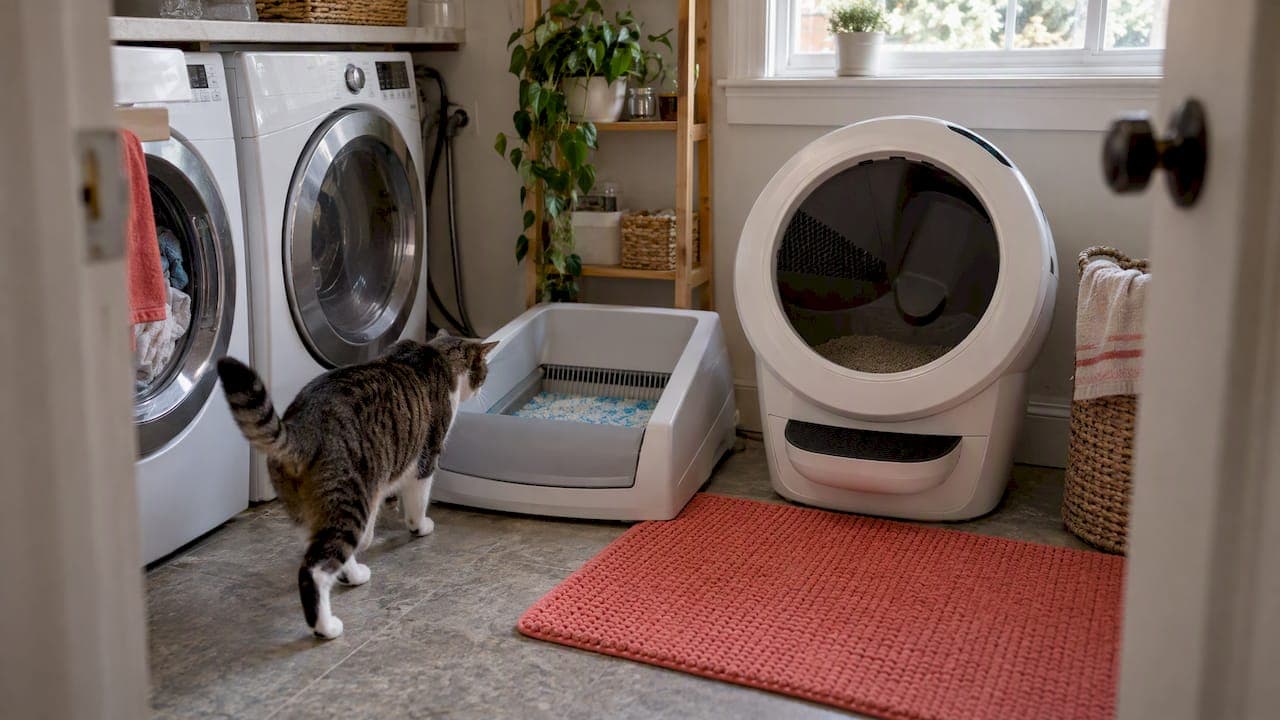
For most multi-cat homes or anyone who wants health monitoring, the Litter-Robot is worth the higher price; for single-cat households, small apartments, or tight budgets, the PetSafe ScoopFree gets the job done for less. The real trade-off is money versus how hands-off you want the routine to be. The table below breaks down the specifics.
TL;DR:
- ScoopFree requires proprietary crystal trays, which need replacement every few weeks or sooner if odor develops; the rotating globe system uses clumping litter and liners.
- Newer rotating globe models log visit frequency and duration through an app, but changes can flag concerns only; a veterinarian must assess them.
- ScoopFree’s open, low profile suits cats wary of enclosed spaces, while the globe’s height and footprint may challenge kittens, senior cats, and small breeds.
- Both systems require monthly deep cleaning despite automatic cycles, so introduce either gradually and keep the familiar box available during the first week.
Table of Contents
- ScoopFree vs Litter-Robot: Quick Comparison
- How Litter-Robot and ScoopFree Actually Work
- Mechanism, Litter, Size, Noise, and Odor: What the Differences Mean for Your Cat
- What It Actually Costs to Own Each System
- Matching the Right Box to Your Household
- What Our Hands-On Testing and Vet-Informed Research Showed
- Our Take on the ScoopFree vs Litter-Robot Debate
- A Different Way to Shop for Your Cat's Litter Setup
- FAQ
- Sources
ScoopFree vs Litter-Robot: Quick Comparison
Here is how the two systems stack up across the factors that actually affect daily life with a cat.
| Dimension | PetSafe ScoopFree | Litter-Robot (4/5 family) |
|---|---|---|
| Upfront cost | Lower | Higher |
| Ongoing consumables | Disposable crystal trays, replaced regularly | Clumping litter plus occasional filter or liner costs |
| Cleaning mechanism | Timed rake sweeps waste into a covered tray | Rotating or sifting globe separates waste from clean litter |
| Litter compatibility | Proprietary crystal litter only | Standard clumping clay or compatible alternatives |
| Maintenance time | Tray swap every few weeks, quick wipe-downs | Periodic bowl cleaning and waste drawer emptying |
| Suitable cat count | Best for one cat | Handles multiple cats well |
| Noise and comfort | Open top, low profile | Enclosed globe, quieter cycle but bigger footprint |
| Odor control | Relies on pad or tray chemistry | Sealed waste drawer contains odor longer |
| Monitoring features | None | App logs and weight sensing on newer models |
| Best for | Budget buyers, small spaces, single-cat homes | Multi-cat households, hands-off routines, health tracking |
A few things stand out once you look past the price tags.
- The ScoopFree's compact, open design suits cats who dislike enclosed spaces and fits easily in a studio apartment or small bathroom.
- The Litter-Robot's sealed waste drawer means you empty it far less often than you'd swap a ScoopFree tray, which matters most in multi-cat homes.
- Both systems still need a monthly deep clean. Automatic does not mean maintenance-free, even on higher-end models.
In short, the ScoopFree wins on upfront cost and footprint, while the Litter-Robot wins on how little you have to touch it once it's running.
How Litter-Robot and ScoopFree Actually Work
The two systems solve the same problem (keeping waste away from your cat and your nose) with completely different mechanics.
The Litter-Robot family uses a rotating, sifting globe. After your cat steps out, a sensor triggers the globe to rotate slowly, sifting clumped waste through a screen while clean litter falls back to the bottom. The waste drops into a sealed drawer lined with a disposable bag, which you empty all several days depending on how many cats use it. Newer units in the Litter-Robot 4 and Litter-Robot 5 lines add weight sensing and app connectivity, logging each visit so you can see usage patterns from your phone.
The PetSafe ScoopFree takes a simpler approach. A timed rake waits roughly 20 minutes after your cat uses the box, then sweeps solid waste into a covered compartment at the back of the unit, according to PetMD's explanation of rake-style systems. The box uses disposable crystal litter trays, marketed to last around a month, that sit directly in the unit and get replaced as a whole piece rather than topped off.
A few practical notes for either system:
- Litter-Robot models ship in different sizes and price points; the core mechanism (rotating sift, sealed drawer) stays consistent across the 4 and 5 variants.
- ScoopFree trays come in regular and larger sizes, and PetSafe also sells a version with a lower entry for small cats or kittens.
- Both brands include safety sensors that pause the cleaning cycle if your cat re-enters the box mid-cycle.
Understanding these two mechanisms, rake versus rotating sift, explains almost every difference you'll read about in reviews: cost, noise, odor control, and how much hands-on attention each system demands.
Mechanism, Litter, Size, Noise, and Odor: What the Differences Mean for Your Cat
The mechanical difference between these two boxes drives nearly every other trade-off you'll weigh.
Mechanism and failure modes. A rake system like the ScoopFree has fewer moving parts, but the rake can jam if clumps are unusually large or if hair tangles in the mechanism. The safety sensor will typically pause the cycle rather than force it, so a jammed rake usually just means a missed cleaning cycle until you intervene. The Litter-Robot's rotating globe has more components (motor, sensor array, sifting screen) and generally needs a firmware or sensor reset occasionally, which the companion app will usually flag.
Litter compatibility. This is one of the biggest lifestyle differences between the two. ScoopFree requires proprietary crystal litter, which does not clump. Instead, odor control depends on the crystals and the tray's chemistry, and PetMD notes that trays marketed to last around 30 days often need changing sooner once odor builds up. Litter-Robot units use standard clumping clay litter, which most cats already prefer. PetMD's litter box guidance notes that most cats do best with unscented, low-dust clumping litter, and that keeping the box clean matters more than any other single factor in whether a cat keeps using it.
Size and placement. The ScoopFree's open, low-profile design takes up less floor space and suits cats who dislike feeling enclosed. The Litter-Robot's globe shape has a larger footprint and sits higher off the ground, which can be a hurdle for kittens, senior cats, or very small breeds, though it offers more interior room for larger cats once they're inside.
Noise and cat comfort. An enclosed, rotating unit can feel unfamiliar to a cat who has never used anything but an open pan. Veterinary behaviorists have noted that enclosed designs can make some cats feel trapped, and that consistent placement and a slow transition matter more than the box's technology. An open rake system avoids that enclosure issue entirely, which can be the deciding factor for a nervous or older cat.
Pro Tip: Introduce any automatic litter box gradually: leave it powered off and let your cat explore it for a few days before turning on the cleaning cycle.
Odor control and waste containment. This is where real-world reports diverge most. Owner discussions on Reddit comparing the two systems commonly describe the Litter-Robot as more hands-off overall thanks to its sealed drawer, while the ScoopFree is cheaper and more compact but can develop odor if the crystal tray isn't swapped on schedule. Crystal litter doesn't clump, so urine odor control shifts almost entirely to the tray's absorbent pad, meaning a missed swap shows up as smell fast.
Monitoring and health features. Weight sensing and app logs, available on newer Litter-Robot models, track how often and how long each cat visits the box. These features can help you notice a change in frequency or duration before it becomes obvious, though monitoring tools are a flag, not a diagnosis: any meaningful shift still calls for a vet visit, not just an app notification. Our guide to health-monitoring cat litter goes deeper into what these pattern changes can and can't tell you.

What It Actually Costs to Own Each System
Budgeting for an automatic litter box means looking past the sticker price to the consumables you'll buy every month.
The ScoopFree has the lower upfront cost of the two systems, and its ongoing expense comes from replacement crystal trays. Owner reports consistently point out that upfront savings on a rake-and-crystal system often shift into recurring consumable costs, since trays need replacing on a regular cycle to avoid odor. The Litter-Robot costs more upfront but runs on standard clumping litter, so your main recurring expense is the litter itself plus occasional waste-drawer liners.
A simple way to plan maintenance time:
- Daily: Glance at the unit for a full waste drawer or tray indicator light, about 30 seconds.
- Weekly: Wipe down the entry point and check for litter tracking around the base, a few minutes.
- Every few weeks: Replace the ScoopFree crystal tray, or empty the Litter-Robot's sealed waste drawer and replace the liner.
- Monthly: Do a full wipe-down of the interior, sensors, and any removable parts on either unit, as recommended for all automatic litter boxes.
| Task | ScoopFree | Litter-Robot |
|---|---|---|
| Consumable | Disposable crystal tray | Clumping litter plus liner |
| Replacement frequency | Every few weeks, sooner if odor appears | Litter topped off regularly, drawer emptied periodically |
| Time per task | A few minutes per tray swap | A few minutes per drawer change |
| Deep clean | Monthly wipe-down | Monthly wipe-down |
If you want a broader sense of what a cat costs per year beyond the litter box itself, OutletPicks' breakdown of annual cat costs is a useful way to put these consumable costs in context.
Matching the Right Box to Your Household
The right choice depends less on brand loyalty and more on your cat, your space, and your patience for maintenance.
- Single cat, small apartment: The ScoopFree's compact footprint and lower cost make it an easy fit when space and budget are the main constraints.
- Multi-cat household: The Litter-Robot's sealed drawer and higher capacity handle multiple cats without daily attention, which matters more as cat count goes up.
- Timid or anxious cat: An open, low-profile design like the ScoopFree avoids the enclosure issue that can make some cats avoid a rotating globe unit.
- Frequent traveler: The Litter-Robot's longer stretch between waste drawer changes and app alerts give more peace of mind when you're away for a few days.
- Strict budget buyer: The ScoopFree delivers most of the hands-off benefit at a fraction of the cost, as long as you stay on top of tray swaps.
Before deciding, run through a short checklist: how much floor space can you spare, what's your monthly budget for consumables, does your cat tolerate enclosed spaces, and do you want app-based health monitoring. If your cat has a strong litter preference or you're not ready to commit to either system, a cheap manual box paired with consistent scooping is a reasonable middle ground while you figure out what fits.
What Our Hands-On Testing and Vet-Informed Research Showed
We test automatic litter boxes in real homes, tracking setup time, actual maintenance minutes per week, and how cats react in the first few days of use, rather than relying on spec sheets alone.
Across that testing, a few patterns held up:
- Setup for both systems took under 30 minutes, but the Litter-Robot required more calibration time before the sifting cycle ran reliably.
- Maintenance time matched what owner reports suggest: ScoopFree tray swaps were quick but needed more frequent attention, while Litter-Robot drawer changes happened less often but took slightly longer per session.
- Cats who were already used to open pans needed a longer adjustment period with the enclosed Litter-Robot globe than with the open ScoopFree tray.
Pro Tip: Keep your cat's old litter box available (unplugged, if it's an old automatic unit) for the first week of transition so they always have a familiar fallback.
On the vet-informed side, the consistent guidance is that litter texture and box cleanliness drive usage far more than brand or technology, and that placement and gradual introduction matter as much as the mechanism itself. Weighing the pros and cons honestly: the ScoopFree's crystal litter keeps tracking low but isn't every cat's preferred texture, and the Litter-Robot's clumping litter compatibility is a comfort advantage that comes with a higher price tag and bigger footprint.
Our Take on the ScoopFree vs Litter-Robot Debate
Most comparisons frame this as a simple budget-versus-features decision, but the dimension that actually predicts satisfaction is litter texture preference, not price. A cat who already tolerates clumping clay will likely adapt faster to a Litter-Robot, while a cat accustomed to crystal or fine-grain litter may resist the switch regardless of which automatic box you buy.

If you're undecided, start with the ScoopFree if budget or space is your main constraint, and upgrade to a Litter-Robot later if you add cats or want monitoring data. If you already have multiple cats or a health concern you want to track, skip straight to the Litter-Robot rather than buying twice.
Whichever you choose, transition your cat slowly, keep the old box available during the switch, and call your vet if litter box habits change in ways the monitoring data doesn't explain.
— Chris
A Different Way to Shop for Your Cat's Litter Setup
Rather than hiring a service or committing blind to one box, we test these products in real homes first, so you get the maintenance times, cat reactions, and odor notes before you spend the money. That's the gap we fill: hands-on, vet-informed testing instead of a spec sheet or a single owner's anecdote.
If you're weighing litter types alongside the box itself, our cat litter category rounds up tested options by texture, dust level, and odor control, and our pet tech category covers monitoring devices and automatic boxes beyond the two compared here. If odor containment or hiding the unit matters to your space, litter box enclosure ideas are worth a look alongside either system. Start with whichever category matches what you're deciding on right now, and check the specific pros and cons we list before you buy.
FAQ
Which litter box is better, PetSafe or Litter-Robot?
Neither is universally better: the Litter-Robot suits multi-cat homes and owners who want health monitoring, while the PetSafe ScoopFree suits single-cat households and tighter budgets. The right pick depends on your cat count, space, and how much you want to spend upfront versus on recurring consumables.
Is there a better option than Litter-Robot?
For most buyers, the main alternative is the PetSafe ScoopFree, which costs less upfront and fits smaller spaces, though it needs more frequent tray swaps. Whether it's "better" depends on whether you value lower cost and footprint over the Litter-Robot's sealed waste drawer and monitoring features.
How do vets feel about Litter-Robot?
Vet-informed guidance generally focuses less on brand and more on cat comfort and consistency of use: enclosed designs like the Litter-Robot's globe can make some cats feel trapped, so a gradual introduction matters. Monitoring features on newer models can help flag changes in elimination patterns, but a vet evaluation is still needed to interpret what those changes mean.
What are people saying about the PetSafe ScoopFree litter box?
Owner reports commonly describe the ScoopFree as compact and budget-friendly, especially for single-cat homes, but note that the disposable crystal tray needs regular swapping to avoid odor. Some reviews also point out that its non-clumping litter trades lower tracking for more reliance on timely tray changes.