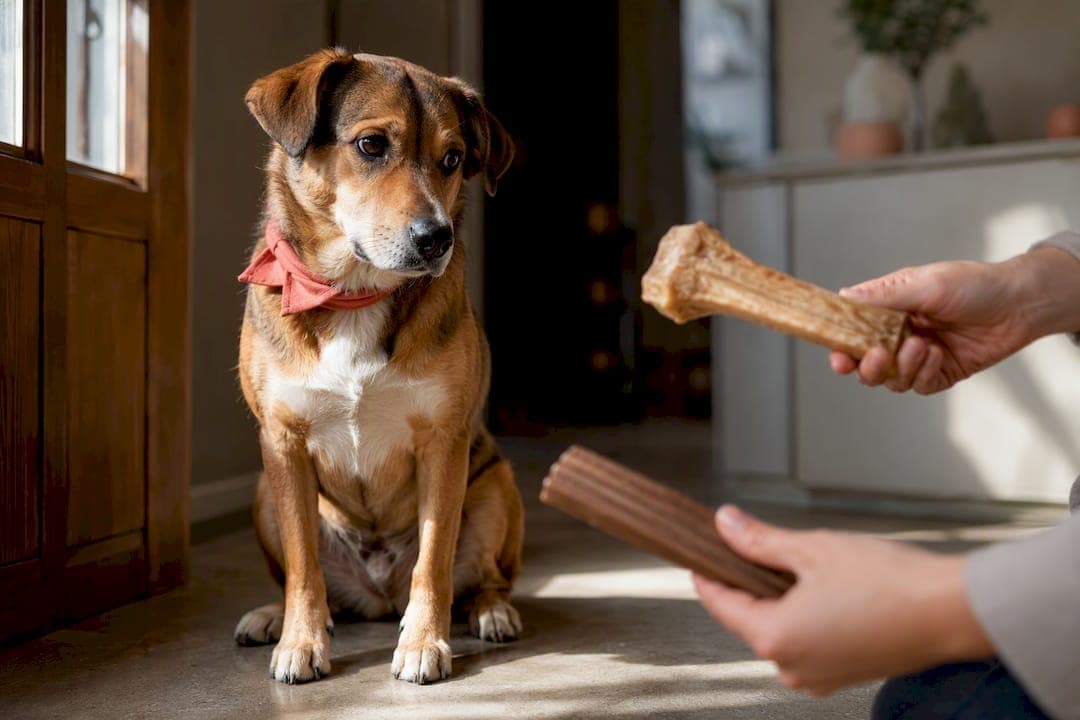
Most natural bones are worth skipping. The safer, vet-informed choice is a VOHC-vetted dental chew or a yielding rubber or TPR chew matched to your dog's size and chewing style, since rigid bones carry real risks of tooth fracture and contamination that yielding, clinically tested chews avoid. The section on choosing by dog size and style below walks through exactly how to match a chew to your own dog.
TL;DR:
- Most natural bones pose risks of tooth fracture and contamination, making VOHC-accepted dental chews a safer, clinically tested alternative.
- Chews should indent slightly under pressure and avoid small, sharp, hollow, or raw bones to prevent choking, splintering, and bacterial infection.
- Veterinary evidence shows that many natural bones exert forces exceeding canine tooth limits and are linked to a high rate of obstruction cases.
- Daily VOHC-accepted chews, combined with brushing and rotational toys, provide proven oral health benefits without the hazards of natural bones.
- Owners should verify chews carry VOHC approval or trial data and consult vets for guidance, especially if dental work or existing conditions are present.
Table of Contents
- What makes a chew safe or unsafe for your dog
- What to buy instead of natural bones
- The evidence behind bone-related injuries
- Choosing the right chew for your dog's size and style
- Daily habits that keep dental care safer than bones
- How we test chews and where vets weigh in
- Your quick checklist before buying a chew
- Why we steer owners away from natural bones
- Get safer chew picks without the guesswork
- Sources
- FAQ
What makes a chew safe or unsafe for your dog
Whether a chew is safe comes down to two things: how it behaves under bite force, and how clean it is. A chew that gives slightly under pressure protects teeth, while a rigid one concentrates force on a single tooth, usually the upper fourth premolar, the tooth most often fractured by hard chews.
Size and shape matter just as much as hardness. A chew small enough to swallow whole, or one that splinters into sharp fragments, turns a dental aid into a choking or obstruction risk. Marrow bones hollowed out in the middle are a particular problem because a dog's jaw or tongue can get trapped inside the ring.
Processing changes the risk profile too. Heat-treated, pasteurized, or clinically tested products behave predictably, while raw or unprocessed items carry more variable contamination risk.
- A chew should indent slightly under firm fingernail pressure rather than resist completely.
- Avoid anything small enough to be swallowed whole or shaped with sharp edges after chewing.
- Skip hollow marrow bones that can trap a dog's jaw.
- Favor heat-treated or clinically evaluated products over raw or unprocessed ones.
- Wash your hands and any surface the chew touched, since bacteria can transfer even from dried products.
VOHC Accepted products have undergone clinical trials showing measurable reductions in plaque, calculus, and gingivitis, which is the clearest independent signal that a chew does what it claims without relying on raw hardness to scrape teeth clean.
What to buy instead of natural bones
Once you accept that hardness alone is not a safety feature, the choice narrows to a handful of categories that balance real dental benefit against manageable risk.
- VOHC-accepted dental chews are the closest thing to a clinically proven option, since they carry trial data on plaque and calculus reduction and are formulated to yield rather than shatter.
- Heat-treated edible chews like tendons, trachea, and collagen sticks are processed to reduce microbial load and tend to be softer than raw cartilage or bone.
- Yielding rubber or TPR chews and dental toys offer repeatable mechanical cleaning through texture and ridges rather than raw density, making them reusable and easier to sanitize.
- Cooked bones should be avoided entirely, since cooking dries out the bone and makes it brittle enough to splinter into sharp shards.
- Raw, whole weight-bearing bones carry the opposite problem: they're often harder than a dog's tooth enamel can tolerate, plus the contamination risk that comes with any raw animal product.
A daily VOHC-accepted chew paired with a rotating rubber toy covers most of what natural bones promise, minus the fracture and bacterial contamination risks. Kiblco's review of dental chews for plaque and tartar breaks down specific options by size and chew strength.
Pro Tip: Keep a rotation of two or three approved chews so your dog stays interested without gnawing any single one down to a hazardous size.
What to avoid: cooked bones of any kind, raw weight-bearing bones (femur, marrow bones), antlers and hooves that don't yield to fingernail pressure, and any chew small enough to be swallowed whole. Dense natural chews like the ones covered in Kiblco's yak chew safety guide fall into a similar gray zone and deserve the same scrutiny.
The evidence behind bone-related injuries
The case against bones isn't just caution, it's measurable. A cadaveric study of canine teeth found the mean force needed to fracture the maxillary fourth premolar was about 1,281 newtons, plus or minus 403 newtons. Many rigid natural bones and antlers don't yield anywhere near that threshold, which means normal chewing can exceed the force a tooth can withstand.

Obstruction is the other major hazard. Veterinary literature has documented bone-related foreign bodies present in 30% to 80% of dogs and cats presenting with esophageal foreign bodies, a range that reflects how often bone fragments end up lodged rather than digested.
Contamination adds a third layer of risk. The AVMA strongly discourages feeding raw or undercooked animal-source proteins, citing a study that found Salmonella species in 16% of tested dried natural dog treats, and another that found Salmonella in 30% of fecal samples from dogs fed homemade raw diets. Cooking a bone solves the raw-contamination problem but creates a new one: dry heat leaches moisture and makes the bone brittle enough to splinter into shards that can tear soft tissue on the way down.
- Bleeding gums, a loose tooth, or reluctance to chew on one side of the mouth are signs a chew has already caused damage.
- Vomiting, retching, or refusing food after chewing a bone can signal an obstruction and warrants a same-day vet call.
- Visible fragments or sharp edges left on a chew mean it should be removed and replaced immediately.
Kiblco's raw versus kibble guide goes deeper into the contamination evidence for owners weighing a raw feeding approach.
Choosing the right chew for your dog's size and style
Start with four quick questions before you buy anything: how old is your dog, what's the current state of their teeth, are they a light, moderate, or aggressive chewer, and do they have any existing dental work or medical conditions that change the calculus.
- Light chewers, including many toy and small breeds, generally do well with soft, yielding dental chews sized to their mouth rather than anything marketed as heavy-duty.
- Moderate chewers can usually handle a VOHC-accepted chew sized for their weight, given once daily as part of a routine.
- Aggressive chewers need a durable but still yielding toy rather than raw hardness, since durability and rigidity are not the same thing. Kiblco's guide to chew-proof toys for aggressive chewers covers options built for that chewing style specifically.
Give a chew for 10 to 15 minutes under supervision rather than leaving it out all day, and remove it once it's worn down to a size your dog could swallow whole or once sharp edges appear. Puppies, seniors with worn enamel, and dogs with existing crowns or root canals should stick to the softest end of the yielding spectrum regardless of their general chewing style, since a chew rated for heavy chewers can still fracture a tooth that's already compromised.
The nail-test rule of thumb still applies at home: if you can't indent a chew with a firm fingernail press, it's probably too hard for most dogs. Any sign of choking, repeated vomiting, a loose tooth, or gum bleeding after chewing means a same-day call to your veterinarian, not a wait-and-see approach.

Pro Tip: Run a supervised five-minute trial with any new chew before leaving your dog alone with it, watching specifically for how much force it takes to break off a piece.
Daily habits that keep dental care safer than bones
Brushing remains the foundation of dental care, and no chew, however well-designed, replaces it. Professional cleanings under anesthesia catch what brushing and chewing can't, particularly below the gumline.
On top of that baseline, a single VOHC-accepted chew given once a day, sized correctly for your dog's weight, is the most evidence-backed chew habit available. A randomized controlled trial found that dogs fed specific dental chews over 28 days showed reduced calculus coverage, pocket depth, bleeding, plaque thickness, and halitosis compared with dogs on diet alone, along with favorable shifts in oral microbiota.
- Rotate two or three approved chews or dental toys to keep enrichment high without over-relying on one product.
- Use rubber or TPR dental toys between chew sessions for mechanical plaque disruption that doesn't wear down over time.
- Treat collagen sticks and other formulated edible chews as a supplement to, not a replacement for, brushing.
- Watch for any chew that softens unevenly or breaks apart faster than expected, since that's a sign to switch products.
Kiblco's toothbrush toy roundup and dental chew guide both cover specific products that fit into this kind of routine.
How we test chews and where vets weigh in
Reviews come from products purchased and used in real homes, not manufacturer samples, with pet parents tracking how a chew holds up over repeated sessions. We watch for how much a chew yields under bite pressure, whether it fragments into sharp pieces, and how quickly a dog loses interest or wears it down to an unsafe size.
Health-related picks, including any dental chew recommendation, get cross-checked against fracture-risk and contamination concerns before they make it into a guide.
- Splintering under moderate chew pressure is an automatic disqualifier, regardless of how well a chew performs otherwise.
- Excessive hardness, meaning a chew that doesn't yield to firm pressure, gets flagged even if it lasts a long time.
- Rapid breakage into small, swallowable pieces rules out a product no matter how popular it is.
At-home testing by a handful of pet parents is naturally smaller in scale than a formal VOHC clinical trial, so we treat our hands-on observations as a practical check, not a replacement for clinical evidence.
Your quick checklist before buying a chew
The safest bet for most dogs is a VOHC-accepted dental chew or a yielding rubber toy, sized correctly and given under supervision, rather than any natural bone.
| Checklist item | What to look for |
|---|---|
| Texture | Chew indents under firm fingernail pressure |
| Size fit | Matches your dog's weight and jaw size, per product label |
| Evidence | Carries VOHC Accepted status or published trial data |
Call your veterinarian right away if you notice bleeding gums, a loose tooth, vomiting, or any sign your dog swallowed a fragment.
Why we steer owners away from natural bones
The idea of a "safe natural bone" persists mostly because most dogs chew one without incident, not because the risk is small. A single fracture or obstruction event can mean a dental extraction or abdominal surgery, and neither outcome shows up in a bag of rawhide at the pet store.
What gets underestimated is how much marketing language, "natural," "long-lasting," "farm-raised", substitutes for actual safety data. A rubber chew with a VOHC trial behind it tells you something concrete about plaque reduction. A raw femur bone tells you nothing except that it's hard, which is precisely the property that makes it risky.
We favor chews with yielding textures and clinical backing because that combination is the only one that's been tested rather than assumed. If your dog has existing dental work, or you're not sure which category fits their chewing style, a quick conversation with your veterinarian before your next purchase is worth more than any product review, including ours.
— Chris
Get safer chew picks without the guesswork
Finding a chew that's actually durable and actually safe takes more digging than reading a product label, since terms like "natural" and "long-lasting" say nothing about fracture risk or hygiene. A team buys and tests dog products in real homes, then pairs those observations with veterinary input before anything gets recommended, so you're not left comparing marketing claims against each other.
If you're ready to swap out risky natural bones, our Dog Health and Treats category covers vetted dental chews and edible options sized by breed and chewing style, while our Dog Gear category covers durable rubber and TPR toys built for enrichment rather than raw hardness. Brands like BetterBone show what a well-engineered yielding chew looks like for tougher chewers, and it's the kind of product our reviews help you compare against other options.
Check the Dog Health category for a chew that fits your dog's size and chewing style today.
Sources
- AVMA attachment: Animal‑source protein and raw diets (AVMA)
- Cadaveric study on tooth fracture forces (Frontiers in Veterinary Science)
- VOHC accepted products (Veterinary Oral Health Council)
- Study: Effects of commercial dental chews on oral microbiota and dental scores (PMC)
FAQ
Which bones are safe for dogs to eat?
No bone, raw or cooked, is guaranteed free of fracture or contamination risk, which is why veterinary guidance favors VOHC-accepted dental chews and yielding rubber or TPR chews instead. Cooked bones splinter easily, and raw bones carry contamination risks documented by the AVMA.
Do veterinarians recommend giving dogs bones?
Most veterinary guidance steers owners away from natural bones because of documented tooth fracture and obstruction risks, recommending clinically tested alternatives instead. The VOHC Accepted seal is the credential veterinarians point to when recommending a specific dental chew.
What is the healthiest thing for a dog to chew on?
A VOHC-accepted dental chew given once daily, alongside regular brushing, has the strongest evidence behind it for improving plaque, calculus, and gum health. Yielding rubber or TPR toys are a safe complement for chewing enrichment between dental chew sessions.
What are some vet-approved chew options for dogs?
Products carrying the VOHC Accepted seal have published clinical trial data showing reductions in plaque, calculus, and gingivitis. Kiblco's dental chew guide reviews specific VOHC-accepted options sized by dog weight and chewing style.