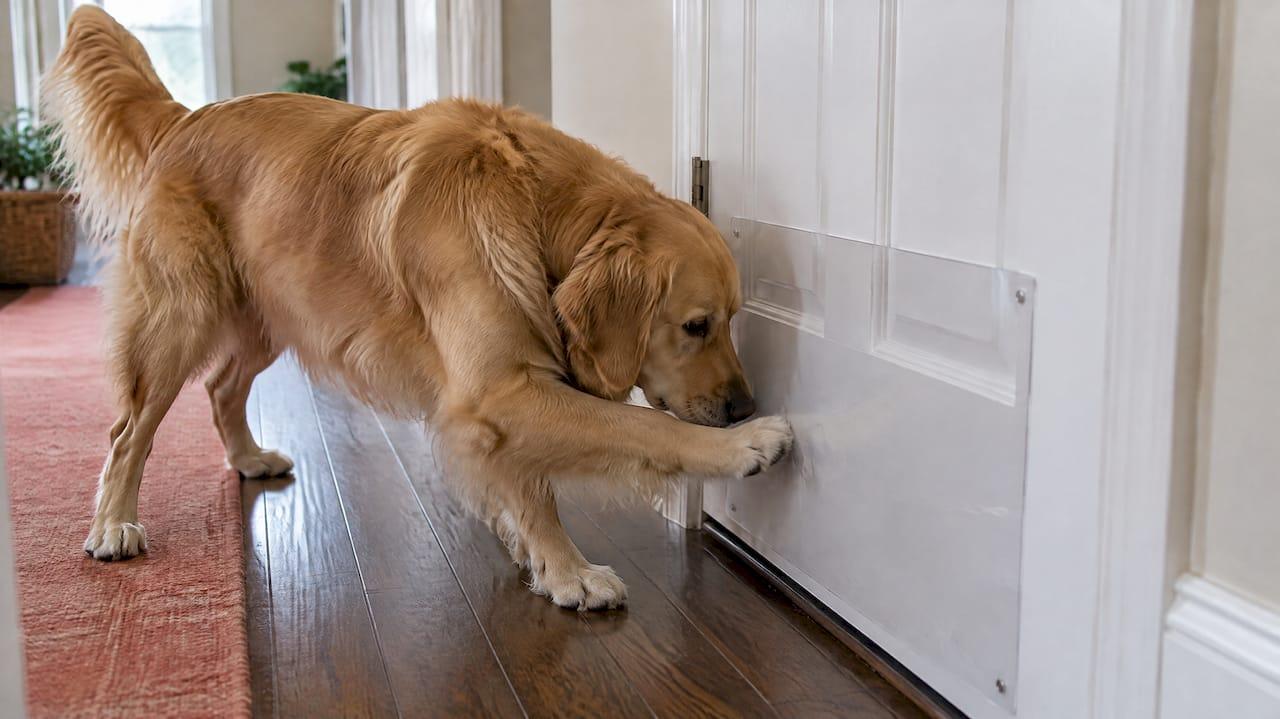
The fastest way to protect a door from dog scratches is to cover the part your dog actually reaches with a clear, rigid guard, then give your dog a better way to ask for what the scratching is about. The guard saves the paint this week. The new habit saves the door for good. Below: how to pick a guard for your door type, how to install it, how to change the behavior, and what to do about floors, furniture and car doors.
TL;DR
- Guard the bottom 24 to 36 inches of the door and the frame edge with a clear rigid shield, a kick plate or heavy film, and match the mounting method to your door type.
- Hollow-core doors have a thin skin, so use adhesive guards and skip long screws. Glass and sliding doors need film or screen guards, not screws.
- Scratching usually has a reason: needing out, boredom, loneliness or stress. Teach a bell or a sound button so your dog can ask, and see a vet if the behavior changes suddenly or happens when you leave.
- Trim nails regularly, add a gate a few feet back from the door, and keep a clean, dry surface under any adhesive.
- For the car, a waterproof door cover protects the panels while your dog learns to settle.
Table of Contents
- Why dogs scratch doors in the first place
- Step 1: Measure the zone that needs protection
- Step 2: Choose a guard that fits your door type
- Step 3: Prep and install it so it lasts
- Step 4: Fix the behavior so the guard is a backup
- Repairing scratches that are already there
- Protecting car doors from dog scratches
- Protecting floors and furniture from the same dog
- Our perspective
- Where to start with gear
- FAQ
- Sources
Why dogs scratch doors in the first place
Before you buy anything, spend a few days watching. A PetMD veterinarian's guide recommends noting what gets damaged, where and when, because the pattern points to the motivation. A dog who scratches the back door at 6 a.m. probably needs to go out. A dog who scratches the front door at 3 p.m. may be waiting for someone to come home.
Trainer Pat Miller, writing in Whole Dog Journal, lists common reasons a dog wants through a door: toileting, boredom, loneliness, temperature discomfort or stress. Her point is to meet that need and teach another way to ask. Vetstreet's advice is similar: check that your dog gets outside as often as needed and is not left out too long before you work on door-pawing.
Three patterns are worth sorting out early:
- Scratching when you are home, at a door to the yard: usually a communication problem. A bell fixes it (see below).
- Scratching at the door you leave through, while you are gone: destruction around the exit, especially with pacing or panting, may point to separation anxiety. Talk to your veterinarian.
- Sudden new scratching in a dog who never did it: a change in behavior is a reason for a vet visit, not a bigger guard.
Step 1: Measure the zone that needs protection
Most damage lands low. According to one flooring and door-protection guide, the area to cover is usually the bottom 24 to 36 inches of the door plus the frame edge. Instead of guessing, do this:
- Crouch next to your dog and stand them up on their back legs at the door. Mark the highest scratch you see or expect.
- Measure the door width, then the height from the floor to that mark. Add a few inches of margin.
- Look at the frame and casing. If your dog digs at the gap along the latch side, the edge needs cover too.
- Note whether the door opens over carpet or a threshold, because you will need a small bottom gap so it still swings.
A large dog that jumps will need a taller guard than a small dog that paws at knee height. Big, tall dogs often need the full 36 inches or more.
Step 2: Choose a guard that fits your door type
The same guide notes that the door type decides the mounting method. This is where most installs go wrong, so check what your door is made of first. Knock on it: a hollow, light sound means hollow-core; a dense, dull one means solid wood or solid-core.
| Door type | Best guard style | Mounting | Avoid |
|---|---|---|---|
| Solid wood or solid-core | Clear rigid shield, metal or plastic kick plate, heavy film | Screws or adhesive both work | Nothing special, but pre-drill screw holes |
| Hollow-core interior | Lightweight clear film or adhesive-mounted shield | Adhesive | Long screws, which can poke through the thin skin |
| Steel or fiberglass | Magnetic or adhesive guards | Magnet or adhesive | Drilling |
| Glass or sliding | Screen guards or clear film | Film or adhesive | Screws |
Clear film versus rigid shield versus metal plate
Clear film or vinyl sheets are discreet and work like a screen protector on a phone: they take the scratching instead of the paint. They are good for light to moderate scratchers and for rentals, where you want something that peels off.
Clear rigid plastic shields take more punishment and suit dogs that dig hard. They are thicker, so they stand out more, and they are screwed or glued in place.

Metal kick plates are the strongest option for large dogs and heavy daily use. They suit solid doors best, since they are usually screwed or glued to the lower edge.
WikiHow's door guide also describes a DIY version using cut plexiglass or fiberglass panels held with hook-and-loop strips. It works as a stopgap, but cut edges can be sharp, so sand and round the corners before your dog gets near it.
Don't forget the casing
Dogs often chew and claw at the corners and trim around the door. Clear L-shaped corner guards cover that edge without changing the look of the room, and the same guide recommends them for casing edges.
Pet-safe and low-residue choices
Look for guards described as non-toxic and residue-free, and apply them to a smooth, fully cured painted surface. Fresh paint, peeling paint and textured surfaces are where adhesives pull finish off when removed. Whatever you choose, keep the rest of the door free of loose edges your dog can chew, because a lifted corner of film is an invitation.
Step 3: Prep and install it so it lasts
- Clean the surface with rubbing alcohol so adhesive grips. Dust and oils are the most common reason a guard peels.
- Smooth rough spots. Touch up loose or splintered fibers first, so the guard does not trap damage behind it.
- Dry-fit the guard and mark the position with painter's tape. Keep a small gap at the bottom for carpet or a threshold.
- Apply from one edge to the other, pressing out bubbles with a card or squeegee, then press down the edges firmly.
- Screw only into solid doors, and pre-drill so you do not split the wood. On hollow-core, stay with adhesive.
- Give adhesive time to set before you let your dog near it, following the instructions on your product.
If your home was built before 1978
Be careful with sanding, scraping or any prep that disturbs old paint on doors and trim. Homes built before 1978 may contain lead-based paint, and the EPA says exposure from disturbed lead paint is the largest cause of childhood lead poisoning. Test the paint before you sand. If it tests positive, use lead-safe practices or hire a certified professional. A guard that sticks to intact, cleaned paint without sanding avoids the problem altogether.
Step 4: Fix the behavior so the guard is a backup
A guard protects the wood. It does not tell your dog what to do instead. One flooring company's guide makes this point well: pair the barrier with a better option, such as a doorbell, a mat or a baby gate a few feet back from the door, plus more exercise and regular nail trims.
Teach a bell or sound button
Whole Dog Journal suggests teaching your dog to ring a bell or press a sound button: mark and reward each activation, then open the door so that going out is itself the reward. Hang the bell at nose height by the door your dog uses most. Ring it yourself before each trip out at first, so the sound and the door opening become linked.
We compared several options for this in our guide to the best pet doorbells for potty training dogs.
Manage access while the habit fades
A pet gate placed a few feet back from the door keeps your dog away from the surface completely while the new routine settles in. Our roundup of the best dog gates for inside the house covers which styles hold up with strong, determined dogs.
Give the energy somewhere to go
Bored and under-exercised dogs find their own entertainment, and the door is a favorite target. A longer walk, a puzzle feeder or a chew can take the edge off. See our picks for puzzle feeders for smart dogs, treat-dispensing balls and quiet dog toys. If your dog is calmer with something to lick, our lick mat guide explains how they are used for settling.
Do not punish. PetMD's advice is to redirect destructive behavior toward a toy rather than punish it, which keeps the door from becoming a source of anxiety.
Rule out anxiety
If the scratching happens mainly when you leave, and comes with pacing, panting or drooling, treat it as a stress signal. Vetstreet's advice is that suspected fear or anxiety merits a conversation with your veterinarian. For dogs who struggle when alone, see our look at treat dispensers for separation anxiety.
Keep nails short
Short nails cause less damage everywhere, doors included. Veterinarians often recommend trimming every three to four weeks. If clippers make your dog tense, our guide to dog nail scratchers for stress-free trimming at home covers a gentler route.
Repairing scratches that are already there
Shallow claw marks on a wood door are a fixable weekend job. Family Handyman's repair guide says that when scratches are not too deep, you lightly sand the area, feathering into the undamaged wood, wipe off all the dust, and apply gel stain with a dry brush. Mix colors to match and test on scrap wood first. If the spot looks dull once dry, a light spray of clear finish feathered outward blends it in.
Do the repair before you install a guard, so you are not sealing damage underneath. On a pre-1978 painted door, check the lead note above before you sand.
Protecting car doors from dog scratches
Car interiors take the same abuse: claws on the door panel, drool on the window trim. Covers for the inside of the door are the simple fix. A good one should be waterproof, washable and attach securely without slipping when the door opens. One example is a waterproof two-piece car door cover made from Oxford fabric. Pair it with a seat cover and trimmed nails, and you cover the likely damage zones.

The same principle applies in the car as at home: management buys time, and training solves the cause. A dog who clambers at the door while riding may need a harness, a seatbelt tether or a settled routine before getting in. Practice short drives to places the dog enjoys.
Protecting floors and furniture from the same dog
A dog who scratches doors usually leaves marks elsewhere too. A few quick wins:
- Floors: The National Wood Flooring Association recommends protector pads on furniture legs that touch the floor, and says minor scratches can be touched up with markers, stain pens or repair kits. Bigger repairs are for a professional.
- Rugs for traction: Non-slip-backed area rugs in hallways, entryways and by food stations reduce scratching and give pets grip.
- Furniture: Use a pet gate to restrict access to rooms where damage happens, and give your dog its own items to keep busy.
- During training: Positive-training expert Victoria Stilwell suggests temporarily covering furniture with a plastic cover, blanket or bedsheet.
If you also share your home with a cat who treats the couch as a scratching post, our guide to cat scratching posts that save your couch covers the same problem from the feline side.
Our perspective
Most door-scratch articles end at the product. Ours starts with a simple idea: a guard is the cheapest part of the fix, and it is only half of it.
When we test gear in real homes, the products that earn their place are the ones that fit how a dog actually behaves. A gate placed a few feet from the door, a bell your dog learns in a week, a clipped nail: each costs little and each moves the problem away from the door instead of just covering it.
Every review we publish lists the downsides next to the upsides, takes no payment for coverage, and on health topics is cross-checked by veterinary experts. That is the standard we apply to gates, doorbells, puzzle feeders and anything else that helps your dog stop scratching. Pick the guard for your door type, then pick the gear that makes the guard unnecessary.
Chris
Where to start with gear
If you are shopping for a gate, a doorbell, a puzzle toy or a nail tool, our Dog Gear reviews are the place to compare them. Each review is based on products purchased and tested in real homes and lists clear pros and cons, so you can match a product to your dog's habits before you buy.

For anxious dogs, the Dog Health section covers calming and wellness products with veterinary input, and Pet Tech covers gadgets for monitoring and training.
FAQ
Will a door protector damage my paint?
Not if you match it to the surface. Apply adhesive guards to clean, fully cured, smooth paint and avoid fresh or peeling paint. Choose products labeled residue-free, and warm the edge gently when you remove one so it lifts slowly.
How high should a dog door guard go?
Cover the bottom 24 to 36 inches of the door, and measure your dog's highest scratch plus a few inches of margin. Taller dogs that jump will need more height. Add corner guards if the casing is getting clawed too.
How do I stop my dog from scratching the door when I am home?
Work out why your dog wants through the door, usually to go out, then teach a bell or sound button so asking works better than scratching. Reward each press and open the door right away. Keep exercise and nail trims up to date.
Is door scratching a sign of separation anxiety?
It can be, particularly when the damage is at the exit you leave by, you are gone, and your dog also paces or pants. Sudden new scratching is another reason to call your veterinarian before assuming it is a training issue.
How do I repair dog scratches on a wood door?
For shallow marks, sand lightly and feather into the surrounding wood, wipe off the dust, and dab on gel stain with a dry brush. Finish with clear spray if the spot looks dull. Deep gouges may need wood filler or a professional.
Sources
- Door Protection From Dog Scratching: Guards That Work
- How to Protect Doors From Dog Scratches: 6 Simple Solutions
- How to Keep Your Dog From Chewing and Scratching Everything
- How to Stop Your Dog from Scratching Door
- Is Your Dog Scratching Up Your Doors? Teach Him to Ring the Bell Instead
- EPA: Lead Renovation, Repair, and Painting Rule
- Easily Repair Pet Claw Marks
- Problem Prevention, National Wood Flooring Association
- Preventing Scratches on Hardwood Floors From Pets
- 9 Ways to Protect Your Furniture From Pets
- Pets and Furniture: Everything You Need to Know