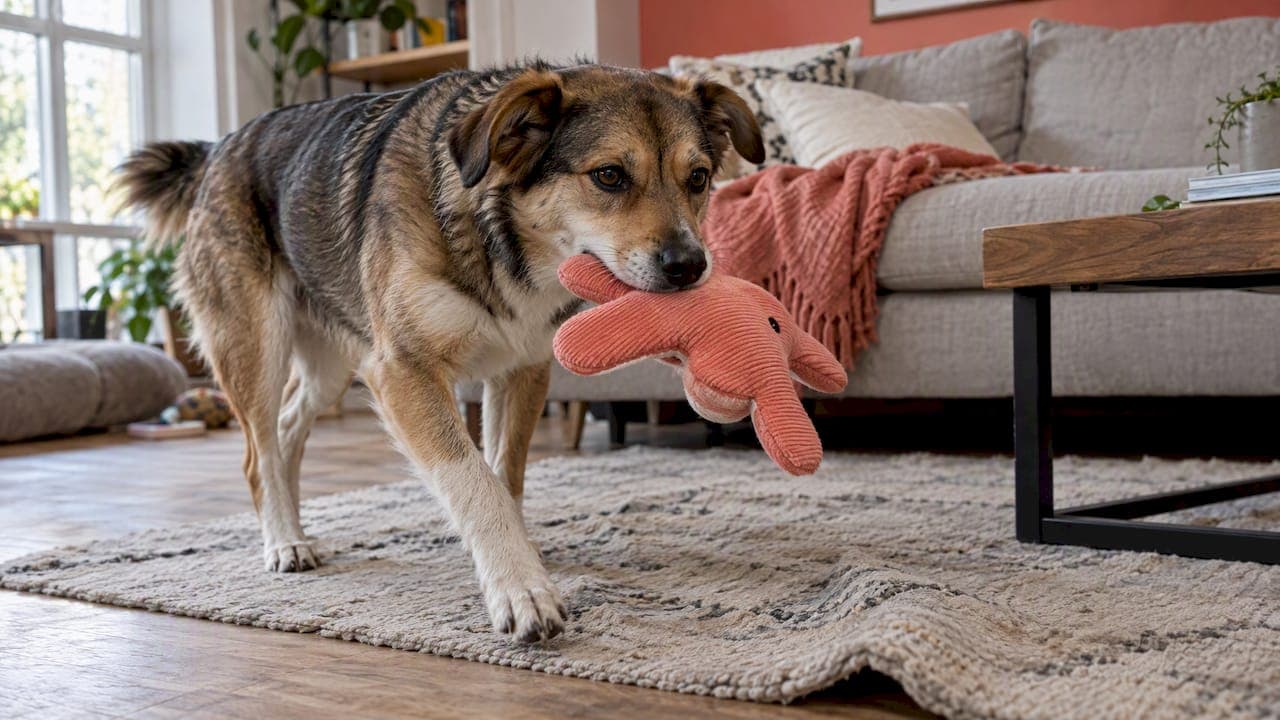
The quietest dog toys fall into four groups: ultrasonic "silent" squeakers, no-squeak plush, dense treat-filled rubber, and lick or puzzle toys. Which one is right depends less on the toy than on how your dog plays. A gentle carrier does fine with a silent-squeaker plush. A dog that shreds everything is far better off with solid rubber, which is quiet because it can't be destroyed in a few minutes.
Below we explain how each type works, who it suits, where it fails, and how to keep quiet play safe. We link to our own hands-on guides where we have tested the products.
TL;DR
- Ultrasonic silent squeakers are quiet for you and audible to your dog, but they suit gentle and moderate chewers only.
- For heavy chewers, dense treat-filled rubber and lick mats are quieter and safer than plush.
- No toy is 100% safe: supervise new toys, and toss anything frayed or showing stuffing.
- Use the fingernail test: if you can't dent a chew toy with your nail, it is too hard for your dog's teeth.
- Rotate toys. Leaving everything out at once leads to boredom and more destruction.
Table of Contents
- What makes a dog toy "quiet"
- Type 1: Ultrasonic "silent" squeakers
- Type 2: No-squeak plush
- Type 3: Dense treat-filled rubber
- Type 4: Lick mats, snuffle mats and puzzles
- Quick comparison
- Pick the right toy for your dog
- Safety rules that matter more than noise
- Our take
- Find quiet toys we have tested
- FAQ
- Sources
What makes a dog toy "quiet"
Noise comes from three places: a squeaker or crinkle element inside the toy, the toy's material hitting hard floors, and the way your dog plays with it. Most shoppers only think about the first. Fixing it is easy. Fixing the other two takes a little more thought.
Squeakers are loud on purpose. According to the AKC, most dogs like toys that simulate prey, which is why squeaky and soft toys are so popular. The high-pitched squeak and the ripping of plush can be deeply satisfying. So when your dog hammers a squeaker for twenty minutes, it is doing something natural, not misbehaving.
That is why simply taking the noise away often disappoints. A quiet toy has to give your dog something else to do: carry, tug, lick, forage or chew. The best quiet options replace the reward rather than remove it.
Type 1: Ultrasonic "silent" squeakers
These plush toys contain a squeaker that works at a pitch dogs hear and most people don't. One product page for this style of toy describes frequencies of 24 to 28 kHz, audible to dogs and effectively silent to human ears. In practice you hear a soft puff of air when your dog bites down, while your dog gets the squeak it wants.
Who they suit
Gentle carriers, cuddlers, puppies learning to settle with a toy, and small dogs that mouth rather than rip. If your dog treats a plush toy as a companion, this is the closest thing to the classic experience without the noise.
Where they fall short
- Durability. Reviews on a major retail page for one popular ultrasonic toy show frequent complaints about toys failing within an hour under intense chewing, and the brand itself is not meant for aggressive chewers.
- Mistaken for broken. Owners often assume the toy is dead when it simply makes no audible sound. Before you return it, watch your dog's ears. A dog that perks up at every bite is hearing something you aren't.
- Ingestion risk. Once a plush toy is torn open, the internal squeaker mechanism is exposed. The same product research flags swallowing it as a real hazard for heavy chewers.
- Not every dog responds. Some dogs seem to ignore the ultrasonic squeak entirely, and the toy is then just a plain plush.
One reviewer in the search results, writing about a popular ultrasonic plush, said these toys are not a fit for aggressive chewers. That matches what we hear from pet parents who tried them with shredders.
Type 2: No-squeak plush
These have no squeaker at all. Some are flat and unstuffed, with canvas and crinkle-free fabric, which removes both the noise and the filling that dogs pull out. Others are plush toys with the squeaker box simply left out.
They are the quietest soft option and a good fit for dogs that carry toys around the house at night. One caution from the vet-sourced guidance: many squeaker-less toys are still stuffed with material that poses an ingestion risk if torn. "No squeak" does not mean "safe to shred." Unstuffed flat designs reduce that risk, but they don't remove it.
Type 3: Dense treat-filled rubber
If your dog shreds toys, this is the category to start with. The VCA Animal Hospitals guidance says that durability claims in marketing can mislead, because how long a toy lasts depends on your dog's bite force and chewing style. For dogs that destroy plush, the safest and quietest choice is a dense rubber toy you can stuff with food, rather than a plush labeled "ultra-durable."
Rubber is quiet for two reasons. It doesn't tear, so there's no ripping sound. And a stuffed toy shifts your dog's mind from destruction to problem-solving. Experts quoted by the AKC make the same point: quiet play is often about the type of engagement, and stuffable toys and treat puzzles lower the volume of play naturally.
One practical downside is that rubber toys can bounce and clatter on tile or hardwood. Play on a rug or carpet, or use the toy in a crate or on a mat. For our tested picks, see our guide to chew-proof toys for aggressive chewers.
Type 4: Lick mats, snuffle mats and puzzles
These are the quietest of all, and they tire a dog out in a different way. Licking is repetitive and soothing. Sniffing and foraging use mental energy. VCA's advice on puppy chewing suggests rotating toys to keep them fresh and offering constructive alternatives when a dog is fixated on a noisy toy, which is exactly what these mats are for.
Where they fit:
- Evenings and work calls. A smeared lick mat can buy you a quiet half hour.
- Crate time. A frozen lick mat gives a dog something calm to do while settling.
- Rainy days. A snuffle mat turns a handful of kibble into a search game.
We cover them in detail in Lick Mats 101, our snuffle mat roundup and our puzzle feeder guide. Treat-dispensing balls can be noisier on hard floors, but they are a good choice for chasers, and we tested several in our treat-dispensing ball guide.
Quick comparison
| Type | Noise level | Best for | Main risk |
|---|---|---|---|
| Ultrasonic silent squeaker plush | Near silent to humans | Gentle and moderate chewers | Shredded in minutes by heavy chewers; exposed squeaker |
| No-squeak plush | Silent | Carriers and cuddlers | Stuffing ingestion if torn |
| Dense treat-filled rubber | Quiet on carpet, can clatter on hard floors | Heavy chewers | Too hard if it fails the fingernail test |
| Lick and snuffle mats | Silent | Settling, crate time, enrichment | Needs supervision; not a chew toy |
| Rope and tug toys | Quiet | Interactive play | Loose strings can be swallowed |
Pick the right toy for your dog
If your dog is a gentle carrier
A silent-squeaker plush or a no-squeak plush is a good fit. Check the seams when you buy and again every few days. Even a gentle dog can open a seam over time.
If your dog is a shredder
Skip plush entirely. Choose dense, stuffable rubber and keep stuffing it. Supervision matters most here. VCA and the AVMA stress that no toy is completely safe, and that play with new or destructible toys needs supervision to prevent choking and intestinal blockages, according to the research notes we reviewed. Watch a new toy for the first several sessions to learn your dog's destruction pattern before leaving it alone with it.
If your dog is a puppy
Puppies chew for relief while teething, and their deciduous teeth are fragile. Soft rubber that gives a little is better than anything rock hard. VCA's puppy chewing guidance notes that nearly everything dogs chew has been found to cause problems at some point, including rawhide and pigs' ears, which is a good reason to be selective.
If your dog is a senior
Older dogs can have worn enamel and sore mouths. Softer toys and puzzle feeders are kinder, and the AKC's senior dog toy list includes stuffed puzzle toys as one option for mental activity indoors.
If you want to tug quietly
Tug is one of the quieter interactive games, as long as your dog isn't growling through it. Our tug toy guide covers what held up for strong jaws.

Safety rules that matter more than noise
Quiet is a nice feature. Safety is the baseline. A few rules from veterinary sources:
- Use the fingernail test. VCA says that if you can't press a fingernail into a toy, it is likely too hard and can fracture teeth. This matters most for puppies and for seniors.
- Avoid very hard objects. VCA warns against real bones, antlers and nylon chews, which can crack teeth. If your dog needs a dental chew, our guides to VOHC-accepted chews versus natural bones and dental chews for plaque go deeper.
- Discard damaged toys. Frayed edges and exposed stuffing mean it is time to throw the toy out.
- Supervise new toys. Do this until you know how your dog treats them.
- Rotate. Leaving all toys out at once often creates toy boredom, and the dog then destroys the few favorites. Keep three or four out and swap them weekly.
- Teach "drop it" and "leave it." The AKC's experts describe these cues as the best long-term strategy for managing intense play, since they let you end a session before it gets out of hand.
If your dog has swallowed part of a toy, or is vomiting, lethargic or straining after chewing something, call your veterinarian or an emergency clinic right away rather than waiting.
Our take
We review pet products in real homes, and noisy toys are one of the most common complaints we hear. Here is our honest view, based on how we test.
The silent squeaker is a clever idea that works best for exactly the dogs that need a toy least: the gentle ones. A dog that is hard on toys will often get through a plush silent squeaker faster than a regular one, and then you have a torn toy and an exposed internal part. So we never recommend ultrasonic plush as a first choice for a chewer, and we say so in the downsides of any review that includes one.

What we tend to recommend instead is a change of habit. Swap the plush for a stuffed rubber toy at the times of day when noise is the problem. Keep a lick mat in the freezer for calls. Keep the squeaker toys for supervised play when you don't mind the sound. Most households don't need zero noise all day, they need quiet at specific times.
We also push back on durability claims. A "tough" label tells you very little. Your dog's bite and habits decide it, so we judge toys by how they hold up in actual homes, with pros and cons stated plainly, and we get veterinary input for health-related picks.
— Chris
Find quiet toys we have tested
If you want to shop rather than read, we have put our tested dog picks in one place. Our Dog Gear reviews cover toys and everyday equipment, and each one lists the downsides next to the strengths. Some links lead to retailers, and we earn a commission if you buy, which never changes what we say about a product. We don't accept payment for coverage.
FAQ
Do silent squeaker dog toys really work?
For many dogs, yes. The squeaker produces a pitch dogs hear and people mostly can't. Some dogs don't seem to respond to it, and many owners mistake a working toy for a dead one because they hear nothing. Watch your dog's ears and reaction rather than relying on your own hearing.
What is the quietest toy for a dog that chews everything?
A dense, stuffable rubber toy is usually the quietest option that lasts. Fill it with food, and consider freezing it so that it takes longer. Lick mats are even quieter, though they are for licking rather than chewing. Avoid plush for dogs that shred.
Are quiet dog toys safer than squeaky ones?
Not automatically. Safety depends on the material, the size, the hardness and your dog's chewing style. A silent plush can still be torn and swallowed, and a no-squeak toy can still be stuffed. Vet sources say that no toy is completely safe, so supervise play and discard damaged toys.
Why is my dog obsessed with squeaky toys?
The squeak mimics the sound of prey, so chasing and squeaking is an instinctive reward for many dogs. You can usually redirect that energy with rotating toys and quiet alternatives that offer a repetitive, soothing release, such as lick mats and frozen treat dispensers.
How do I entertain a dog that doesn't like toys?
Try changing the type of play rather than the toy count. Food-based activities, such as snuffle mats, puzzle feeders and lick mats, often work for dogs that ignore balls and plush. Short tug sessions with you can also help, because many dogs like the game more than the object.
Sources
- VCA Animal Hospitals: How to choose the best chew toy for your dog
- VCA Animal Hospitals: Teeth, teething and chewing in puppies
- VCA Animal Hospitals
- American Kennel Club: Best puppy toys
- American Kennel Club: Why do dogs like squeaky toys?
- American Kennel Club: Best toys and games for senior dogs
- Retail product page for an ultrasonic silent squeaker toy
- SheKnows: ultrasonic squeaker dog toy