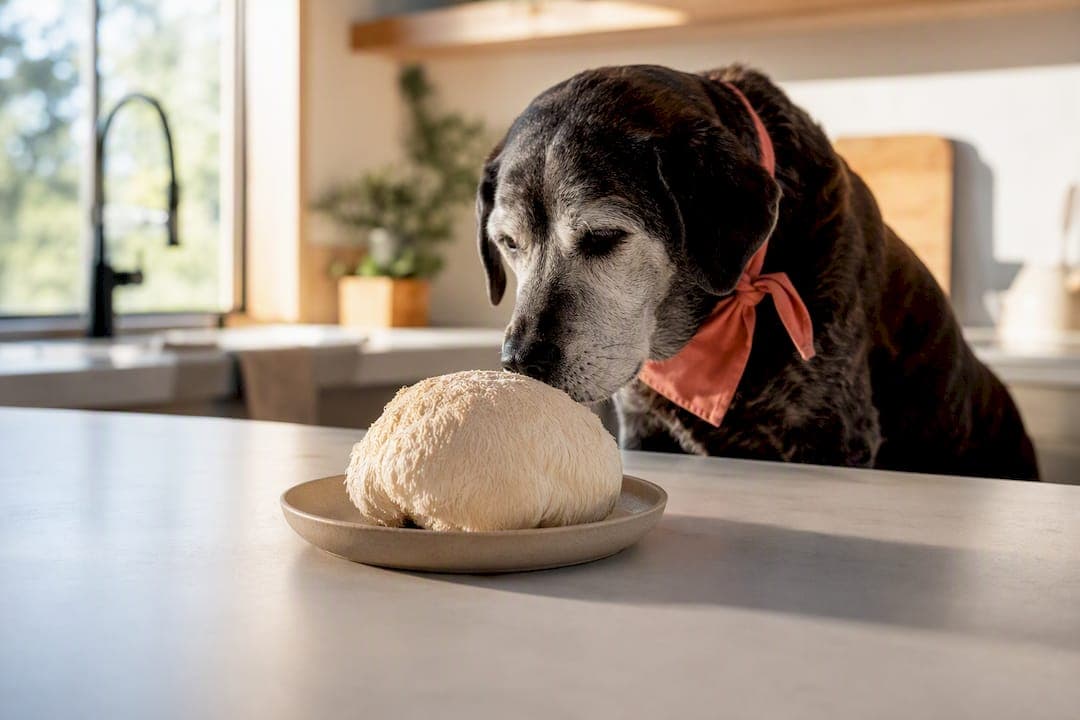
Lion's mane is a reasonable, low-risk mushroom supplement to try for a senior dog showing signs of cognitive slowdown. Most healthy dogs tolerate it well when the product is fruiting-body based and dosed correctly. The catch: canine-specific research is still thin, benefits build gradually over weeks to months, and dogs on blood thinners, NSAIDs, or immune-suppressing drugs need veterinary clearance first.
TL;DR:
- Lion's mane has been shown to significantly alter the gut microbiome in dogs, supporting immune health, but has no confirmed cognitive benefits in canines.
- The onset of any noticeable effects typically takes several weeks to months, making early judgment unreliable.
- Products made from fruiting bodies with dual extraction, tested for beta-glucan content and transparent labeling, offer the best quality and efficacy.
- Dogs on blood thinners, NSAIDs, or immunosuppressants require veterinary approval due to bleeding and immune interaction risks.
- A thorough, vet-informed evaluation of supplement labels and easy-to-implement feeding protocols improves safety and results.
Table of Contents
- What Is Lion's Mane and Why Do Owners Give It to Dogs?
- What Does the Research Actually Show?
- Safety, Side Effects, and Drug Interactions to Watch For
- Fruiting Body vs. Mycelium: Why Formulation Determines Quality
- How to Dose and Introduce Lion's Mane Safely
- Who Should Avoid Lion's Mane and When to Call a Vet
- How to Choose a Safe, Effective Lion's Mane Product for Your Dog
- Kiblco's Vet-Informed Take on Lion's Mane Products
- Where to Find Vetted Lion's Mane Products Before You Buy
- Sources
What Is Lion's Mane and Why Do Owners Give It to Dogs?
Lion's mane, or Hericium erinaceus, is a shaggy white mushroom traditionally used in East Asian cooking and medicine. It contains two compound families that get most of the research attention: hericenones and erinacines. Both have shown, in lab and animal studies, an ability to stimulate nerve growth factor (NGF), a protein involved in maintaining and repairing neurons. The mushroom also contains beta-glucans, complex sugars tied to immune and gut-microbiome activity.
That combination is why lion's mane shows up in the same conversation as other dog supplements for brain health. Owners aren't reaching for it to treat a diagnosed disease. They're reaching for it because their dog is aging, and the usual signs of canine cognitive decline, like disorientation, disrupted sleep, or reduced interest in play, have started creeping in.
The commonly claimed benefits fall into three buckets:
- Cognitive support for senior dogs. The NGF connection is the headline reason lion's mane gets marketed for brain health, though the mechanism is stronger in lab data than in real-world canine proof.
- Calming and anxiety support. Some integrative veterinarians pair lion's mane with other natural remedies for dogs with anxiety, citing anti-inflammatory effects that may indirectly support mood, though this use is more anecdotal than the cognitive angle.
- Gut and immune health. Beta-glucans are prebiotic-like compounds that appear to feed beneficial gut bacteria, which ties into broader immune function as dogs age.
None of these are cure claims. Lion's mane mushrooms for pets are best understood as a support supplement, not a substitute for a diagnosed medical treatment.
What Does the Research Actually Show?
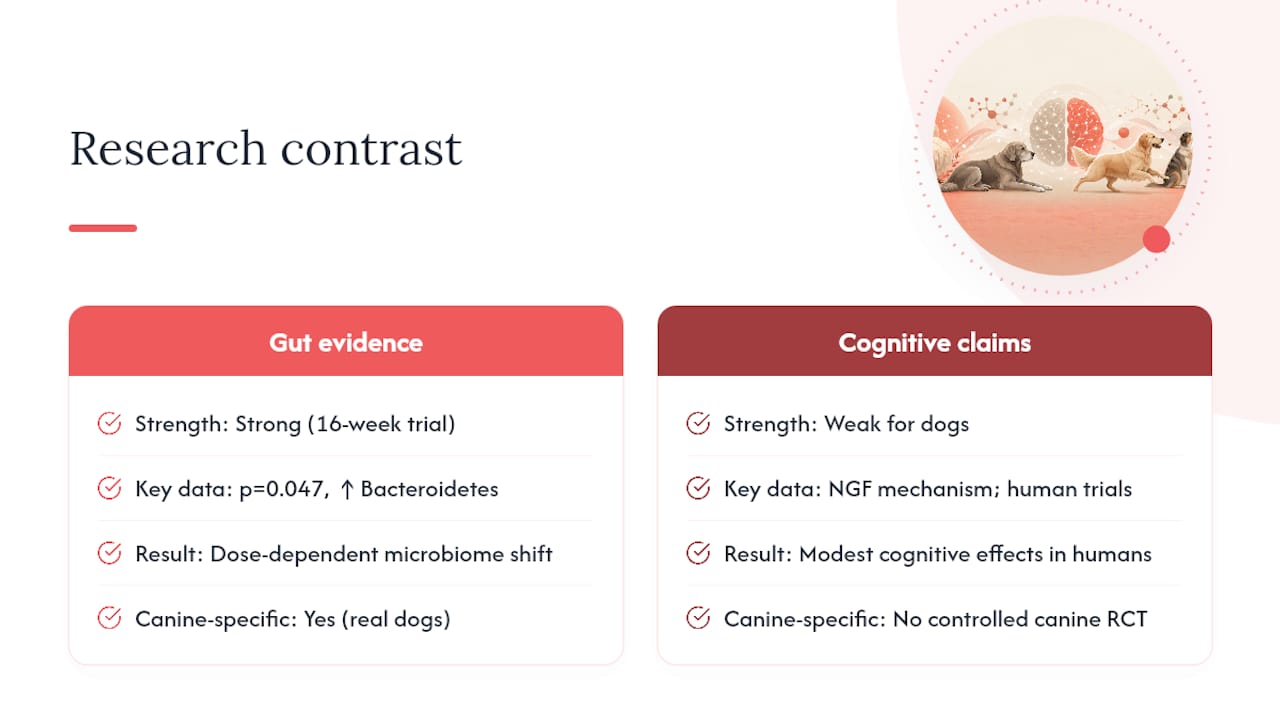
The single strongest piece of dog-specific evidence is a 16-week feeding trial in aged dogs, which found dose-dependent shifts in gut bacteria, including a statistically significant increase in Bacteroidetes and a drop in Firmicutes at higher doses (p=0.047), according to a study published on PMC. That's a real, measurable effect in real dogs, and it supports the gut and immune-health claims better than anything else in the current literature. It says nothing directly about memory or cognition, though a healthier gut microbiome is increasingly linked to brain health in aging animals generally.
The cognitive story rests on a different body of work. Rodent and human studies have repeatedly shown that lion's mane stimulates nerve growth factor production, and small human trials have reported modest cognitive improvements in older adults after regular use. One evidence review notes that no controlled canine cognitive trial has yet proven a clinical benefit in dogs specifically, which means the cognitive case for lion's mane is extrapolated, not confirmed, according to an analysis of the current evidence.
What the numbers actually say: A 16-week canine trial found statistically significant microbiome shifts at higher doses (p=0.047). That's solid support for gut effects. Cognitive benefit claims, by contrast, rest on mechanistic NGF data and small human trials, not a dog-specific clinical trial.
That gap matters for how you set expectations. If a product's marketing implies lion's mane will reverse cognitive decline the way a prescription medication might, that's overselling a mechanism that's still investigational in dogs. If the marketing frames it as gut and immune support with a plausible, evidence-backed shot at cognitive benefit, that's a fair description of where the science actually stands.
Onset time also matters, and it's slower than most owners expect. Reports on human trials note that improvements built gradually over several weeks and, in some cases, faded after supplementation stopped. Translated to dogs, that means you shouldn't expect a noticeable shift in the first week or two. A realistic timeline runs several weeks to a few months before you can fairly judge whether it's working.
Safety, Side Effects, and Drug Interactions to Watch For
Lion's mane has a good safety profile in the sources currently available, but "good" doesn't mean risk-free. The most common issues are mild and digestive: loose stools, gas, or a temporarily reduced appetite, especially in the first week as a dog's gut adjusts. These usually resolve on their own once you back off the dose.
The bigger concerns are interactions, not the mushroom itself:
- Bleeding risk. Lion's mane may have mild blood-thinning properties, and combining it with NSAIDs or anticoagulant medications can raise the risk of bleeding complications, according to veterinary guidance from the American Kennel Club.
- Immune modulation. Because beta-glucans can stimulate immune activity, lion's mane isn't automatically a safe pairing for dogs on immunosuppressant drugs or those in active cancer treatment.
- Allergic reactions. Rare, but possible. Watch for itching, hives, facial swelling, or vomiting shortly after a new dose.
Pro Tip: Keep a simple log for the first month: the date you started, the exact dose, and one line each day noting stool quality, appetite, and energy. If something changes, you'll know whether it's the mushroom or something else entirely.
A basic monitoring checklist covers you well:
- Week 1: Start at a fraction of the target dose. Watch stool consistency closely.
- Weeks 2 to 4: Move to the full recommended dose if tolerance looks good.
- Anytime: Stop and call your veterinarian if you see repeated vomiting, blood in stool, unusual bruising, or facial swelling.
If your dog takes a daily medication of any kind, that's the conversation to have with your vet before the first dose, not after a reaction shows up.
Fruiting Body vs. Mycelium: Why Formulation Determines Quality
Not all lion's mane products are made from the same part of the mushroom, and the difference changes what you're actually paying for. Fruiting body refers to the visible mushroom itself, the part with the highest concentration of beta-glucans and the active compounds tied to NGF stimulation. Mycelium is the root-like network the fungus grows from, often cultivated on grain, which means mycelium-on-grain products can be diluted with starch rather than the compounds you're actually shopping for.
Quality-focused sourcing generally favors whole fruiting-body extracts or a fruiting body plus mycelium blend clearly labeled as such, according to guidance from Watts Pet Learn's ingredient analysis. Veterinary voices echo the same point: cheap mushroom supplements often lean on fillers, and the strongest results come from high-quality, properly extracted fruiting bodies.
Dual extraction is the other detail worth understanding. Beta-glucans are water-soluble, but some of lion's mane's other beneficial compounds are better pulled out with alcohol. A dual-extracted product, hot water plus alcohol, captures more of the mushroom's full compound profile than a single-method extract.
When you're reading a label, check for these things in order:
- Species name confirmed as Hericium erinaceus, not a generic "mushroom blend."
- "Fruiting body" stated explicitly, rather than just "mushroom powder" or "mycelium."
- A Certificate of Analysis (COA) available, ideally showing tested beta-glucan percentage.
- No proprietary blend language hiding actual milligram amounts.
- No xylitol or other dog-unsafe sweeteners, which sometimes sneak into flavored chews.
A product that fails on more than one of these is one to skip, no matter how polished the packaging looks.
How to Dose and Introduce Lion's Mane Safely
Start low, watch closely, and let the label do most of the talking. Because lion's mane dosing isn't standardized the way a prescription drug is, the safest approach is to follow the product's own weight-based dosing chart and confirm it with your veterinarian rather than eyeballing a number from a general guide.
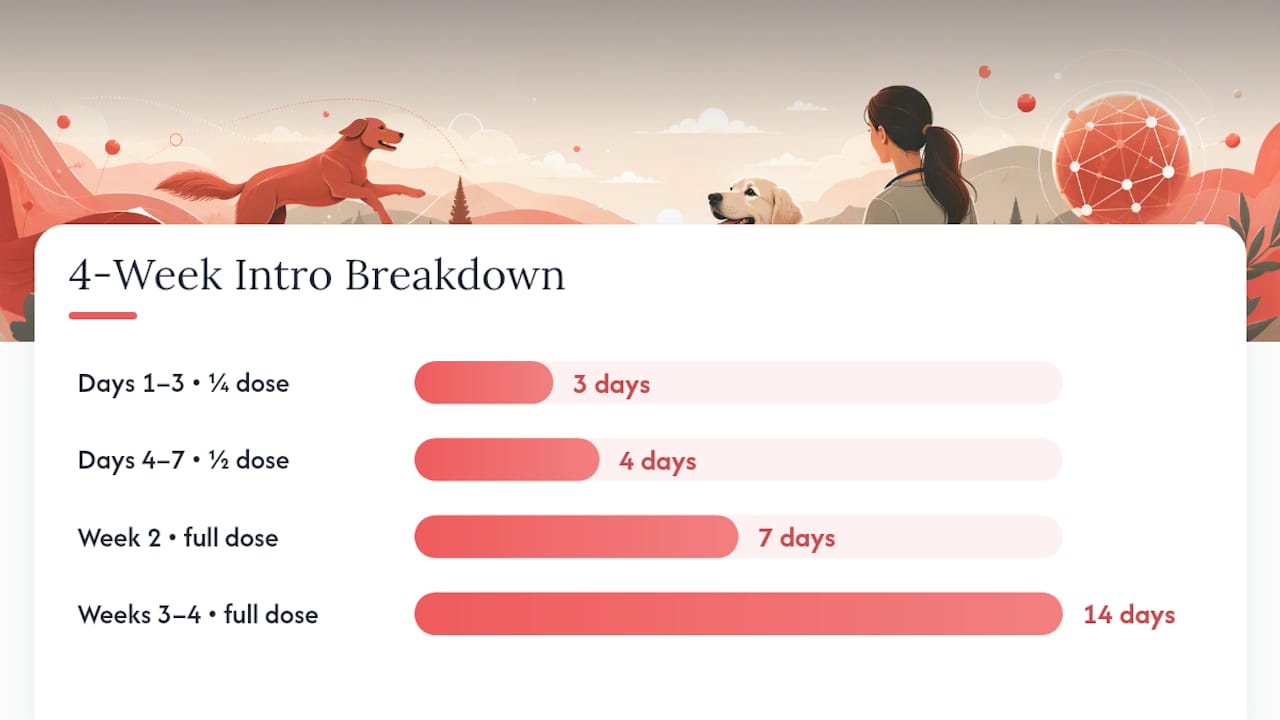
A practical four-week introduction plan looks like this:
- Days 1 to 3: Give roughly a quarter of the label's recommended dose, mixed into a small amount of wet food or a favorite treat.
- Days 4 to 7: Move to half the recommended dose if there's no digestive upset.
- Week 2: Reach the full label dose, assuming stools and appetite look normal.
- Weeks 3 to 4: Hold at the full dose and start tracking behavior or cognitive changes, not just digestion.
Pro Tip: If your dog is a picky eater, crush capsules or mix liquid extract into bone broth rather than dry kibble. The earthy mushroom flavor is more noticeable in dry food than in something with a stronger smell of its own.
If digestive upset shows up at any point, drop back to the previous dose for a few more days before trying to increase again. Some dogs simply need a slower ramp than others.
Give it a fair trial before judging results. Because the strongest cognitive evidence comes from mechanisms that build gradually, plan on eight to twelve weeks of consistent use before deciding whether lion's mane is doing anything measurable for your dog. Judging it at the two-week mark almost always leads to a false negative.
Who Should Avoid Lion's Mane and When to Call a Vet
Lion's mane isn't the right fit for every dog, and skipping the vet conversation in these cases is the actual risk, not the mushroom itself. Dogs on anticoagulants, NSAIDs, or any medication with a bleeding-risk warning need clearance first, since lion's mane's mild blood-thinning properties can stack with those drugs. The same caution applies to dogs with a known bleeding disorder.
Dogs on immunosuppressant therapy, or those undergoing active cancer treatment, are another category where the mushroom's immune-modulating beta-glucans could work against the treatment plan rather than alongside it. Autoimmune conditions belong in that same conversation.
There's a second, less obvious reason to see a vet first: not every symptom that looks like cognitive decline actually is. Thyroid imbalances, chronic pain, vision or hearing loss, and metabolic issues can all mimic the confusion and behavior changes owners attribute to "doggy dementia." A quick diagnostic workup rules out the fixable causes before you spend months on a supplement chasing the wrong problem.
How to Choose a Safe, Effective Lion's Mane Product for Your Dog
Shopping for a mushroom complex for dogs gets a lot easier once you know exactly what to look for on the label. Run through this checklist before adding anything to your cart:
- Confirm the species and part used. Look for Hericium erinaceus, fruiting body, listed plainly, not buried in a blend.
- Check the extraction method. Dual extraction (water and alcohol) generally pulls more of the mushroom's active compounds than a single method.
- Look for milligrams per serving and dosing by body weight, not a vague "give one scoop" instruction.
- Request or find a COA. A reputable brand will show third-party test results, including beta-glucan percentage.
- Confirm it's formulated for dogs, not repackaged from a human nootropic line that may contain sweeteners like xylitol.
- Compare price against transparency, not against the lowest number. A slightly pricier product with a stated beta-glucan percentage and a public COA is usually the better buy over a cheaper one with none of that information.
Independent buying guides aimed at general mushroom supplement shoppers, like The Functional Sip's review of mushroom supplements, reinforce the same theme: label transparency is the single best predictor of a product that actually delivers what it claims. When a brand hides its dosing behind "proprietary blend" language, that's usually a sign to keep looking.
Kiblco's Vet-Informed Take on Lion's Mane Products
The gap between how lion's mane is marketed and what it can currently prove is wider than most product pages admit, and that's exactly where a hands-on, vet-informed review process earns its keep. When Kiblco evaluates mushroom supplements, the test isn't just "did the dog eat it." It's whether the label matches the product inside the bag, whether dosing instructions are specific enough to actually follow, and whether the packaging makes it easy to stay consistent over the two or three months a fair trial actually requires.
Palatability turns out to be a bigger differentiator than most owners expect. A capsule that requires disguising in three different treats every day rarely survives a twelve-week trial, no matter how strong the formulation is. The products that hold up over time tend to be the ones an owner can mix into food without a fight, with a COA they can actually find, and a dosing chart that doesn't require a calculator.
The honest position is this: lion's mane deserves a place in a senior dog's wellness plan, but it deserves to be evaluated the way any supplement should be, on label clarity and real-world usability, not just a hopeful ingredient list.
— Chris
Where to Find Vetted Lion's Mane Products Before You Buy
Kiblco is built for exactly the moment you're in right now: standing in front of a dozen lion's mane products with nearly identical claims and no easy way to tell which ones actually match their labels. Every review runs through hands-on testing and vet-informed criteria, checking the details that matter most here, fruiting-body sourcing, dual extraction, COA availability, and dosing clarity, so you're not left guessing which brand is worth the higher price tag.
Guides on mushroom complexes, cognitive support chews, and gut health formulas can break down the pros and cons plainly, with the caveats included. If you're ready to compare specific products side by side before you commit to a bottle, start with Kiblco's reviews and buying guides and see which lion's mane formula actually earns its label claims.
Sources
The gut-microbiome findings referenced above come from a 16-week feeding trial in aged dogs published on PMC, the strongest dog-specific data currently available. Safety and drug-interaction guidance draws on the American Kennel Club's overview of medicinal mushrooms for dogs, and the discussion of cognitive evidence limits reflects an independent review of lion's mane research for dogs. If your dog takes any regular medication or has a diagnosed health condition, talk to your veterinarian before starting any new supplement.
- Effects of Hericium erinaceus supplementation on gut microbiome in aged dogs (PMC)
- Medicinal mushrooms for dogs: Uses, side effects, and alternatives (AKC)
- Lion's Mane for Dogs: Cognitive support and what science shows