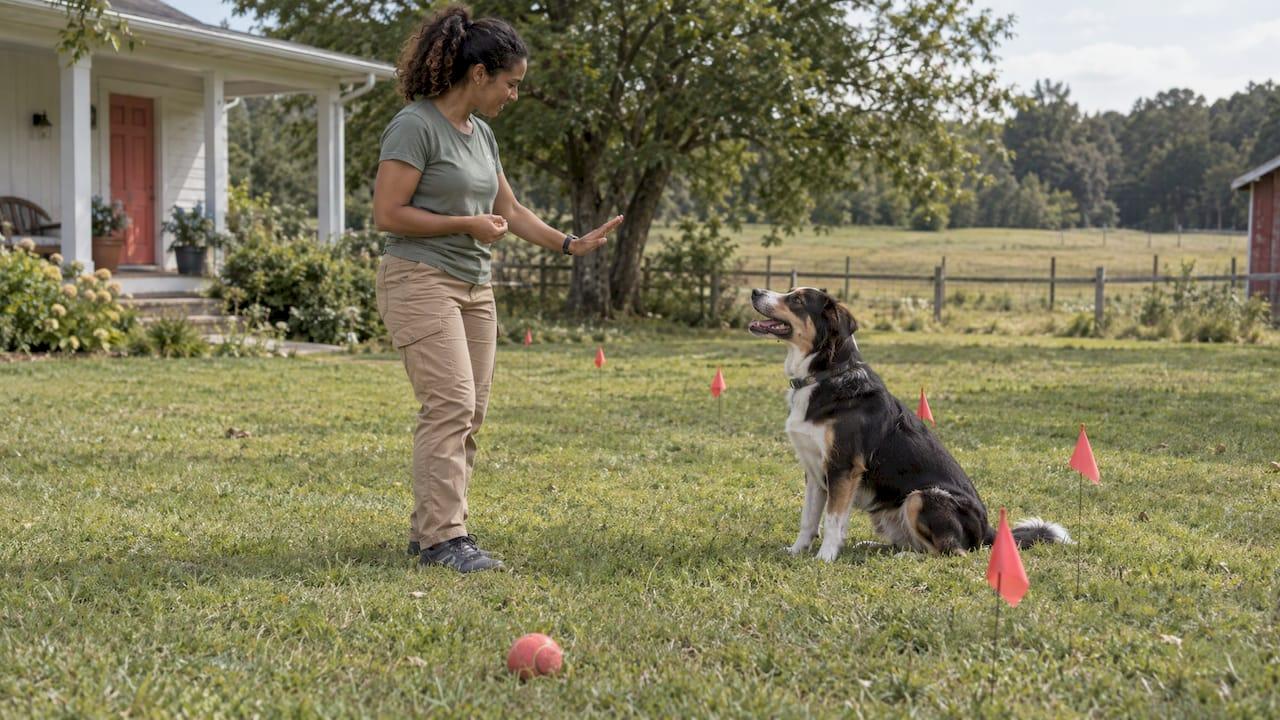
You can keep a dog in an unfenced yard, but not with one gadget or one trick. It takes a layered plan: a dog who is identified and trained, a boundary the dog understands, a containment tool that suits your property, and you being outside with the dog. Below is the routine we would hand a friend, with what to buy at each step and where each step usually goes wrong.
TL;DR
- Supervision is the base layer. The American Kennel Club (AKC) says the best way to keep a dog in the yard is to be out there with them.
- Before any off-leash time, make sure your dog has a microchip, an ID tag with your phone number, and a reliable recall.
- Boundary training with flags takes several months of short daily sessions. Plan for that, not a weekend.
- A GPS dog fence, a managed long line and a well-set-up yard can all be part of the plan. Match the tool to your dog and your property.
- Check your city or county rules first. Many places require a dog to be leashed or contained unless it is behind a fence.
Table of Contents
- Start with the dog, not the gear
- Be in the yard with your dog
- Teach a boundary with flags
- Add a GPS fence to the plan
- Use a leash, long line or tether the safe way
- Set up the yard so the dog wants to stay
- Check your local rules first
- If your dog does get out
- Our perspective
- Find the right gear for your yard
- FAQ
- Sources
Start with the dog, not the gear
Most yard escapes are not a dog deciding to leave. They are a dog reacting. VCA Animal Hospitals notes that even a well-trained dog can bolt at a thunderclap, a gunshot, a scary stranger, another dog, or the sudden appearance of a deer or squirrel. That is why the first job is a safety net for the moment something goes wrong.
VCA recommends three things before any off-leash yard time:
- A permanent microchip, registered with your current contact details.
- A collar or harness with a readable tag showing your phone number.
- Optionally, a GPS tracker, so you can find a dog who does get out.
The same page lists the skills to build: radius training (the dog checks in with you without being asked), a solid recall even with distractions, an emergency "stop" cue, and reliable "Leave It" and "Drop It." Practice each on a leash first, then on a long line, and only then in an open yard.
It also helps to keep the dog healthy and current on flea, tick and heartworm preventives, since Merck Animal Health recommends this for dogs who spend time outdoors. Our Dog Health reviews cover the supplements and treats we have tested in real homes, with vet input on the health picks.
Be in the yard with your dog
The AKC's escape-prevention guide, updated in October 2022, puts it plainly: play fetch, brush, train or simply sit out there with your dog, and avoid leaving a dog alone outdoors for long stretches or when you cannot watch them.
The stakes are real. Merck Animal Health reports that 80% of lost pets disappear from their own yard, through an open gate, a jump over the fence, or theft. In an unfenced yard the first two risks look different, but the lesson is the same: the moments you are not watching are the moments dogs go missing.
What supervised time looks like in practice:
- Go out with the dog, phone in your pocket, and give the yard a purpose: fetch, a sniff-and-find game, short training reps.
- Keep a leash or long line within reach for the first weeks, even if you plan not to use it.
- Put the dog's toys and puzzle feeders away from the property edges. Merck suggests this to keep the dog's attention toward the center of the yard.
- If you cannot be outside, the dog should be indoors or somewhere properly supervised. A well-run outdoor dog daycare setting is one example of what safe, supervised outdoor time looks like, and it is a useful checklist for what to look for in your own routine.
Teach a boundary with flags
Boundary training is the classic fence-free method, and it is slow on purpose. The version below follows AKC trainer Stephanie Gibeault's method, updated in March 2026.
What you need
Boundary flags (the small flags used to mark yard lines), a clicker or a marker word, a 15 to 20 foot leash, and your dog's favorite treats.
The steps
- Teach the flag indoors first. Spend a week or two teaching the dog that a flag means good things, rewarding every look or approach.
- Mark the perimeter. Place flags every 8 to 10 feet along the edge of the area you want the dog to stay in.
- Walk the line on a long leash. Take your dog around the yard and click and treat when the dog turns back from the edge.
- Repeat once or twice a day. Expect this to run for several months, not days.
- Add distractions slowly. Introduce a family member walking by, then a ball rolling, then a neighbor's activity, one at a time.
- Never punish a crossing. If the dog goes over the line, calmly return to an easier step.
- Keep the flags up. AKC advises waiting until the dog has been reliable for at least six months before removing them.
Where it goes wrong
The usual failures are rushing the distraction stage and training only on a quiet day. Whole Dog Journal trainer Pat Miller, who teaches a similar approach with a rope perimeter, a long line and a dedicated cue such as "Fence," points out that boundary training cannot be relied on when something very tempting is on the other side. So treat the behavior as something you ask for while you are present, and build everything else in this guide around that fact.
Add a GPS fence to the plan
For many owners, especially on larger lots, rural property or yards with irregular edges, a GPS dog fence is the tool that makes a virtual boundary practical. You set the boundary on an app and the collar works with your training to help your dog learn where the yard ends. It pairs well with the flag work above, because the dog already understands the idea of an edge.
Because GPS fences are a larger purchase, we test them at home and write up the pros and cons. Our GPS dog fence guide walks through what we look for, and the Pet Tech category collects every gadget review we have done.
A few habits make any GPS fence work better:
- Train first, then rely. Introduce the boundary on a leash while you are present, the same way you would with flags.
- Keep supervising. A virtual boundary is one layer of the plan. Your presence and your recall cue are the others.
- Keep the ID and microchip. The tag and chip stay on the plan whatever tool you choose.
- Check fit and battery. A collar that is loose or uncharged cannot do its job.
If you mainly want to know where your dog is, a tracker is a different product from a fence. Our smart collar roundup covers collars that monitor health and activity.
Use a leash, long line or tether the safe way
A leash is the simplest containment tool there is, and the one that works the day you buy it. A sturdy six-foot option such as this heavy duty 6-foot leash is the right length for walks and for keeping a dog close during yard time.
For more room, a long line (a 15 to 30 foot lead) lets a dog explore while you hold the other end. This is the training tool Gibeault and Miller both use. Keep these safety points in mind:
- Hold it, do not anchor it. Ask A Vet's Dr. Duncan Houston says a long line must be actively managed to avoid entanglement, and a dog should never be left tied out unattended.
- Check the dog's neck. Merck warns that a lead or tether can tangle around the dog's neck, so look it over regularly.
- Do not chain a dog as a routine. The Animal Protection of New Mexico's tethering study cites the American Veterinary Medical Association's guidance to never tether or chain a dog as a containment method, because it can contribute to aggressive behavior.
If you want a tether-style option for play rather than confinement, read our guide to the tether tug for dogs for how it works and how to use it safely. And if you like a longer, flexible lead, see our write-up on whether retractable leashes are safe first.
Set up the yard so the dog wants to stay
A yard that is interesting and comfortable is easier to contain than a bare one. Merck's backyard checklist is a good starting point: fresh water, shade, toys and puzzles placed away from the edges, and no thorny or toxic plants.
Other setup steps that matter without a fence:
- Walk the edges daily. The American Animal Hospital Association advises checking the perimeter every day for holes, snow piles and fallen branches, which still applies if part of your boundary is a hedge, wall or neighbor's fence.
- Use gates where you have them. The AKC recommends an airlock or double gate and locks or hook-and-eye closures on every latch. If your driveway or side path has a gate, this is worth doing.
- Give the dog a destination. A sandbox, a shaded bed or a favorite spot near the house pulls attention inward.
Heat and shade
The AKC warns that dogs cannot regulate temperature as well as people, so shade is essential to prevent heatstroke. Shade moves with the sun, so check on your dog often, and in heatwaves keep the dog indoors as much as you can. Hot hardscaping can also burn paws.

To make summer yard time easier, see our reviews of dog cooling mats, elevated dog beds for hot climates and paw balms for hot weather. Browse more in Dog Gear.
Check your local rules first
Leash and containment rules are set by cities and counties, and they differ a lot. Three examples show the range:
| Place | What the rule says |
|---|---|
| Blaine, Minnesota | A dog not physically contained by a fence on the owner's property must be restrained and on a leash at all times, and animals found at large can be impounded (guide revised June 2024). |
| Winslow Township, New Jersey | Dogs on public streets must be leashed and under control, and a tethered dog's restraint must end at least five feet from any fence, pool, wall or other object, with dogs under six months not allowed to be tethered (as of October 2025). |
| Los Angeles County, California | A dog on public property needs a leash no longer than six feet, while an owner may let a dog be unrestrained on private property with consent, according to a summary of the county code. Burbank's code asks that a dog on an unenclosed lot be securely leashed or tethered so it cannot go beyond the boundaries. |
In a place like Blaine, an unfenced yard may mean the dog is on a leash whenever outside. Search your city or county's animal control ordinance, or call the office, before you decide how much freedom to give your dog. Your landlord or HOA may have its own rules too.
If your dog does get out
Assume it will happen once and prepare. Keep a current photo of your dog on your phone, make sure the microchip registration has your number, and keep the tag on the collar at all times. A GPS tracker lets you check location quickly. Learning what dog tracks look like can also help if you are searching near brush or woods: this guide to telling dog tracks from coyote tracks shows the differences.
Small dogs need extra care. Merck notes that smaller dogs can be easy prey for hawks or coyotes depending on where you live, which is one more reason to stay outside with them.
Our perspective
We test pet products in real homes, so we see the same pattern with yard containment again and again: the owners who are happiest do not rely on one product. They treat a tool as one part of a routine.
Start with the basics that cost little: a microchip, a tag, a recall you have practiced, and your own presence. Then choose a tool that suits the dog's temperament and your property. For many households that means flag training plus a long line, and for others it means adding a GPS fence once the dog understands the idea of a boundary.
That is why our reviews list pros and cons, durability and ease of use, and why our health picks are cross-checked with veterinary input. We buy what we review, we accept no payment for coverage, and we disclose our affiliate relationships. When you read a review of a GPS fence or a leash, you should know how it held up in a real yard.
Pick the layers you can keep up for the life of your dog, and be outside with them while the habits form.
Chris
Find the right gear for your yard
When you are ready to shop, our Pet Tech reviews cover GPS fences and other gadgets tested in real homes, and our Dog Gear reviews cover leashes, beds, cooling gear and more. Each review lays out pros and cons so you can match the product to your dog.

If you are still weighing a GPS fence, start with our honest guide to GPS dog fences and then compare the options in the Pet Tech category.
FAQ
Can I keep a dog in my yard without any fence at all?
Yes, with training, supervision and the right tools, though not by leaving the dog alone. The AKC says the best method is to be in the yard with your dog, and boundary training is meant to be used while you are present. Combine a microchip, a tag and a reliable recall with a leash, a long line or a GPS fence.
How long does boundary training take?
Plan on several months. AKC's flag method calls for one or two short sessions a day over several months, adding distractions gradually, and waiting until the dog has been reliable for at least six months before removing the flags.
Is it safe to tie my dog out in the yard?
Not as a routine. Veterinary and humane guidance cited by Animal Protection of New Mexico advises against tethering or chaining a dog, and Ask A Vet says never to leave a tied dog unattended. If you use a long line, hold it, watch the dog, and check that it cannot tangle around the neck.
What should my dog wear when we are outside?
A collar or harness with an ID tag showing your phone number, plus a registered microchip. VCA Animal Hospitals also lists a GPS tracker as an option, which helps you find a dog quickly if they slip away.
Sources
- How to Keep a Dog From Escaping the Yard (AKC)
- Dog Boundary Training (AKC)
- Yard Safety: Keeping Your Dog Safe Outside (AKC)
- Boundary Training (Whole Dog Journal)
- Off-Leash Training for Dogs (VCA Animal Hospitals)
- Dog-proofing your backyard (Merck Animal Health USA)
- Safer containment guide (Ask A Vet)
- Run-away prevention (American Animal Hospital Association)
- Public Safety and Humane Implications of Persistent Tethering (Animal Protection of New Mexico)
- Dog ordinances (Winslow Township, NJ)
- Los Angeles Dog Leash Laws (Dog Bite Law Group)