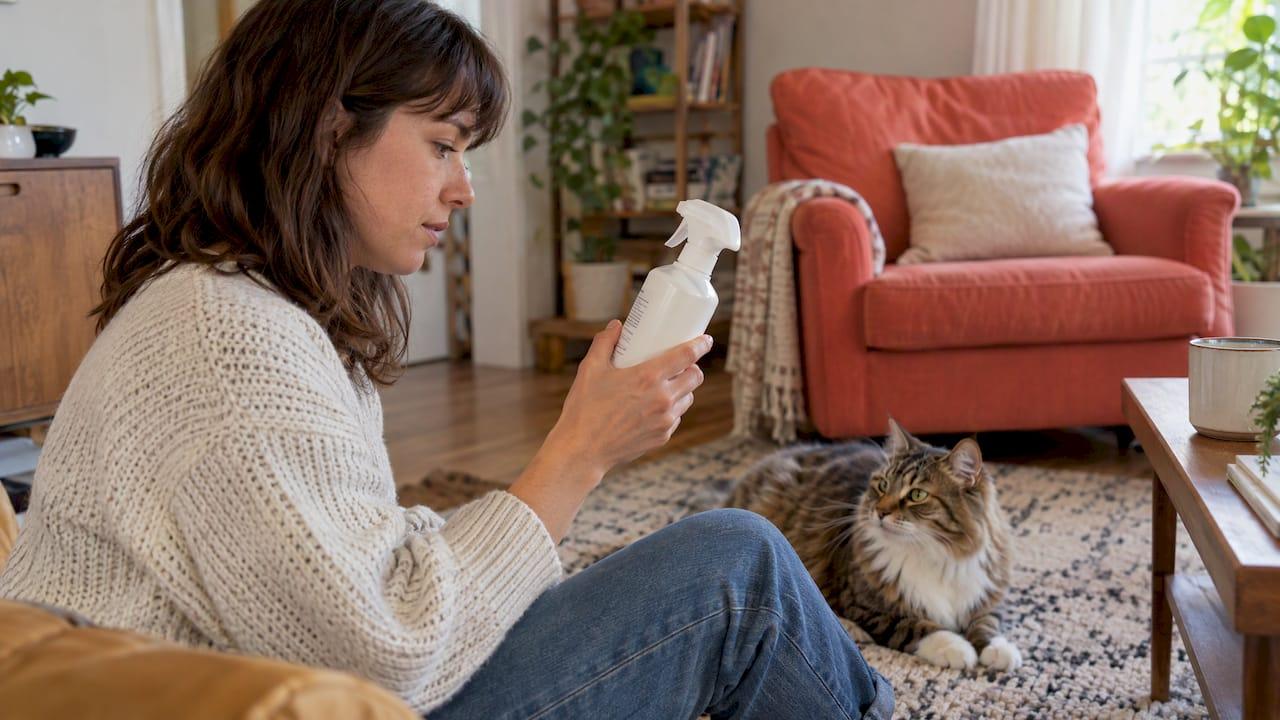
The right flea spray for a cat is one whose label names cats, matches your cat's age and weight, and is applied to one cat at a time with the directions followed exactly. A spray made for the house is a different product with a different job, and a spray made for dogs can be dangerous on a cat. Below you'll find how to read the label, how to apply a spray, what to think about with "natural" formulas, how to treat your home, and when to call your vet.
TL;DR
- Only use a spray whose label says it is for cats, and check the minimum age and weight before you buy. The FDA says never to use a product on a kitten unless the label allows it.
- Never use a dog-only product on a cat. Some dog products contain pesticide concentrations that can cause seizures in cats.
- "Natural" does not mean safe for cats. Essential-oil sprays can cause serious reactions, and cats are more sensitive than dogs.
- Fleas mostly live in your home, not on your cat, so treat bedding and carpets too, and keep cats out of the room while a home spray dries.
- Call your vet right away if your cat drools, wobbles, vomits, or seems depressed after any flea product.
Table of Contents
- What kinds of flea spray exist for cats
- How to read a flea spray label before you buy
- How to apply flea spray to a cat safely
- Natural flea spray for cats: what to know first
- Fleas in the house: using a home spray without risking your cat
- Flea spray for kittens
- Our perspective
- Where to find tested cat health picks
- When to call your vet
- FAQ
- Sources
What kinds of flea spray exist for cats
When people search for a flea spray for cats, they are usually looking at one of three very different products. Mixing them up is the most common and most costly mistake.
| Type | Where it goes | Typical job | Key label check |
|---|---|---|---|
| Spray for the cat | Directly on the cat's coat | Kills fleas on the animal, some also kill eggs and ticks | Names cats, lists minimum age and weight |
| Home or premise spray | Carpets, upholstery, pet bedding areas | Kills larvae and eggs in the environment | Pets out of the room until dry |
| Yard spray | Outdoor shaded areas | Reduces outdoor flea populations | Not for use on the animal |
A cat spray is applied to the animal. A home spray is a pesticide for surfaces, and your cat should not be in the room while it is applied or while it dries. The two should never be swapped, even when the active ingredient sounds similar.
Some cat sprays also carry an insect growth regulator (IGR), which stops immature fleas from developing. The product details published by one manufacturer describe active ingredients that inhibit development of immature flea stages while also killing adult fleas, ticks, and lice. That matters because adults on the cat are only a small slice of the problem.
Sprays are one format among several. Spot-ons and oral treatments are often easier for cats who hate being sprayed, and we compare them in our guide to flea and tick treatments for cats, spot-ons versus oral.
How to read a flea spray label before you buy
The label is the product's legal instruction sheet, and it answers most safety questions before you open the bottle. Go through it in this order.
1. Species
The US EPA says flea and tick products should be used only on the species named on the label, and that dog products should never go on cats, because some pesticides are more toxic to one species than another. If "cats" is not clearly printed, put it back.
The risk is concrete. A city animal-services document explains that dog-only permethrin products can contain 45 to 60 percent permethrin, and that even a few drops of concentrated permethrin could be lethal to a cat, with seizures possible within hours. Cats also cannot process these compounds the way dogs can. A manufacturer's veterinary monograph notes that the feline liver cannot conjugate pyrethroid metabolites with glucuronide, and that a cat's small body mass, dense hair, and constant grooming probably add to the toxicity.
2. Age and weight
The FDA advises choosing a product that matches your pet's species, life stage, and weight class. The minimums are on the label. As an example of how this reads in practice, one federally registered label for a spot-on cat product states that it is for cats 8 weeks and older weighing at least 2 pounds. Sprays vary, so read yours rather than assuming.
3. Dose by weight
Spray labels often dose by pumps per pound. An older federal label for a cat and dog spray, for instance, calls for roughly 1 to 2 pumps per pound of body weight and says not to use it on kittens or puppies under 8 weeks. Treat that as an illustration of how the dosing works, not as instructions for your product. Weigh your cat on a bathroom scale (weigh yourself, then yourself holding the cat) and follow your own label.
4. What the product does
Look for whether it kills adults only or also eggs and larvae, how long it protects, and whether it also covers ticks. If you also need a tick plan, say so to your vet, because the answer changes by region.
5. Re-read it every time
The FDA also notes that directions and warnings can change, so read the label each time you buy, not just the first time.
How to apply flea spray to a cat safely
Most sprays are used the same way. Your exact label wins over any general steps, but this is the shape of a safe routine.
- Choose a ventilated spot and have a towel and your gloves ready. The FDA suggests washing your hands with soap and water afterward, or wearing protective gloves.
- Treat one pet at a time. Keep the treated cat apart from other pets until the product dries, per the FDA.
- Protect the face. One manufacturer's instructions say to cover the cat's eyes with your hand, avoid spraying the mouth, nose, or eyes, and spray the head, ears, and chest until damp before spraying from neck to tail and finishing with the legs. For the head area, a federal label for another spray says to spray onto a gloved hand and rub gently into the hair.
- Work against the lie of the coat so the product reaches the skin, not just the fur's surface, and follow your label on how damp the coat should get.
- Keep the cat from licking until it is dry. Distraction with a play session in a separate room works well.
- Store the bottle away from food and out of reach of children and pets.
Avoid soaking the animal. The ASPCA warns that the alcohol in many flea sprays can intoxicate a pet that is soaked with the product, with unsteady walking, vomiting, diarrhea, sleepiness, and in serious cases seizures or death.
A cat who panics at the hiss of a spray bottle is a common reason owners switch format. Our Cat Health picks are a good place to compare options that don't involve a bottle at all.
If you have a dog too
Multipet homes need extra care. Veterinary guidance from AAHA says cats should be kept away from dogs treated with pyrethrin or pyrethroid products for the first 24 hours, and that drooling is one sign of toxicity in cats that can be fatal if left untreated. A veterinarian from the ASPCA told Consumer Reports that if your cat regularly licks or grooms your dog, you should avoid permethrin on the dog because it can transfer. Ask your vet to match both pets' products.
Natural flea spray for cats: what to know first
Natural sprays are among the most searched options, and the appeal is easy to understand. You want something gentle for an animal who licks everything. The trouble is that the word "natural" says nothing regulated about safety.
The ASPCA says essential-oil flea and tick products can cause depression, unsteadiness, weakness, vomiting, diarrhea, and seizures, and that these products are often not regulated by the FDA or EPA and have not gone through rigorous testing to prove safety or efficacy. Consumer Reports cites a 2012 study in the Journal of Veterinary Emergency and Critical Care that found dozens of reports of health problems in pets exposed to commercial essential-oil flea products, and a veterinary professor there notes that cats are more likely than dogs to react badly to essential oils.
Citrus extracts are a good example. The same city document points out that d-limonene and linalool are natural flea-control agents that can still cause harm if used improperly on cats.
So how do you choose well? If a natural-style spray catches your eye:
- Confirm that the label names cats and gives an age and weight minimum.
- Check the ingredient list for essential oils, and show it to your vet before the first use.
- Patch-test nothing yourself. Ask your vet instead, and never put diluted oils on a cat from a recipe.
- Avoid kitchen mixtures. Apple cider vinegar sprays and similar home remedies turn up in many guides, but none replaces a labeled product when your cat has an active infestation.
If you're researching plant-based options more broadly, this explainer on coconut oil against ticks covers how people use it with dogs. Cats groom constantly and ingest whatever is on their coat, so any natural product for a cat should be cleared with your vet first.
Fleas in the house: using a home spray without risking your cat
Adult fleas on your cat are the visible tip. Eggs, larvae, and pupae sit in carpet, cracks, and bedding. That is why a cat-only spray rarely ends an infestation by itself.
Pick the right kind of home treatment
The University of California's Statewide IPM Program recommends treating infested carpet and unwashable upholstery with a hand sprayer or aerosol containing an insect growth regulator such as methoprene or pyriproxyfen. It also says that total-release foggers don't give the coverage of direct sprays unless they contain an IGR, and that insecticides other than IGRs often fail because they never reach larvae at the base of carpet fibers.
Expect a wait. The same program explains that IGR treatment kills larvae but not pupae, so fleas can keep emerging for up to two weeks, and that vacuuming should continue for the following two weeks. If you still see fleas on day five, that is normal, not a failed treatment.
Keep your cat safe during treatment
The city guidance recommends removing all pets from the house for the period on the container, removing food and water bowls, letting the area dry completely before cats return, and opening windows or running fans to air the home out. Put your cat in a closed, untreated room with a litter box, water, and a bed, or board her with a friend if the label calls for a long absence.
A simple home routine
- Wash bedding, blankets, and removable covers in hot water.
- Vacuum carpets, rugs, and furniture edges daily, and empty the canister or bag outdoors.
- Treat the areas your cat actually lies in, not the whole house at random.
- Re-treat only on the schedule the label gives.
Odors can linger after cleaning, and many owners also want a fresh-smelling home. If that applies, see our roundup of odor-eliminating sprays for pet homes. Keep your litter routine in mind too, and check our guide to litter deodorizers and cat safety before adding any new product near the box.
Flea spray for kittens
Kittens are the group where a wrong choice costs the most. The FDA and EPA both say not to apply a product to a kitten unless the label specifically allows it, and the label gives the minimum age or size. For kittens too young for any product, the FDA recommends a flea comb to remove fleas and eggs.

A veterinary clinic's guide to kitten flea care puts typical thresholds in plain terms: under 4 weeks, comb and a gentle bath only; a fast-acting oral tablet is used from 4 weeks at a minimum of 2 pounds; and most spot-on and oral products begin at 8 weeks. Because these thresholds are product-specific, always confirm with your vet before you treat a kitten, especially if she is underweight, unwell, or nursing.
Also treat the mother and the nest. Washing the kittens' bedding in hot water removes a large share of eggs and larvae without any chemical touching the kittens.
Our perspective
We test pet products in real homes, and flea control is the category where we see owners get hurt by good intentions. The pattern is almost always the same: a spray or a "natural" shortcut that was never meant for a cat, used on a cat because it was in the cabinet.
That is why our rule at Kiblco is simple. We look at who the product is labeled for, what it actually does against the flea life cycle, and how easy it is for a normal household to use correctly. Our health picks are cross-checked by veterinary experts, and every review states the downsides plainly, because a honest pros and cons list is more useful than a glowing one.
For most cats, we think the best outcome comes from combining a labeled cat product with home treatment, and from choosing a format your cat will tolerate. A spray that is applied wrong, or skipped because the cat hides, protects nobody. Browse our cat health reviews with that in mind, and talk to your vet about what fits your cat's age, weight, and lifestyle.
Chris
Where to find tested cat health picks
If you're ready to compare products, our Cat Health reviews bring together hands-on tests of cat health products, each with clear pros, cons, and notes on usability. We buy and test products in real homes, with health picks cross-checked by veterinary experts, and we disclose our affiliate relationships.

If you're weighing spot-on products against sprays, start with our comparison of two popular spot-on options for cats. Browse more at Kiblco.
When to call your vet
The FDA says to call a veterinarian right away if your pet has a bad reaction to a flea or tick product. Watch for dizziness, wobbliness, poor coordination, poor appetite, depression, vomiting, diarrhea, or excessive drooling, and know that some animals have had seizures or died. See the FDA guidance for the full list.
What to do while you reach help:
- Keep your cat calm, warm, and away from other pets.
- Keep the product container so you can read the ingredients and the EPA registration number to the vet.
- Don't induce vomiting or give home remedies unless a veterinarian tells you to.
- Call your own vet, or an emergency clinic if it's after hours.
Also call your vet before treating if your cat is a kitten, is elderly, is pregnant or nursing, is underweight, or has a health condition. They can match a product to her, and to any dog in the home.
FAQ
Is flea spray for dogs safe to use on cats?
No. The EPA says dog products should never be applied to cats, because some pesticides are more toxic to one species than another. Dog-only permethrin products in particular can cause seizures in cats. Use only a product whose label names cats.
Can I use flea spray on my kitten?
Only if the label specifically allows it and your kitten meets the minimum age and weight. Many products start at 8 weeks. For younger kittens, the FDA recommends a flea comb, and your vet can advise on the rest.
Are natural flea sprays safer for cats?
Not automatically. The ASPCA warns that essential-oil products can cause tremors, vomiting, and seizures, and they are often not rigorously tested. Choose a labeled cat product and show any natural spray's ingredient list to your vet first.
Do I need to treat my house if I spray my cat?
Usually yes. Most of the flea population lives in carpets, bedding, and furniture as eggs, larvae, and pupae. UC IPM recommends an IGR-containing spray for infested carpet and upholstery, plus regular vacuuming, with fleas possibly emerging for up to two weeks afterward.
How long should I keep my cat away from a treated room?
Follow the time printed on the container, and let the area dry fully. Remove food and water bowls, ventilate the room, and only then let your cat return.
Sources
- Safe Use of Flea and Tick Products in Pets, FDA
- Controlling Fleas and Ticks on Your Pet, US EPA
- Cats and Flea Control Products, City of Flower Mound
- Advantage Treatment Spray for Cats, Elanco
- Feline Flea and Tick Control monograph, Hartz
- Advantage II for Cats label
- EPA pesticide product label, spray treatment
- Should You Fear the Flea?, ASPCA
- Pyrethrins and pyrethroids, AAHA
- Natural tick prevention for dog or cat, Consumer Reports
- Fleas, UC Statewide IPM Program
- Best Flea Treatment For Kittens, Ridgefield Veterinary Center
- Kokosöl gegen Zecken, Natureflow Pets