
Fiber supplements help most with three specific problems: chronic constipation, certain forms of large-bowel diarrhea, and recurring anal gland impaction only when a veterinarian has weighed in on the cause. If your vet gives the go-ahead, three forms cover almost every situation: psyllium powder for flexible dosing, a veterinary fiber blend like Proviable for balanced soluble and insoluble fiber, or psyllium capsules like VETASYL for dogs that refuse powder in food. Introduce any of them gradually over five to seven days, and keep fresh water available at all times.
TL;DR:
- Soluble fiber like psyllium effectively reduces defecation frequency and improves stool firmness in dogs with chronic loose stools when used at proper doses.
- Mixed-fiber blends support both stool consistency and gut bacteria, making them more suitable for complex digestive issues than single-ingredient products.
- Fiber supplements should be introduced gradually over five to seven days and always with unlimited fresh water to prevent dehydration and worsen symptoms.
- Avoid fiber use in dogs with megacolon, suspected obstructions, or severe motility disorders, and consider therapeutic diets for significant fiber increases.
- Measuring accurately, selecting products with transparent ingredients, and consulting a veterinarian are essential for safe, effective fiber supplementation.
Table of Contents
- What Is the Difference Between Soluble and Insoluble Fiber?
- Which Digestive Problems Does Fiber Actually Help?
- How Do You Choose the Right Fiber Supplement?
- Fiber Supplements for Dogs: Side-by-Side Comparison
- How Do You Dose and Introduce a Fiber Supplement Safely?
- How Kiblco Tests Fiber Supplements
- What I've Learned Watching Dog Owners Try These Supplements
- Where to Start Shopping for a Fiber Supplement
- Sources
- FAQ
What Is the Difference Between Soluble and Insoluble Fiber?
Soluble fiber dissolves in water and forms a gel in the gut. It slows transit time, softens stool in constipated dogs, and firms up stool in dogs with diarrhea by absorbing excess water. Insoluble fiber does the opposite job: it doesn't dissolve, and it adds bulk that speeds up transit and stimulates the colon to contract more regularly. Most dogs with digestive complaints need some combination of both. This is why single-ingredient products often underperform compared to blends.
Psyllium husk is the most studied soluble fiber for dogs. It comes from the seed husks of the Plantago ovata plant and swells into a gel when it hits water, which is exactly why hydration matters so much when you're using it.
Beet pulp, common in commercial dog foods, is a moderately fermentable fiber that sits between soluble and insoluble, feeding gut bacteria while also adding bulk. Cellulose is almost purely insoluble and mostly just adds bulk without fermenting. Inulin, extracted from chicory root, is a prebiotic fiber that ferments quickly and feeds beneficial bacteria, which is why you'll see it in microbiome-focused products. Pumpkin, the household staple every dog owner has heard about, contains a modest amount of soluble fiber along with water content that can help mild cases.
Here's a quick breakdown of where common sources land:
- Psyllium husk: mostly soluble, forms a gel, softens or firms stool depending on baseline hydration
- Beet pulp: moderately fermentable, supports bulk and gut bacteria
- Cellulose: mostly insoluble, adds bulk with minimal fermentation
- Inulin: highly fermentable prebiotic, feeds beneficial bacteria quickly
- Pumpkin: modest soluble fiber plus water, mild and short-term use only
One clinical trial on working police dogs found that daily psyllium supplementation dropped defecation frequency from an average of 3.5 times a day to 2.9 times a day, and roughly 90% of the dogs developed consistent, well-formed stools during the month-long trial. That's a meaningful shift for dogs with chronic loose stool, and it's part of why psyllium remains the default recommendation among veterinarians.
Mixed-fiber blends exist because no single fiber type does everything. A product that combines psyllium's water-absorbing gel with a fermentable prebiotic like inulin or beet pulp can address both stool consistency and gut bacteria balance in one scoop. That's the logic behind products like Proviable Fiber Powder, which pairs psyllium husk with microcrystalline cellulose, apple fiber, and beta-glucans rather than relying on one ingredient alone.
Which Digestive Problems Does Fiber Actually Help?
Fiber has real, evidence-backed uses, but it isn't a universal fix, and using it in the wrong situation can make things worse. The clearest clinical case is chronic idiopathic large-bowel diarrhea, the kind that doesn't stem from an infection or parasite but from a colon that isn't processing water and waste normally. In the police-dog trial mentioned above, daily psyllium at roughly 4 tablespoons a day for a month produced firmer, more consistent stools in the large majority of dogs, and some dogs kept those improvements even after supplementation stopped.
Constipation is the other well-supported use. Soluble fiber's gel-forming action pulls water into the colon and softens hard, dry stool, which is often more effective and gentler than a laxative for mild-to-moderate cases. Fiber can also help dogs with recurring anal gland impaction, since bulkier stool applies more natural pressure to express the glands during normal defecation.
But fiber isn't right for every gut problem, and there are real contraindications:
- Megacolon or severe colonic motility disorders: adding bulk to a colon that already can't contract properly can worsen impaction rather than relieve it
- Acute obstruction or suspected foreign body: fiber should never be given until this is ruled out by a veterinarian
- Some cases of small-intestinal disease: these often respond better to low-residue diets than to added fiber
There's also a scale issue worth understanding before you reach for a supplement. According to Today's Veterinary Practice's clinical review, therapeutic high-fiber diets can supply far more total dietary fiber than a supplement realistically can add on top of regular food. If your dog needs a large jump in fiber intake to manage a chronic condition, a prescription high-fiber diet may do more than any powder or capsule sprinkled over kibble.
Evaluate the fiber content of the current diet before adding a supplement. In cases where a substantial increase in total dietary fiber is medically necessary, a therapeutic diet formulated for that purpose may accomplish more than supplementation alone.
How Do You Choose the Right Fiber Supplement?
Start with the fiber type, not the brand name on the label. A dog with hard, infrequent stools generally needs a soluble-fiber-forward product like psyllium. A dog with loose, large-bowel diarrhea often does better with a mixed blend that includes some fermentable fiber alongside the soluble component. If you're not sure which category your dog falls into, that's exactly the kind of question to bring to your vet rather than guess from a product description.
Beyond fiber type, four practical factors separate a good choice from a frustrating one:
- Product form. Powders mix into food and allow fine dose adjustments, but some dogs pick around them. Capsules like VETASYL guarantee a consistent dose but only work if your dog will actually swallow one.
- Dose adjustability. Look for directions given by body weight, not a single flat scoop size. A product only offering "one scoop per meal" regardless of whether your dog weighs 12 pounds or 90 pounds is a red flag.
- Ingredient transparency. Any label that just says "fiber blend" without naming the specific sources tells you nothing about whether it's soluble, insoluble, or prebiotic. Walk away from vague labeling.
- Added sugars or flavorings. Some human-marketed fiber products include sweeteners that add unnecessary calories or, in the case of certain sugar substitutes, real toxicity risk. Stick to products formulated specifically for dogs.
Pro Tip: Bring your dog's current stool consistency described in plain terms (dry and pellet-like, loose and unformed, mucus-coated) to your next vet visit. That single detail helps your vet match the fiber type to the actual problem instead of guessing from a general "digestive issues" description.
Before you buy anything, it's worth asking your vet three direct questions: Is this constipation, colitis, or something else? Would a therapeutic diet accomplish more than a supplement here? And is there any reason, like megacolon or a suspected obstruction, that fiber isn't appropriate right now?
Fiber Supplements for Dogs: Side-by-Side Comparison
The table below reflects how five common options differ on fiber type, form, and practical use. All prices and formulations should be confirmed on the manufacturer's page before buying, since products get reformulated.
| Product | Fiber type(s) | Form | Starting dose guidance | Best for |
|---|---|---|---|---|
| Psyllium husk (generic powder) | Soluble (psyllium) | Powder | 0.25–6 tbsp/day, varies widely by size; median around 2 tbsp/day in clinical use | Constipation and large-bowel diarrhea, under vet guidance |
| VETASYL® Fiber Capsules (Virbac) | Soluble (mostly psyllium husk) | Capsule (dose varies) | Per label, adjusted by weight | Dogs that won't eat powder mixed into food |
| Proviable Fiber Powder (Nutramax) | Mixed: psyllium husk, cellulose, apple fiber, beta-glucans | Powder | 1/2 tsp per 20 lb, twice daily as a starting point | Owners wanting a balanced, prebiotic powder with clear per-weight dosing |
| AnimalBiome Fiber Biome Blend | Mixed: beet fiber, MOS, larch arabinogalactan | Powder | Per label, gentle introduction recommended | Microbiome support and dogs with sensitive digestion |
| Canned pumpkin (human-grade) | Soluble, modest amount | Puree or powder | Roughly 1 to 4 tablespoons depending on size, short-term trial only | Mild, short-term stool issues before a formulated product |
A few things stand out once you look past the chart. Psyllium husk in generic bulk powder form gives you the most dosing flexibility of anything on this list, since you can adjust the amount in quarter-teaspoon increments as your vet directs, but it's also the messiest to mix and some dogs pick around the gritty texture in food.
VETASYL solves the palatability problem by locking the psyllium into a capsule, which matters most for dogs that are food-selective or that get fed multiple times a day by different family members who might not measure consistently. The tradeoff is that you need a dog willing to take capsules, either plain or hidden in a pill pocket.
Proviable Fiber Powder and AnimalBiome's Fiber Biome Blend both take the mixed-fiber approach, but they're built for slightly different goals. Proviable leans toward general digestive support with a clearly stated per-weight dose, which makes it easier to titrate up or down under vet direction (see the detailed science behind fiber supplements). AnimalBiome markets its blend specifically around microbiome nourishment, with ingredients chosen for their prebiotic fermentation rather than pure bulk, which tends to suit dogs with more sensitive or reactive guts.
Canned pumpkin remains the go-to household experiment, and it's not a bad one for a mild, short-term issue. But the math doesn't hold up for chronic problems: one cup of canned pumpkin provides only around 7 grams of fiber, and matching the fiber density of a therapeutic prescription diet would require an impractical volume of pumpkin per meal. Treat it as a bridge option, not a long-term therapeutic tool.
How Do You Dose and Introduce a Fiber Supplement Safely?
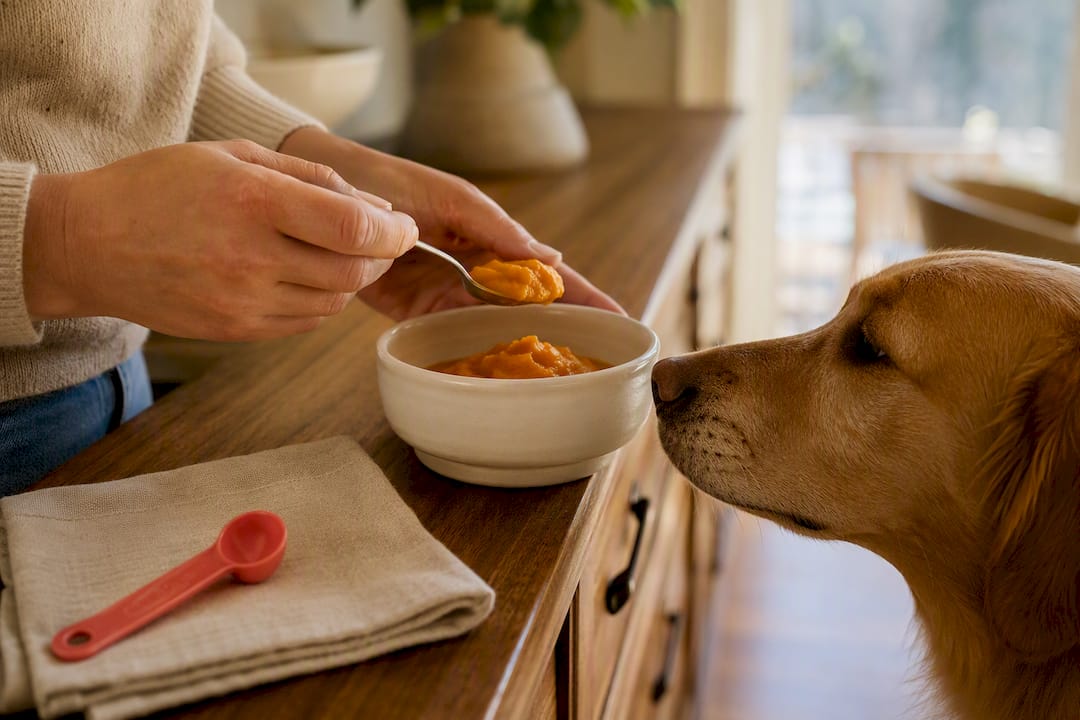
Dosing fiber correctly comes down to three things: starting low, watching the stool, and never letting hydration lag behind. Clinical dosages for psyllium reported in veterinary literature range from as little as 0.25 tablespoons up to 6 tablespoons per day, which is a wide enough spread that guessing without your vet's input is genuinely risky for a small dog.
- Start at roughly a quarter to a half of the label's suggested dose for your dog's weight, especially with psyllium powder, and confirm the target dose with your vet based on your dog's size and condition.
- Increase gradually over five to seven days, checking stool consistency daily. A simple fecal scoring approach, rating stool from too hard to too loose on a 1 to 7 scale, gives you a consistent way to track whether the dose is working.
- Keep water bowls full and accessible at all times. Soluble fiber pulls water into the gut, and an underhydrated dog on fiber can end up more constipated, not less.
- Watch for interactions. Fiber can slow the absorption of some oral medications if given at the same time, so space supplements at least two hours from other drugs unless your vet says otherwise.
- Stop and call your vet if you see vomiting, worsening constipation, blood in stool, or no improvement after one to two weeks. Those signs mean the fiber isn't addressing the root cause, or the diagnosis needs a second look.
Watch, too, for the mismatch between condition and fiber type. Insight from veterinary nutrition literature notes that large-intestine problems often respond better to higher insoluble fiber, while small-intestine issues tend to do better with soluble fiber or, in some cases, a low-fiber approach entirely. Getting that distinction wrong is one of the more common reasons owners feel like "fiber just didn't work" for their dog.
How Kiblco Tests Fiber Supplements
The review process starts with products purchased and used in real homes, not samples sent by manufacturers for a quick write-up. Health-related picks, including fiber supplements, get cross-checked against veterinary sources and clinical literature before recommendation, and affiliate relationships are disclosed upfront.
For fiber products specifically, testing notes focus on the details that actually affect whether an owner sticks with a supplement long enough to see results:
- Mixability: does the powder blend smoothly into wet or dry food, or does it clump and sit visibly on top where a picky dog can avoid it?
- Palatability: will the dog eat food with the supplement mixed in on the first try, or does it take multiple attempts and different foods?
- Stool response: using simple day-by-day observation, does stool consistency shift within the expected one to two week window?
Additional hands-on notes and reader-submitted feedback on specific fiber products will continue to be added as more households test them over time.
What I've Learned Watching Dog Owners Try These Supplements
The dogs that do best on fiber supplements almost always belong to owners who measured carefully instead of eyeballing a scoop. A slightly heaping teaspoon looks harmless, but it can double the intended dose for a 20-pound dog and cause the exact loose stool the supplement was supposed to prevent.
Mixing matters more than people expect. Powder stirred into wet food or a small amount of warm water tends to disappear better than powder dumped dry onto kibble, where a picky eater will sniff it out and leave a suspicious pile at the bottom of the bowl. And if a dog's stool hasn't improved within two weeks, or symptoms have gotten worse rather than better, that's not a sign to try a bigger dose. It's a sign to get back in front of a veterinarian who can rule out something fiber was never going to fix.
— Chris
Where to Start Shopping for a Fiber Supplement
Kiblco tests supplements the way an actual dog owner uses them: purchased at retail, tried at home, and checked against veterinary sources before anything gets a recommendation. That means the picks in Kiblco's Dog Health category reflect real mixability and palatability notes, not just a repackaged ingredient list from a manufacturer's press release.

If your dog needs help with dosing tools, like a measuring scoop that actually matches the increments your vet recommended, Kiblco's Dog Gear category covers accessories that make consistent dosing easier day to day. Every review states affiliate relationships clearly, and no brand pays for placement or a better writeup. Start with the Dog Health picks, cross-reference the dosing guidance with your vet, and go from there.
Sources
- The use of soluble fibre for the management of chronic idiopathic large-bowel diarrhoea in police working dogs — PMC
- Dietary fiber aids in the management of canine and feline gastrointestinal disease — Today's Veterinary Practice (2025 PDF)
FAQ
What Is a Good Fiber Supplement for a Dog?
Psyllium husk, either as a plain powder or in capsule form like VETASYL, is the most clinically studied option, while mixed-fiber powders like Proviable combine soluble and insoluble sources for broader digestive support.
What Is a Good Fiber to Give Dogs?
Psyllium is the most evidence-backed soluble fiber for dogs, shown to improve stool consistency and reduce defecation frequency in a clinical trial on working dogs; beet pulp and inulin are common supporting sources in mixed blends.
What Is the Best Fiber Supplement for Dogs?
There isn't one universal best option, since the right choice depends on whether your dog has constipation, diarrhea, or needs microbiome support. Kiblco's Dog Health picks are vetted with veterinary input specifically to help match the product to the condition.
Can I Give My Dog a Fiber Supplement?
Yes, but only after ruling out contraindications like megacolon or an intestinal obstruction with a veterinarian, and only by introducing it gradually over five to seven days with constant access to water.