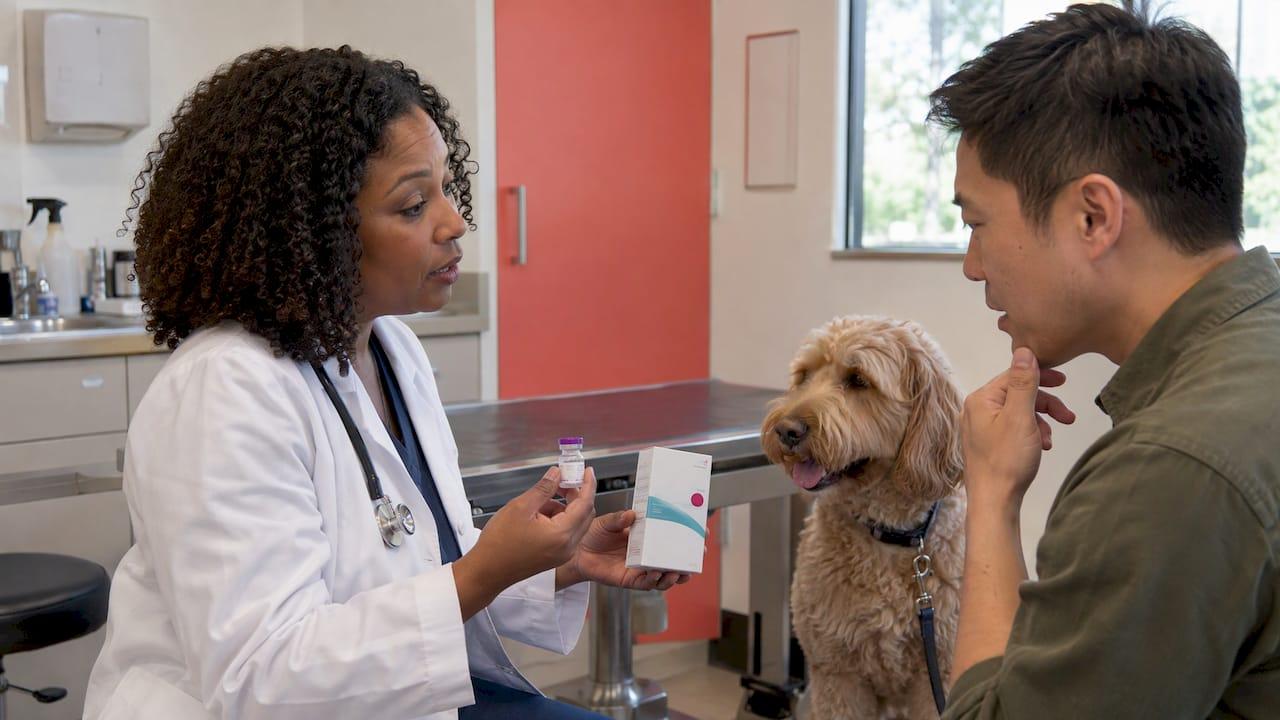
Apoquel is a daily itch-control tablet that can start working within hours. Cytopoint is a vet-administered injection that targets one itch signal and can last weeks. Both treat allergic itch in dogs, neither works for every dog, and your veterinarian picks between them based on your dog's age, health history, how inflamed the skin is and how easy daily pills are for your household. This guide walks through the real differences so you arrive at the appointment ready to ask good questions.
TL;DR
- Apoquel (oclacitinib) is an oral drug given once or twice a day. Zoetis says it can start relieving itch in as little as 4 hours.
- Cytopoint (lokivetmab) is an injection given at the vet's office. Relief starts within 24 hours and lasts 4 to 8 weeks.
- Veterinary guidelines say each drug works better in some dogs, and neither is 100% effective.
- Age and health history often decide the choice: Apoquel is for dogs 12 months and older, while Cytopoint has no listed age or health restriction.
- Cost depends on weight. One veterinary clinic estimates roughly $60 to $90 a month for Apoquel in a 50-pound dog and $75 to $150 per Cytopoint injection.
Table of Contents
- How each drug stops the itch
- Cytopoint vs Apoquel at a glance
- Speed and how long relief lasts
- How well they work
- Which dog suits which drug
- Side effects and safety
- What it costs
- Alternatives if neither drug is the right fit
- Questions to bring to your vet
- Our perspective
- Find supportive products for your dog
- FAQ
- Sources
How each drug stops the itch
The two medicines reach the same goal by different routes.
Apoquel contains oclacitinib, a Janus kinase (JAK) inhibitor. It is FDA-approved for itch associated with allergic dermatitis and for atopic dermatitis in dogs at least 12 months old. It blocks signaling from several inflammatory and itch-related cytokines, including IL-2, IL-4, IL-6, IL-13 and IL-31. In plain terms, it turns down a number of the messages that tell the skin to itch and swell. It comes as a tablet and a chewable tablet.
Cytopoint contains lokivetmab, a caninized monoclonal antibody that neutralizes IL-31, a key itch signal. It does not touch the wider inflammatory pathways. It is injected under the skin at a veterinary office, and it comes in 10, 20, 30 and 40 mg vials matched to body weight.

A board-certified veterinary dermatologist, Dr. Mollie Mesman, describes Apoquel as an anti-itch drug with some anti-inflammatory action, and Cytopoint as a drug that specifically blocks itch caused by IL-31. That difference in reach explains most of what follows.
Cytopoint vs Apoquel at a glance
| Factor | Apoquel | Cytopoint |
|---|---|---|
| Active ingredient | Oclacitinib (JAK inhibitor) | Lokivetmab (monoclonal antibody) |
| How it is given | Oral, at home | Injection under the skin, at the vet |
| Dosing schedule | Every 12 hours for up to 14 days, then every 24 hours | Every 4 to 8 weeks |
| Onset | As little as 4 hours (manufacturer) | Within 24 hours (manufacturer) |
| Age | Dogs 12 months and older | Listed age: any |
| Listed health restrictions | History of demodicosis, neoplasia, serious infection | None listed in the AAHA table |
| Main target | Several inflammatory and itch cytokines | IL-31 only |
| Estimated cost | About $2 to $3 per pill | About $75 to $150 per injection |
Sources for the schedule, age and restriction rows: the AAHA 2023 guidelines. Cost figures come from one clinic's published estimate and will vary by region, clinic and dose.
Speed and how long relief lasts
Apoquel is the faster-feeling option for many owners. Zoetis reports that it can start relieving itch in as little as 4 hours, which is why it is often chosen for a dog who is scratching raw right now. The catch is consistency: relief depends on the next dose. Miss a few and the itch can return.
Cytopoint takes up to a day to kick in, then one injection covers 4 to 8 weeks. You do not have to remember a pill, which helps in households where several people share dog duties or where the dog spits out everything hidden in cheese.

How long a given injection lasts is individual. Some dogs need a repeat closer to four weeks, others stretch toward eight. Your vet will adjust the interval by watching when scratching creeps back, so a simple itch diary helps (more on that below).
How well they work
The most useful honest answer to "does Apoquel work as well as Cytopoint?" comes from the 2023 AAHA guidelines: oclacitinib is more effective in some patients and lokivetmab in others, neither is 100% effective, and individual response varies a lot. There is no universal winner, so trying one and switching if it underdelivers is a normal path.
Some numbers help set expectations:
- In a prospective study of Cytopoint, 94% of assessable dogs reached treatment success by day 7 and 98% by day 28. Success meant a drop of at least 20 mm on a pruritus visual analog scale. A retrospective study in the same paper reported success in 87.8% of allergic dermatitis cases.
- A study summarized by a veterinary dermatology practice found no statistically significant difference between Apoquel and prednisolone on owner-assessed itch or vet-assessed skin scores. The same summary reports Cytopoint and cyclosporine performing comparably over three months, with close to a 60% drop in CADESI lesion scores in both groups.
The studies use different methods and dogs, so do not stack them against each other like a scoreboard. They show that both drugs are real, effective tools, not that one beats the other.
When inflammation is severe
The AAHA guidelines say that for mild to moderate inflammation and itch, either drug may be used. For severely inflamed skin, many veterinary dermatologists would lean toward glucocorticoids, and lokivetmab may suit cases where inflammation is less severe. A DVM360 article takes a similar view: Apoquel is often the first pick when a dog has both significant inflammation and itch, because it acts on several pathways, while Cytopoint is a strong choice for puppies under a year and for dogs with a history of medication side effects. Dr. Mesman adds that in her opinion Cytopoint is not a good fit for severely inflamed ears and paws.
Which dog suits which drug
These are patterns vets describe, not rules. Your dog's exam decides.
Apoquel tends to fit when:
- The dog is over 12 months old.
- Itch and visible inflammation are both significant.
- You want fast relief and can give a tablet reliably every day.
- The dog takes pills happily.
Cytopoint tends to fit when:
- The dog is under a year. Dr. Mesman calls it potentially the best choice for a dog under 1 year.
- The dog is hard to pill, or did not tolerate Apoquel. A clinic vet notes it is a good option for dogs who are hard to pill.
- There is a history of demodicosis, cancer or serious infection, which are listed restrictions for Apoquel.
- Inflammation is milder and itch is the main problem.
One more wrinkle: if your vet suspects food allergy and plans an elimination diet, tell them which drug is on board. Since a Cytopoint injection may last up to two months, Dr. Mesman says it should be considered carefully during a diet trial because it may mask signs for too long. If you are planning one, this walkthrough of a vet-supervised 8 to 12 week dog allergy diet explains how a trial is structured.
Side effects and safety
Both drugs are widely used, and both come with things to know. Safe use starts with your vet's exam and a clear list of what else your dog takes.
Apoquel
The current US label lists post-approval adverse events in decreasing order, including vomiting, lethargy, decreased appetite, diarrhea, elevated liver enzymes, skin infections, seizures, increased thirst and demodicosis. It is not for dogs under 12 months, dogs with serious infections, or breeding, pregnant or lactating dogs. It may increase susceptibility to infection and may worsen existing neoplastic conditions.
For context, a 2025 safety review of post-marketing surveillance estimated more than 91 million dogs treated and an adverse event frequency of 0.025%, or 2.5 per 10,000 treated animals, which falls in the "rare" category under the European Commission's definition. The same review cited a matched retrospective cohort showing no significant difference in neoplasia incidence between oclacitinib-treated dogs and dogs on other systemic therapies. Call your vet promptly if your dog develops vomiting that persists, unusual lethargy, lumps, or signs of infection while on it.
Cytopoint
In a field safety study, adverse effects were comparable with placebo. Transient vomiting, diarrhea and lethargy can appear in the first few days. Rare hypersensitivity reactions (facial swelling, hives, anaphylaxis) are possible, so watch your dog after an injection and contact the clinic or an emergency vet right away if you see swelling or breathing trouble. Some dogs may also develop anti-drug antibodies that reduce how well the injection works, which is one reason a dog's response can fade over time.
What it costs
Prices differ by clinic, region and dog size, so use these as ballpark figures only. One veterinarian reports Apoquel runs about $2 to $3 per pill, so roughly $60 to $90 a month for a 50-pound dog. The same source puts Cytopoint at $75 to $150 per injection depending on weight.
The monthly math is closer than it first looks. If a dog needs an injection every four weeks, Cytopoint can cost about the same as a month of Apoquel for a mid-size dog. If the injection holds for eight weeks, the per-month cost drops. Ask your clinic for a quote for your dog's weight, and whether visit or exam fees are separate.
Alternatives if neither drug is the right fit
Searches for Apoquel alternatives and Cytopoint alternatives usually mean one of three situations: it is not working, it is too costly, or the dog had a reaction. The AAHA guidance lists these options your vet may consider:
- Glucocorticoids (steroids): rapid onset, but common side effects, especially with long-term use.
- Cyclosporine: a slow-onset option that takes 4 to 6 weeks to be maximally effective. It has common side effects, needs periodic monitoring of liver enzymes and blood cell counts, and is not suited to acute flares. The AAHA guidelines suggest it may be considered if both Apoquel and Cytopoint have been ineffective.
- Allergen-specific immunotherapy: the only strategy that changes the immune response. It requires allergy testing and has a slow onset, months to a year, so it is a long-term plan.
- Antihistamines: of questionable efficacy, and they may help only mildly itchy dogs. If you are wondering about Apoquel versus Benadryl, this is the honest answer: antihistamines rarely match prescription drugs for allergic itch, and you should ask your vet for the correct product and dose before giving any.
Supportive care sits alongside all of these. Regular bathing with a gentle product can ease dry, irritated skin between treatments, though it does not replace medication. A soothing option many owners reach for is an aloe and oatmeal conditioner for sensitive skin. Ask your vet how often bathing suits your dog's skin.
If you also deal with seasonal flare-ups, our vet checklist for Apoquel or Cytopoint covers what to track in the first month.
Questions to bring to your vet
The AAHA guidelines recommend that if adequate control is not reached by the third veterinary visit, referral to a veterinary dermatologist should be presented as an option. Keep that in mind if you are on your second or third drug trial.
Before the visit, write down:
- When the itch started, and whether it is seasonal or year-round.
- Where your dog itches most: ears, paws, belly, base of the tail.
- What your dog eats, including treats and chews, and anything you have changed recently.
- Every medication, supplement and flea or tick product your dog takes.
- Any previous skin infections, demodectic mange or lumps.
- Whether pills are easy or a daily fight.
Then ask:
- Is my dog's itch from environmental allergy, food, fleas or a mix?
- Does my dog's age or history rule either drug out?
- How will we measure whether it is working, and by what date?
- If it does not work, what is the next step?
Keep a simple daily itch score from 0 to 10 for the first month. It gives your vet something better than "he seems a bit better."
Our perspective
We review pet products, and we do not prescribe medicine, so we will not tell you which drug your dog should take. That is a decision for you and your vet.
What we can say from reviewing health products in real homes is that the dogs who do best are the ones whose owners keep notes, follow the vet's plan and add the right support around it. Prescription itch control handles the immune response. Everything else, from a gentle skin routine to the right treats during a diet trial, either helps the plan along or quietly gets in its way.
That is why our health picks are cross-checked by veterinary experts and why we state the downsides of every product we cover. When you are choosing support items for an allergic dog, look for simple ingredient lists, clear directions and a plan your vet has seen.
Chris
Find supportive products for your dog
Once your vet has set the treatment plan, the next question is what else to use around it. Our reviews are based on products purchased and tested in real homes, with health picks cross-checked by veterinary experts and clear pros and cons for each.

Browse our dog health reviews for supplements, treats and skin-friendly options, or start from the Kiblco home page to see every category. If you are also managing parasites, our comparison of Advantix vs Frontline is a useful next read, since fleas can mimic or worsen allergic itch.
FAQ
Is Apoquel or Cytopoint better for dogs?
Neither is better for every dog. Veterinary guidelines say each works better in some patients and neither is fully effective. Your vet will weigh age, inflammation level, medical history and how you can give the drug, then adjust if the first choice underperforms.
Can a dog take Apoquel and Cytopoint together?
Some vets use both for a severely itchy dog, but that is a decision for your vet, not something to try on your own. Ask about it if one drug alone has not controlled the itch, and ask what monitoring they recommend.
Is Cytopoint safer than Apoquel?
Cytopoint has no listed age or health restrictions in the AAHA table, and its field-study side effects were comparable with placebo. Apoquel has a rare adverse event rate in surveillance data but carries label restrictions. Both have rare serious reactions, so safety depends on your dog's history.
What can I use if Apoquel stops working?
Your vet may suggest Cytopoint, cyclosporine, short-term steroids or allergen-specific immunotherapy, depending on your dog's signs. Do not stop or swap medication without a vet's guidance, and ask about a dermatology referral if control is still poor by the third visit.
Is Apoquel or Benadryl better for dog allergies?
Apoquel is a prescription drug approved for allergic itch in dogs. Antihistamines have questionable efficacy and may only help mildly itchy dogs. Check with your vet before giving any human product, because some contain ingredients that are unsafe for dogs.
Sources
- AAHA 2023 Management of Allergic Skin Diseases in Dogs and Cats guidelines
- AAHA antipruritic and anti-inflammatory medications table
- AAHA: From the Guidelines, Summer flare-ups
- Zoetis Petcare: Apoquel for pet owners
- Zoetis: Cytopoint product page
- Safety of the selective JAK1 inhibitor oclacitinib in dogs (PMC, 2025)
- Use of Cytopoint in the allergic dog (PMC)
- Cytopoint, Apoquel, and Atopica, Oh My! How do we decide (Mesman, 2026)
- DVM360: When to use Apoquel and when to use Cytopoint
- The Derm Vet: Apoquel and Cytopoint effects on pruritus and inflammation
- Hearthstone Animal Clinic: Ragweed and fall allergies in dogs