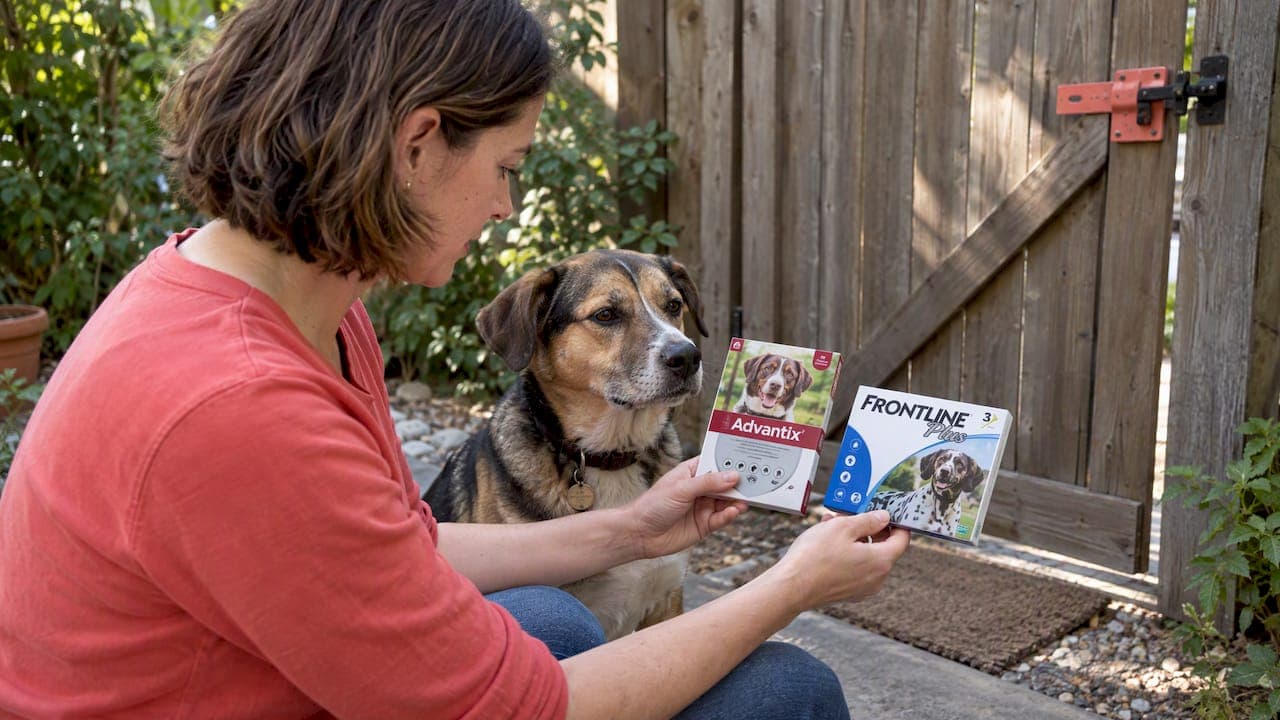
K9 Advantix repels biting insects and can reduce tick attachment before it happens, while Frontline Plus kills fleas and ticks after they make contact. The right pick depends on your exposure risk and, critically, whether a cat lives in your home: permethrin in Advantix is dangerous to cats, so households with both species usually need a different plan.
TL;DR:
- Advantix provides strong repellency against ticks, with efficacy rates of 84% to 98.5%, especially effective before attachment occurs.
- Both products require correct application to skin, and improper use—such as applying to fur or incorrect dosing—can significantly impair effectiveness.
- Advantix's permethrin is toxic to cats, making it unsuitable for households with feline companions unless strict separation is maintained.
- Both products work through different mechanisms: Advantix repels and kills on contact, while Frontline Plus kills after attachment, with repellency offering a preventive advantage.
- Long-term flea control depends on consistent treatment and environmental management, involving vacuuming and cleaning bedding, rather than relying solely on either topical product.
Table of Contents
- Advantix vs Frontline at a glance
- How each product works at the chemical level
- What the research actually shows about effectiveness
- Safety rules and household considerations
- Choosing the right product for your household
- Applying either product correctly for full protection
- Cost comparison and value for money
- User experience and ease of application
- Potential side effects beyond the label
- Manufacturer reputation and customer support
- Kiblco's take on real-world application mistakes
- Compare vetted picks before you buy
- FAQ
- Sources
Advantix vs Frontline at a glance
Both products treat dogs monthly, but they work through different mechanisms and carry different household restrictions. Here is how the two compare across the factors that actually drive the decision:
- Active ingredients: Advantix combines imidacloprid, permethrin, and pyriproxyfen; Frontline Plus pairs fipronil with (S)-methoprene, according to EPA's K9 Advantix Plus label and EPA's Frontline Plus label.
- Mechanism: Advantix repels and kills on contact; Frontline Plus kills after the parasite attaches or bites.
- Cat safety: Advantix's permethrin is toxic to cats; Frontline Plus has separate cat-labeled formulations but the dog version should never go on a cat.
- Waterproofing: Both labels describe water resistance after the product dries, though bathing soon after application can reduce effectiveness.
- Label minimums: Both require dogs to meet a minimum age and weight before use, per their respective labels.
- Common adverse effects: Application-site irritation is the most reported issue for both; ingestion or cat exposure raises the risk of neurologic signs.
If your dog spends time in wooded or high-mosquito areas and no cat shares the home, Advantix's repellency adds a layer of protection. If you have a multi-species household or want a product with a long safety record around cats elsewhere in the house, Frontline Plus fits more homes without extra precautions.
How each product works at the chemical level
Advantix's permethrin acts as a repellent and contact insecticide, meaning ticks, fleas, and biting flies are often deterred or killed before they bite. Imidacloprid, a neonicotinoid, adds a fast-acting adulticide effect against fleas. Pyriproxyfen, an insect growth regulator, interrupts flea development so eggs and larvae in the environment do not mature, according to the K9 Advantix Plus label.
Frontline Plus relies on fipronil, which disrupts the nervous system of fleas and ticks on contact, and (S)-methoprene, another growth regulator that targets immature flea stages, per Frontline Plus's EPA label. Fipronil generally needs the parasite to make contact with treated skin or fur rather than repelling it outright.
The practical difference: repellency can reduce the odds of a tick ever attaching, which matters for pathogen transmission timing. Kill-after-contact still stops infestations and breaks the flea life cycle, just at a later point in the exposure.
What the research actually shows about effectiveness
A controlled 2003 study tested both products against Rhipicephalus sanguineus, the brown dog tick, in a lab setting. Advantix showed 84.0% to 98.5% repellency efficacy across days 3 through 35, while Frontline Plus ranged from negative 28.1% to 56.8% in the same test, meaning more ticks attached in some Frontline-treated dogs than in untreated controls at certain points.
The 2003 study used 50 adult brown dog ticks per dog across three groups of six dogs, tracked through day 35, showing a clear repellency gap for this species under lab conditions, per the Parasitology Research study. That result applies specifically to Rhipicephalus sanguineus in a controlled challenge, not to every tick species or to field conditions where weather, grooming, and coat type vary.

EPA labels for both products claim fast action against fleas and ticks, with month-long protection windows when applied correctly. But the Merck Veterinary Manual notes that eliminating an established flea infestation commonly takes up to two to three months, because eggs, larvae, and pupae already in the home environment continue to emerge regardless of how fast the adulticide works. Consistent treatment of every pet in the household, paired with vacuuming and laundering pet bedding, does more for long-term control than any single product's lab efficacy numbers.
Safety rules and household considerations
Permethrin is the single biggest safety issue in this comparison. Cats lack the liver enzyme needed to metabolize it efficiently, so even small amounts from grooming a treated dog can cause tremors, seizures, or death, according to Merck's toxicology guidance. If a cat lives in your home or visits regularly, Advantix is not a safe choice unless you can guarantee complete separation until the product fully dries.

Fipronil carries a wider safety margin with low dermal absorption when used as directed, though ingestion or excessive licking can still trigger neurologic signs.
Before applying either product, check these label points:
- Confirm your dog's current weight matches the correct tube size, since both labels group dogs by weight range.
- Verify your dog meets the minimum age listed on the label, typically around seven weeks for Advantix products.
- Ask a veterinarian before treating pregnant, lactating, or medically compromised dogs, or dogs already on other medications.
Watch for drooling, vomiting, tremors, or unusual lethargy after application, and contact a veterinarian immediately if you see them, especially in a cat accidentally exposed to permethrin.
Pro Tip: Keep treated dogs separated from cats and other pets for at least 24 hours after application, not just until the product looks dry.
Choosing the right product for your household
Work through this checklist before you buy either product:
- Identify your dog's main exposure risk: heavy tick or mosquito activity favors a repellent like Advantix, while routine flea prevention works fine with either product.
- Check whether a cat lives in or regularly visits your home; if so, rule out permethrin-based products entirely.
- Confirm your dog's age, weight, and health status against the label minimums and any vet-flagged conditions.
- Consider bathing and swimming habits, since frequent water exposure can shorten protection windows on both products.
- Factor in local tick-borne disease prevalence, since repellency offers an edge where early attachment prevention matters most.
A dog that hikes through tall grass with no cat in the house is a straightforward case for Advantix. A multi-pet household with a resident cat should default to Frontline Plus or a cat-safe alternative, with a veterinarian weighing in on the final choice. Always loop in a vet for puppies under the label's minimum age, pregnant or nursing dogs, or any dog with a prior reaction to flea and tick products.
Applying either product correctly for full protection
Part the fur at the base of the neck or between the shoulder blades and apply the full tube directly to skin, not fur, matched to your dog's current weight. Keep dogs and other pets from licking the application site until it dries, which typically takes several hours.
A few application habits make the biggest difference in outcomes:
- Apply on a dry day and avoid bathing for 48 hours before or after treatment when possible.
- Retreat on the schedule your label specifies, since both products are built for monthly use and applying early (outside of heavy-infestation label allowances) wastes product without adding protection.
- Treat every pet in the household on the same schedule to prevent fleas from cycling between untreated animals.
Even with perfect application, expect full control of an established infestation to take up to two to three months, since environmental flea stages keep emerging after the adult population is gone, per Merck's flea guidance.
Cost comparison and value for money
Both products are sold in multi-month packs, and per-dose pricing varies by retailer, dog weight tier, and whether you buy a three-month or six-month supply. Larger packs generally lower the per-tube cost for both brands, and weight-based tiers mean a large-breed dose costs more than a small-breed dose for either product.
Value depends less on sticker price and more on what you are solving for. If repellency reduces the odds of a tick ever attaching, that upstream protection can be worth paying for in high-exposure areas, even if the per-tube price is similar to Frontline Plus. If your priority is routine flea control in a cat-containing household, Frontline Plus delivers that without the added cost of managing cat separation or risking an accidental exposure incident, which can mean an emergency veterinary bill far larger than the price difference between products.
Buying in bulk from a consistent source and sticking to the labeled monthly schedule does more for cost efficiency than chasing the cheapest single tube, since inconsistent treatment extends how long an infestation takes to clear and can mean buying extra product to catch up.
User experience and ease of application
Owners generally describe both products as straightforward: part the fur, apply to skin, done in under a minute for most dogs. The biggest friction points are not the application itself but getting the timing and dosing right.
Dogs with thick or long coats can make it harder to part fur down to skin, which sometimes leads to product landing on hair rather than skin, a mistake that reduces absorption and effectiveness. Dogs that dislike the application process may need a treat distraction or two people, one to hold and one to apply.
Multi-pet households report more friction with Advantix specifically, since separating a treated dog from a cat for a full day adds a logistical step that Frontline Plus users do not usually need to manage.
Potential side effects beyond the label
Beyond the application-site irritation both labels disclose, owners occasionally report excessive licking at the treatment site, temporary hair thinning where the product was applied, or mild lethargy in the first day. These are not universal reactions, and most dogs tolerate either product without issue.
More serious reactions, including tremors, drooling, or vomiting, are more often tied to misapplication than to the product itself. A common pattern: owners use a tube sized for a different weight dog, apply it to fur instead of skin, or allow a treated dog to groom a housemate too soon. These errors, flagged in veterinary toxicology literature, explain many of the anecdotal "it didn't work" or "it made my pet sick" reports that circulate in pet owner forums, according to Merck's fipronil toxicology page. Reducing exposure to tick habitat around the home, through routine yard maintenance and limiting time in tall grass, also lowers how often either product gets tested against a real parasite challenge, a point covered in this overview of dog environmental behavior.
Any neurologic sign, severe irritation, or persistent vomiting warrants an immediate call to a veterinarian rather than waiting it out.
Manufacturer reputation and customer support
Both Advantix and Frontline Plus come from established veterinary pharmaceutical manufacturers with long track records in the flea and tick category, and both maintain publicly available EPA-registered labels that spell out exact ingredients, claims, and safety directions. That transparency matters more than brand loyalty: the label is the binding document for what a product can legally claim and how it should be used.
Retailer-side support, meaning return policies, authenticity guarantees, and customer service, tends to vary more by where you buy than by which brand you choose. Buying from established retailers reduces the risk of counterfeit product, a known issue in the topical flea and tick category broadly.
Kiblco's take on real-world application mistakes
Hands-on testing in real homes surfaces the same errors repeatedly: wrong tube size for the dog's current weight, product applied to fur instead of skin, and treated dogs allowed to interact with other pets before the product dries. These mistakes can undercut both products' real-world performance more than any ingredient difference between them. That is why we list clear pros and cons rather than a single winner, matching product features to exposure risk and household safety instead of a blanket recommendation.
Compare vetted picks before you buy
Commissions are earned when purchases are made through the links provided, with disclosures included on every review that involves product testing in real homes rather than solely relying on manufacturer claims. If you want to keep comparing flea and tick options, our Dog Health category rounds up vetted picks by exposure type and household makeup.

Before you buy either product, double-check the label matches your dog's exact species, age, and weight, since a mismatched tube is one of the most common causes of poor results.
FAQ
What has replaced Frontline Gold for dogs?
Frontline Plus remains Frontline's primary fipronil-based dog product, and label details for current formulations are available through EPA's Frontline Plus label. Always check the specific product label at purchase, since formulations and names can change by region and retailer.
What's the difference between Frontline and Frontline Plus?
Frontline Plus adds (S)-methoprene, an insect growth regulator, to fipronil, targeting immature flea stages in addition to adult fleas and ticks. This combination is what gives Frontline Plus its environmental flea-control claims beyond a standalone fipronil product.
What are the differences between Bravecto and Frontline Plus for cats?
Frontline Plus has separate cat-specific formulations that use fipronil without permethrin, since permethrin is toxic to cats. Bravecto uses a different active ingredient class and dosing schedule; a veterinarian can advise which fits a specific cat's health profile and exposure risk.
Is Advocate the best flea treatment?
There is no single flea treatment that qualifies as best for every dog, since the right choice depends on exposure type, household species mix, and your dog's age and health. Repellent products like Advantix suit high-tick-exposure homes without cats, while fipronil-based products like Frontline Plus fit more multi-pet households.
Sources
- Evaluation of K9 Advantix (TM) vs. Frontline Plus (R) topical treatments to repel brown dog ticks (Rhipicephalus sanguineus) on dogs
- US EPA, Pesticide Product Label, K9 ADVANTIX PLUS 20, 07/22/2011
- Fleas in dogs and cats - Merck Veterinary Manual