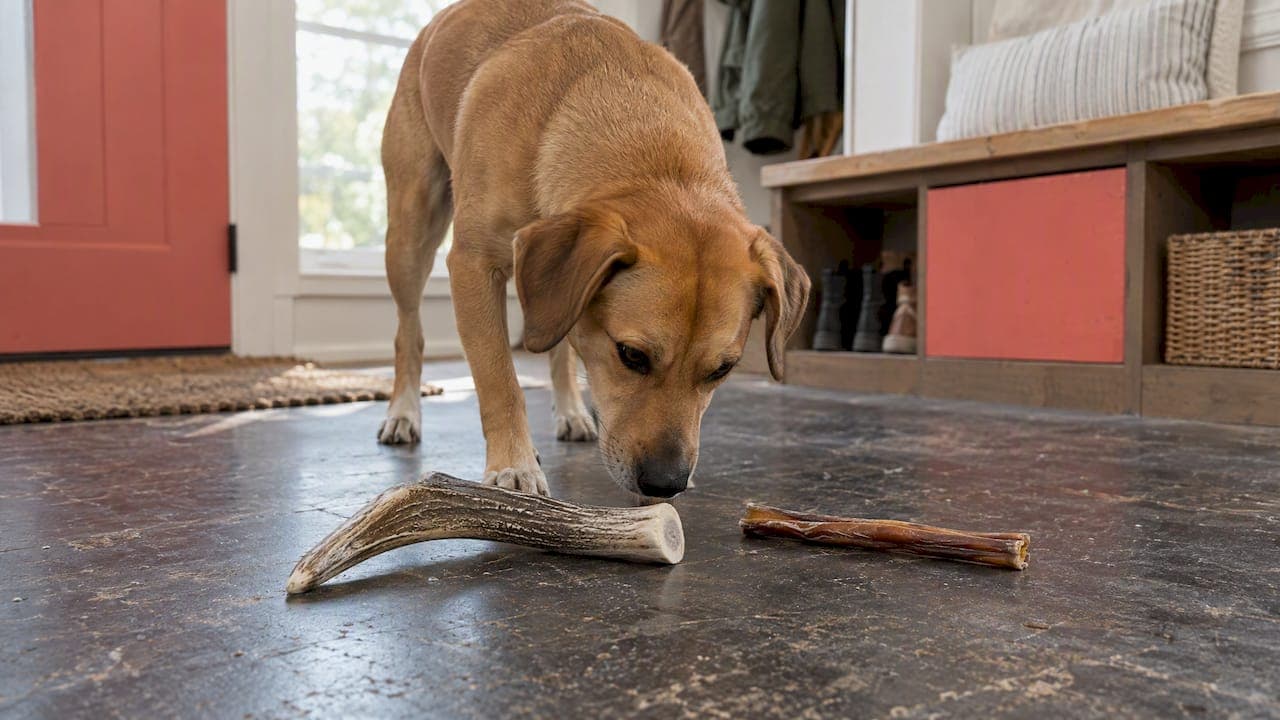
For most dogs, bully sticks are the safer choice. Antlers last far longer, but they are hard enough to crack teeth, and veterinary sources keep flagging that risk. Bully sticks are softer and digestible, but they are not risk-free either: they are calorie-dense, they can carry bacteria, and a dog that gulps the last inch can choke. Below we compare the two on what matters, then show you how to match a chew to your dog.
TL;DR
- Bully sticks are the lower-risk option for teeth and digestion. Antlers are the bigger fracture risk, and most veterinarians advise skipping them.
- Antlers last much longer than bully sticks, but durability is the very thing that makes them hard on teeth.
- Count bully-stick calories inside your dog's 10% daily treat allowance, and buy plain, unflavored sticks from a brand that tests for pathogens.
- Gulpers, aggressive chewers and puppies need extra caution with both chews. Supervise every session and take the chew away once it is small enough to swallow.
- If your dog needs something that lasts, a softer chew that flexes under pressure is a better bet than a hard one.
Table of Contents
- What you are actually comparing
- Safety for teeth: the biggest gap
- Digestion and splintering
- Hygiene, calories and what bully sticks add
- How long each chew lasts
- Side-by-side comparison
- Which dogs suit which chew
- How to give either chew more safely
- Perspective: what we have seen testing chews
- Better options if neither chew fits
- Find vet-informed chews and dental picks
- FAQ
- Sources
What you are actually comparing
The two chews are very different things, and that explains most of the trade-offs.
Antlers are shed by deer, elk or moose and sold whole, split or cut into sections. They are bone-like, dense and hard, with very little oil or aroma. Nothing is rendered or cooked in the usual sense, which is why many owners see them as natural and low-processing.
Bully sticks are made from bull pizzle (the muscle), dried and often baked or smoked. They are a single-ingredient, animal-derived chew. They are softer, meat-scented and much more appealing to most dogs, and they break down as the dog gnaws.
So you are weighing a very hard, long-lasting object against a softer, edible, short-lived one. That one difference drives almost every point below.

Safety for teeth: the biggest gap
This is where antlers lose. A University of Wisconsin veterinary dentist notes that hard objects, antlers included, commonly cause painful dental fractures, and that things that bend or flex are less likely to break a tooth. The same page says most veterinarians advise staying away from antlers, and presents bully sticks as a safer choice than antlers for tooth safety.
The physics are simple. Veterinary practice reporting notes that dogs often have bite forces sometimes exceeding 3,000 Newtons, which raises fracture risk when they chew hard materials such as antlers. The large upper back tooth (the carnassial) is the one that tends to break, and a slab fracture there can mean a root canal or an extraction.
The American Kennel Club likewise says most veterinarians advise staying away from antlers, and suggests supervising any chew and asking your veterinarian or checking the Veterinary Oral Health Council (VOHC) list for recommendations. We cover that list and why it matters in our guide on why vets prefer VOHC-accepted chews over natural bones.
A practical test many dentists use: if you would not want to be hit on the kneecap with it, it is too hard for your dog's teeth. Antlers fail that test. A bully stick passes.
Owners often say antlers are fine for "gnawers" and risky for "chompers." That is a fair observation about behavior, but it does not remove the hardness problem. A dog that gnaws gently today can bite down hard when a chew slips or a puppy gets excited. If you do choose an antler, pick a thick piece, never a thin or sharp-edged one, and retire it as soon as you see a chipped edge or a sharp point.
Digestion and splintering
Both chews can cause trouble if swallowed in pieces, but the risks differ.
Antlers. Splintered or broken fragments can lodge in the mouth, throat or intestines and cause blockages, according to the University of Wisconsin. Because antler is bone-like, it does not soften the way a meaty chew does. Split antlers expose the porous marrow center, which some dogs love and which breaks off more easily.

Bully sticks. A bully stick is digestible, which is why it tends to be recommended over rawhide. The danger is usually the last chunk. Choking is a significant risk for both chew types, especially in dogs that gulp, with airway obstructions or gastrointestinal blockages as possible results, as Today's Veterinary Practice notes. A holder that grips the end of the stick keeps your dog from swallowing the final piece whole.
The takeaway: digestible does not mean you can stop watching. A bully stick swallowed whole can still obstruct, and a dog that gulps is a poor match for either chew.
Hygiene, calories and what bully sticks add
Bully sticks have their own downsides, and an honest comparison has to include them.
Bacteria. Bully sticks are minimally processed animal-derived chews and may carry bacterial pathogens. A 2018 recall covered several bully-stick products because of potential Salmonella contamination. Wash your hands after handling them, keep them away from small children, and do not leave a half-chewed stick on the couch.
Flavored sticks. AAHA advises avoiding bully sticks that are coated or treated with flavoring, which are sometimes contaminated with bacteria and can cause digestive upset. Plain, single-ingredient sticks are the better pick.
Calories. Chews are treats, and bully-stick calories should be counted inside the 10% daily treat limit. For a small or overweight dog, a daily bully stick can eat up most of that allowance. Ask your veterinarian what your dog's daily treat budget looks like, and trim meals on chew days if needed. Antlers are comparatively lean because they are mostly mineral and protein and are not oily, though a dog does not gnaw off much of one, so you are weighing a lot less food value for a lot more tooth risk.
If your dog already has a sensitive stomach, pancreatitis history or a weight problem, skip rich chews and talk to your vet first. It is also worth knowing the wider list of foods that are dangerous for dogs when you are building a treat routine.
How long each chew lasts
This is the one area where antlers clearly win. A whole antler can last weeks for a moderate chewer, and a power chewer can still make it last longer than any bully stick. A standard bully stick often disappears in a single session of 10 to 30 minutes, and a determined chewer can finish a thin one faster. Thicker, braided or "jumbo" sticks last longer, and they cost more.
But longevity is not the same as value. A chew that lasts a month because it is rock hard is not a bargain if one bad chomp ends in a dental bill. If you want a chew that does last, a middle path is a softer long-lasting chew. Our vet-informed guide to yak chews explains how hard cheese-style chews behave, and what to check before buying them.
Side-by-side comparison
| Factor | Antlers | Bully sticks |
|---|---|---|
| Hardness | Very hard, bone-like | Softer, gives under pressure |
| Tooth fracture risk | Higher; vets commonly warn against them | Lower, though no chew is zero risk |
| Digestibility | Fragments can block the gut | Digestible, but large swallowed pieces can still block |
| Lifespan | Weeks for many dogs | Minutes to under an hour |
| Calories | Low per gram, little eaten | Count toward the 10% treat limit |
| Bacteria concerns | Low | Possible; avoid flavored or coated sticks |
| Smell | Barely any | Strong, meaty |
| Best for | Few dogs; only with vet approval | Moderate chewers, supervised |
| Puppies | Avoid; teeth are more fragile | Only sized and supervised, with vet guidance |
Which dogs suit which chew
AAHA says to choose chews by your dog's chewing style (passive, moderate or aggressive) and size. Aggressive gulpers are ill-suited to hard or potentially splintering items and need safer, supervised alternatives. Here is how that plays out.
Gentle and moderate chewers
A moderate chewer who gnaws slowly is the best candidate for a bully stick. Pick a stick that is longer than your dog's muzzle and thick enough that it cannot be swallowed whole. Use a holder for the last few inches.
Power chewers and gulpers
These dogs are the hardest to buy for. Antlers are tempting because they last, but a powerful bite is exactly what cracks a tooth. Bully sticks disappear quickly, which is why they also carry the choking risk of that final piece. We put together a roundup of bully sticks for power chewers that looks at thickness and durability, and a separate list of chew-proof toys for aggressive chewers for when a toy is the smarter option.
Puppies and seniors
Puppies have teeth that are more prone to fracture, and are less likely to stop chewing when something is too hard. Antlers are a poor choice. Seniors with worn, brittle or missing teeth are in a similar position. For both, ask your veterinarian which chews fit your dog's mouth, and do not hand over anything you cannot dent with a thumbnail.
Dogs with health conditions
Dogs with pancreatitis, obesity, allergies to beef or a history of stomach upset should not get a daily rich chew. The same goes for dogs with existing dental disease or broken teeth. Get a dental check first.
How to give either chew more safely
- Check with your vet first. Your veterinarian knows your dog's teeth, weight and history.
- Match size to the dog. The chew should be too large to swallow whole and too big to fit all the way into the mouth.
- Supervise every session. Stay in the room. Do not leave a chew with a dog that is crated, or with several dogs at once.
- Take it away early. Swap a bully stick for a new one, or remove it with a treat trade, when it gets short. Retire an antler the moment it chips, cracks or shows a sharp edge.
- Buy plain. Choose single-ingredient bully sticks without flavoring or coating, from a brand that shares its testing and sourcing.
- Wash up. Wash your hands and the surface the chew touched.
- Count the calories. Keep all chews inside the 10% daily treat limit.
- Look in the mouth. Once a week, check for chips, red gums or a dog that stops chewing on one side.
If your dog suddenly drools, paws at the mouth, refuses food, vomits, strains to poop or seems painful after a chew, call your veterinarian that day. A cracked tooth or a partial blockage can look like a mild stomach bug.
Perspective: what we have seen testing chews
We buy and test chews in real homes, and the pattern is consistent. The antler is the one that makes owners happiest at first, because it lasts, it does not smell and it stays tidy on the rug. It is also the one our veterinary advisers push back on the hardest, and their reasoning keeps matching what the dental sources say. A chew that lasts three weeks is great marketing and bad dentistry.
Bully sticks are not perfect, and we do not pretend otherwise. They are pricey for how fast they vanish, they smell, and the calories add up for small dogs. But when we ask which of the two a vet would rather see in a dog's mouth, the answer is the one that gives a little. For dogs that need more variety, we rotate in dental chews and textured toys rather than chasing durability.
So our default advice is plain: skip antlers unless your own vet has examined your dog's teeth and approves, use plain bully sticks sparingly for dogs that suit them, and look at VOHC-accepted products when your goal is cleaner teeth. Our readers get the full pros and cons for every product we cover, including the downsides, and we disclose our affiliate relationships.
— Chris
Better options if neither chew fits
If you read the above and decided neither is right for your dog, you have options:
- VOHC-accepted dental chews. These have been reviewed for plaque or tartar control. See our picks for dental chews that tackle plaque and tartar.
- Toothbrush toys. Textured rubber toys that you can bend, which scrub while your dog chews. We tested a set in our dog toothbrush toys roundup.
- Collagen sticks. A digestible, softer alternative, covered in our collagen sticks guide.
- Yak chews. Hard when new but they soften as a dog works on them, which is a different risk profile from an antler.
The common thread is a chew that flexes, softens or breaks down, rather than one that resists.
Find vet-informed chews and dental picks
If you are ready to shop, we have done the testing. Our reviews cover what held up in real homes, what did not, and what our veterinary advisers flagged.

Browse our Dog Health and Dog Treats reviews for chews, dental products and supplements, each with pros, cons and durability notes. If you are still shopping for gear around the chew, such as holders, toys and feeders, our Dog Gear section has hands-on reviews too.
FAQ
Are deer antlers good for dogs?
They are long-lasting and low in odor, but most veterinarians advise against them because they are hard enough to fracture teeth, and splinters can cause blockages. If you are considering one anyway, ask your veterinarian to look at your dog's teeth first.
Are bully sticks recommended by vets?
Many vets consider them a better choice than antlers or rawhide, with caveats. Choose plain sticks, supervise your dog, count the calories inside the 10% treat limit, and handle them with clean hands because they can carry bacteria.
Which lasts longer, an antler or a bully stick?
An antler lasts far longer, often weeks, while a bully stick may be gone in minutes to under an hour. Lasting longer is not a benefit if the hardness damages teeth.
Are antlers or bully sticks better for puppies?
Neither is a simple yes. Antlers are the riskier option because puppy teeth fracture more easily. A correctly sized bully stick under supervision is lower risk, but ask your veterinarian what suits your puppy's age and breed.
Sources
- Protect Your Pet's Teeth: Top Tips from a Veterinary Dentist, UW School of Veterinary Medicine
- Advise clients 'durable' treats are not worth the risk, Veterinary Practice News
- Antlers for Dogs: Are These Treats Safe for Dogs to Chew?, American Kennel Club
- The Benefits and Risks of Chew Treats, Today's Veterinary Practice
- Bully stick recall notice, Ohio Veterinary Medical Association
- Don't Chew On This!, AAHA
- Dangerous foods for dogs guide