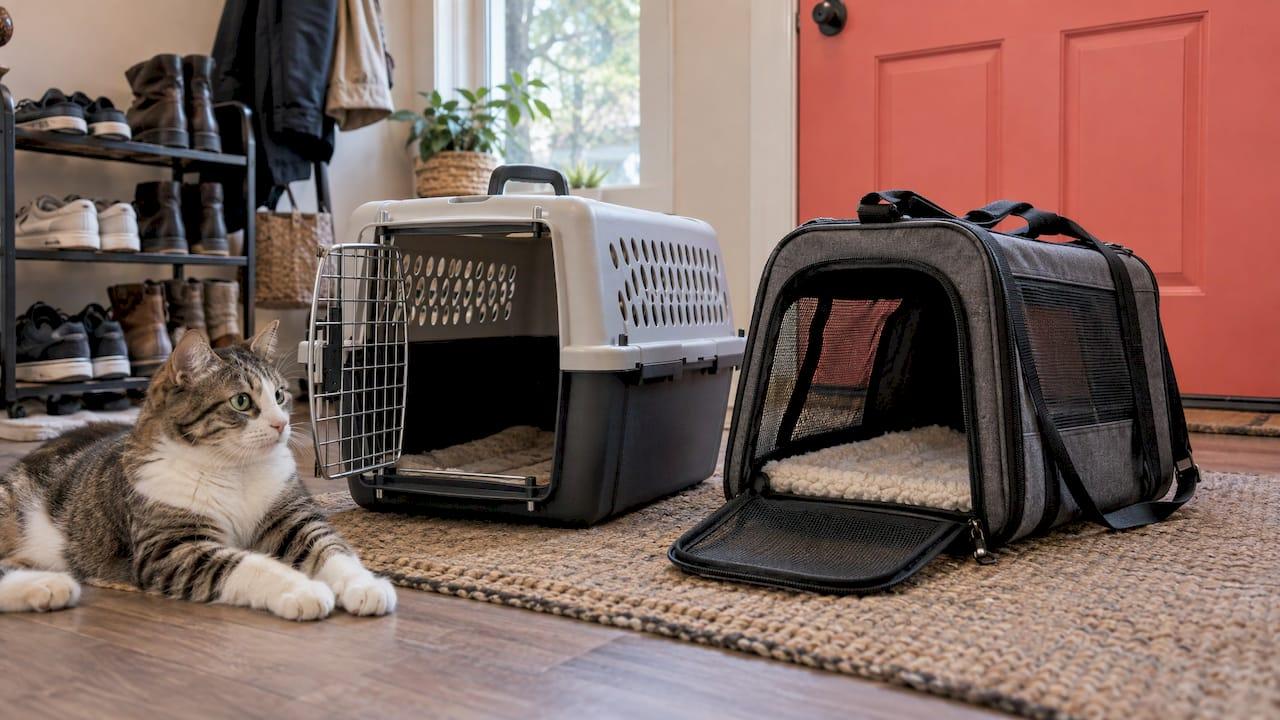
For most cats, the best everyday carrier is a sturdy hard-sided model with a removable top and a front door, because it protects better in the car, cleans up easily and lets a vet examine your cat without pulling her out. A soft-sided carrier is the better pick for a calm, small pet on short trips and for under-seat airline travel, where the lighter weight and flexible shape help. The right answer depends on your pet's temperament, your size limits and how you travel, and the sections below show how to decide.
If you shop for gear often, our Cat Gear and Dog Gear pages collect the carriers and travel products we review, each with its pros and cons spelled out.
TL;DR
- Hard-sided carriers give more impact protection, are easy to disinfect and are harder for a determined cat to escape, but they are bulky and awkward to store.
- Soft-sided carriers are lighter, easier to stash and usually the practical choice for under-seat airline travel, but they offer less crash protection and can be chewed or clawed.
- For cats, choose a carrier with a removable top and several openings. Many vets prefer to examine the cat in the bottom half.
- For dogs, size matters more than style: your dog must be able to stand, turn around and lie down comfortably.
- No law sets a crash standard for pet carriers, so for car travel look for independent testing, not just a "crash-tested" label.
Table of Contents
- The main differences at a glance
- Which one do cats prefer?
- When a hard carrier is the better call
- When a soft carrier is the better call
- Dogs: size first, style second
- Airline cabin rules, in brief
- Car safety: the part most buyers overlook
- How to decide: a short checklist
- Our perspective
- Find a carrier we've reviewed
- FAQ
- Sources
The main differences at a glance
Pet carriers fall into two camps, and the trade-offs are consistent across cats and small dogs. A veterinary-health company's carrier guide lists the following.
| Feature | Hard-sided | Soft-sided |
|---|---|---|
| Impact protection | Stronger | Weaker |
| Weight | Heavier | Lighter |
| Storage | Bulky, hard to store | Folds or compresses |
| Cleaning | Easy to wipe and disinfect | Can be harder to clean |
| Escape resistance | Harder to break out of | Depends on closures, can be clawed or chewed |
| Comfort | Needs bedding added | Often comfortable as is |
| Airline cabin fit | Often too rigid for tight spaces | Fits under many seats |
That table is the shortcut. The rest of this guide explains which of those rows should drive your decision.
Which one do cats prefer?
There is no universal winner, because cats differ. The AAFP and ISFM feline-friendly handling guidelines note that some cats like to see out, while others are less anxious when covered. A carrier works as a hiding place, a secure closed container, which is much of why it calms a cat when set up properly.
The same guidelines say a good carrier is sturdy, secure, stable, easy to carry and quiet, so that opening the door does not startle the cat. They also point out that a removable top is especially useful for fearful, fear-aggressive, sick or less mobile cats.
A few practical readings of that:
- A cat who hides and freezes usually does better in an enclosed carrier she can be covered in. A hard carrier with a towel draped over it works well.
- A curious, social cat may enjoy a soft mesh carrier. VCA Animal Hospitals says soft mesh carriers are lighter and give those cats a better view.
- A cat who gets carsick is easier to deal with in a hard carrier, which VCA notes is simpler to clean.
If your cat is already stressed by carriers, our guide to the best cat carriers for anxious cats walks through options built around calm, secure loading.
Why the cat's own history matters
A carrier that your cat associates with being forced inside, a painful vet visit or another cat's scent can be a lost cause. VCA suggests buying a new carrier, or even a different style, such as moving from hard plastic to soft mesh, to restart positive training. So the "right" type can simply be the one your cat has no bad memories of.
The FelineVMA's 2025 position statement makes a larger point: the vet visit starts at home. It recommends educating cat caregivers on carrier size and material, getting the cat used to the carrier ahead of time and giving her a place to hide, for example by covering the carrier with a towel or blanket. It also notes that poor transport experiences are a major reason caregivers put off veterinary care. A calm carrier routine protects your cat's health as much as the trip itself.
If you want to know what a low-stress vet visit looks like on the clinic side, this overview of Fear Free vet visit expectations shows how a practice can handle nervous patients gently.
When a hard carrier is the better call
Choose hard-sided in these situations.
1. Car travel and general protection. Hard shells hold their shape and resist impact better. That is also why they suit crowded storage spaces, such as a trunk or a pile of luggage, without getting crushed. The AKC's dog carrier guide says hard-sided dog carriers are preferred for their durable construction, since their sides will not be crushed by suitcases, boxes or tight spaces.
2. Vet visits for cats. Plastic carriers with a removable top let a vet unclip the top and examine your cat in the bottom half, according to VCA. The AAFP/ISFM guidelines likewise say a carrier should allow easy removal of a cat who will not come out on her own, or an exam in the bottom half. A cat who is already scared often feels safer if she never has to be pulled out.
3. Escape artists and messy travelers. A solid shell is harder to claw or chew through. Cleanup after an accident or motion sickness is easier because the surface can be wiped and disinfected.
4. Cargo or long-haul transport. If an airline requires your pet to travel in the hold, a rigid container is the norm. DVM360's guide to pet cargo travel notes that each animal needs room to stand, sit erect, lie in a natural position and turn around, and that a crate sold as "airline-approved" may need modification to meet current IATA Live Animal Regulations. Check the airline's own rules before you buy.
Checking a hard carrier's build
Not all hard carriers are equal. Zoetis advises that for hard-sided models, sides secured with screws are the most durable and secure, while plastic pegs can break and are hard to replace. Look for a door that latches firmly, plenty of ventilation and a surface with no cracks.
When a soft carrier is the better call
Soft-sided makes sense in these situations.
1. Flying in the cabin. For in-cabin travel, the IATA container rules do not require rigid construction, and the welded-wire-mesh requirement does not apply to soft-side bags. That is stated in the IATA container requirements (Edition 52, January 2026). A soft carrier can squeeze under a seat in a way a rigid one often cannot, but airlines set their own size limits, so measure against your airline's published dimensions.
2. Small pets on short trips. The AKC notes that soft carriers are popular for small dogs, with mesh side panels that unzip for extra ventilation and flaps that fold out for more stretching space.
3. Carrying comfort and storage. A soft carrier is lighter and easier to stow in a closet, which matters if you only use it a few times a year. If you hike with your dog, our roundup of dog backpacks and carriers for hiking covers designs built for being on your back instead of in your hand.
4. Cozy dwelling time. Soft carriers often have padding built in. If you want one that doubles as a spot where your cat lounges at home, see our review of enclosed cat beds.
Checking a soft carrier's closures
The weak point of soft carriers is the zipper. The AKC advises assessing the integrity of zippers, latches, Velcro and interlocking clips and asking whether your dog could break through them. For cats, Zoetis says avoid Velcro and snaps, which are not secure enough to prevent escape, and choose zippers with locks or latches instead. The AKC also notes mesh panels provide airflow and help prevent heat exhaustion.
A soft carrier you can trust has stitched seams that are not fraying, a lockable zipper, firm mesh and a stiff base so it does not sag under your pet's weight.
Dogs: size first, style second
Style matters less for dogs than fit. The AKC says your dog should be able to stand up, turn around and stretch when lying down. To measure, take the length of your dog's back from the neck to the base of the tail, and the height from shoulder to the ground, then add a few inches. In the AKC's example, a Dachshund standing 9 inches tall needs a carrier at least 12 inches tall.
Here is how that plays out in practice:
- Toy and small breeds can use either type. Soft is lighter for errands, hard is steadier in a vehicle.
- Medium dogs usually need a hard crate-style carrier because few soft carriers hold their shape at that weight.
- Long road trips call for something sturdier. The AKC suggests a heavy-duty, crate-like carrier with room for toys and blankets, a "home away from home."
A dog who is nervous about enclosed spaces may need practice before any trip. This explainer on adult dog crate training stages lays out a gentle progression, which is useful for carrier acclimation too. For long drives, our guide to cozy dog car beds covers comfort for the ride itself.
Airline cabin rules, in brief
In-cabin limits vary by airline. IATA's regulations require a total ventilated area of at least 16% of the four sides, with openings that are nose-proof and paw-proof, a maximum of 25 mm by 25 mm for dogs and 19 mm by 19 mm for cats, per the IATA container requirements. A typical in-cabin soft carrier tops out around 18 to 19 inches long, 11 inches wide and 11 inches tall, depending on the airline, so confirm yours before you buy. Always read the carrier's listed dimensions against the airline's page for your specific route and date.

Car safety: the part most buyers overlook
There is no legal crash-performance standard for pet carriers in the United States. Independent testing exists, though. The Center for Pet Safety's 2015 carrier study evaluated carriers that claimed crash protection and carriers that made no such claim, warning that weak structure or connection strength can injure pets and people in a crash. In its summary report, CPS said there were no performance standards for carriers at the time and borrowed the 30 mph crash condition from the federal child safety seat standard. Success meant the carrier fully contained the test dog and stayed connected to the test bench.
The lesson is not that hard always beats soft. In those tests, a plastic carrier fractured even though its restraint held, and another carrier's connections failed and released it from the test bench. A restraint cannot make up for a carrier that is not built to survive a crash.
What to do with that:
- Treat "crash-tested" as a claim to verify, not a guarantee. Look for testing by an independent body to a published standard.
- Secure the carrier on the vehicle floor behind the driver or passenger seat for cats, per the FelineVMA statement.
- Use a seat belt only with a crash-test-certified carrier. The FelineVMA warns a belt on an uncertified carrier may crush it.
- Never leave a pet in a parked car. The AVMA-reported figure cited by a pet-safety company is that a vehicle interior can reach 114°F within 30 minutes on an 80°F day.
How to decide: a short checklist
Run through these questions in order.
- Will your pet ever fly in the hold? Then you need a rigid container that meets the airline's rules.
- Is your pet a cat who needs vet exams? Pick a hard or hybrid carrier with a removable top and a front opening.
- Is your pet a small, calm animal making short trips or flying in the cabin? A soft carrier with a lockable zipper and a firm base is a good fit.
- Does your pet fear the current carrier? Switch styles and start fresh, as VCA suggests.
- Will it ride in a car often? Prioritize independent crash-test data over material alone.
- Is it the right size? Measure, add a few inches, and confirm your pet can stand, turn and lie down.
Two more habits matter whichever you pick. Leave the carrier out at home so it becomes a normal, safe space, and add a familiar blanket. The AAFP/ISFM guidelines also suggest a synthetic feline facial pheromone spray at least 30 minutes before transport to help calm a cat.
Our perspective
Choosing a carrier looks like a style question, but it is really a question about your pet's nerves and your routine. The cats we hear about most from readers are the ones who vanish under the couch when the carrier appears. For those households, a sturdy, enclosed carrier that lives out in the living room and opens from the top is usually the first fix.
That is why our reviews pay attention to the details that decide whether a carrier gets used: closures, ventilation, how easily it opens, how it cleans, and how it holds up over time. Every product we cover is purchased and tested in real homes, health picks are cross-checked with veterinary experts, and every review states its downsides plainly. We accept no payment for coverage, and we disclose our affiliate relationships.
Our advice: pick the carrier your pet will walk into, then check that it fits, latches and ventilates properly. Style comes after that.
Chris
Find a carrier we've reviewed
If you're ready to shop, start with our Cat Gear and Dog Gear collections. Each review lists pros, cons, durability and usability from home testing, with veterinary input where health is involved.

New to cats? Our new cat owner checklist puts the carrier alongside the other essentials to sort before gotcha day. You can also browse everything at Kiblco.
FAQ
Are soft carriers safe for cats?
Yes, for many cats, as long as the closures are secure. Zoetis recommends zippers with locks or latches and advises against Velcro and snaps for cats. Soft carriers offer less impact protection than hard ones, so for car rides pay attention to independent crash-test data and secure the carrier on the floor behind a seat.
Hard or soft carrier for a dog?
Fit comes first: your dog needs to stand, turn around and lie down. Small dogs do well in either style, with soft often easier for errands and hard steadier in vehicles. Larger dogs and long road trips generally call for a heavy-duty, crate-style hard carrier.
What size cat or dog carrier should I buy?
Measure your pet from neck to base of tail and from shoulder to the ground, then add a few inches. The AKC's example is a 9-inch-tall Dachshund needing a carrier at least 12 inches tall. If you plan to fly, also compare the carrier to your airline's published under-seat dimensions.
Where should I put a carrier in the car?
For cats, the FelineVMA says to secure the carrier on the vehicle floor behind the driver or passenger seat. Use a seat belt only with a crash-test-certified carrier, because a belt on an uncertified one may crush it. Keep the carrier out of direct sun and never leave your pet in a parked car.
Sources
- Choosing the Best Carrier for Your Cat, Zoetis Petcare
- AAFP and ISFM Feline-Friendly Handling Guidelines
- FelineVMA 2025 position statement on transportation of cats in motor vehicles
- Cat Behavior and Training: Crate Training and Travel, VCA Animal Hospitals
- Choosing the Right Dog Carrier for Travel and Activities, American Kennel Club
- How to prepare for pet cargo travel, DVM360
- Container Requirements, IATA, Edition 52
- 2015 Carrier Study Results, Center for Pet Safety
- Center for Pet Safety 2015 Carrier Crashworthiness Study summary
- Fear Free vet visit expectations
- Adult dog crate training stages