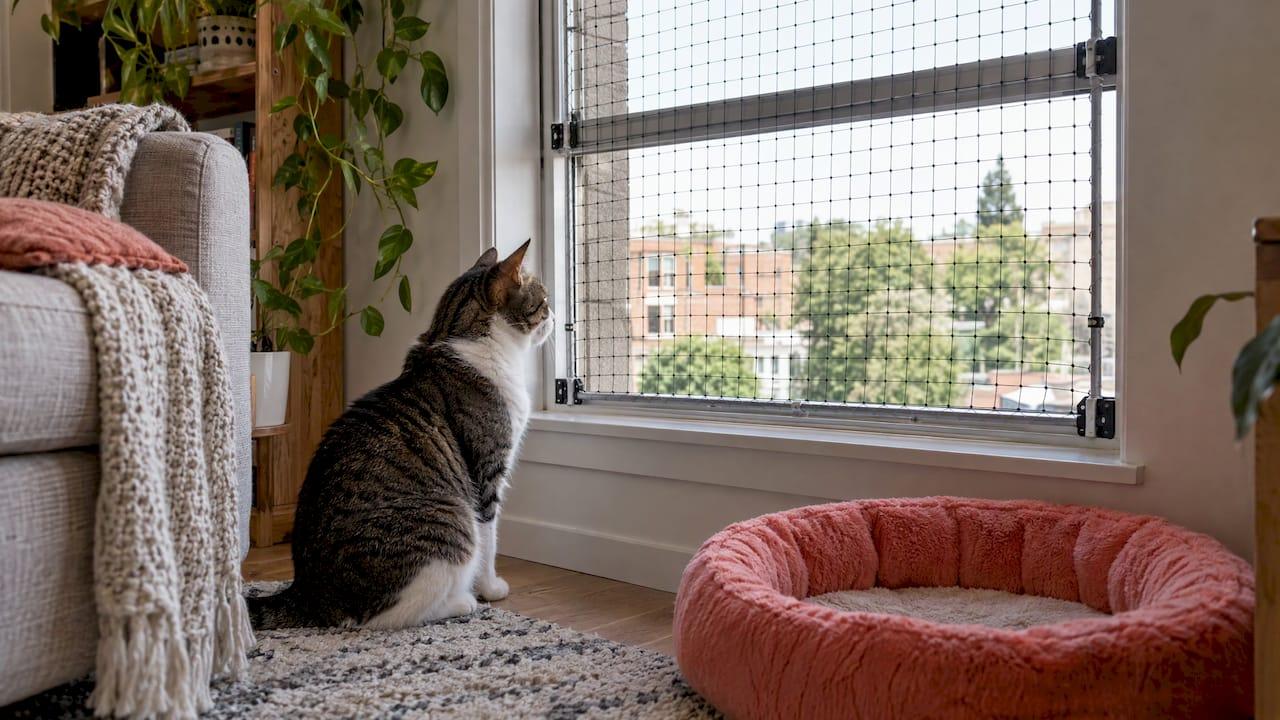
The safest way to cat-proof a window is a snug, sturdy barrier that leaves no gap for a cat to push through: a pet-resistant screen or metal mesh, wedged or fixed tightly into the frame, with a stopper so the sash cannot open further. A net or guard that sits loose, or leaves a wide gap against the glass, only looks like protection. Below you will find what to fit on each window type, how to install it, how to check it each season, and the hazards a net does not cover.
At Kiblco we review cat gear with real cat owners and vet input, so this guide sticks to what veterinary and animal welfare bodies say, then shows how to apply it in an ordinary home.
TL;DR
- Fit snug, sturdy screens in every window your cat can reach. The ASPCA recommends this for all windows and calls high-rise syndrome fully preventable.
- Do not count on childproof window guards. Cats and small dogs can slip through them.
- Use a stopper on double-hung, sliding and crank-out windows so the opening stays small, and keep any gap between a guard and the glass as narrow as you can.
- Some cats fit through openings under 3 inches, so measure the gaps, not the cat.
- Recheck the frame fit and the mesh itself before you open windows each season.
Table of Contents
- Why a regular window screen is not enough
- What counts as a real cat window safety net
- How to install a window safety net, step by step
- Special case: tilt windows
- Check and maintain the barrier
- Other ways cats get out
- Common mistakes to avoid
- Find the next piece of cat gear
- FAQ
- Sources
Why a regular window screen is not enough
A standard insect screen is built to keep bugs out. It is thin, and it sits in a light frame that a cat leaning on it can pop loose. The ASPCA's guidance on high-rise syndrome (the term vets use for injuries when cats fall from windows or balconies) lists open, unscreened windows as a cause of shattered jaws, punctured lungs, broken limbs or pelvises, and death.
The same guidance makes a point many owners miss: cats often fall by accident, not because they deliberately jump from a height. A bird or another animal outside can distract a cat enough to send it over the sill. That is why a calm, sleepy cat is not a reason to leave a window open and unprotected.
The scale of the problem is real. In 2013 the ASPCA reported that its own animal hospital saw more than 100 high-rise cases the previous year, typically three to five a week in warmer months. That is one hospital's history, not a national rate, but it shows how seasonal the risk is: it peaks when we open windows.
What counts as a real cat window safety net
"Safety net" covers several products. What they have in common is the job: a rigid or tightly tensioned barrier across the opening. The kinds worth considering:
| Option | What it is | Where it fits best |
|---|---|---|
| Pet-resistant screen | A heavier screen material built to withstand claws and teeth, set in a snug frame | Standard windows you open in summer |
| Metal mesh (wire or aluminum) | Decorative wire or aluminum mesh attached to the inside of the windowsill with screws or rivets, covering a screen or a bare opening | Windows you want protected permanently |
| Adjustable pressure-fit guard | An expandable frame with reinforced mesh that you wedge into the window opening | Renters, and windows where drilling is not an option |
| Window stopper | A device that stops a sash from opening further | Double-hung, sliding and crank-out windows, as a second layer |
The East Bay SPCA's escape-prevention handout suggests keeping windows closed when cats are unsupervised and using robust screen material, such as pet screen, on the windows you do open. Closed is always safer than screened, and screened is always safer than open.
Why childproof guards do not work
The ASPCA warns that cats and small dogs can slip through childproof window guards, so they do not give adequate protection. Their bars are spaced for a child's body, not a cat's. If your windows already have them, treat them as a base and add mesh behind or in front, rather than counting them as your safety measure.

Why a small gap is still a big gap
Cats have free-floating collarbones, which lets some of them fit through openings smaller than 3 inches, depending on size. The practical rule: if your cat's head fits, assume the body can follow. Slim young cats and kittens are the most likely to surprise you.
That is also why the space between a guard and the windowpane matters. The professional guidance is to leave as little space as possible between a guard and the glass. Closing hairline gaps at the frame edge follows the same principle as a DIY gasket trick for sealing gaps, where a snug seal along an edge stops small animals from squeezing out.
How to install a window safety net, step by step
1. Walk the house and list every window a cat can reach
Include windows behind furniture, bathroom windows, and any window above a couch or cat tree. A cat climbs to reach a sill, so a window you think is out of range probably is not. Preventive Vet's updated guidance says to open only the top of a window when it is well above the cat's jumping range, and to count launch points within about 7 feet. A bookshelf, a dresser or a cat tree next to a window moves that range.
Where it goes wrong: people check the floor-to-sill height and forget the furniture. Measure from the highest surface your cat can reach.

2. Measure the opening, then the gaps
Measure the width and height of the opening where the barrier will sit, inside the frame. Pressure-fit and adjustable guards are sold in size ranges, so a measurement a quarter inch off can leave a gap. Note any spots where the frame meets the wall or sash with a visible slot.
Where it goes wrong: measuring only at the middle. Window openings are rarely perfectly square, so measure top, middle and bottom, and use the smallest figure for a wedge-fit.
3. Choose the mounting method for your situation
- Owners: screws or rivets give the strongest hold. Metal mesh can be attached to the inside of the windowsill this way.
- Renters: an adjustable frame wedged tightly into the opening avoids drilling. A Reddit thread among cat owners makes the same practical point: it has to be tight against the frame. Check your lease before screwing anything into trim.
For the screws-in route, the vet guidance adds one condition: if you fix a screen frame into the opening, keep a safe emergency exit available for people and pets in a fire. Keep at least one window or door in each key room that you can open quickly.
4. Add a stopper for the window type
For double-hung or sliding windows, a stopper keeps the sash from opening further, and a stopper is also available for crank-out windows. The stopper makes a good second layer, because a determined cat can work a wedge-fit frame, but a limited opening gives less to work with.
5. Test the fit yourself
Push the installed barrier firmly with your palm at the center and at each corner. It should not flex out of the frame or shift. Look along the edges for slots. Then watch your cat's first few visits to the window while you are in the room.
Special case: tilt windows
Tilt-in windows, which open inward from the top, are a trap risk of their own. Cats Protection in the UK identifies the inward-tilting design as a potentially fatal entrapment hazard: a cat trying to pass through can become caught in the V-shaped gap. The charity advises closing tilted windows when cats are home alone, or fitting safety netting or grilles. Tilt windows are more common in European homes than American ones, but they do turn up in newer builds and imported hardware. If you have one, treat it as a window that is either closed or fully covered when you are out.
Check and maintain the barrier
A barrier is only as good as its weakest point, and sun, weather and claws wear on it. Before you open windows for the season, check the screen-frame fit and the screen material for pulling away or rot, and recheck that the screen is stable. A quick routine:
- Frame: press along every edge. Any movement means it needs re-wedging or new fasteners.
- Mesh: look for snagged strands, small tears, and spots where a claw has pulled the mesh away from the frame.
- Gaps: slide a ruler along the edges. Anything near 3 inches is too big; tighter is better.
- Stoppers: confirm they still lock and have not loosened over the winter.
- Cat's habits: if your cat has started to paw at one corner, that is the weak spot. Fix it before the cat does.
Swap out anything that is stretched, sun-faded or brittle. Mesh that has been through a few summers may not hold the way it did new.
Other ways cats get out
A good window barrier handles one route. The question "how do I keep my cat from escaping the house" has other answers too, and they work best together:
- Doors: a cat that dashes out when someone arrives is a common escape. A baby gate or a closed room door in the entry zone gives you a buffer.
- Balconies: the same snug-barrier logic applies to open railings. Cats can slip between balusters and fall for the same reasons they fall from windows.
- Unscreened vents and basement windows: check low openings, not just upper floors.
- Boredom at the window: a cat that wants to be outside will keep testing the barrier. Give it a safe place to watch the world. Our guide to window perches for indoor cats covers the setups that give cats a view without access to an open sash.
If you rent and are setting up for a new cat, our guide to cat-proofing an apartment covers the fixes that do not cost you a deposit.
Common mistakes to avoid
- Opening the window "just a crack" for an unsupervised cat. A gap under 3 inches is enough for some cats.
- Relying on the existing insect screen. It is made to stop insects.
- Leaving a gap behind a guard. The space between guard and glass is where paws and bodies get stuck.
- Putting furniture under a protected window. It changes the launch point for a jump at the top of the window.
- Screwing everything shut. Keep one clear exit route for emergencies.
- Skipping the seasonal recheck. Rot and loosening are slow, and cats find them first.
What we would tell a friend
At Kiblco, we review pet products by buying them and using them in real homes, and health-related picks are cross-checked with veterinary experts. Every review lists the downsides as plainly as the strengths, and we accept no payment for coverage. That approach shapes how we think about window safety.
The barrier is the part you cannot compromise on, so follow the vet and shelter guidance first: a snug, sturdy fit, a small gap to the glass, a stopper, and a seasonal check. Once that is done, the cat's behavior is the second half of the job. A cat with a good, safe place to watch birds is less likely to throw itself at the window. That is why we pair barrier advice with perches, wand toys and wall shelves, and why our cat gear reviews look at durability and usability, not just looks.
Start with the physical fix, then give your cat something better to do at the window than test it.
Chris
Find the next piece of cat gear
Once the windows are secure, the cat still needs somewhere to climb, perch and play. Our Cat Gear reviews cover perches, shelves and other indoor setups, each with pros and cons and notes on durability and ease of use, tested by cat owners.

For play that burns off a window-watching cat's energy, see our guide to interactive wand toys, or browse Cat Toys. If you are adding vertical space, our stud-tested wall shelf guide shows how to mount shelves securely.
FAQ
What is the best way to cat-proof a window?
Fit a snug, sturdy screen or metal mesh in the opening, and wedge or fasten it tightly into the frame. Add a stopper on double-hung, sliding or crank-out windows. The ASPCA's advice is to install snug, sturdy screens in all windows and to tightly wedge adjustable screens into their frames.
Are there window screens that cats can't destroy?
No screen is truly indestructible, but pet-resistant screen and metal mesh are far tougher than a standard insect screen. The strongest results come from a rigid material, a tight frame fit and a seasonal check for pulled edges. Replace any mesh that is stretched, torn or brittle.
Can a cat fit through a small gap in a window?
Yes. Because of their free-floating collarbones, some cats can pass through openings smaller than 3 inches. Keep any gap between a guard and the windowpane as small as possible, and use a stopper to limit how far a sash opens.
Do childproof window guards work for cats?
No. The ASPCA says cats and small dogs can slip through childproof guards, so they are not adequate on their own. Pair them with mesh or replace them with a snug cat-rated barrier.
Is it safe to leave windows open when I am at work?
The safest choice is to keep windows closed when your cat is unsupervised, as the East Bay SPCA suggests. If you do open one, use robust screen material, a stopper, and only a window well above your cat's reach.
Sources
- High-Rise Syndrome: Lifesaving Tips for Cat Parents, ASPCA
- ASPCA Urges Pet Owners to Install & Secure Window Screens
- Preventing Your Cat From Falling Out the Window, Preventive Vet
- Feline Escape Prevention in Home, East Bay SPCA
- Keeping Cats Safe Outside, Cats Protection