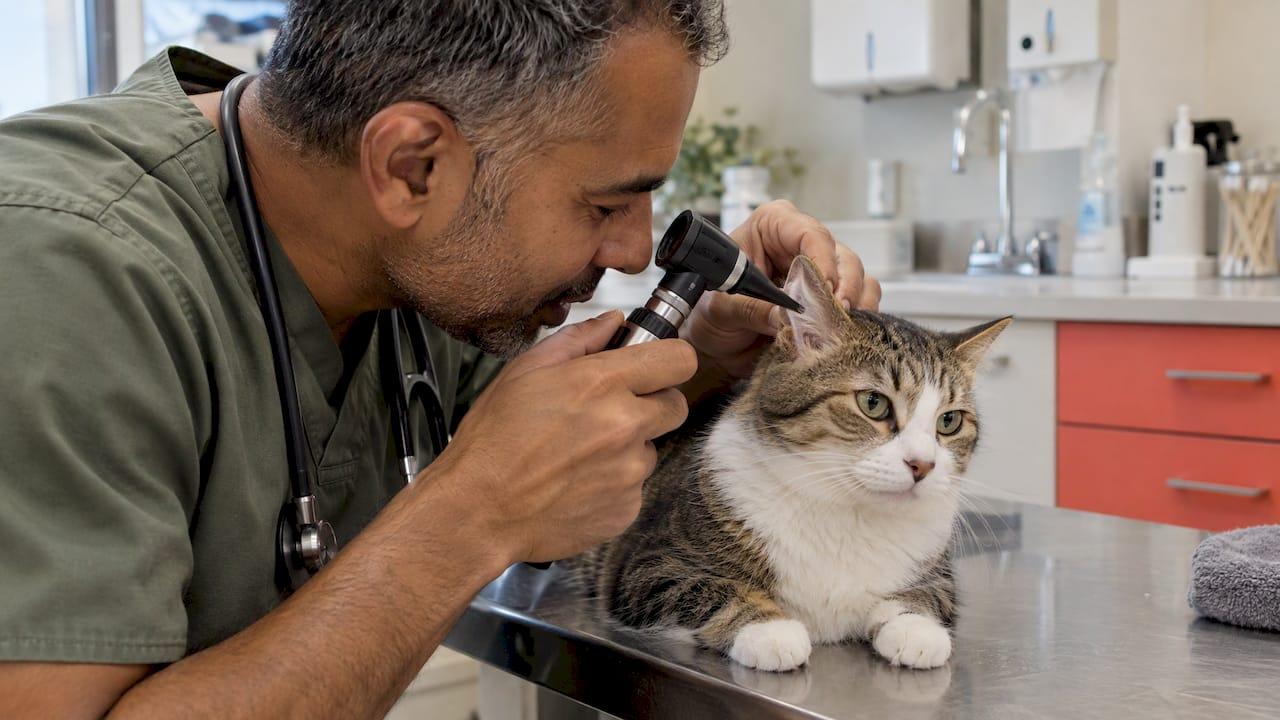
The most reliable cat ear mite treatment is an anti-parasitic medicine matched to your cat by a veterinarian, after the vet confirms mites are really the problem. Ear mites are very treatable, and most cats feel better within days. Clearing every mite, eggs included, takes about three to four weeks. This guide covers how to recognize mites, which medicines are used, what drops from the store can and can't do, and how to keep mites from coming back.
TL;DR
- Dark, crumbly debris and head shaking can point to ear mites, but other ear problems look alike. Get a vet to confirm before you treat.
- Vets use prescription and FDA-approved anti-parasitic medicines, in drops or other forms, chosen for your cat's age and health.
- The mite life cycle runs about three weeks, so a treatment that stops early can leave mites behind. Plan on a recheck.
- Tea tree oil, peroxide, rubbing alcohol and dog parasite products are not safe stand-ins for cats.
- Treat every pet in the home that the vet advises, or the mites can pass back and forth.
Table of Contents
- What ear mites look like in a cat
- Is it really ear mites? Why the vet visit comes first
- Ear mite medicine for cats: the options
- How to give ear drops to a cat
- How long does cat ear mite treatment take?
- Natural ear mite treatment for cats: what's safe and what isn't
- Why ear mites keep coming back
- Our perspective
- Find vet-informed cat care picks
- FAQ
- Sources
What ear mites look like in a cat
Ear mites are tiny surface mites that live mostly in the ear canal. VCA Animal Hospitals describes them as the second most common external parasite on pets after fleas, found on cats, dogs and ferrets.
Common signs include:
- Scratching at the ears and shaking the head
- Dark, waxy or crusty debris in the ear
- Hair loss around the ears from scratching
A 2021 peer-reviewed review of feline ear disease adds a useful detail. Cats with this mite (Otodectes cynotis) are usually affected in both ears. They often have a lot of dark brown debris that looks like coffee grounds. About 23% of affected cats also have signs outside the ear canals, such as on the head or neck. The same paper names this mite as the most common primary cause of outer ear infection (otitis externa) in cats, implicated in 53 to 69% of cases.
That last number cuts both ways. Mites are a likely suspect, but in a large share of cases the cause is something else. Allergies, yeast, bacteria, polyps and foreign material can all produce a dirty, itchy ear.
Is it really ear mites? Why the vet visit comes first
The dark debris is not proof. VCA notes that other ear conditions cause similar signs, so a veterinarian needs to rule them out. The Cornell Feline Health Center says a vet can look into the ear with an otoscope and collect debris on a cotton swab to examine under a microscope. Seeing mites and eggs confirms the diagnosis. Cornell advises seeking veterinary care without delay if you suspect an infestation.
There is a safety reason too. Banfield Pet Hospital points out that some medications can cause significant damage if the eardrum is ruptured. The safest path is to have a vet diagnose the exact problem and check that the eardrum is intact before anything goes in the ear. You can't see that at home.
Book the visit sooner if your cat is a kitten, if the ear looks red or swollen, if there is a smell or pus, or if your cat is tilting its head or seems unsteady. Those can signal an infection that needs more than mite medicine. Banfield notes that a vet may also need to treat a secondary bacterial or yeast infection.

Ear mite medicine for cats: the options
There are many effective products. Cornell's Dr. Miller notes that topical, oral and systemic agents exist, and most, such as ivermectin, are highly effective. Which one your cat gets depends on age, health and how bad the infestation is. Banfield says vets choose the product and dose for the individual cat instead of using one approach for all.
Prescription and FDA-approved drops
Two examples show how this works in practice:
- Milbemycin oxime 0.1% otic solution. The FDA DailyMed label for Milbemite Otic lists it as approved for ear mite infestations in cats and kittens four weeks of age and older, with effectiveness maintained through the mite life cycle. In a placebo-controlled field trial described on that label, 99% of treated cats were mite negative on microscopic exams through day 30.
- Ivermectin otic suspension 0.01%. Under 21 CFR § 524.1195, it is approved for adult ear mites in cats and kittens four weeks and older. The regulation notes that effectiveness against eggs and immature stages has not been proven, which is one reason the treatment course matters.
Your vet may also use other forms, including oral or topical medicines that work through the body. Follow the label and your vet's instructions exactly, including the number of days.
Over-the-counter ear mite drops
Pharmacy-aisle and pet-store drops for cats typically rely on insecticide ingredients. The key practical point comes from Veterinary Partner (VIN): over-the-counter products with insecticides that do not kill developing eggs must be used for at least 21 days, the length of the mite life cycle. Prescription products can shorten treatment to 10 to 14 days.
If you go the over-the-counter route after your vet confirms mites, check these on the label:
- It says it is for cats. Some dog products can be toxic to cats.
- Your cat's age is covered. Minimum ages vary by product, so read the label.
- The directions give a clear schedule, and you can commit to the full length.
- Your vet has okayed it, especially if there is any sign of infection or a damaged eardrum.
A tip for choosing: a product is only as good as the diagnosis behind it. Drops aimed at mites will not fix a yeast infection or an allergy.
How to give ear drops to a cat
Cats rarely love this, so set up the room before you start.
- Read the label or your vet's directions. Confirm the dose and which ears get treated. Mites usually affect both.
- Wrap a calm cat loosely in a towel, or have a second person help.
- Hold the ear flap gently upright and apply the drops into the canal without pushing the tip deep inside.
- Massage the base of the ear for a few seconds so the medicine spreads. You may hear a squishing sound. That is normal.
- Let your cat shake. Wipe only what you can see with a soft cloth.
- Praise your cat, offer a treat, and write down the date so you don't lose count over three weeks.
Do not push cotton swabs into the canal. Your vet will tell you whether a cleaner is part of the plan.
How long does cat ear mite treatment take?
Most cats feel relief within a few days, according to Spot Pet Insurance. Complete clearing, eggs included, generally takes three to four weeks, and a follow-up vet visit is standard to confirm the mites are gone.
The reason is biology. The Veterinary Partner page puts the mite life cycle at three weeks, with eggs hatching after about four days. Treatment that kills adults but not eggs has to keep going until the last eggs have hatched and been killed. Stopping when the itching fades is the most common way mites return.

The same logic applies to mites on other animals: success depends on outlasting the life cycle and verifying that the mites are actually gone. Pest specialists describe this in their own field too, such as how long mite treatment lasts and why they confirm elimination before calling a job finished. For your cat, that confirmation is the recheck at the vet.
A realistic timeline
| Stage | What to expect |
|---|---|
| Days 1 to 3 | Less scratching and head shaking in many cats |
| Week 1 | Debris should start to lessen, but eggs may still be hatching |
| Weeks 2 to 3 | Keep going with the full course your vet or the label sets |
| Weeks 3 to 4 | Mites and eggs generally cleared; recheck to confirm |
This follows the ranges above. Your vet's plan overrides any general timeline.
Natural ear mite treatment for cats: what's safe and what isn't
People search for home remedies because the mites itch and the vet bill looms. Here is where the evidence lands.
Banfield says there is no safe household remedy that will reliably clear an ear mite infestation instantly. It also warns about specific items:
- Tea tree oil can be toxic to cats.
- Hydrogen peroxide can irritate inflamed ear tissue.
- Rubbing alcohol can be painful in an inflamed ear.
- Dog ear mite or parasite products can be toxic to cats.
Cornell's Dr. Miller does mention that even baby oil, applied several times a day for a month, can smother mites. That is a slow, messy approach with no confirmed diagnosis behind it, and it doesn't check the eardrum or catch infection. Treat it as something to ask your vet about, not a first move.
Safe home care is mostly supportive: keeping your cat from scratching the ear raw, keeping the area clean as your vet shows you, and finishing the prescribed course.
Why ear mites keep coming back
When mites seem hard to clear, Veterinary Partner suggests asking four questions:
- Was the mite infection confirmed at the start?
- Was ongoing infection confirmed after treatment?
- Were all the household pets treated?
- Should a newer product be considered?
The third one trips up many homes. Since mites live on cats, dogs and ferrets, a dog in the house can carry them and pass them back, which answers the common question of whether dogs can catch mites from cats. Ask your vet whether every pet should be treated at once.
Indoor cats can still pick mites up from another pet, a new kitten or a foster animal. Mites spread by close contact, so new arrivals deserve a vet check before they share space with your cat.
If your cat also has fleas, ear scratching can have more than one cause. Our guides on choosing and using flea spray for cats safely and spot-on versus oral flea treatments can help you sort out the parasite side with your vet.
Our perspective
Ear mites are a good example of why we test and review pet products the way we do. The shelf is full of drops that promise quick results, and most pet parents just want the scratching to stop. But the diagnosis comes first, and the full treatment course comes second. A product only helps if it matches the problem.
That is why our health picks are cross-checked by veterinary experts and why every review states the downsides plainly. We buy products and use them in real homes, and we accept no payment for coverage. When you shop for anything that goes in a cat's ears, we would rather you read the label like a vet would: right species, right age, right schedule.
Our Cat Health reviews are built for that kind of decision. We lay out pros and cons so you can choose with confidence, then follow your vet's plan.
Chris
Find vet-informed cat care picks
Once your vet has confirmed the cause and set the plan, you may need supplies for the weeks ahead. Our reviewers test cat health products in real homes and write up the pros and cons, with veterinary input on health picks. Browse our Cat Health reviews to compare options before you buy.

We earn commissions if you buy through our links, and we never accept payment for coverage.
FAQ
Can dogs get ear mites from cats?
Yes. Ear mites are found on cats, dogs and ferrets, so they can pass between pets that share a home. Ask your vet whether every animal should be examined or treated at the same time, since untreated pets can reinfect the cat.
Can I use over-the-counter ear mite drops for my cat?
Some over-the-counter drops are labeled for cats, but they often need to be used for at least 21 days because they may not kill eggs. Get a vet to confirm mites and check the eardrum first, and never use a product made for dogs.
How fast will my cat feel better?
Many cats feel relief within a few days. Clearing all the mites and eggs usually takes three to four weeks, and your vet will likely want a recheck to confirm the infestation is over.
Is there a safe natural ear mite treatment for cats?
No household remedy has been shown to reliably clear an infestation, and some popular ones are harmful. Tea tree oil can be toxic to cats, and peroxide or rubbing alcohol can hurt an inflamed ear. Ask your vet about safe options.
Sources
- Ear Mites in Cats and Dogs, VCA Animal Hospitals
- Chronic Otitis in Cats: clinical management of primary causes, PMC
- Ear Mites: Tiny Critters that can Pose a Major Threat, Cornell Feline Health Center
- Ear mites in cats: signs, treatment, and prevention, Banfield Pet Hospital
- MILBEMITE OTIC Solution, FDA DailyMed
- 21 CFR § 524.1195, Ivermectin otic suspension
- Ear Mites in Dogs and Cats, Veterinary Partner (VIN)
- Cat Ear Mites: Symptoms, Treatment & Prevention, Spot Pet Insurance
- Mite treatment duration and confirming elimination