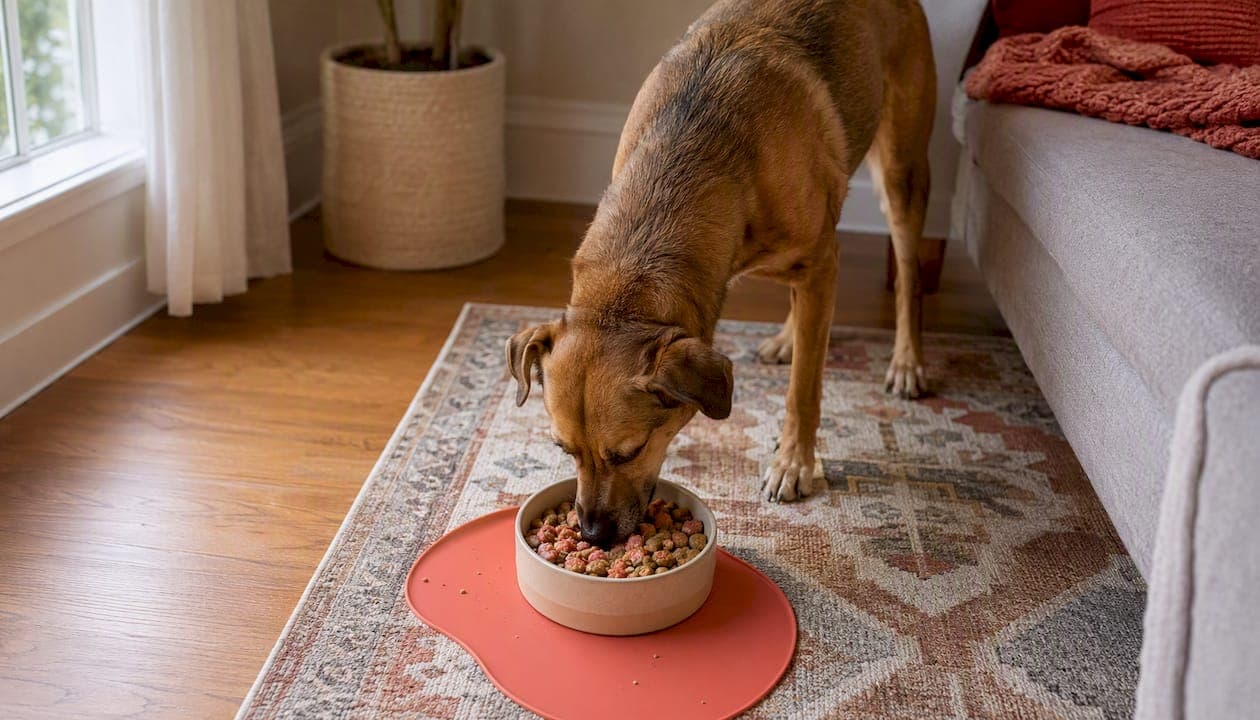
Raw coated kibble is dry kibble finished with a freeze-dried raw powder coating. It sits between standard kibble and a fully raw diet, offering better palatability and a modest protein boost at the surface while requiring similar hygiene precautions to fresh raw meat.
- What it is: Extruded or oven-baked kibble tumble-coated with freeze-dried raw powder, sometimes with a lipid adhesive to help it stick. The AAFCO statement on the label still governs whether the product is nutritionally complete.
- Best for: Picky eaters, dogs or cats transitioning off a raw diet, and owners who want more palatability without the prep work of a fully raw food diet.
- Primary tradeoff: Freeze-drying preserves organisms rather than killing them. The Cornell Riney Canine Health Center is explicit: treat freeze-dried coatings as raw for hygiene purposes. Check whether the brand uses HPP (high-pressure processing) and confirm the AAFCO life-stage statement before buying.
Key Takeaways
Raw coated kibble is a legitimate middle-ground option for most healthy pets, but the freeze-dried coating requires raw-meat hygiene and careful label reading to get real nutritional value from it.
| Point | Details |
|---|---|
| Treat the coating as raw | Freeze-drying preserves pathogens; wash hands and surfaces after every feeding. |
| Check the AAFCO statement first | Confirm "complete and balanced" for your pet's life stage before any other label detail. |
| Convert protein to dry-matter basis | As-fed protein numbers overstate the difference; calculate DMB to compare products accurately. |
| Expect a 30–50% price premium | Budget accordingly and store opened bags in an airtight container to slow oxidation. |
| Kiblco's top picks | Stella & Chewy's SuperBlends and Instinct Raw Coated lead on availability, named proteins, and label transparency in the U.S. |
Table of Contents
- Which raw coated kibble options are worth buying in the U.S.?
- What does "raw coated" actually mean?
- How to read the label and guaranteed analysis
- Is raw coated kibble safe?
- How to choose the right raw coated kibble for your pet
- Feeding tips, storage, and what it costs
- Kiblco's recommended picks
- Allergen considerations specific to raw coatings
- How raw coated kibble compares to other diet types
- The honest case for raw coated kibble (and where it falls short)
- Kiblco's picks, tested and linked
- Sources
Which raw coated kibble options are worth buying in the U.S.?
Two brands dominate the U.S. shelf space for raw coated dog food, and both are worth knowing well before you spend money.
Stella & Chewy's SuperBlends
Stella & Chewy's raw coated dog food is oven-baked kibble finished with their freeze-dried raw coating. DogFoodAdvisor's label analysis puts the dry-matter protein near 29.9% for a representative recipe, with named meats appearing high in the ingredient list. Available at Chewy, Amazon, PetSmart, and Petco in multiple bag sizes. Best for: picky eaters and owners who want a recognizable brand with wide retail availability. The line also includes a raw coated dry cat food with life-stage variants, which matters if you're feeding both species.
Instinct Raw Coated (Nature's Variety)
Instinct's Raw Coated line wraps a grain-free kibble core with freeze-dried raw coating and is one of the few lines that explicitly states cage-free poultry or grass-fed beef as the first ingredient. Protein content on a dry-matter basis typically runs in the high 20s to low 30s depending on the recipe. Available at most major U.S. pet retailers and on subscription via Chewy's Autoship. Best for: owners prioritizing grain-free dog food formulas and named single-protein sources for dogs with food sensitivities.
Comparison snapshot:
| Product | Best for | Declared protein (DMB approx.) | Processing note | Price band | Availability | Life stage |
|---|---|---|---|---|---|---|
| Stella & Chewy's SuperBlends | Picky eaters, wide retail access | ~29.9% | Oven-baked core + freeze-dried raw coating | $$ (mid-premium) | Amazon, Chewy, PetSmart, Petco | Adult, puppy lines available |
| Instinct Raw Coated | Grain-free, single-protein needs | High 20s–low 30s | Kibble core + freeze-dried raw coating | $$ (mid-premium) | Chewy, Amazon, independent pet stores | Adult, puppy |
- Stella & Chewy's SuperBlends: multiple protein options (chicken, beef, salmon), grain-free recipes, widely stocked.
- Instinct Raw Coated: cage-free and grass-fed sourcing claims, strong brand transparency on protein sourcing.
- Both lines carry AAFCO complete-and-balanced statements — confirm the life-stage designation matches your pet before buying.
Pro Tip: On any product page, scroll to the "Guaranteed Analysis" section and look for the phrase "complete and balanced for [life stage] as per AAFCO." If it says "intended for intermittent or supplemental feeding only," it is not a complete diet.
What does "raw coated" actually mean?
The manufacturing sequence matters because it explains exactly what you're paying for. The kibble core is made the conventional way: ingredients are mixed, extruded or oven-baked at high heat, and dried. That cooking step kills pathogens in the core. Then, in a separate tumble-coat step, the finished kibble pieces are sprayed or tumbled with freeze-dried raw powder, often held in place by a small amount of fat or oil as an adhesive.
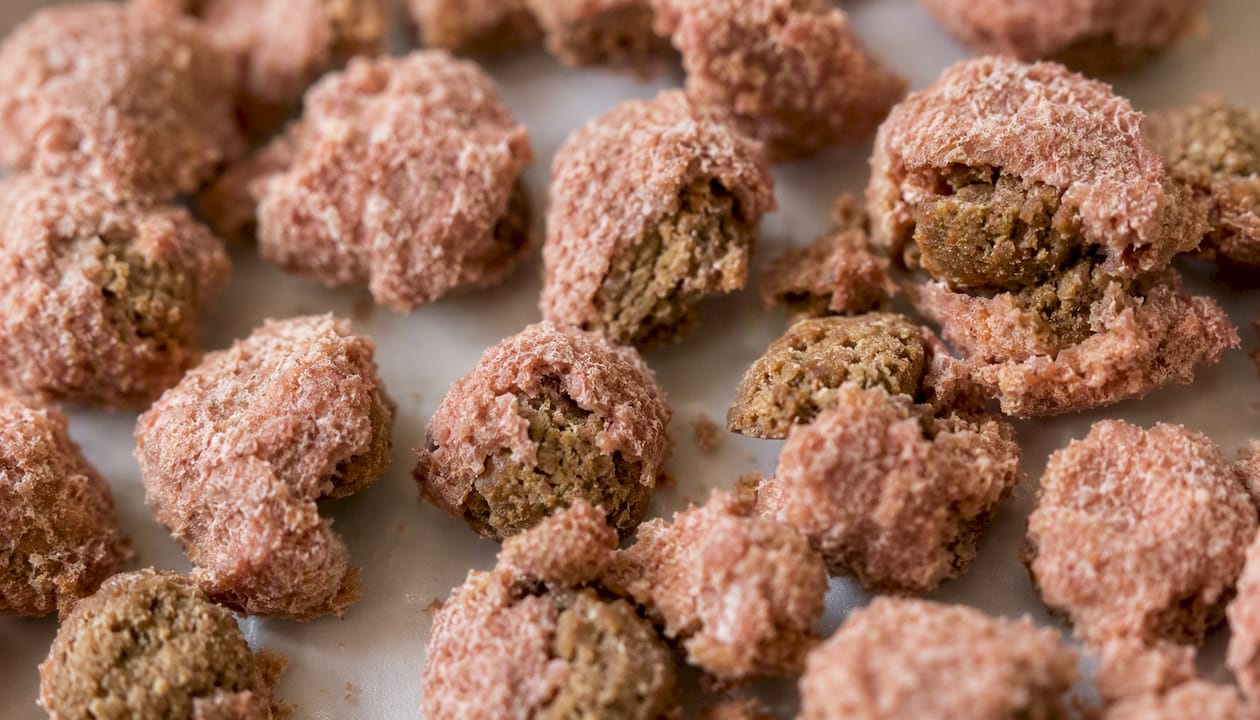
Freeze-drying removes moisture through sublimation at very low temperatures, which preserves flavor compounds, some heat-sensitive nutrients, and the aroma that makes dogs and cats more interested in the bowl. What it does not do is cook the material. As Kabo explains, freeze-drying and HPP are not 100% effective at eliminating bacteria, so the coating remains microbiologically raw even after processing.
What the coating actually adds:
- Flavor and aroma: The biggest practical benefit. Picky eaters often respond immediately to the smell difference.
- Surface protein and fat: The coating raises the as-fed protein and fat numbers you see on the label, though the magnitude depends on how thick the coating is relative to total bag weight.
- Some micronutrients: Heat-sensitive vitamins and enzymes that would be destroyed during extrusion can survive in the freeze-dried layer.
- Probiotics (in some formulas): A few brands add live cultures to the coating step, since those organisms wouldn't survive the kibble's cooking phase.
How to read the label and guaranteed analysis
The guaranteed analysis on a raw coated kibble bag lists protein, fat, fiber, and moisture as-fed, meaning the percentages reflect the food as it comes out of the bag, water and all. That makes direct comparisons between products tricky because moisture content varies.
Converting to dry-matter basis (DMB) levels the playing field. The formula: divide the as-fed nutrient percentage by (100 minus the as-fed moisture percentage), then multiply by 100.
A thin freeze-dried coating will nudge the as-fed protein number upward, but if the coating is only a small fraction of the total bag weight, the DMB shift is modest. DogFoodAdvisor's analysis of Stella & Chewy's SuperBlends illustrates this: the ~29.9% DMB protein reading reflects the combined kibble core and coating, not the coating alone. Ingredient order still matters because it tells you whether the protein is coming from fresh named meat (which is heavy with water and will shrink after cooking) or from a named meat meal (already concentrated).
Label checklist before you buy:
- AAFCO "complete and balanced" statement with a named life stage
- Named protein source as the first ingredient (e.g., "chicken," "beef," not just "meat")
- Declared protein and fat percentages you can convert to DMB
- HPP or validated pathogen-reduction claim on the coating
- Probiotics or added micronutrients (check if they're in the coating or the core)
- No vague "animal digest" or "meat by-products" as the primary protein
PetMD notes that freeze-dried products are minimally processed and tend to cost more, but there's no strong evidence they outperform conventional kibble nutritionally when the guaranteed analysis numbers are comparable. The label is your best tool.
Is raw coated kibble safe?
The short answer: yes, for most healthy adult dogs and cats in households without vulnerable people, provided you handle it like raw meat. The longer answer requires understanding what the processing actually does.
Freeze-drying preserves organisms rather than destroying them. The Cornell Riney Canine Health Center references FDA and Penn research showing measurable pathogen presence in some raw pet food products, and explicitly states that freeze-dried inclusions should be treated as raw for hygiene purposes. HPP reduces pathogen load without heat, but as ScienceInsights reports, HPP is not a sterilization step. Not every brand uses it, and many labels omit explicit HPP claims.
Safe-handling steps:
- Wash hands with soap and water before and after every feeding.
- Clean food bowls and any surfaces the kibble touches daily.
- Keep raw coated kibble away from human food prep areas.
- Discard uneaten portions promptly rather than leaving them out for hours.
- Store opened bags in a sealed container in a cool, dry place.
Who should be cautious: Households with young children, pregnant people, elderly adults, or immunocompromised family members face higher risk from incidental pathogen exposure. Pets with compromised immune systems, cancer, or recovering from surgery are also candidates for a fully cooked diet instead. Talk to your vet before switching those animals to any raw or raw-adjacent product.
Pro Tip: Feed on a washable silicone placemat and wipe your dog's or cat's muzzle with a damp cloth after meals. It takes ten seconds and meaningfully reduces the amount of raw coating residue that gets transferred to furniture, hands, and faces.
How to choose the right raw coated kibble for your pet
Start with your pet's life stage. A puppy or kitten needs a formula with an AAFCO statement that says "growth" or "all life stages." An adult maintenance formula fed to a growing puppy is a nutritional mismatch regardless of how good the coating is.
Decision checklist:
- Life-stage AAFCO statement matches your pet's current stage
- Primary protein source is a named meat (chicken, beef, salmon, lamb)
- Declared protein/fat on DMB meets your vet's recommendation for your pet's size and activity level
- HPP or other validated pathogen-reduction process stated by the manufacturer
- Ingredient quality: named meats or named meat meals, not generic "meat" or "animal protein"
- Grain-free vs. grain-inclusive: grain-free dog food is popular, but the FDA has been investigating a potential link between grain-free diets and dilated cardiomyopathy (DCM) in dogs — discuss with your vet if your dog is a large breed
- Kibble size appropriate for your pet's breed and jaw size
- Probiotics or added micronutrients if your pet has digestive sensitivities
Questions to ask the manufacturer before buying:
- Is the freeze-dried coating HPP-treated?
- What percentage of the bag by weight is the raw coating versus the kibble core?
- Where is the product manufactured, and what third-party safety testing is done?
Red flags to walk away from:
- No AAFCO statement anywhere on the bag
- "Meat" or "animal protein" as the first ingredient with no species named
- Inconsistent guaranteed analysis numbers across bag sizes of the same formula
- A recalled product line with no public corrective action statement
- Manufacturer unable or unwilling to answer the HPP question
Feeding tips, storage, and what it costs
Raw coated kibble typically runs 30–50% more than comparable standard kibble. A 4–5 lb bag from Stella & Chewy's or Instinct generally lands in the $20–$30 range; larger bags (10–25 lbs) bring the per-pound cost down but require careful storage once opened.
Storage matters more with raw coated kibble than with standard dry food. The freeze-dried coating contains fats that oxidize faster once exposed to air, heat, or light. Follow these steps after opening:
- Transfer kibble to an airtight container immediately after opening the bag. For practical airtight and pest-proof container options, Giddy Pets has a useful storage guide worth bookmarking.
- Store the container in a cool, dry location away from direct sunlight and heat sources.
- Do not store near the stove, dishwasher, or any appliance that generates heat.
- Check for off-odors (rancid or sour smell) before each feeding. If it smells wrong, discard it.
- Follow the manufacturer's "use within X days of opening" guidance, typically 4–6 weeks.
- Some manufacturers recommend refrigerating opened portions of smaller bags. Check the product page for that specific guidance.
Transitioning from standard kibble:
- Days 1–2: 75% old food, 25% raw coated kibble.
- Days 3–4: 50/50 mix.
- Days 5–6: 25% old food, 75% raw coated kibble.
- Days 7–10: 100% raw coated kibble, monitoring stool consistency and energy.
Loose stools during transition are common and usually resolve within a few days. If they persist past day 10, slow the transition further or consult your vet. Pets with inflammatory bowel disease, pancreatitis, or known food allergies should transition under veterinary supervision.
Kiblco's recommended picks
Kiblco's selections here are based on label analysis (AAFCO statement, named protein sources, declared guaranteed analysis), confirmed U.S. retail availability, visible safety or HPP claims where stated, and life-stage coverage. No brand paid for placement.
Stella & Chewy's SuperBlends Raw Coated The most widely available raw coated option in U.S. pet retail. Named meats appear first in the ingredient list, the oven-baked core is a sound nutritional base, and the freeze-dried coating delivers the aroma boost picky eaters respond to. The main caveat: Stella & Chewy's does not prominently advertise HPP on all SuperBlends packaging, so contact their customer service line to confirm the pathogen-reduction process for the specific recipe you're buying.
Instinct Raw Coated A strong pick for owners who want grain-free formulas with clearly sourced proteins. Cage-free poultry and grass-fed beef options are available, and the brand's transparency on sourcing is above average for the category. The grain-free formulation means you should discuss DCM risk with your vet if you're feeding a large or giant breed long-term.
Allergen considerations specific to raw coatings
Standard kibble allergen concerns center on protein sources (chicken, beef, dairy, wheat, soy) and are well-documented. Raw coated kibble adds a layer of complexity because the coating is a separate ingredient stream that may introduce proteins not present in the kibble core.
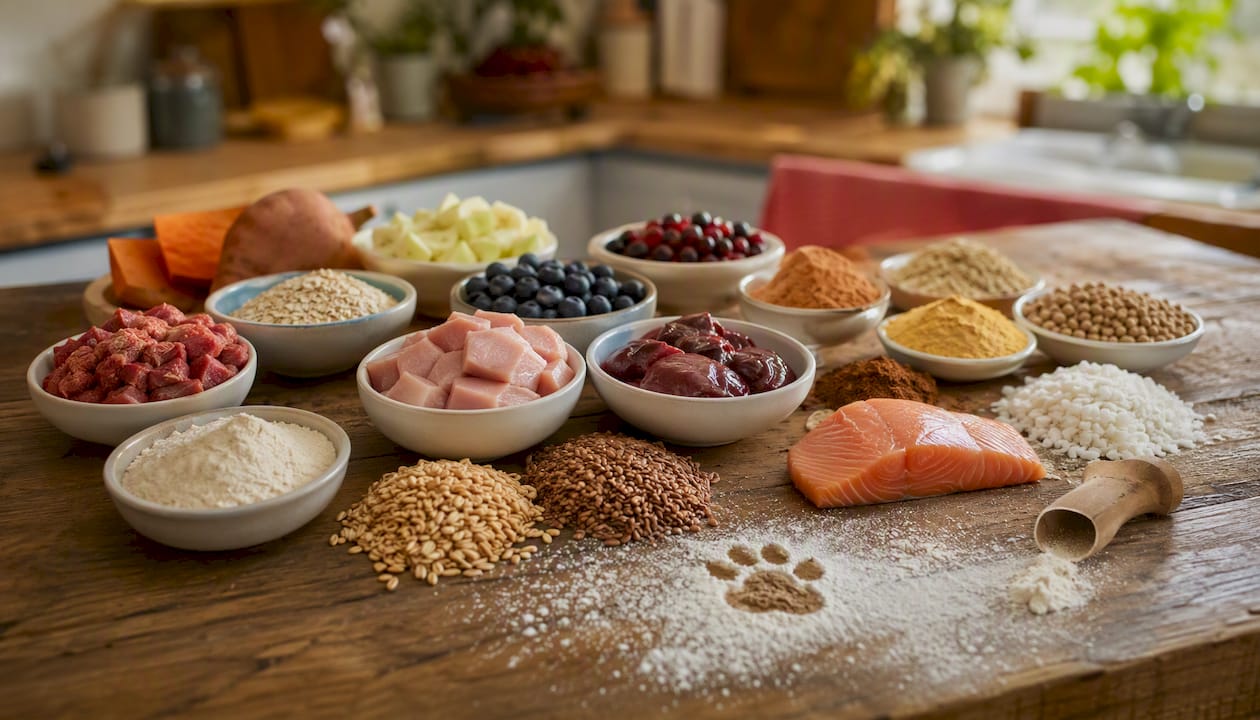
A dog tolerating a chicken-based kibble core might react to a coating that includes beef organ powder, fish meal, or egg. Because the coating is applied after the main cooking step, cross-contamination from shared manufacturing lines is also possible. Brands that process multiple protein varieties on the same equipment may not guarantee separation, which matters for pets with confirmed food allergies.
If your pet has a diagnosed protein allergy or is on a veterinary elimination diet, raw coated kibble is generally not the right format. The coating introduces too many variables to maintain the single-protein control an elimination diet requires. A cooked single-protein kibble or a hydrolyzed protein formula is a safer choice in that situation. For pets with mild sensitivities rather than confirmed allergies, reading the full ingredient list of both the kibble core and the coating description is the minimum step before switching.
Some raw coatings also include organ meats (liver, kidney, heart) that are nutritionally dense but can trigger loose stools in dogs not accustomed to them, particularly during the first week of feeding. That's not an allergy response, but it's worth knowing before you attribute digestive upset to the wrong cause.
How raw coated kibble compares to other diet types
Raw coated kibble occupies a specific middle position, and knowing where it sits helps you decide whether it's actually the right format for your household.
Traditional kibble is the baseline: fully cooked, shelf-stable, the lowest cost per serving, and the most studied format for long-term canine and feline nutrition. It carries no raw pathogen risk. The tradeoff is palatability for picky eaters and the loss of heat-sensitive nutrients during extrusion.
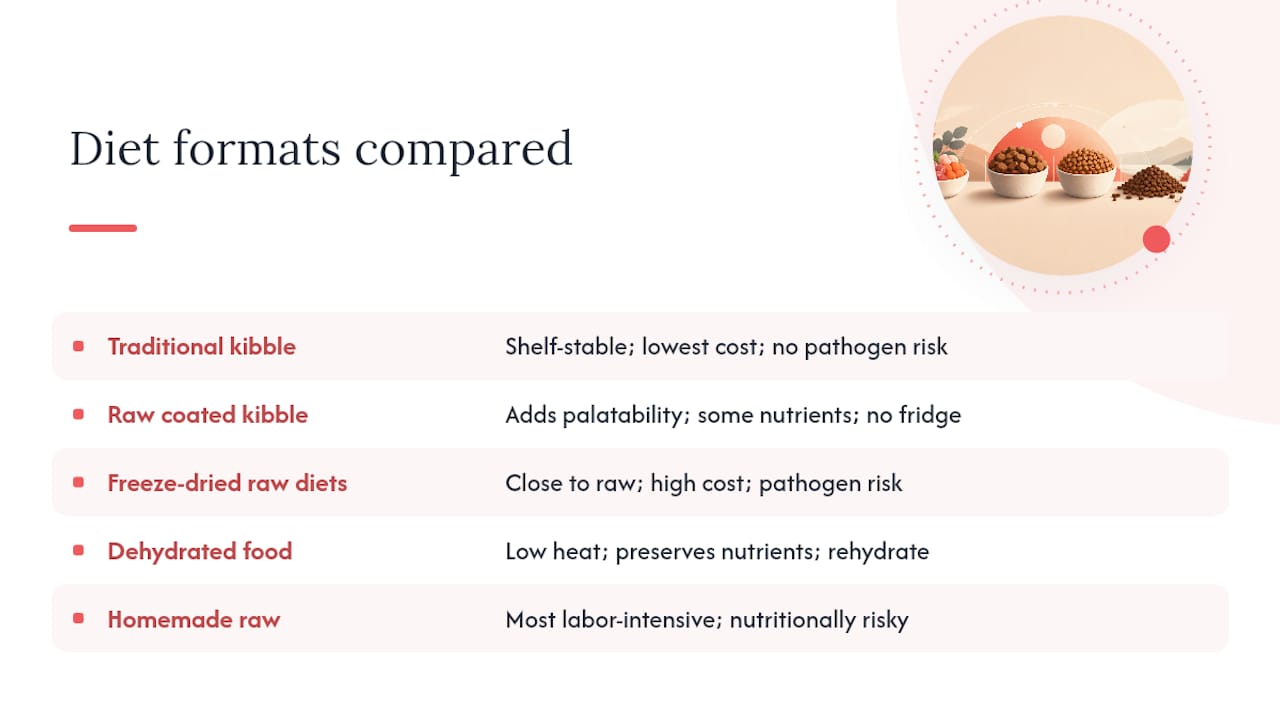
Raw coated kibble adds palatability and some surface nutrients without requiring the prep work or refrigeration of a fully raw diet. It's a practical middle ground for owners who want more than standard kibble but aren't ready for a fully raw feeding routine.
Freeze-dried complete raw diets (not coated kibble, but fully freeze-dried meals) are nutritionally closer to a whole raw diet. They require rehydration, cost significantly more per serving, and carry the same pathogen handling requirements. For owners who want the raw food diet for dogs experience with less mess than fresh raw, this is the next step up from raw coated kibble.
Dehydrated dog food uses low heat over a longer period to remove moisture. It preserves more nutrients than extrusion but does apply some heat, which places it between kibble and freeze-dried in terms of processing. Dehydrated food typically requires rehydration and costs more than standard kibble, though less than freeze-dried complete diets.
Homemade raw is the most labor-intensive and nutritionally risky option without professional formulation. The AVMA and FDA both caution against homemade raw diets without veterinary nutritionist oversight because of the difficulty of achieving complete and balanced nutrition consistently.
For owners who want palatability without raw safety concerns, cooked toppers are worth considering. Kiblco's guide to dog food toppers that make kibble irresistible covers cooked options that add flavor without the pathogen tradeoff.
The honest case for raw coated kibble (and where it falls short)
The category gets oversold in two directions at once. Some brands market raw coated kibble as nearly equivalent to a fully raw diet, which the label math doesn't support when the coating is a thin layer on an otherwise conventional kibble. Others dismiss it entirely because of pathogen risk, which overstates the danger for healthy pets in households without vulnerable people.
The real picture is more useful than either extreme. For a picky eater who's been refusing standard kibble, a raw coated formula can be the difference between a dog that eats and one that doesn't. The aroma difference is genuine. For a dog already thriving on a high-quality standard kibble, the upgrade is modest and the price premium is real.
Where the category genuinely earns its keep is in the transition space: owners moving a pet off a fully raw diet toward something more convenient, or owners who want the palatability benefits of a freeze-dried cat treat format applied to a complete daily diet. In those cases, the coating is doing real work.
The safety piece is manageable, not scary, but it does require consistent habits. Treat the bag like you'd treat raw chicken: wash your hands, clean the bowl, don't leave food sitting out. That's the whole protocol. Most pet owners already do most of it.
Kiblco's picks, tested and linked
Kiblco reviews raw coated kibble the same way we review every pet product: label analysis first, then real-world palatability feedback from pet parents, with vet-informed safety context layered in. No brand pays for a recommendation here.

If you're ready to buy, both Stella & Chewy's SuperBlends and Instinct Raw Coated are available through our affiliate links at Chewy, Amazon, and Petco. You get the same price you'd find anywhere, and a small commission supports Kiblco's independent testing work at no cost to you.
For the full breakdown of every product we've evaluated, including probiotics, toppers, and other food formats, visit Kiblco and browse by category. If you're weighing raw coated kibble against a cooked topper approach, our dog food toppers guide covers the lower-risk palatability alternatives in detail.
Affiliate disclosure: Kiblco earns a commission on qualifying purchases made through links on this page. This does not affect our recommendations.
Sources
The safety and label-reading guidance in this article draws on the following primary and independent sources. Manufacturer pages are noted as such.
- Raw foods for dogs: Evidence-based advice from the Riney Canine Health Center | Cornell University College of Veterinary Medicine
- Is Raw Coated Kibble Good for Dogs: Pros & Cons - ScienceInsights
- Stella & Chewy’s SuperBlends Raw Coated Kibble Dog Food Review (Dry) | Dog Food Advisor
- Raw Coated Dog Food | Stella & Chewy's