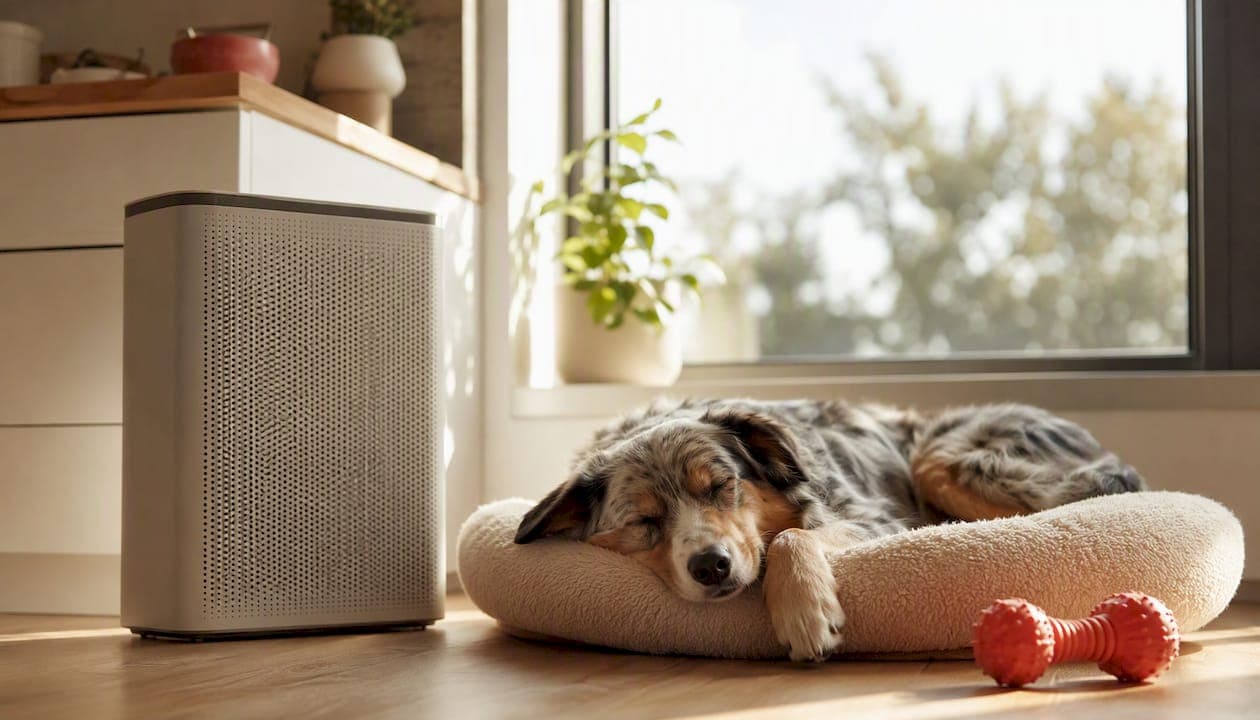
For most pet households, the Levoit EverestAir is the best overall HEPA pick, the Alen BreatheSmart 75i wins for heavy odor control, the Coway AP-1512HH is the smart budget buy, the Blueair Blue Signature Large handles big open rooms, and the Levoit Vital 200S fits small bedrooms and apartments without hogging outlet space. Each one uses a true HEPA (H13-rated in most cases) filter that captures 99.97% of airborne particles down to 0.3 microns, which matters because pet dander typically runs 2.5 to 10 microns wide. That's well within HEPA's capture range, so the filtration technology itself isn't in question. What separates these five models is how they handle the parts of pet ownership that generic air purifiers ignore: matted hair clogging a pre-filter in three weeks, litter box funk that a thin carbon layer can't touch, or a compressor whine that keeps a nervous dog awake at 2 a.m.
- Best overall: Levoit EverestAir — Strong CADR for living rooms and bedrooms up to 1,700 sq ft, with a washable pre-filter that catches long hair before it reaches the HEPA stage.
- Best for odors: Alen BreatheSmart 75i — Heavy activated carbon load designed for litter boxes and multi-dog homes; rated for rooms up to 1,300 sq ft.
- Best budget: Coway AP-1512HH (Coway 150) — Compact, quiet, and inexpensive to run, good for a 361 sq ft bedroom or home office.
- Best large room: Blueair Blue Signature Large — Built for open-concept living areas up to 1,150 sq ft with high sustained airflow.
- Best small room: Levoit Vital 200S — Fits nightstands and small bedrooms, with a genuine sleep mode that doesn't sacrifice filtration.
Start by placing whichever unit you buy in the room your pet sleeps in, not the living room. HEPA filtration only pulls dander out of the air passing through the unit. It won't lift dander that's already settled into carpet fibers or a couch cushion, so a filter alone isn't a total fix for a shedding-heavy home.
Key Takeaways
A layered strategy combining HVAC filtration, a room-matched true HEPA purifier, HEPA vacuuming, and regular grooming outperforms any single fix for pet dander, hair, and odor control.
| Point | Details |
|---|---|
| Match room size to CADR | Divide unit CADR by square footage; aim for a ratio above 1.0 for allergy-level filtration. |
| Prioritize placement over specs | Place the purifier where pets sleep for the largest measured reduction in airborne dander. |
| Weigh carbon for odor problems | Litter box and multi-dog odor need heavy activated carbon, not just high CADR. |
| Skip switchable ionizers | Disable or avoid ionizer/plasma modes since true HEPA media does the actual capture work. |
| Pair air cleaning with surface care | HEPA vacuuming and grooming remove embedded dander that no purifier can pull from the air. |
| Start with Kiblco's tested picks | Kiblco's hands-on reviews narrow the field to purifiers proven to handle real pet households. |
Table of Contents
- Best HEPA Filters for Pet Dander, Hair, and Odors Compared
- How Do You Pick the Right HEPA Purifier for Your Home?
- What Our Testing Found in Real Pet Homes
- Most Buying Guides Get the Priority Order Backward
- Get Vetted Pet Product Picks Before You Buy
- Sources
Best HEPA Filters for Pet Dander, Hair, and Odors Compared
Picking a HEPA filter for pets comes down to matching filter stages and airflow to your actual room, not just grabbing the highest-rated unit on a retailer's site. Here's how the six models worth considering stack up on the specs that matter for pet owners specifically.
| Model | Best for | Room size / CADR | Filter stages | Noise (dBA) | Filter cost/frequency | Price band |
|---|---|---|---|---|---|---|
| Levoit EverestAir | Overall pet homes | ~1,700 sq ft, high CADR | Washable pre-filter, carbon, True HEPA | ~24 low / ~50 high | Every 6-8 months, ~$70/yr | Mid-range |
| Alen BreatheSmart 75i | Heavy odor control | ~1,300 sq ft | Pre-filter, heavy carbon blend, H13 HEPA | ~25 low / ~50 high | Every 6-9 months, ~$90/yr | Premium |
| Coway AP-1512HH | Budget buyers | ~361 sq ft | Washable pre-filter, carbon, True HEPA | ~24 low / ~53 high | Every 6-12 months, ~$40/yr | Budget |
| Blueair Blue Signature Large | Large open rooms | ~1,150 sq ft | Washable fabric pre-filter, particle + carbon filter | ~32 low / ~62 high | Every 6 months, ~$100/yr | Premium |
| Levoit Vital 200S | Small rooms/bedrooms | ~503 sq ft | Pre-filter, carbon, True HEPA | ~24 low / ~48 high | Every 6-8 months, ~$50/yr | Mid-range |
| Winix 5510 | Value with extras | ~360 sq ft | Washable pre-filter, carbon, True HEPA, PlasmaWave | ~27.8 low / ~55.1 high | Every 3-4 months, ~$60/yr | Budget |
Alen BreatheSmart 75i. This is the one to buy if litter box odor or a multi-dog household is your main complaint, not just visible fur. The carbon load is noticeably heavier than what you get in budget units, closer to a pellet-based carbon layer than a thin sheet insert, which is why it holds up longer against strong smells. It costs more up front and the filters aren't cheap to replace.
- Pro: Heaviest carbon load in this lineup for odor-heavy homes.
- Pro: Multiple color panel options to match a room.
- Con: Higher price point than Coway or Winix.
- Con: Larger footprint, not ideal for small apartments.
Levoit EverestAir. The washable pre-filter is the standout here. It pulls off enough loose fur that the True HEPA filter underneath lasts longer between replacements, which is exactly what a shedding cat or double-coated dog demands.
- Pro: Washable pre-filter reduces long-term filter costs.
- Pro: Smart sensors auto-adjust fan speed to detected particles.
- Con: App connectivity can be finicky on some routers.
- Con: Larger unit, less discreet in small rooms.
Levoit Vital 200S. Built for a bedroom rather than an open floor plan, and its quiet mode genuinely stays under 25 dBA, which matters if a light-sleeping cat startles at compressor hums.
- Pro: Compact size fits nightstands and small offices.
- Pro: Quiet sleep mode with dimmable display.
- Con: CADR too low for rooms over roughly 500 sq ft.
- Con: Filter includes activated carbon but a lighter load than the Alen.
Winix 5510. The budget pick with the most bonus features, including a PlasmaWave ionizing function. That function can be switched off, which you should do, since ionizers can generate trace ozone.
- Pro: Lowest-cost option with True HEPA certification.
- Pro: Auto mode responds to light and air quality sensors.
- Con: PlasmaWave ionizer should stay disabled for pet-safety reasons.
- Con: Filters need replacing more often than pricier competitors.
Blueair Blue Signature Large. This is the one for a big shared living room with multiple pets. The washable fabric pre-filter is unusual, most competitors use disposable foam, and it means less recurring cost even though replacement HEPA/carbon cartridges run higher than budget models.
- Pro: Highest sustained CADR for large open spaces.
- Pro: Washable fabric pre-filter cuts down on waste.
- Con: Noticeably louder on max speed than the Levoit or Coway options.
- Con: Premium price for both the unit and replacement filters.
Coway AP-1512HH (Coway 150). The value leader. It's been a bestseller for years because it does the basics right: quiet at low speed, true HEPA rated, and cheap enough to run in every bedroom of a multi-pet house without breaking a budget.
- Pro: Lowest total cost of ownership in this group.
- Pro: Compact and genuinely quiet at typical settings.
- Con: Room coverage tops out around 361 sq ft.
- Con: No dedicated heavy-carbon odor mode for strong smells.
Watch for marketing language that blurs "True HEPA" with "HEPA-type" or "HEPA-like." Only true HEPA, and ideally an H13 designation, guarantees the 99.97% capture rate at 0.3 microns. A red flag across cheaper models: a pre-filter that can't be removed and washed, which turns into a hair-clogged bottleneck within weeks in a heavy-shedding home.
How Do You Pick the Right HEPA Purifier for Your Home?
Matching a purifier to your space isn't guesswork if you run the numbers first. Follow this sequence before you buy anything.
- Measure your room's square footage. Multiply length by width. A 12x14 bedroom is 168 sq ft; a 20x20 living room is 400 sq ft.
- Check the CADR rating against that square footage. CADR (Clean Air Delivery Rate) measures cubic feet of filtered air per minute. Divide the manufacturer's CADR by your room's square footage; a ratio above 1.0 usually delivers strong air changes per hour (ACH) for allergy control.
- Target 4-5 ACH for pet allergy relief. To convert CFM to ACH: ACH = (CFM x 60) / room volume in cubic feet. A unit rated at 200 CFM in a 12x14x8 room (1,344 cubic feet) delivers roughly 8.9 ACH, more than enough. That same 200 CFM unit in a 20x20x8 living room (3,200 cubic feet) drops to about 3.75 ACH, borderline for allergy-level filtration.
- Match filter stages to your pet's specific problem. Heavy shedder? Prioritize a washable pre-filter. Litter box or multi-dog odor? Prioritize carbon weight over raw CADR.
- Factor in noise tolerance for both humans and pets. Dogs and cats notice sustained mechanical noise more than people do, so a unit's low-speed dBA rating matters more than its max-speed number if it'll run overnight.
- Set a maintenance budget before you buy. Add up pre-filter cleaning, HEPA replacement, and carbon replacement costs annually, not just the sticker price.
| Room type | Recommended ACH | Example unit CFM needed |
|---|---|---|
| Small bedroom (150 sq ft) | 4-5 ACH | ~100-120 CFM |
| Large bedroom/office (300 sq ft) | 4-5 ACH | ~200-240 CFM |
| Living room (400-500 sq ft) | 4-5 ACH | ~270-330 CFM |
| Open-concept space (700+ sq ft) | 3-4 ACH | ~400-470 CFM |
For filter staging, the ideal setup for a pet home is a three-part system: a washable pre-filter to catch visible hair, an activated carbon layer for odor gases, and a true HEPA stage for airborne dander and dust. Skimping on any one stage creates a bottleneck; a thin carbon insert gets saturated within weeks in a home with a litter box, and a non-washable pre-filter clogs fast enough to choke airflow before the HEPA filter ever wears out.
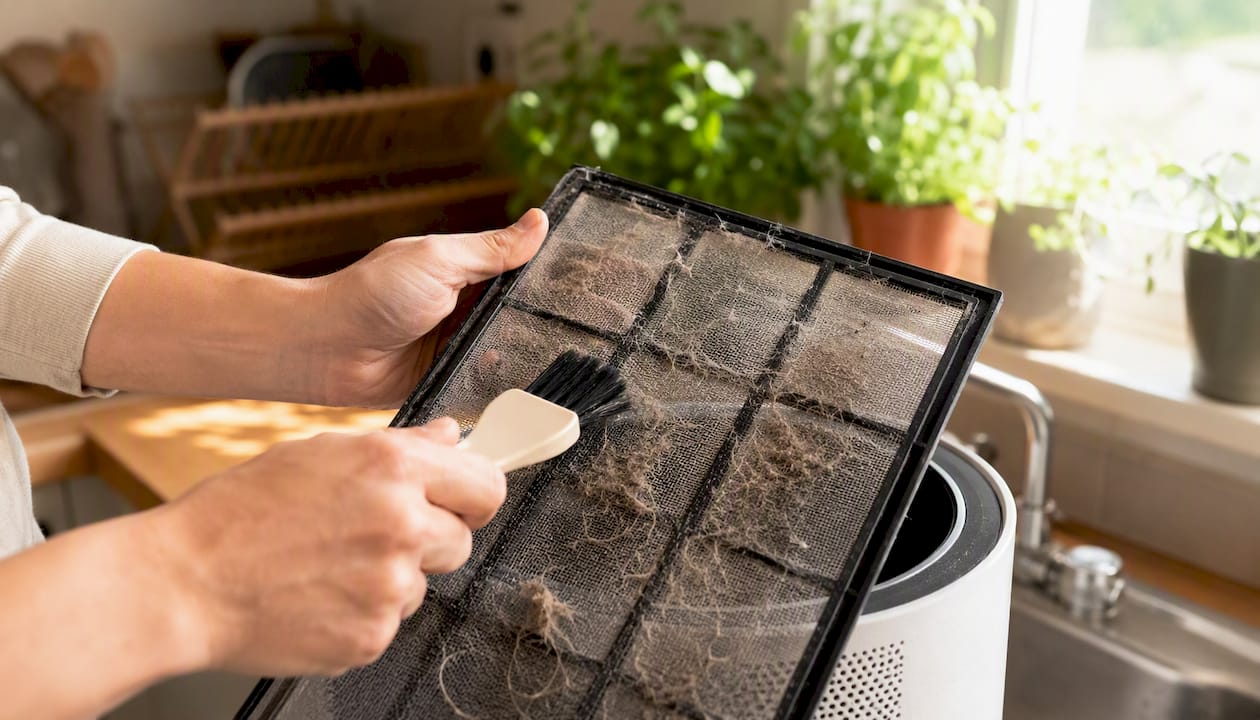
Maintenance runs on a predictable schedule. Wipe or vacuum a washable pre-filter every one to two weeks in a shedding-heavy home. Replace the True HEPA filter every 6 to 12 months depending on usage, and expect $40 to $100 a year in filter costs across the models above. For operating costs, checking a model's ENERGY STAR listing gives you a real number to compare energy draw between similar-capacity units before you commit to running one 24/7.
Pro Tip: Don't upgrade your HVAC filter to MERV 13 without checking your system's maximum supported rating first. Exceeding it increases static pressure on the blower motor and can shorten its life.
Avoid units with an ionizer or "plasma" mode that can't be switched off. These generate trace ozone, and while manufacturers frame them as a bonus feature, most air quality guidance treats them as unnecessary risk in a home with pets and kids. True HEPA media does the actual dander-capturing work; the ionizer is marketing weight.
What Our Testing Found in Real Pet Homes
Kiblco's testing across single-pet and multi-pet households used handheld airborne particle counters to measure dander concentration before and after running purifiers in bedrooms, living rooms, and dedicated pet areas. The pattern held consistently: a portable HEPA unit alone helped, but combining it with a MERV 11-13 HVAC filter upgrade produced the largest, most sustained drop in airborne dander across the whole house, not just the room the purifier sat in.
The single biggest variable wasn't which model ran, it was where it sat. Units placed in the room where pets actually sleep consistently outperformed the same unit placed in a rarely used living room, even when the living room had more square footage. Dogs and cats spend hours motionless in one spot overnight, shedding and releasing dander the whole time, so that's where localized capture matters most.
A layered approach beat any single fix on its own:
- HVAC baseline: MERV 11 for single-pet homes, MERV 13 for multi-pet or allergy-heavy households, assuming the system supports it.
- Portable HEPA in priority rooms: bedrooms and wherever pets nap most, positioned at least a foot from walls to avoid restricted airflow.
- HEPA vacuuming: surface dander embedded in carpet and upholstery needs mechanical removal, since no air purifier reaches it.
- Regular grooming: brushing outdoors or in a bathroom reduces the total dander load entering the air in the first place.
None of these four steps alone matched what the combination delivered. Skipping grooming, in particular, meant purifiers had to work harder just to keep pace with new shedding, which showed up as higher running speeds and faster filter saturation in our measurements; practical Goldendoodle allergy friendly home tips for Canadians offer complementary advice on grooming and dander reduction.
Most Buying Guides Get the Priority Order Backward
Most buying guides for pet owners lead with CADR numbers and call it a day. That's backward. A purifier with a huge CADR rating sitting in your living room while your dog sleeps in the bedroom is solving the wrong problem. The room matters more than the raw spec.
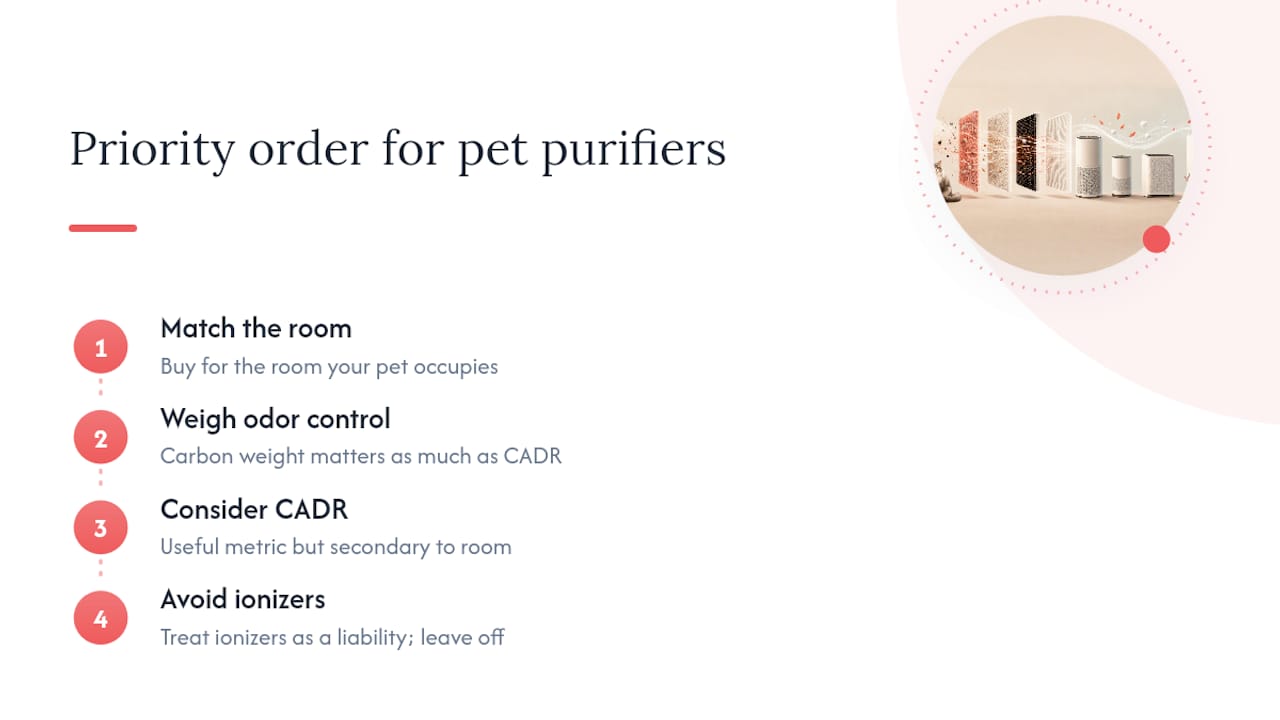
The second thing conventional advice underweights is odor. Reviewers obsess over particle counts because they're measurable and easy to compare, but the complaint that actually drives most pet owners to buy a purifier is smell, litter boxes, wet dog, that stale carpet funk, not visible dust in a sunbeam. Carbon weight deserves as much attention as CADR, and most comparison charts bury it in a footnote.
The overrated feature, by a wide margin, is the ionizer or "plasma" add-on. It shows up on spec sheets as a premium bonus. In a pet home it's a liability with no upside, since true HEPA media already does the capture work these gimmicks claim to add. If you take one thing from this guide, let it be this: buy for the room your pet actually occupies, weight odor control as heavily as particle removal, and treat any switch labeled "ionizer" as one you should leave off.
Get Vetted Pet Product Picks Before You Buy
Choosing between an Alen, a Levoit, a Coway, and half a dozen other options shouldn't require reading six spec sheets and guessing which one actually works with a shedding dog in the room. Kiblco tests trending pet products hands-on, in real homes with real pets, and publishes the pros and cons other retailers leave out of the product description.

If HEPA filtration solved half your problem, the other half is everything else in your pet's daily routine: grooming tools that actually cut shedding, calming aids for a dog that startles at every compressor click, or a pheromone diffuser for a multi-cat household under stress. Kiblco's hands-on air purifier reviews go deeper than any spec table, flagging which models held up after three months of daily shedding and which ones quietly underdelivered. Browse the latest tested picks at Kiblco and find the next product worth adding to your pet's routine.