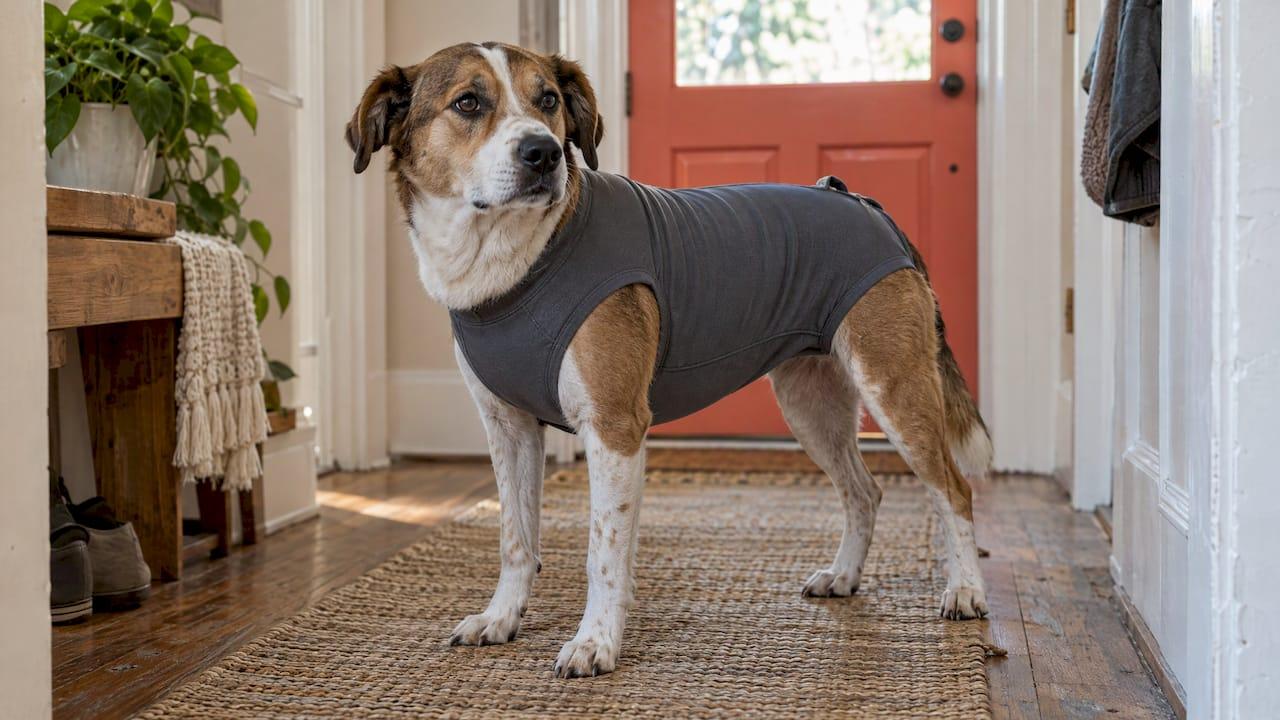
A dog recovery suit is a snug, stretchy bodysuit that covers a stitched incision, wound or irritated patch of skin so your dog can't lick, chew or scratch it. Many owners use one as a softer stand-in for the plastic cone after a spay, neuter or other surgery. The right suit fits closely without pinching, fully covers the area, and gets checked and washed on a schedule. Your veterinarian decides whether it is the right choice for your dog's procedure.
TL;DR
- A recovery suit (also sold as a surgical suit or recovery onesie) is a cone alternative that covers the incision with soft, stretchy fabric.
- Whatever device you pick has to stop your dog from reaching the wound and be comfortable enough to wear. Ask your vet if a suit suits your dog's surgery.
- Measure your dog with the maker's size chart, check the closures and leg openings, and buy a second suit so you can rotate while one is in the wash.
- Check the incision at least twice a day and call your vet about swelling, excessive redness or discharge.
- Eye surgery and some other delicate procedures often still require a cone. Follow your surgeon's instructions.
Table of Contents
- What a dog recovery suit is and when it helps
- Recovery suit vs. cone: an honest look at how they differ
- Questions to ask your vet before you buy
- How to choose the right dog recovery suit
- Fitting the suit step by step
- Daily care while your dog recovers
- Common problems and fixes
- Our perspective
- Where to find more vet-informed picks
- FAQ
- Sources
What a dog recovery suit is and when it helps
A recovery suit looks like a dog-sized onesie. It is usually made of a breathable, stretchy knit, and it slips over the head and legs and closes with snaps, zippers or hook-and-loop tabs. The body panel sits over the belly, back or hip, depending on the design. Some versions have a pee-hole or a flap for bathroom breaks. Others are cut for male dogs after neutering, for females after spaying, or for wounds on the torso.
The point is simple: if your dog can't get a tongue or teeth to the stitches, the stitches stay put. Licking, scratching or pulling at stitches can slow healing, introduce bacteria and cause severe damage, according to Zoetis Petcare. Veterinary teams consider suits one of several alternatives meant to deter patients from traumatizing their incision, per the American Animal Hospital Association's wound-care coverage.
Common situations where owners and vets reach for a suit:
- Abdominal surgery, such as spays, and neuters where the incision sits on the belly or groin.
- Torso wounds and hot spots, where a dog keeps going back to the same patch.
- Skin conditions that make a dog scratch or chew, when your vet has approved a physical barrier.
- Dogs in heat, where owners want to keep things clean at home. Check with your vet first if the suit is also meant to protect a healing area.
- Dogs who panic in a cone and bump into furniture, refuse to eat, or won't settle.
Suits are less suited to wounds on the head, face, mouth or lower legs, where the fabric can't reach or stay in place. Foam wraps or bandages are sometimes used there. One veterinary report described layered foam pipe insulation as a simple, economical protective device after closure of problematic wounds near the elbow. That is a vet-directed solution for a specific location, not a home project.
Recovery suit vs. cone: an honest look at how they differ
The cone, also called an E-collar, is the standard. It is rigid, cheap, and keeps a dog's mouth away from almost any part of the body when it is sized properly. Its drawbacks are well known to anyone who has watched a dog crash into a doorframe: it blocks peripheral vision, makes eating and drinking awkward, and can make sleeping difficult.
A suit swaps the barrier for fabric. Dogs can move, eat, lie down and sleep more naturally. Suits may also provide gentle compression that can help reduce swelling and give some dogs a sense of security, according to a veterinary hospital's discussion of surgical suits. Those are possible benefits for some dogs, not a guarantee.
Here is how the two compare on the points owners ask about most:
| What you care about | Dog recovery suit | Plastic cone |
|---|---|---|
| Coverage | Torso, belly, back, hip area depending on design | Keeps the mouth away from most of the body when sized correctly |
| Moving around the house | Usually no bumping into furniture | Can catch on doors, walls and furniture |
| Eating and drinking | Normal bowl access | May require raising bowls or removing the cone at meals under supervision |
| Sleeping and crate time | Often easier to settle | Can be loud and bulky in a crate |
| Cleaning | Machine washable, but you need a spare | Wipe clean |
| Head, eye and face procedures | Not suitable | Often required |
| Wound visibility | Covered, so you need to check under the fabric | Easy to see the area |
One caution belongs here. Veterinarians at UC Davis note that for delicate procedures such as eye surgery, an E-collar is often clinically required because alternatives may not reliably prevent irreversible trauma. If your surgeon sends you home with a cone for that kind of procedure, keep it on.
The evidence is also thin on which option is best. The AAHA coverage points out that no clinical studies have compared the efficacy or welfare impact of recovery suits and other alternatives against one another. So the practical answer is to match the device to the wound and the dog, and let your veterinarian confirm it.
Questions to ask your vet before you buy
A suit works best when you decide before surgery day, so there is no scramble the night you bring your dog home. At the pre-op visit or the discharge appointment, ask:
- Is a suit appropriate for this procedure and incision location? Belly and groin incisions are common candidates. Others may not be.
- Will the suit fully block access to the incision? Some dogs are determined. Your vet knows your dog's temperament and the surgery site.
- Should my dog wear a cone as a backup? Many owners keep a cone for moments when the suit is in the wash or when they can't watch their dog.
- How long will the device stay on? Plan for the length of the activity restriction. VCA Animal Hospitals suggests restricting activity for 7 to 14 days after surgery, though your surgeon's timeline rules.
- Can I take the suit off for bathroom breaks, and how? Ask whether you should use a leash on a short walk and how to handle accidents.
If the clinic dispenses a suit, ask what size and style they use. Many hospitals stock them.
How to choose the right dog recovery suit
The listings that dominate search results all promise comfort and protection. The details that make or break the choice are more specific.
Coverage and design
The PDSA's cone guidance applies to any device: make sure it completely stops your dog from getting to the wound and is comfortable to wear. For a suit, that means:
- The fabric must overlap the incision with a margin on all sides, not just touch it.
- Check the length. A suit that rides up when your dog sits can expose a belly incision.
- Match the cut to your dog's sex and the surgery site, and look for a bathroom-friendly opening if your dog will wear it for days.
- Look at the leg holes. They should be snug enough to stay put but never dig into the armpit or groin.
Fabric
Look for a soft, breathable knit with four-way stretch that is machine washable. Thin, stretchy cotton or cotton-blend knits are common. Avoid anything scratchy near the incision. Dogs that are sensitive to certain fibers, or have a skin condition, may do better with plain, minimal-seam fabric. Ask your vet if you are unsure.
Closures
Snaps, zippers and hook-and-loop tabs each have trade-offs. Snaps along the back or belly are easy to open for checks but can pop on a wriggly dog. Hook-and-loop can collect fur. Zippers are quick but need to be positioned so they don't rub the wound. Pick the one you can operate with one hand while holding a nervous dog.

Size
Most makers size by chest girth and back length, and some add neck girth. Measure while your dog stands. Use a soft tape, snug but not tight, and follow the chart for the specific suit, because sizing differs from one maker to the next. If your dog falls between sizes, check the maker's guidance. A suit that is too loose can slide or bunch, and one that is too tight can squeeze the incision or restrict breathing.

A spare
Plan on two. Dogs soil suits with food, water, urine and drainage, and recovery lasts days. A second suit saves you from putting a damp or dirty garment back on a healing dog.
Fitting the suit step by step
- Do a dry run before surgery. Let your dog sniff the suit, then put it on for a few minutes with treats. A dog that has already worn it is calmer on day one.
- Lay out the suit on the floor with the closures open, belly side up. Guide your dog's front legs through first, then the back legs.
- Pull the fabric smoothly over the body and close the fasteners. Check that the fabric sits flat over the incision and isn't twisted.
- Do the two-finger check. You should be able to slide two fingers under the fabric at the chest and belly. If you can't, go up a size.
- Watch for five minutes. Look for scratching, pulling, hunching or refusal to move. Some dogs freeze at first. That usually passes with distraction and treats.
- Test the barrier. See whether your dog can get their mouth to the covered area. If they can, the suit isn't doing its job. Call your vet.
Daily care while your dog recovers
A suit hides the incision, which means you have to look under it on purpose. VCA Animal Hospitals recommends inspecting an unbandaged incision at least twice daily and contacting your veterinarian if you notice swelling, excessive redness or discharge. Build that check into the morning and evening routine.
A simple daily routine:
- Morning: open the suit, check the incision, check that the fabric is dry and clean, and offer a bathroom break.
- Midday: a quick look at the suit position. Re-seat it if it has shifted.
- Evening: open the suit, inspect the incision again, and swap in the clean suit if needed.
- Overnight: if you can't watch your dog, keep them in a crate or small room with the suit on, and keep the cone nearby as a backup if your vet advises it.
Wash the suit according to the maker's instructions, usually a gentle machine cycle with fragrance-free detergent, and let it dry fully before using it again. Never put a damp suit on a healing incision.
Call your vet if you see:
- Swelling, heat or excessive redness around the incision
- Discharge, a bad smell, or an incision that has opened
- Your dog chewing through the suit or getting to the wound anyway
- Rubbing, chafing or raw skin under the leg holes or collar line
- Refusal to eat, vomiting or lethargy
Gentle comfort matters too. A soft bed helps a dog rest through restricted activity, and our guide to orthopedic dog beds covers what to look for in supportive bedding. If your dog gets anxious during crate rest, see our look at anxiety wraps for dogs, and ask your vet before combining any wrap with a recovery suit.
Common problems and fixes
My dog won't move. Some dogs freeze when dressed. Use treats, a short leash and a calm voice. If your dog is still frozen after a day, tell your vet.
The suit slides or rides up. Re-check the size. A longer back length or adjustable closure often solves it. A suit that keeps shifting can expose the incision, so don't leave your dog unsupervised in it.
My dog chews the fabric. Redirect with a chew toy or a frozen lick mat if your vet agrees, and supervise. If your dog keeps pulling at the suit, go back to the cone and ask your vet.
Accidents inside the suit. Change it right away. This is the main reason to own two.
Hot weather. Pick a lightweight, breathable suit and keep your dog in a cool room. Check for panting or restlessness.
Our perspective
We review pet products the way we'd want them reviewed if we were the ones buying: purchased, used in real homes, and judged on how they hold up through washing, wriggling and week-long wear. For recovery gear, that means we care less about the product photo and more about the boring details, like whether the closures open one-handed at 6 a.m. and whether the seams rub when a dog sits.
Our health picks are cross-checked with veterinary input, and every review states its downsides plainly. We take no payment for coverage, and we disclose our affiliate relationships. If you are shopping for a recovery suit, we suggest the same approach: start with your vet's guidance, choose on fit and coverage rather than color, and buy a spare.
A good suit makes recovery calmer for dog and owner alike. We'd rather you buy the right one once than keep swapping designs while your dog heals.
Chris
Where to find more vet-informed picks
Shopping for recovery gear is easier when you can compare products with the pros and cons laid out. Our Dog Health page collects our vet-informed reviews of supplements, treats and care products, and Dog Gear covers everyday equipment for your dog. Both link to the retailers where you can buy.

If you are new to us, start on the Kiblco homepage to see how we test and what we cover for dogs and cats.
FAQ
Can a dog sleep in a recovery suit?
Yes, many dogs rest more easily in a suit than in a cone, and suits are often more comfortable in a crate. Check the incision before bed and again in the morning. If you can't supervise, ask your vet whether to add a cone as a backup.
How long does a dog wear a recovery suit?
It depends on the procedure and what your surgeon says. Activity is commonly restricted for 7 to 14 days after surgery. Your dog should wear the protection until your vet clears you to remove it.
Is a surgical suit for dogs better than a cone?
Neither is better in every case. A suit is often more comfortable and lets a dog move naturally, while a cone covers more situations, including eye and other delicate procedures. Ask your vet which fits your dog's surgery.
How do I know what size recovery suit to buy?
Measure your dog's chest girth and back length while standing, then compare them with the maker's size chart. Sizes vary between makers, so don't assume your dog's clothing size carries over. The suit should sit flat and let you slip two fingers underneath.
Can my dog pee and poop while wearing one?
Most suits are designed for it, with a bathroom opening or a design that lets you unfasten the back. Take your dog out on a leash, keep outings short, and change the suit if it gets soiled.
Sources
- Use of commercially available foam pipe insulation as a protective device (JAVMA)
- Beyond Closure, AAHA Trends Magazine
- The No Cone Zone: Pet Surgical Suits, VMC Easton
- Ophthalmology Service, UC Davis School of Veterinary Medicine
- How to Make the Dog Cone More Comfortable, Zoetis Petcare
- How To Put A Cone Collar On Your Dog, PDSA
- Care of Surgical Incisions in Dogs, VCA Animal Hospitals