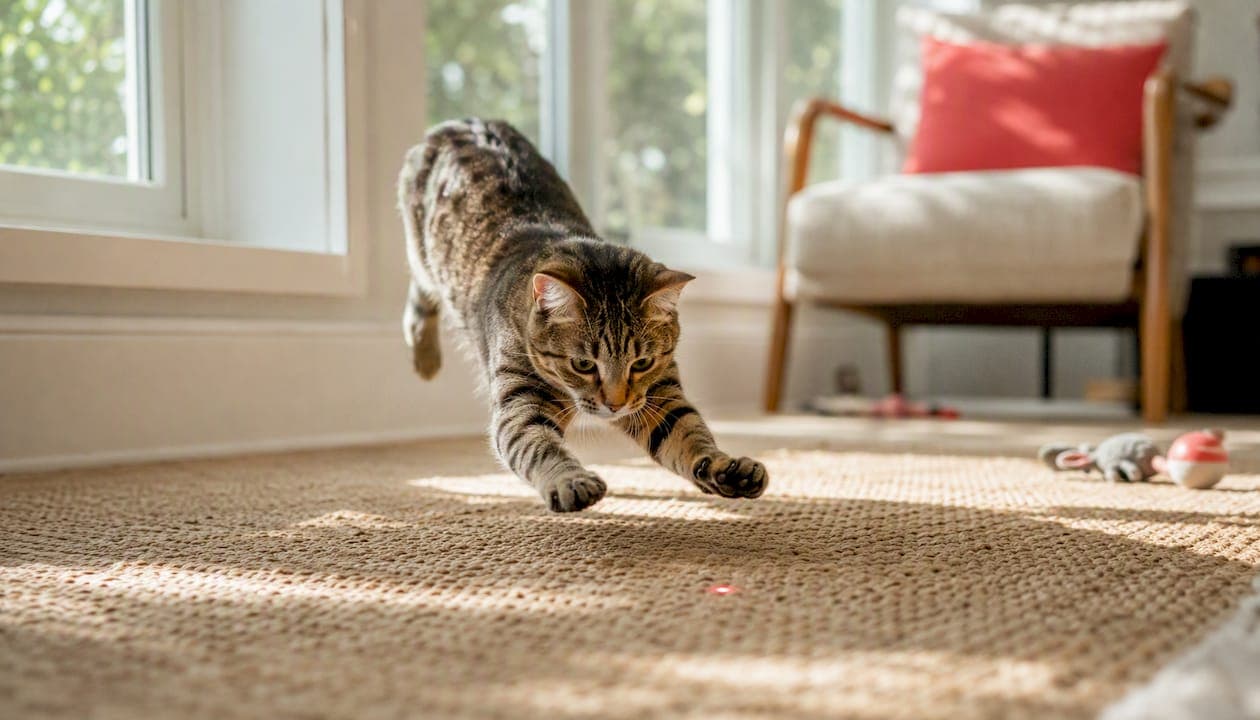
Cat laser toys are safe for most cats when you follow three rules every single session: keep the beam away from eyes, keep sessions short, and always end with something your cat can physically catch. Skip any one of those, and you trade a fun activity for a frustrated, anxious, or potentially injured cat.
Here's the short version before we go deeper:
- Do supervise every session, even with an automatic unit
- Do end every play session by directing the dot to a physical toy or tossing a treat so your cat completes the hunt
- Don't aim the laser at your cat's face or eyes, ever
- Don't leave an automatic laser running while you're in another room
If your cat starts chasing reflections on the wall after the toy is put away, that's a sign something is off. Stop laser play and try a wand toy or another interactive option instead.
Key Takeaways
Cat laser toys are safe when three rules are followed every session: beam away from eyes, sessions under 15 minutes, and always end with a physical catch.
| Point | Details |
|---|---|
| The three safety rules | Keep beam off eyes, limit sessions to 5–15 minutes, always finish with a physical catch or treat. |
| Behavioral risk is real | Frequent laser play without a finish step is linked to obsessive light-chasing and frustration behaviors. |
| Power output matters | Prefer Class 1 or Class 2 pet lasers; avoid any device above 5 mW or with no stated output. |
| Automatic lasers need supervision | Timers enforce session length but cannot supervise physical safety or complete the hunt. |
| Red flags to act on | Stop laser play if your cat chases reflections when the toy is gone, overgroomes, or shows aggression after sessions. |
| Kiblco's tested picks | Kiblco reviews laser toys for documented power class, auto-shutoff, and finish-step compatibility so you don't have to guess. |
Table of Contents
- Why cats chase laser dots
- What laser play can do for your cat
- Risks to watch for: behavioral and physical harms
- How to use laser toys safely, step by step
- Power levels, automatic lasers, and what to check before you buy
- Alternatives and pairing strategies that actually work
- How often and how long: session frequency and duration
- Red flags: when to stop and get help
- What Kiblco's testing and vet contributors found
- How Kiblco uses laser toys at home
- Kiblco's vet-informed toy picks make it easier
- Sources
Why cats chase laser dots
The moving dot mimics small, fast prey, and that triggers your cat's full predatory sequence: stalk, chase, pounce, capture. Cats are hardwired hunters, and their visual system is especially tuned to detect quick, erratic motion at ground level. A laser dot that darts and pauses like a fleeing insect hits every trigger at once.
Speed and unpredictability matter here. A dot that moves in slow, steady circles doesn't excite most cats the way one that zips, freezes, and darts again does. The problem is that the sequence never finishes. There's no capture, no physical contact, no prey. That incomplete loop is exactly what causes behavioral trouble when laser play isn't managed well.
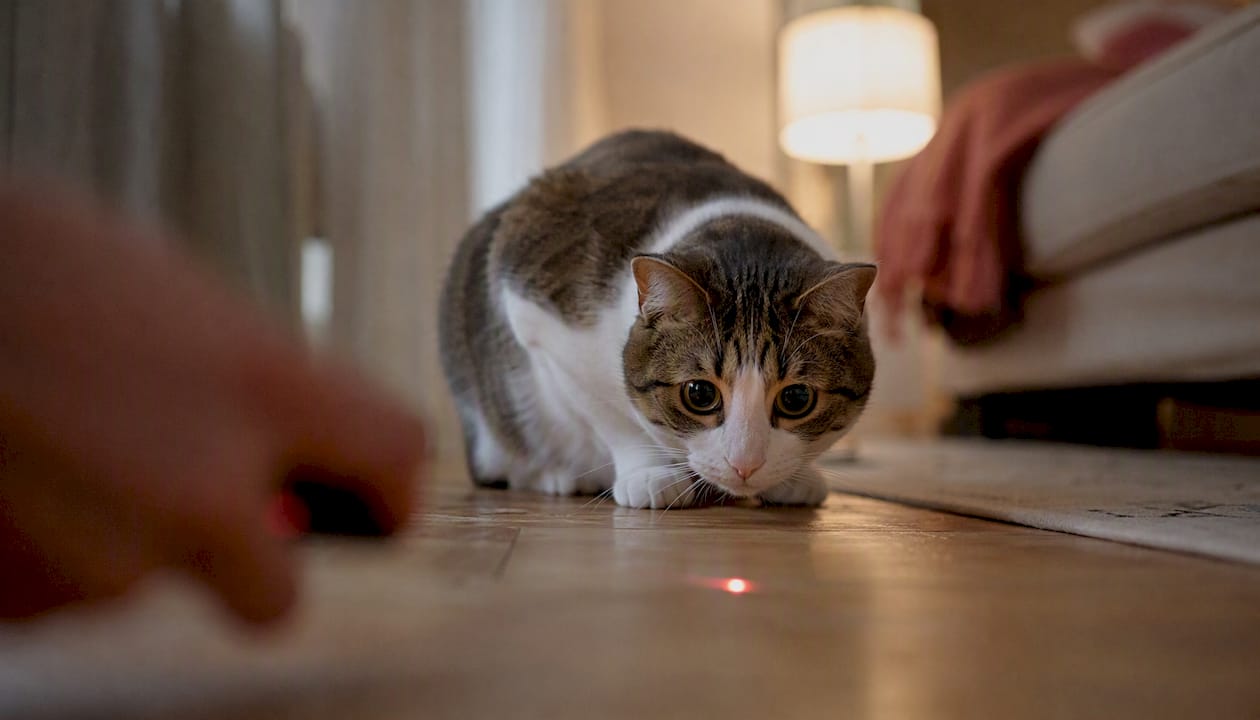
Pro Tip: Move the dot in short, insect-like bursts with deliberate pauses rather than sweeping it in wide arcs. This mimics real prey movement, keeps your cat focused without overstimulating them, and makes the eventual handoff to a physical toy feel like a natural conclusion.
What laser play can do for your cat
Properly used, laser play is one of the more effective ways to give an indoor cat a cardio burst, mental engagement, and a few minutes of real interaction with you. According to PetMD, laser pointers can provide genuine exercise and mental stimulation when owners avoid shining beams into eyes and let cats "catch" a physical object at the end.
The benefits stack up quickly for cats who don't get much movement during the day:
- Short cardio bursts that raise heart rate and work large muscle groups
- Cognitive engagement from tracking and predicting the dot's movement
- A healthy outlet for predatory energy that indoor cats can't spend on real prey
- Bonding time with you, since you're the one controlling the action
Think about a sedentary adult cat who spends most of the day on the couch. Two or three short laser sessions a day, each ending with a plush kicker toy or a few freeze-dried treats, can noticeably shift their activity level within a week. The key word is "short." More on that below.
Risks to watch for: behavioral and physical harms
The risks fall into two clear categories. Physical risks include eye injury from high-power beams and bodily harm from unsafe jumps or collisions during play. Behavioral risks are subtler but arguably more common: frustration, redirected aggression, and obsessive light-chasing.
Here's what to watch for:
- Retinal injury: Rare but real, and directly tied to laser power output. Higher-power devices carry meaningfully greater risk even from brief, accidental exposure.
- Frustration and redirected aggression: A cat that never catches anything can become irritable. That frustration sometimes lands on you, another pet, or the furniture.
- Obsessive behaviors: Research published in PMC found an association between more frequent laser play and guardian-reported abnormal repetitive behaviors, including persistent light-chasing and reflection fixation.
- Physical injury: Cats going full speed after a dot can misjudge a jump, collide with furniture, or slip on hard floors. Clear the play area before you start.
Laser toys don't cause problems on their own. The problems come from high-power devices, sessions that run too long, and play that ends with the dot simply disappearing. All three are owner-controlled variables.
Hill's Pet notes that retinal risk increases with higher milliwatt output, and devices above roughly 5 mW present meaningful risk even in momentary exposures. Purpose-built pet lasers with documented low-power classification are the safe choice. Novelty pointers with no stated output are not.
On automatic lasers: A timer can limit session length, but it cannot see your cat leap toward a shelf, and it will not hand over a toy when the session ends. Petful's vet guide is direct on this: owners should be present for laser play even when using automatic units, because timers cannot supervise physical safety or complete the hunt.
How to use laser toys safely, step by step
The short protocol: supervise every session, run a short total time depending on your cat's age and fitness, and always finish with a physical catch and a treat or meal. The Nevada Humane Society recommends keeping sessions to 5 minutes or less and transitioning the dot to a physical toy or treat at the end, every time.
Here's how to run a session from start to finish:
- Clear the play area. Remove obstacles at jump height. Hard floors are fine; rugs give better traction.
- Start slow. Let the dot appear at floor level and move it in short, prey-like bursts. Never aim it at your cat's face.
- Build intensity gradually. Speed up the dot, add pauses, let your cat stalk before the "prey" moves again.
- Watch for overheating or heavy panting. That's your cue to wind down, not a signal to keep going.
- End deliberately. Slow the dot, direct it toward a plush toy or kicker, then switch off the laser. Hand over the physical toy or toss a treat immediately. A puzzle feeder works especially well here because it extends the hunt-catch-eat sequence naturally.
Handheld vs. automatic lasers at a glance:
| Feature | Handheld laser | Automatic laser |
|---|---|---|
| Control over aim | Precise | Limited |
| Finish step | Easy to execute | Requires pairing with a treat/toy |
| Supervision needed | Yes | Yes |
| Risk of long sessions | Higher (human error) | Lower (timer enforces dose) |
| Best for | Engaged, present owners | Supplemental enrichment only |
Pro Tip: In multi-cat homes, run separate sessions for each cat or use two lasers simultaneously so cats aren't competing for the same dot. Competition during play raises stress and can trigger redirected aggression. If you have children using the laser, set a clear rule: the beam stays on the floor and never points above the cat's shoulder height.
Quick supervision checklist:
- Play area cleared of obstacles
- Laser aimed at floor level only
- Session timer set (5–10 minutes)
- Physical toy or treats ready for the finish
- You are in the room for the entire session
Power levels, automatic lasers, and what to check before you buy
Purpose-built pet lasers with documented low-power classification are the right choice. Avoid any pointer with no stated output, and never use industrial or "military-grade" lasers near a cat.
Laser devices are classified by power output, and the class tells you the practical risk level:
Hill's Pet guidance aligns with ophthalmology standards in flagging devices above roughly 5 mW as carrying real retinal risk. Consumer guidance consistently recommends Class 2 or documented low-power pet lasers and steering clear of unlabeled novelty pointers.
When you're reading a product page or package, look for four things: stated laser class, milliwatt output, an auto-shutoff timer, and randomized movement patterns. A product that lists none of those is a product to skip.
Alternatives and pairing strategies that actually work
The most effective fix for laser-play frustration is pairing the laser with a toy your cat can physically catch. A laser warm-up followed by a wand handoff and a treat is the sequence vets and behaviorists converge on most often.
Good options to pair with or substitute for laser play:
- Wand and teaser toys: The gold standard for completing the predatory sequence. Your cat can bite, kick, and carry the toy. Interactive wand toys are the most natural handoff from a laser session.
- Plush kicker toys: Great for cats who like to wrestle. Toss one the moment the laser goes off and most cats will redirect immediately.
- Puzzle feeders: Extend the hunt into the eat phase. A puzzle feeder placed at the end of the laser's path gives the session a satisfying, food-motivated conclusion.
- Motion-activated toys with biteable parts: Useful for solo play between sessions. Unlike lasers, these let the cat physically capture something. Wobble toys fall into this category and work well as between-session enrichment.
A practical pairing sequence: run the laser for 3–5 minutes, slow the dot toward a wand toy you're holding at floor level, drop the laser and animate the wand for 2–3 minutes, then let your cat "catch" it and offer a treat or small meal. That full arc, stalk to catch to eat, is what keeps cats satisfied rather than restless after play.
How often and how long: session frequency and duration
Daily short sessions are fine for most cats. Start with brief sessions and scale up total playtime across one to several short bursts per day, depending on your cat's age and fitness level.
A practical weekly structure:
- Sedentary adult cat: One 5-minute session per day, always ending with a wand toy and a treat. Build to two sessions after two weeks if the cat is engaged and not showing any stress signs.
- Active young cat (1–3 years): Two to three sessions per day, 5–8 minutes each, with a physical toy finish every time. These cats have energy to burn and benefit from the variety.
- Senior cat or cat with mobility issues: One gentle session of 3–5 minutes, dot kept close to the floor, no high jumps encouraged. Consult your vet if your cat has arthritis or a heart condition before adding any new exercise routine.
A few practical notes:
- Watch your cat's breathing. If they're panting, the session is too long or too intense.
- Overweight cats tire faster. Shorter, more frequent sessions are better than one long one.
- Kittens under six months have short attention spans. Two-minute bursts are plenty.
- If your cat walks away mid-session, let them. Forcing engagement backfires.
Red flags: when to stop and get help
Stop laser play immediately if you notice any of the following:
- Persistent chasing of lights or reflections after the toy is put away. This is the clearest sign that laser play has crossed into compulsive territory. The Nevada Humane Society flags repetitive light-chasing that continues when the toy is gone as a signal the cat needs different enrichment and possibly a behavior consult.
- New or increased overgrooming, pacing, or hiding after sessions. These are signs of anxiety or overstimulation, not normal post-play behavior.
- Aggression directed at you or other pets after play. Redirected aggression following laser sessions points to frustration from an incomplete hunt.
- Any sign of eye pain or visual change: squinting, pawing at the eye, cloudiness, or reluctance to be in bright light. These warrant a vet visit, not a wait-and-see approach.
For behavioral red flags, the next step is stopping laser play entirely and switching to wand toys or other catchable options. If the behavior persists after two weeks without laser play, a feline behaviorist consultation is worth scheduling. When you call your vet, report when the behavior started, how often it occurs, and whether you've noticed any changes in appetite or litter box use. Those details help them triage quickly.
Pro Tip: Keep a simple log for the first two weeks of laser play: date, session length, finish method used, and any behavior you noticed afterward. If something goes sideways, that log is exactly what your vet or behaviorist will ask for.
What Kiblco's testing and vet contributors found
Kiblco's hands-on testing across multiple households consistently showed the same pattern: supervised short sessions that ended with a physical catch produced the best outcomes. Cats were active during play, calm afterward, and showed no fixation on lights or reflections between sessions. Sessions that ended with the laser simply switching off, no toy, no treat, were the ones that produced restless or agitated behavior in the hours that followed.
The vet contributors who reviewed Kiblco's testing process summarized the guidance this way:
Three rules cover almost every laser safety concern: keep the beam off the eyes, keep sessions under 15 minutes total, and never let the session end without a physical catch. Get those three right and laser play is a genuinely useful tool for indoor cat enrichment.
The three-step protocol that came out of that review:
- Prep: Clear the play area, set a timer, have a wand toy or treats within reach
- Run: Keep the dot at floor level, move it in prey-like bursts, watch your cat's energy level
- Finish: Slow the dot, direct it to the physical toy, hand it over or toss a treat, then end the session
How Kiblco uses laser toys at home
The routine at Kiblco is straightforward: a short laser warm-up, a wand toy handoff, and a treat or small meal to close the loop. Sessions run about 5 minutes with the laser, followed by 3 minutes of wand play, then a few dental treats or a puzzle feeder.
Before each session: furniture pushed back from the center of the room, rugs checked for bunching, wand toy already in hand. The laser dot stays on the floor the entire time. When the timer goes off, the dot slows, moves toward the wand, the laser goes off, and the wand takes over. The cat gets to bite, kick, and carry. Then treats. Then done.
That sequence, repeated consistently, is what keeps laser play in the "useful tool" category rather than the "behavioral problem" category. Kiblco's testing protocols and vet contributor notes are part of every toy review published on the site.
Kiblco's vet-informed toy picks make it easier
Finding a laser toy with a documented power class, a built-in timer, and a clear finish strategy shouldn't require an hour of research. Kiblco reviews cat toys based on hands-on testing by real pet owners and input from veterinary contributors, with transparent pros and cons for every pick.

Every laser toy Kiblco evaluates gets checked for stated laser class, milliwatt output, auto-shutoff function, and whether the product pairs naturally with a physical finish. The result is a shortlist of options that meet the three safety rules without requiring you to decode a product spec sheet.
Browse Kiblco's vet-informed cat toy picks to find options that have already been tested and reviewed for safety, durability, and real-world usability. Kiblco earns a commission on purchases made through links on the site, at no extra cost to you.
Sources
The recommendations in this article draw from the following sources:
- Laser Pointer Etiquette: Tips for Fun and Safe Use - Nevada Humane Society
- Best cat laser toy picks: A vet's guide to safe play - Petful
- Are Laser Pointers Bad for Cats? - PetMD
- Are Laser Pointers Safe for Cats? | Hill's Pet
- PMC article on companion animal behavior (reference supporting behavioral-risk research) - PMC
This article is general information, not a substitute for advice from a qualified doctor. Consult a qualified healthcare professional about your own circumstances before acting on anything here.